01. Quick Answer
ETH does not need a broken long-term thesis to suffer another sharp crash
A crash thesis is not the same thing as a "Ethereum is worthless" thesis. ETH can remain a relevant crypto asset and still fall hard if leverage rebuilds too quickly, if ETF and ETP demand stalls, if macro liquidity tightens, or if traders decide that rollup growth is helping the ecosystem more than the token (CoinShares) (Grayscale). Traders should distinguish three different events: a correction is often a 10% to 20% pullback, a bear market is a deeper and more persistent decline, and a crash is a rapid drawdown of 30% or more that forces behavior to change quickly.
| Category | Evidence-based read | Implication |
|---|---|---|
| Historical data | ETH has a long history of 50%+ drawdowns inside broader crypto cycles | Crash risk is a feature of the asset, not an anomaly |
| Current market conditions | ETH is trading far below the 2025 peak and recent daily closes weakened into mid-May 2026 (Yahoo Finance) | Fragility can remain even after price stabilizes |
| Market structure | CME derivatives, ETF wrappers, and staking products deepen access but also create more ways to hedge or exit (CME Group) (BlackRock) | Ethereum is more institutional, not automatically safer |
| Practical read | The next crash would likely come from forced selling and confidence loss around economics, not from one social-media post | Risk management matters more than narrative purity |
02. Historical Context
Crash risk should be judged against ETH's actual drawdown behavior, not against bullish hopes
Available Yahoo history makes the core point clear: ETH has already traded through extreme downside phases before rebounding sharply (Yahoo Finance). That is why the bearish case has to be specific. Traders should ask what would turn a normal pullback into a crash. In Ethereum's case the answer usually involves a mix of leverage, weak spot demand, and renewed doubt over whether network activity still belongs to the token economically (Grayscale).
| Metric | Latest reading | Why it matters |
|---|---|---|
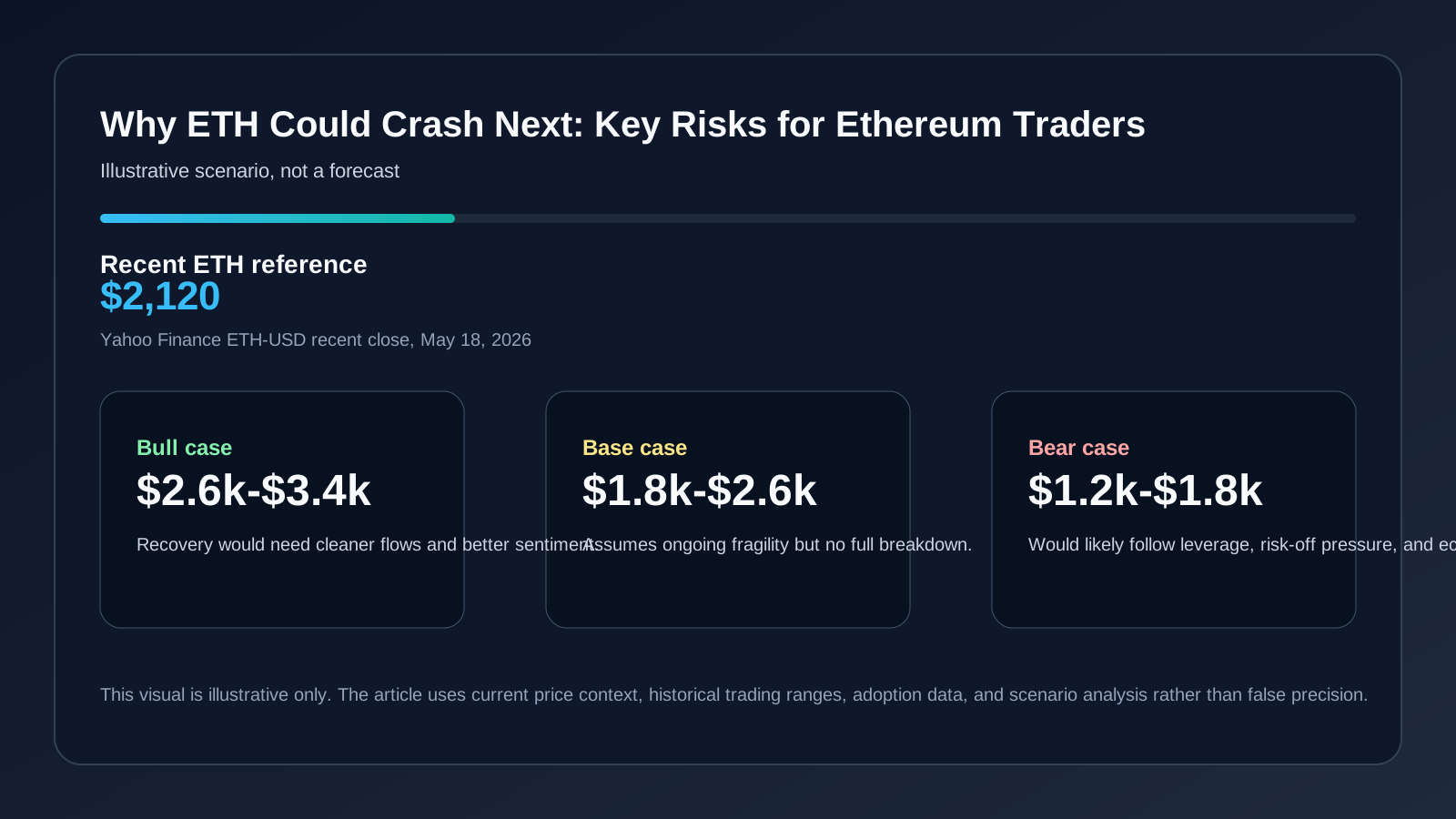
| Recent ETH close | ~$2,120.16 | Current reference point for downside scenarios |
| Recent 1-month range | ~$2,120 to ~$2,369 | Shows that ETH was still losing altitude into mid-May 2026 |
| Fund-flow context | March 2026 inflows brought Ethereum close to net-neutral YTD | Supportive, but not a one-way demand wall |
| Derivatives depth | Ether futures and micro ether futures volume grew strongly in 2025 | More leverage and hedging capacity can cut both ways |
| Event type | Typical magnitude | Market behavior | Why it matters |
|---|---|---|---|
| Correction | ~10%-20% | Fast reset, often trend-consistent | Can be normal noise in ETH |
| Bear market | 20%+ and persistent | Rallies fail and confidence erodes | Damages medium-term momentum |
| Crash | 30%+ quickly | Forced selling, deleveraging, and sharp repricing of risk | Can reset psychology and portfolio behavior violently |
03. Main Drivers
Five risks could trigger the next ETH crash
1. A leverage rebuild followed by liquidation pressure
CME's growing ether derivatives complex means ETH now has deeper tools for leverage and hedging than in earlier cycles (CME Group) (CME Group and Glassnode). If traders rebuild exposure too aggressively while spot demand remains thin, a downside move can accelerate into forced selling.
2. ETF or ETP demand disappoints after being treated as permanent
BlackRock's ETHA and the SEC-approved spot ETF structure are bullish for accessibility (BlackRock) (SEC). They also create complacency if the market starts treating regulated wrappers as automatic buyers. A stalled flow regime can remove an important psychological floor.
3. The market decides rollups are great for Ethereum but bad for ETH
That is the heart of the Grayscale challenge to the pure bull case (Grayscale). If traders conclude that layer 2 growth permanently weakens base-layer economics, valuation multiples can contract quickly even without a collapse in user activity.
4. A staking or policy shock undermines the yield narrative
Fidelity's thesis and the Ethereum Foundation's treasury staking plan both show how central staking has become (Fidelity) (Ethereum Foundation). A major policy or operational shock would hit one of ETH's core institutional narratives.
5. Macro risk-off pressure returns
ETH is still a high-beta digital asset. If rates stay restrictive or liquidity contracts, correlations can rise and good network-level news may stop mattering in the short term.
04. Institutional Forecasts and Analyst Views
Bearish setups are easier to understand when you look at structure rather than ideology
No major institutional source in this research set argues that ETH is headed to zero. The more credible bearish views are structural. Grayscale highlighted fee-capture uncertainty, while CoinShares' near-neutral year-to-date flow picture shows Ethereum demand can be supportive without being overwhelming (Grayscale) (CoinShares).
CME's market-depth data reinforce the same point from another angle: ETH is now part of a deeper derivatives ecosystem, which is healthy for access but can amplify stress when positioning is crowded (CME Group and Glassnode) (CME Group). A crash case is therefore about reflexivity, not about proving that Ethereum has no future.
| Risk factor | Current read | Why traders should care |
|---|---|---|
| Leverage | Manageable, but capable of rebuilding quickly | Leverage is the main fuel for air pockets |
| Flow support | Positive at times, not guaranteed | Flow reversals can change tape behavior fast |
| Value capture | Still debated | Narrative disappointment can hit valuation multiples hard |
| Macro liquidity | Still uncertain | Tighter liquidity can overwhelm crypto-native optimism |
The most serious crash setups are the ones where several of those factors hit together. That is exactly why ETH traders should think in scenarios rather than slogans.
05. Bull, Bear, and Base Case
A crash scenario does not cancel the bullish case; it defines the downside path traders must survive
| Scenario | Price zone | Conditions | Probability |
|---|---|---|---|
| Crash | $1.2k-$1.8k | Macro stress, weak flows, leverage, and renewed doubt over ETH value capture collide | 28% |
| Base | $1.8k-$2.6k | ETH remains fragile but stabilizes while the market keeps debating economics | 42% |
| Relief recovery | $2.6k-$3.4k | Macro improves, flows hold, and the market gives Ethereum another benefit-of-the-doubt rally | 30% |
| Direction | Probability | Comment |
|---|---|---|
| Higher | 29% | Possible, but needs better flow persistence and calmer macro conditions |
| Lower | 38% | Crash risk remains meaningful because ETH still looks structurally contested |
| Sideways | 33% | Repair and compression are plausible after large prior drawdowns |
| Investor type | Prudent approach | Main watchpoints |
|---|---|---|
| Investor already in profit | Trim if ETH has become too large, and do not confuse gains with immunity from drawdowns | Concentration and stop discipline |
| Investor currently at a loss | Avoid capitulating into every dip, but also avoid averaging without a defined thesis | Cash needs and emotional risk |
| Investor with no position | Wait for volatility to settle or use very small staged entries | Flow stability and price structure |
| Trader | Use stop-loss orders, smaller size, and event-aware risk management | Options positioning, ETF flows, and macro calendar |
| Long-term investor | Hold only the size you can survive through another 30%+ drawdown without forced selling | Balance-sheet liquidity and conviction quality |
| Risk-hedging investor | Pair ETH with cash, duration, or lower-beta hedges instead of assuming ETH hedges itself | Correlation behavior in stress periods |
What could invalidate the crash thesis? Sustained inflows, better relative strength, and evidence that Ethereum can keep growing without renewed fee-capture panic would all weaken it. Traders should stay flexible: the better framework is not permanent bearishness, but respect for how fast ETH can punish complacency.
06. FAQ
Frequently asked questions
What is the difference between a correction and a crash in ETH?
A correction is usually a routine pullback of roughly 10% to 20%. A crash is faster, deeper, and more liquidation-driven, often exceeding 30% in a short period.
Why can ETH crash even if Ethereum remains important?
Because price is driven by marginal flows, leverage, and confidence in token value capture. Network relevance does not stop forced selling.
What is the biggest crash trigger right now?
The combination of weak flows, macro stress, and renewed doubt over Ethereum's economics is the most dangerous setup.
Should long-term investors ignore crash risk?
No. They may not need to trade every move, but position sizing and liquidity planning still matter.
Methodology and Invalidation
How to interpret this ETH crash-risk framework and what would change it
The forecast ranges in this article are scenario bands, not promises. They combine live ETH price data, official Ethereum documentation, and institutional or market-structure research from major asset managers, exchanges, research desks, and financial firms, plus editorial judgment about market structure. That mix matters because ether is not driven by one variable. It reacts to fee generation, staking, tokenization demand, rollup economics, derivatives positioning, regulation, and macro risk at the same time.
Probability tables in this article are editorial estimates rather than mathematical certainties. They are derived by weighing whether the evidence currently favors stronger usage and institutionalization, a mixed middle path with slower monetization, or a weaker path marked by fee compression, risk-off conditions, or renewed competition. Where the evidence is mixed, the range stays intentionally wide. False precision is usually a sign that the analyst is hiding uncertainty rather than measuring it honestly.
The bearish setup would be weakened by cleaner spot accumulation, stickier ETF demand, and stronger evidence that Ethereum's scaling roadmap is improving utility without eroding token economics. The most important discipline is to state what would invalidate the working view. Investors who are already in profit, investors sitting on losses, traders, hedgers, and long-term allocators do not need the same playbook, so the positioning table separates horizon and risk tolerance instead of pretending one answer fits everyone. Disclaimer: This article is for informational and research purposes only and does not constitute personalized financial advice.
References
Sources
- Yahoo Finance ETH-USD chart API, available weekly price history
- Yahoo Finance ETH-USD chart API, recent daily closes
- Fidelity Digital Assets, Ethereum Investment Thesis
- U.S. SEC, references to the Spot Ether ETP Approval Order and related approvals
- BlackRock, iShares Ethereum Trust ETF overview
- CME Group and Glassnode, Ethereum: Insights and Market Trends H1 2025
- CME Group, record 2025 derivatives activity including ether futures growth
- CoinShares, Digital asset fund flows, March 16, 2026
- Ethereum.org, Scaling Ethereum
- Ethereum Foundation, Treasury Staking Initiative, February 24, 2026
- Grayscale Research, Ethereum: The OG Smart Contract Blockchain