01. Quick Answer
The most serious downside risk is not that gold loses all structural support, but that the market has become too dependent on favorable macro conditions
Gold futures (GC=F on Yahoo Finance) were trading around $4,545.2/oz on 2026-05-18. The same 10-year monthly series started near $1,318.4/oz on 2016-06-01 and most recently showed $4,545.2/oz, with a 10-year range of roughly $1,150.0 to $4,713.9 and a price-only CAGR near 15.51% (10-year monthly data).
In market language, a correction usually means a 10%-20% pullback from a recent high, a bear market typically means a deeper and more sustained 20%+ decline, and a crash implies a fast, disorderly drop that can exceed 30% over a short period. Gold can experience all three depending on how investor flows, rates, and macro fear interact.
The bearish case for XAUUSD is straightforward: real yields stay firm, ETF ownership weakens, the dollar remains resilient, and central banks become more price-sensitive. In that setup, gold does not need its long-term narrative to die. It only needs fewer investors to feel urgency about owning it.
| Point | Why it matters |
|---|---|
| Correction versus crash | Not every decline means the structural thesis failed. The market can correct sharply even while official demand remains positive. |
| Macro sensitivity | Real yields near 2% keep gold vulnerable to disappointment if investors start preferring cash, bonds, or risk assets. |
| Positioning risk | ETF and speculative flow reversals can move faster than central-bank support can offset them. |
| Invalidation | The downside case weakens quickly if gold attracts fresh ETF inflows despite high real yields. |
02. Historical Context
Gold's strong structural story does not prevent tactical bear markets
A credible bear case begins with humility. Gold's structural backdrop is stronger than it was several years ago, but stronger structure does not eliminate overbought conditions, valuation fatigue, or flow reversals. WGC's own 2026 outlook includes a reflationary downside case where higher yields, a stronger dollar, and risk-on positioning could pull gold 5%-20% lower from then-current levels (WGC Outlook 2026).
The latest data also warns against complacency. Q1 2026 ETF flows stayed positive, but at a slower pace than the strongest 2025 months. Central banks remained buyers, yet WGC's 2025 data also showed they were not indifferent to price. That means the structural floor exists, but it is not infinite.
For bearish analysis, that distinction matters. A market with a higher floor can still produce painful tactical drawdowns if the private-sector bid thins out before the official-sector bid strengthens again.
| Metric | Latest reading | Why it matters |
|---|---|---|
| Current gold price | $4,545.2/oz | Every long-range forecast needs a current anchor rather than an outdated cycle low. |
| 52-week range | $3,207.5 to $5,586.2 | Shows how much of the safe-haven and reserve-diversification story is already in the price. |
| 10-year monthly range | $1,150.0 to $4,713.9 | Useful for separating a normal correction from a genuine regime break. |
| 10-year price CAGR | 15.51% | A high recent compounding rate is a warning against naive straight-line extrapolation. |
| 10-year real yield | 2.00% on 2026-05-14 | Real yields remain one of the cleanest cyclical headwinds or tailwinds for a non-yielding asset. |
| Editorial base range | $3.5k-$4.6k | Scenario ranges are more defensible than a single number for a macro asset. |
| Market term | Typical definition | Illustrative implication from today's price |
|---|---|---|
| Correction | Roughly 10%-20% from a recent high | About $3,636.2 to $4,090.7 if measured from today's level |
| Bear market | A more durable decline of 20%+ | Below roughly $3,636.2 if the selloff becomes structural |
| Crash | A fast, disorderly move that often exceeds 30% | Near or below $3,181.6 if flows and macro stress reverse violently |
03. Main Drivers
Five bearish forces could drag XAUUSD materially lower
1. Real yields stay high or move higher
Gold competes with cash and inflation-linked bonds. The latest FRED reading near 2.00% keeps opportunity cost relevant. If growth holds up and inflation moderates, gold can lose part of its tactical appeal.
2. ETF ownership proves less sticky than bulls assume
Central banks are strategic, but ETFs are often tactical. When momentum fades, ETF liquidation can move much faster than official buying, especially if the market starts to prefer yield-bearing assets.
3. Geopolitical premium compresses faster than fiscal fear builds
Gold benefits when multiple fear channels align. The bearish risk is that war premium or tariff stress cools before debt concerns become urgent enough to keep the private-sector bid alive.
4. Supply becomes more responsive than expected
WGC's 2025 supply data already shows higher recycling and slightly higher mine production. If elevated prices produce more aggressive scrap sales or faster output responses, the supply side can amplify a weaker demand backdrop.
5. AI-led productivity and risk-on markets reduce the urgency to own hedges
The IMF says AI could boost global productivity by up to 0.8 percentage points per year with the right conditions (IMF AI analysis). If that kind of upside surprises materially, real rates and risk appetite could both work against gold.
04. Institutional Forecasts and Analyst Views
Even bullish institutions leave room for real downside, which is exactly why the bear case deserves respect
LBMA survey commentary shows a broad 2026 gold range from about $3,700 to $5,175. That range matters because it proves analysts do not see gold as a one-way asset even in a structurally supportive environment.
World Gold Council scenario work is similarly useful. Its reflationary downside case allows a 5%-20% correction from late-2025 levels, while WGC's 2026 commentary also warns that ETF demand may not revisit 2025 highs if rates stay higher for longer (WGC Q1 2026 outlook).
J.P. Morgan, Goldman, and BofA remain constructive overall, but that does not invalidate the bear case. It simply means a bearish investor must argue for a cyclical setback, valuation compression, or multi-quarter drawdown rather than for a collapse back to pre-rerating norms (J.P. Morgan; Goldman via Reuters).
| Condition | Why it matters | Current read |
|---|---|---|
| Real yields remain near or above 2% | Raises gold's opportunity cost materially. | Still a live risk. |
| ETF flows turn persistently negative | Removes the fastest private-sector source of upside momentum. | Possible, but not yet confirmed. |
| Central banks buy less than expected | Weakens the structural floor. | Not visible yet, but worth monitoring. |
| Dollar and risk assets stay firm | Reduces urgency for safe-haven buying. | Possible if growth remains resilient. |
05. Bull, Bear, and Base Case
A credible bearish framework still needs an explicit invalidation path
Bearish scenario
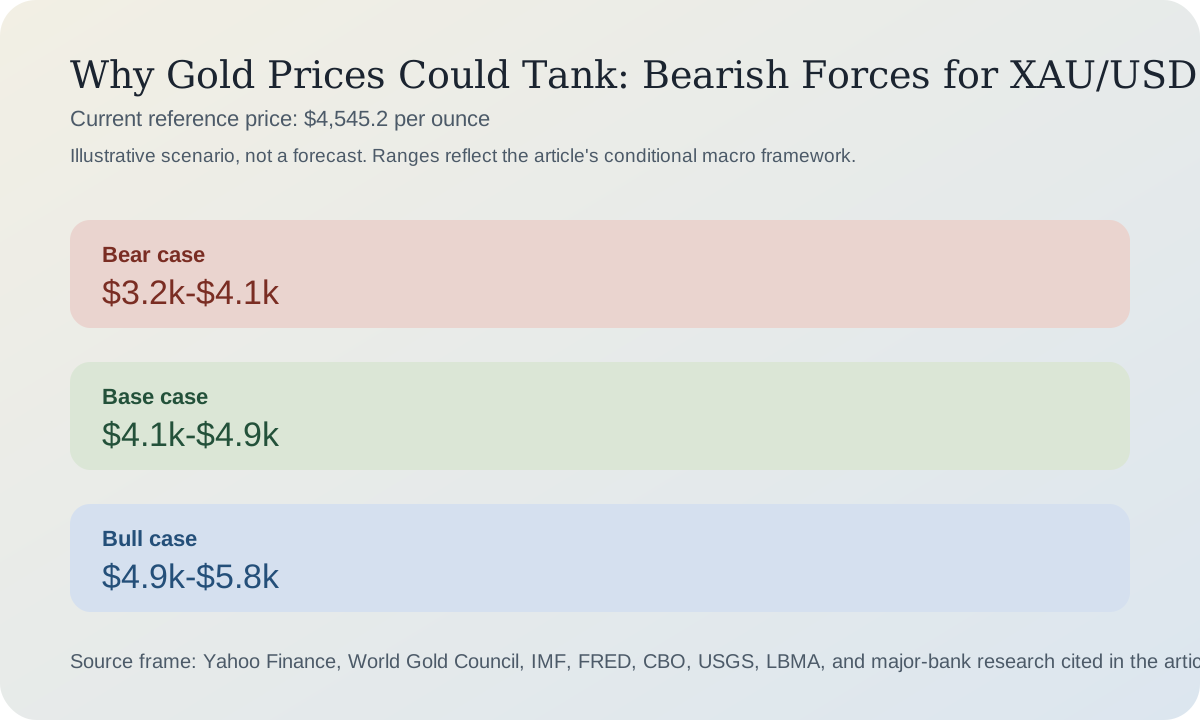
The bearish scenario is a move into the $3,200 to $4,100 zone. That could describe anything from a sharp correction to a deeper bear market, depending on the speed and persistence of ETF outflows, dollar strength, and real-yield pressure.
Base-case scenario
The base case for a bearish article should still be balanced. A broad $4,100 to $4,900 range would imply that structural support remains real even if upside momentum stalls.
Bullish invalidation scenario
The bear case breaks down if gold attracts fresh ETF buying, reserve diversification accelerates further, and real yields fall despite stable or weaker growth. In that environment, tactical downside quickly gives way to another structural leg higher.
Risks to watch
The most important live indicators are real yields, ETF holdings, central-bank purchase reports, and whether gold can or cannot rally on fresh macro stress.
What could invalidate the forecast
The downside view would be too aggressive if central banks keep buying heavily at high prices, ETF demand re-accelerates, and gold resumes outperforming despite positive real yields. Those conditions would imply that the market still has untapped strategic demand.
Conclusion
Why could gold prices tank? Because good macro narratives can become over-owned trades. The evidence is mixed on whether that process has fully started, but the ingredients for a meaningful drawdown are easy to identify and should not be ignored.
| Scenario | Illustrative range | Main trigger | Probability |
|---|---|---|---|
| Deep correction / bear market | $3,200-$4,100 | Higher real yields, weaker ETFs, and less macro fear. | 30% |
| Base range | $4,100-$4,900 | Structural support offsets macro headwinds. | 45% |
| Bullish invalidation | $4,900-$5,800 | ETF demand revives and yields soften. | 25% |
| Path | Estimated probability | Comment |
|---|---|---|
| Probability of rising | 25% | A renewed surge is possible, but it needs fresh private-sector demand. |
| Probability of falling | 30% | Downside remains meaningful because macro support is no longer cheap. |
| Probability of moving sideways | 45% | A sideways, choppy market is the likeliest outcome if structural and cyclical forces offset each other. |
06. Investor Implications
The bear case is most useful as a risk-management tool, not as an ideological anti-gold stance
A disciplined bear case should lead investors toward sizing, hedging, and patience rather than toward absolutist calls. Gold can remain a strategic asset and still punish late tactical buyers. That is the distinction many portfolio decisions miss.
| Investor type | Cautious approach | What to watch |
|---|---|---|
| Investor already in profit | Hold a core allocation if the hedge thesis still fits, but trim or rebalance if gold has become oversized. | ETF flows, real yields, and whether gold keeps failing at resistance after macro shocks. |
| Investor currently at a loss | Separate a broken thesis from a bad entry. Average in only if the time horizon is long and the macro case is intact. | Reserve diversification, official buying, and whether corrections remain orderly rather than structural. |
| Investor with no position | Prefer staged entries, wait-for-pullback plans, or dollar-cost averaging over panic buying after spikes. | The relationship between rates, the dollar, and follow-through demand after geopolitical headlines. |
| Trader | Respect volatility, use stop-losses, and trade the macro tape rather than a single long-term narrative. | TIPS yields, the U.S. dollar, ETF flow data, and momentum around prior highs. |
| Long-term investor | Think in terms of portfolio role, rebalance bands, and scenario probabilities instead of one heroic target. | Debt trends, reserve allocations, and whether gold still diversifies stock-and-bond risk. |
| Reader seeking a hedge | Use gold as one hedge among several and avoid assuming it will respond perfectly to every inflation or recession scare. | Correlation with equities and bonds during stress, not just headline inflation. |
Disclaimer: This article is a research note, not personalized investment advice. Gold can move sharply in both directions, and bearish scenarios are conditional rather than certain.
07. FAQ
Frequently asked questions about the gold bear case
Does a gold bear case mean gold has no long-term role?
No. It means the market may have run ahead of the conditions needed to justify still-higher prices in the near or medium term.
What is the strongest bearish indicator right now?
Persistently high real yields remain the clearest macro headwind because they raise the opportunity cost of holding gold.
What would make the bearish view wrong fast?
A return of strong ETF inflows, softer real yields, and continued heavy official-sector buying at high prices would all weaken the bear case quickly.
References
Sources
- Yahoo Finance GC=F recent daily chart
- Yahoo Finance GC=F 10-year monthly chart
- World Gold Council, Gold Demand Trends Q4 and Full Year 2025
- World Gold Council, Full-Year 2025 central banks
- World Gold Council, Full-Year 2025 supply
- World Gold Council, Gold Demand Trends Q1 2026
- World Gold Council, Q1 2026 outlook
- World Gold Council, Q1 2026 technology demand
- World Gold Council, Gold Outlook 2026
- World Gold Council, Why Gold in 2026? A cross-asset perspective
- World Gold Council, Gold Mid-Year Outlook 2025
- World Gold Council, Central Bank Gold Reserves Survey 2025
- IMF COFER Q4 2025 data brief
- FRED 10-year TIPS real yield series
- Congressional Budget Office, Long-Term Budget Outlook
- USGS Mineral Commodity Summaries 2026
- J.P. Morgan Global Research, gold price outlook
- J.P. Morgan Private Bank, Is it a golden era for gold?
- LBMA 2026 precious metals forecast survey
- LBMA 2026 analyst forecasts for gold
- IMF AI and productivity preparedness article
- Reuters/Investing.com summary of Goldman Sachs gold forecast