01. Quick Answer
The most credible MC downside case is a further rerating lower, not a collapse of the franchise
The bearish case for MC is not that LVMH is a weak company. It is that even the strongest luxury franchise can still fall if the market decides the high-end cycle will stay slower for longer. With MC.PA far below its 2023 peak and luxury still navigating sharper share-price swings, a further pullback remains plausible if fashion demand, China, or investor sentiment disappoint again (Reuters luxury volatility analysis; Reuters on Q1 2026 reaction).
| Risk | Why it matters |
|---|---|
| A correction is easier to imagine than a collapse | LVMH's scale and cash flow make a crash less likely than a prolonged rerating lower. |
| Luxury demand can stay selective for longer | Bain and McKinsey both argue the sector is more difficult and less frictionless than in the boom period. |
| Fashion remains the biggest operational weak point | The flagship division still shapes market confidence more than any other piece of the portfolio. |
| Bear cases need explicit triggers | Without real conditions, a call for further downside is just mood, not analysis. |
02. Historical Context
It is important to distinguish a correction, a bear market, and a crash before discussing MC downside
Before discussing downside, it helps to distinguish three market terms clearly. A correction usually means a drawdown of about 10% from recent highs. A bear market implies a deeper, more sustained decline of 20% or more. A crash suggests a fast, disorderly break typically linked to systemic fear or solvency concerns. For MC, the most plausible negative case is a correction or mild bear market, not a crash, because LVMH still generates large cash flows and retains enormous brand equity (2025 results).
| Type | What it would look like from €455.60 | Most plausible trigger |
|---|---|---|
| Correction | Roughly €410 or lower | Another disappointing luxury season or poor fashion trends. |
| Bear market | Roughly €365 or lower | A longer period of muted China demand and lower luxury multiples. |
| Crash | A disorderly move far below €365 | Would likely require a systemic shock beyond the current evidence base. |
The distinction matters because quality stocks often attract exaggerated narratives. When a stock used to command a premium multiple, any further decline can feel dramatic even if the business itself remains healthy. A rigorous LVMH bear case must therefore focus on earnings risk, valuation risk, and sector structure rather than on sensational language.
Another reason to stay precise is that downside in a stock like MC often comes in waves. First the multiple contracts, then investors question earnings durability, and only later do they start debating whether the sector itself deserves structurally lower valuations. That sequence shapes how far the stock can fall without any existential threat to the business.
03. Main Risks
Five threats could pressure LVMH despite its strength
1. The luxury slowdown may be more structural than bulls hope
McKinsey and Bain both suggest consumer behavior is changing. The market is more selective, and aspirational buyers are under pressure. If that persists, the sector's old growth assumptions may need to reset lower (Bain 2025 outlook; McKinsey 2026).
2. Fashion and leather goods could remain sluggish
Because this segment carries such symbolic and financial weight, a prolonged weak patch can cap the stock's recovery even if jewelry and Sephora remain solid.
3. China recovery may disappoint again
Reuters repeatedly framed China as a key variable in the market's interpretation of LVMH. A stop-start recovery would keep investor confidence fragile (Reuters on China improvement).
4. A premium multiple can keep compressing
The fact that MC already fell from its peak does not mean it cannot fall further. Premium consumer franchises can still rerate lower when the market decides growth and margin certainty are no longer worth old multiples.
5. Luxury-stock volatility is now a factor in its own right
Reuters' February 2026 analysis described how hedge-fund positioning and AI-jittered markets amplified luxury volatility. That makes the downside path potentially more emotional than the underlying fundamentals alone would suggest (Reuters on volatility).
04. Institutional Forecasts and Analyst Views
A credible bear case needs explicit conditions rather than vague negativity
Institutional bearishness on MC is conditional rather than apocalyptic. Public information does not support a broken-franchise thesis. What it supports is a scenario in which slower luxury growth, weaker fashion momentum, and a more disciplined market multiple keep the shares under pressure for longer than many investors expect.
| Condition | Current evidence | Bearish implication |
|---|---|---|
| Luxury remains selective | Supported by Bain and McKinsey industry work | Keeps revenue expectations under pressure. |
| Fashion recovery stalls | Still a real risk after mixed 2025 and Q1 2026 trends | Prevents the flagship division from restoring confidence. |
| China stays stop-start | Plausible according to current market debate | Caps rerating hopes. |
| Valuation stays compressed | Already visible relative to the old peak | Even good businesses can deliver poor stock returns when multiples shrink. |
The evidence is mixed enough that the downside view should stay probabilistic. A bear case that ignores LVMH's cash flow, jewelry strength, and selective retail resilience would be incomplete. A bull case that ignores the sector's changed rhythm would be equally incomplete.
Put differently, the downside setup is strongest when investors stop giving the company the benefit of the doubt on timing. If the market concludes that normalization keeps being pushed out quarter after quarter, even good results in some divisions may not be enough to prevent another valuation reset.
05. Bear, Base, and Counter-Bull Cases
The downside thesis is real, but so is the risk of becoming too dramatic
Bearish scenario
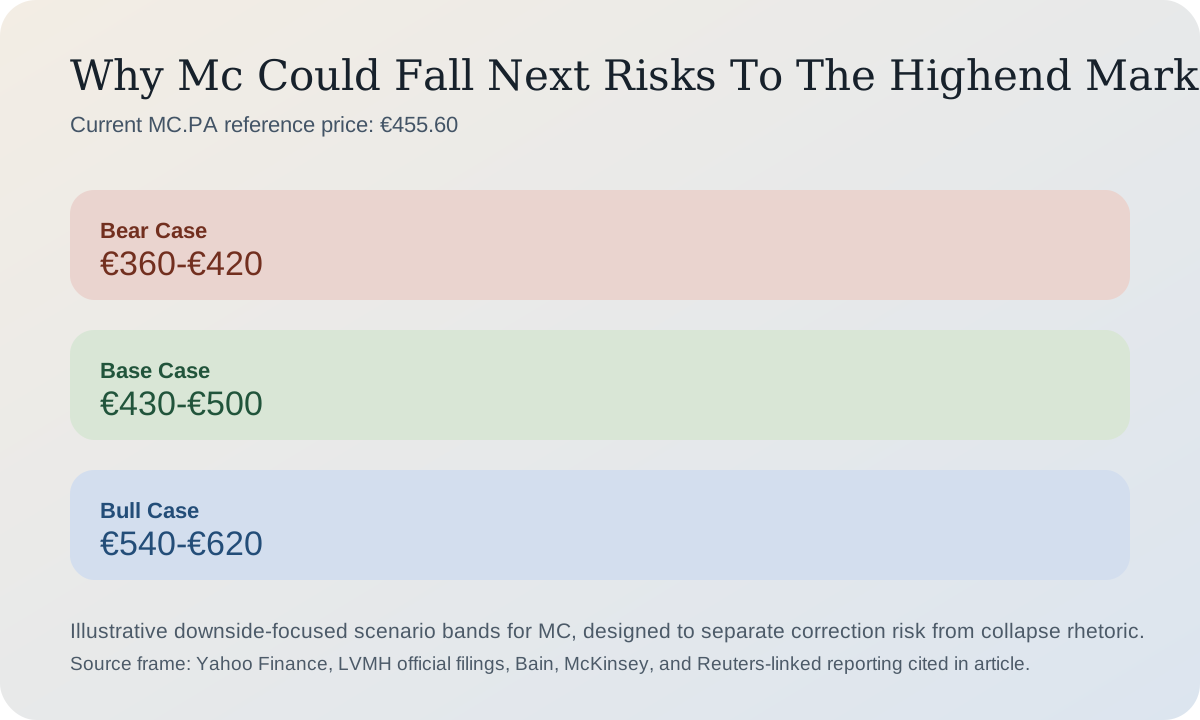
The main downside range is €360 to €420. That would fit a serious but not disorderly pullback driven by slower luxury growth, ongoing fashion weakness, and further multiple compression.
Base scenario
The more balanced range is €430 to €500, where MC spends time consolidating while the market waits for clearer proof of recovery.
Counter-bull scenario
The bull case that would invalidate the bear thesis is €540 to €620 if Asia reaccelerates, fashion stabilizes, and the market becomes convinced the slowdown was mostly cyclical.
| Scenario | Range | What it means | Probability |
|---|---|---|---|
| Bear | €360-€420 | A meaningful but not catastrophic decline in a premium luxury leader. | 45% |
| Base | €430-€500 | A prolonged consolidation while results remain mixed. | 35% |
| Bull | €540-€620 | The bearish call fails because the recovery becomes easier to trust. | 20% |
| Path | Estimated probability | Comment |
|---|---|---|
| Rising | 30% | Possible if the recovery broadens faster than expected. |
| Falling | 45% | The stock remains vulnerable to another leg of luxury-sector disappointment. |
| Sideways | 25% | An elite but expensive stock can spend time rebuilding credibility. |
Risks to watch
China, U.S. aspirational demand, fashion and leather goods trends, raw-material inflation, and whether investor positioning in luxury becomes too optimistic too early are the main risk markers.
What could invalidate the bear case
The downside thesis would weaken if LVMH keeps producing resilient organic growth, if fashion and leather goods stop deteriorating, and if jewelry and Sephora continue to surprise positively enough to carry sentiment.
Conclusion
MC could fall further, but the most rigorous downside view is a correction or extended rerating, not a collapse narrative. The company is too strong for easy catastrophe, yet not strong enough to escape the luxury cycle.
For that reason, bearish investors should look for confirmation rather than drama. Without renewed weakness in core categories or a more hostile sector tape, the downside thesis stays incomplete.
A disciplined downside view should therefore focus on probability, not certainty.
That restraint is part of what makes the thesis investable rather than theatrical, emotional, headline-driven, dogmatic, or anchored to outdated peak valuations and fading luxury euphoria from another cycle entirely. Timing still matters here, too, materially.
Disclaimer: This downside framework is for informational research only. It is not a recommendation to short, sell, or avoid MC categorically.
06. Investor Positioning
Different investor types should react differently to a possible MC pullback
| Reader type | Cautious approach | Risk control |
|---|---|---|
| Investor already in profit | Trim if the position size ignores current luxury-cycle risk. | Rebalance rather than making an all-or-nothing call. |
| Investor currently at a loss | Separate thesis damage from ordinary volatility. | Use thesis reviews or stop-losses if your horizon is short. |
| Investor with no position | Wait for confirmation or deeper pullbacks. | Avoid catching a falling knife in a premium consumer stock. |
| Trader | Respect downside momentum and event risk. | Use stop-losses around earnings and macro headlines. |
| Long-term investor | Keep dry powder and scale in only if the brand-compounding thesis remains intact. | Entry discipline still matters. |
| Risk-hedging investor | Use dedicated hedges, not one bearish stock call. | Macro hedges matter if the concern is consumer weakness or market stress. |
07. FAQ
Frequently asked questions about the MC bear case
Could MC crash?
Current public evidence supports a correction or mild bear-market path more than a crash, because LVMH still has scale, cash flow, and brand strength.
What is the biggest downside trigger?
A prolonged weak recovery in China combined with soft fashion and leather goods trends is the clearest downside trigger.
Why include a bull case in a bearish article?
Because a serious bear case should also explain what would make it wrong.
References
Sources
- Yahoo Finance chart API for MC.PA, 10-year monthly history
- Yahoo Finance chart API for MC.PA, recent daily closes
- LVMH 2025 full-year results press release
- LVMH Q1 2026 revenue press release
- LVMH key documents page, including 2025 annual report
- LVMH 2025 dividend announcement
- Reuters on LVMH shares diving after 2025 results
- Reuters on LVMH fourth-quarter sales and China improvement
- Reuters on LVMH shares after Q1 2026 and Middle East disruption
- Reuters analysis on luxury-stock volatility in 2026
- Bain & Company / Altagamma 2025 luxury market study
- McKinsey State of Fashion 2026
- Bain on luxury slowdown and structural change
- McKinsey on 2026 luxury challenges