01. Quick Answer
The strongest MUFG bear case is not franchise collapse. It is that the market already priced in too much of Japan's new-rate optimism
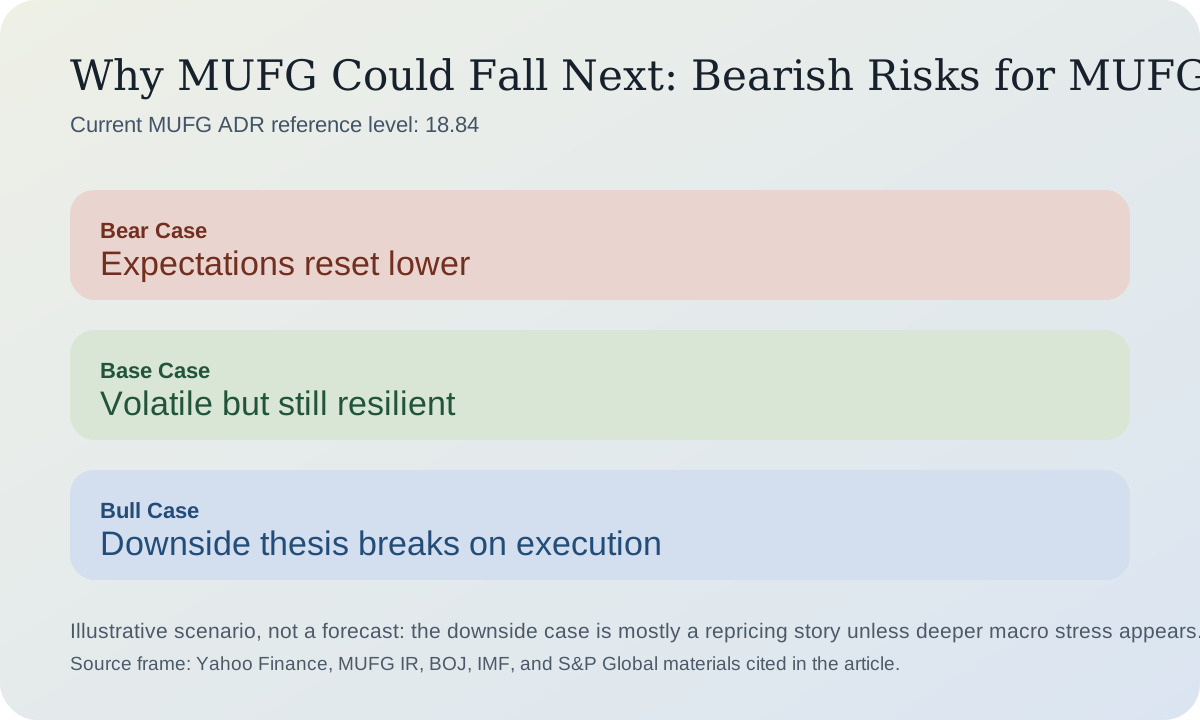
MUFG's ADR sits near the top of its 52-week range at 18.84 versus a 52-week low of 13.19 and a high of 20.15 (Yahoo Finance chart API for MUFG, recent daily closes; Yahoo Finance chart API for MUFG, 10-year monthly history). That matters because downside in strong bank stocks often starts with expectations becoming too clean for the real world rather than with the franchise suddenly breaking.
The evidence supporting caution is real. The BOJ Financial System Report warns about JGB liquidity, foreign NBFI spillovers, and private-credit monitoring. The IMF still points to securities valuation, FX funding, and commercial real-estate pockets of vulnerability. And S&P Global's consensus article already expects MUFG's loan-loss provisions to rise from ¥108.73 billion in the prior year to ¥345.37 billion for the fiscal year ended March 2026 and then higher again over the following two years.
| Point | Why it matters |
|---|---|
| The bear case is about repricing, not ruin | MUFG can stay profitable and still fall if expectations outrun reality. |
| Credit costs are rising from a very low base | That does not break the franchise, but it can narrow the rerating story. |
| Market risk is underappreciated | Japanese banks still carry securities and funding exposures that can matter quickly. |
| The bear thesis can be invalidated | If BOJ normalization and payouts keep delivering, the downside case weakens. |
02. Historical Context
A correction, a bear market, and a franchise break are not the same thing
MUFG has compounded strongly over 10 years, rising from 4.43 to 18.84 (Yahoo Finance chart API for MUFG, 10-year monthly history). That long rerating means a normal correction can still be meaningful in percentage terms even if the long-term story stays intact. Investors should separate three things clearly: a valuation correction, a cyclical bank bear market, and a deeper structural break in the business model.
The first risk is the easiest to imagine. If the market decides the domestic-rate benefit is largely known, the stock can correct even while earnings remain good. The second risk requires several pressures at once, such as weaker Asia activity, rising provisions, and more volatile JGB or FX conditions. The third risk would need a much more serious breakdown in profitability or capital, and current evidence does not support that extreme view (ratings page; official results).
| Type | Rough magnitude | What would cause it |
|---|---|---|
| Correction | 10%-15% | Valuation cools after a strong run; macro expectations become less friendly. |
| Bear market | 20%-35% | Rates disappoint, provisions rise, and market stress compresses the multiple. |
| Structural break | More severe | Would require a much deeper hit to capital, returns, or the Japan banking thesis. |
| Pressure point | Why it matters | Current read |
|---|---|---|
| Provisioning trend | Can offset better spreads | Consensus already expects higher credit costs. |
| JGB and market volatility | Can create valuation losses and funding stress | Flagged by both BOJ and IMF. |
| Over-optimistic rate assumptions | Can compress the whole thesis quickly | Still a live risk if BOJ pauses. |
| Geopolitical spillovers | Affect global credit and funding markets | Explicitly noted in official and sector research. |
03. Main Drivers
Four bearish drivers deserve the most attention
1. The BOJ tailwind may be maturing. The BOJ left the policy rate at 0.75% in April 2026. That still supports banks, but the easiest surprise may no longer be behind the market. If further hikes slow, valuation can compress even without a recession.
2. Credit costs can rise from unusually low levels. S&P Global's consensus-based article shows loan-loss provisions moving materially higher. Rising provisions are normal late-cycle behavior, but they can matter a lot when investors are celebrating cleaner spread income.
3. Securities and funding risk remain real. The IMF stresses mark-to-market securities and cross-currency funding exposures, while the BOJ warns about foreign NBFI spillovers and JGB liquidity. These are classic downside accelerants for bank stocks.
4. The stock has already had a long rerating. After a 10-year price CAGR of 15.65%, MUFG no longer offers the same margin of safety it had when Japan looked permanently stuck in the old regime (Yahoo Finance chart API for MUFG, 10-year monthly history).
04. Institutional Forecasts and Analyst Views
Even constructive institutions still leave room for a meaningful pullback
It is important to be precise here. The public institutional work we have is mostly constructive on Japanese bank profitability. S&P Global in January 2026 and again in May 2026 both highlighted rising Japanese megabank margins. But constructive profitability does not eliminate drawdown risk. It mainly limits how far the bear case can reasonably go without a wider macro shock.
MUFG's official FY2026 assumptions themselves implicitly acknowledge risk. Management's base assumptions include BOJ policy around 1%, U.S. rates in the mid-3% range, Nikkei in the mid-50,000s, and USD/JPY in the lower-150s. If even a few of those assumptions fail, near-term downside becomes more credible.
| Evidence | Bullish interpretation | Bearish interpretation |
|---|---|---|
| Higher rates | Stronger domestic margin tailwind | Much of the benefit may already be priced in |
| Higher profits | Supports payouts and confidence | Raises expectations and the risk of disappointment |
| Stable ratings | Balance sheet remains solid | Does not prevent valuation-led drawdowns |
| Consensus earnings growth | Street still sees momentum | Consensus can reset quickly if macro conditions change |
05. Scenarios, Risks, and Invalidation
The downside case needs several pressures to align
Bearish scenario
The cleanest correction case is roughly $16 to $18, while a fuller bear-market range is closer to $13 to $16. Those outcomes would likely require a softer BOJ path, higher provisions, and a less generous market multiple.
Bullish rebuttal
The bear case is invalidated if MUFG keeps delivering on profit and payout targets while BOJ normalization remains in place. In that outcome, the stock could instead hold above current levels and grind higher.
Base-case scenario
The base case is that MUFG remains volatile but broadly constructive, which means a sharp decline is possible without becoming the most likely outcome.
Risks to watch
Track BOJ language, provisions, CET1, JGB-market liquidity, and any widening gap between official targets and delivered earnings.
What could invalidate the bearish forecast
The bearish framework would be too negative if market losses remain contained, provisions normalize without surprise, and investors continue rewarding Japanese banks for a structurally better margin environment.
Conclusion
MUFG could fall next even if the franchise remains sound. The more the stock reflects clean assumptions about rates, payouts, and execution, the more sensitive it becomes to ordinary banking-market disappointments.
Disclaimer: This article is for research and informational purposes only. Downside scenarios are conditional estimates based on public information and cited sources, not advice to sell or short any security.
| Scenario | Range | Conditions | Probability |
|---|---|---|---|
| Correction | $16-$18 | Expectations cool, but core earnings remain solid | 35% |
| Bear market | $13-$16 | Rates disappoint and credit or market stress rises | 20% |
| Bear invalidation | $19-$23 | Payouts and profits keep reinforcing the higher-rate thesis | 45% |
| Direction | Probability | Comment |
|---|---|---|
| Lower | 35% | The setup is rich enough that disappointment risk is meaningful. |
| Higher | 20% | Upside still exists, but the burden of proof is now higher. |
| Sideways | 45% | Still the likeliest path if some worries emerge but do not fully align. |
06. Investor Positioning
Position sizing should reflect starting point, time horizon, and macro tolerance
A bearish MUFG view still requires nuance because there is a major difference between trimming risk after a rerating and declaring the whole franchise broken.
| Investor type | Prudent approach | Why |
|---|---|---|
| Investor already in profit | Hold the core, but trim if Japanese bank exposure has become oversized after MUFG's long rerating. | That preserves gains while leaving room for BOJ upside if margins keep widening. |
| Investor currently at a loss | Re-check whether the original thesis was about dividends, rates, or broad value re-rating before averaging down. | Losses in bank stocks often come from wrong catalysts rather than wrong franchises. |
| Investor with no position | Build exposure in stages or wait for pullbacks instead of chasing strong sentiment. | Japanese bank stocks can reprice sharply around BOJ meetings, FX moves, and credit headlines. |
| Trader | Use stop-losses, focus on BOJ dates, JGB volatility, and earnings guidance, and avoid treating dividends as a short-term shield. | Near-term price action is still macro-driven. |
| Long-term investor | Favor dollar-cost averaging, periodic rebalancing, and disciplined review of ROE, CET1, and payout quality. | The long case depends on multi-year profitability, not one quarter of excitement. |
| Risk-hedging investor | Consider hedging market beta or rebalancing against cyclical financial exposure. | MUFG can be a hedge against rising Japanese rates, but not against every global risk shock. |
07. FAQ
Frequently asked questions about the MUFG bear case
Could MUFG fall even if earnings stay good?
Yes. Bank stocks often correct when expectations get ahead of the next set of catalysts, even if absolute earnings remain healthy.
What is the biggest downside trigger?
The biggest trigger is likely a softer BOJ path combined with rising provisions or market-value losses.
Does a bearish article mean MUFG is a bad company?
No. A bear case can be valuation- and catalyst-driven rather than a claim that the franchise is weak.
References
Sources
- Yahoo Finance chart API for MUFG, 10-year monthly history
- Yahoo Finance chart API for MUFG, recent daily closes
- MUFG Financial Highlights under Japanese GAAP for the fiscal year ended March 31, 2026
- MUFG Consolidated Summary Report under Japanese GAAP for the fiscal year ended March 31, 2026
- MUFG ratings page
- Bank of Japan Statement on Monetary Policy, April 28, 2026
- Bank of Japan Financial System Report, April 2026
- IMF staff concluding statement for the 2026 Article IV mission to Japan
- S&P Global Market Intelligence on Japan megabank earnings expectations, May 2026
- S&P Global Market Intelligence on Japanese lender margin outlook, January 2026