01. Quick Answer
The cleanest bearish argument is that Nestle still has enough unresolved issues for a correction - and possibly more - if execution slips
A bearish Nestle view does not require a collapse in the underlying business. It only requires the market to decide that modest growth, periodic operational disruption, and a less generous staples multiple justify lower prices.
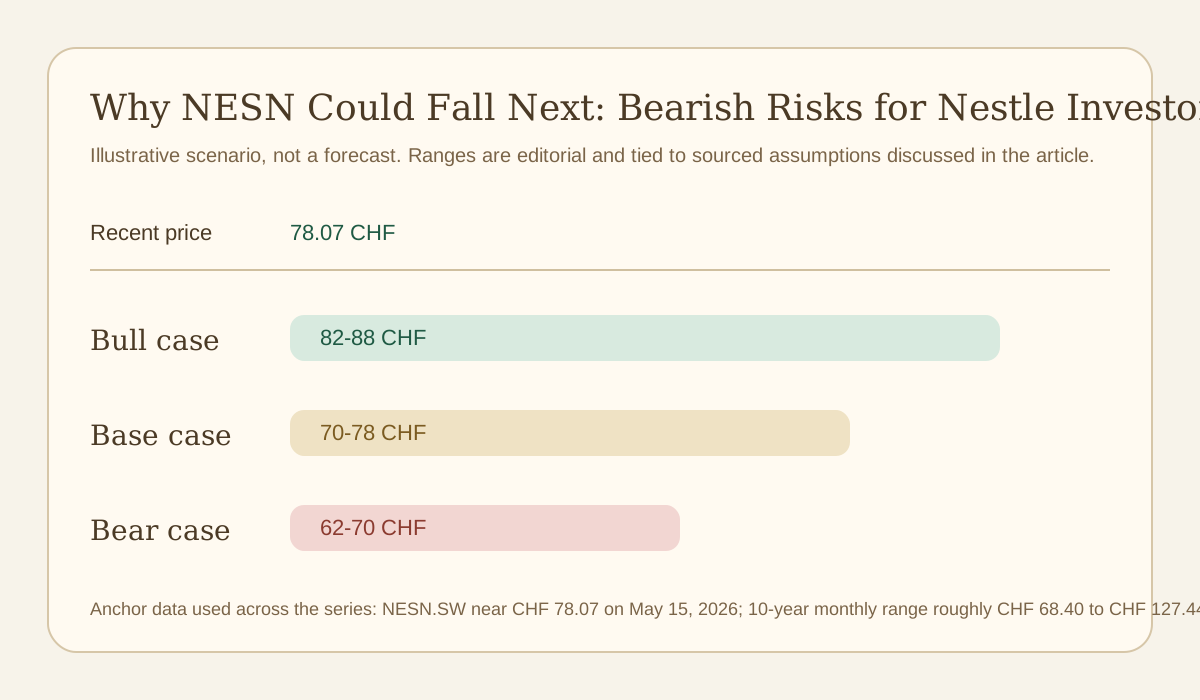
That matters because Nestle is not coming from a washout valuation extreme. The stock recently traded near CHF 78.07 after spending the last year between about CHF 69.90 and CHF 89.43. If the hoped-for recovery in growth quality stalls, the downside can reopen quickly.
| Point | Why it matters |
|---|---|
| Bearish does not mean broken | Nestle can remain profitable and still fall if investors lose confidence in the recovery path. |
| Operational issues are the biggest near-term danger | Recall recovery, water overhang, and margin delivery all matter more than macro narratives alone. |
| It is important to distinguish correction, bear market, and crash | Those outcomes are not interchangeable, and each requires different assumptions. |
| A valid bear case still needs a rebuttal | Coffee momentum, cash flow, and category strength can limit downside if they keep improving. |
02. Historical Context
Nestle's share history shows that even quality defensives can re-rate lower when growth confidence fades
The 10-year monthly range from roughly CHF 68.40 to CHF 127.44 is a reminder that Nestle is not a straight-line safe haven. The stock can spend years compressing from a premium valuation even while the company remains financially sound.
That distinction matters for bearish analysis. A correction is normally a 10% to 20% pullback. A bear market for a stock usually means a decline of more than 20% from a prior high over a sustained period. A crash implies a faster, deeper move, often 30% or more in a short time frame. For Nestle, the first two are far more plausible than the third unless multiple company-specific shocks hit at once.
| Metric | Latest sourced reading | Why it matters |
|---|---|---|
| Q1 2026 recall impact | About minus 90 bps on organic growth and RIG | Shows the business is still vulnerable to execution setbacks in sensitive categories. |
| Water-portfolio process | Partner discussions began in Q1 2026; deconsolidation expected from 2027 | The transition could help, but it also keeps uncertainty alive. |
| 2026 guidance | Maintained despite more geopolitical and macro risk | Good headline, but also means the market will punish a miss more harshly. |
| 10-year peak versus current price | CHF 127.44 versus CHF 78.07 | Illustrates how much premium valuation has already been lost. |
| Data point | Reading | Interpretation |
|---|---|---|
| Correction risk band | Roughly CHF 70-74 from current levels | A 5% to 10% move lower would fit a normal post-rally disappointment pattern. |
| Bear market risk band | Roughly CHF 60-68 | Would likely require multiple disappointments or a structural confidence loss. |
| Crash risk band | Below CHF 60 | Possible only in a severe company-specific or market-wide shock scenario. |
| Business quality floor | Still relatively high | This is why a crash is a low-probability tail risk, not the central bear case. |
03. Main Drivers
Four bearish forces deserve the most attention right now
1. Nutrition recovery could take longer than bulls expect
Nestle's infant formula advisory and published recall timeline show the 2026 issue was material and broad (Nestle advisory; recall timeline). If shelf-space recovery and consumer normalization take longer than expected, the market may stop giving management the benefit of the doubt.
2. Water issues remain a reputational and regulatory overhang
Nestle has already moved toward restructuring the water business, but Perrier-related conditions and broader scrutiny show that the issue is not fully closed. Reuters reported in December 2025 that French authorities allowed continued use of two Perrier wells but added production conditions, which keeps the topic alive (Reuters via Investing.com).
3. The market may still doubt the savings story
A bear would argue that CHF 3.0 billion of savings by 2027 sounds good, but a large part of the market will not pay more for the stock until that promise shows up consistently in margins and free cash flow.
4. Defensive does not mean immune
If real yields rise, food demand softens, or investors rotate away from slower compounders, Nestle can fall simply because its valuation support erodes, even if operations remain acceptable.
| Lever | Latest evidence | Forecast impact |
|---|---|---|
| Recall overhang | Global precautionary recall in more than 50 countries and regions | Could extend the period in which nutrition is a drag on sentiment. |
| Water-regulatory risk | Ongoing conditions around Perrier production in France | Can keep reputational pressure and transition uncertainty elevated. |
| Margin skepticism | Investors still need proof that savings convert to better economics | If they do not, the stock may de-rate again. |
| Premium multiple compression | History shows Nestle has already lost valuation altitude before | Creates downside risk even without a fundamental collapse. |
04. Institutional Forecasts and Analyst Views
The bearish evidence base is real, but it still has to compete with Nestle's cash flow, category breadth, and improving coffee trend
The latest Nestle data does not justify an outright disaster thesis. Management maintained guidance, coffee accelerated, and free cash flow is still expected above CHF 9 billion. That is why the bear case has to be framed carefully: downside is plausible, but the path is more likely to be a correction or sustained de-rating than a collapse.
At the same time, the burden of proof remains on management. If nutrition recovery stalls, water issues keep surfacing, or margin progress disappoints, a defensive stock can fall meaningfully simply because its quality premium stops looking earned.
| Source | What it says | Implication for NESN |
|---|---|---|
| Q1 2026 update | Maintained guidance but acknowledged greater geopolitical and macro risks | Leaves room for disappointment if the external backdrop worsens. |
| Recall advisory and timeline | Confirms a broad operational issue with product withdrawals across markets | Justifies caution on near-term nutrition assumptions. |
| Water transition | Formal engagement with potential partners started in Q1 2026 | Helpful strategically, but a sign the portfolio still contains unresolved issues. |
| Price history | Still far below the 2021 peak | Shows that valuation can compress for a long time when growth confidence fades. |
05. Scenarios
Bear-case scenarios for NESN, with explicit downside taxonomy
The bearish framework below distinguishes three things investors often blur together: a correction, a true bear move, and a low-probability crash. For Nestle, the first is normal risk, the second is plausible, and the third requires much harsher conditions.
The probabilities assume Nestle's franchise quality remains intact even if sentiment weakens. That is why the downside range is meaningful but not catastrophic.
| Scenario | Range | What would likely drive it | Editorial probability |
|---|---|---|---|
| Bear rebuttal fails | CHF 82-88 | Coffee and cash flow stay strong enough that bearish concerns fade and the stock stabilizes or recovers. | 30% |
| Correction | CHF 70-78 | One or two disappointments lead to a standard defensive-stock pullback without a full thesis break. | 40% |
| Bear market | CHF 62-70 | Nutrition, water, and margin concerns compound enough to produce a sustained de-rating. | 24% |
| Crash tail risk | Below CHF 62 | Would likely require a severe new operational shock plus broader market stress. | 6% |
| Outcome | Probability | Interpretation |
|---|---|---|
| Rising | 31% | There is still a credible bullish rebuttal because coffee and cash flow remain meaningful supports. |
| Falling | 39% | Downside odds are elevated because recovery confidence is not yet secure. |
| Moving sideways | 30% | Plausible if the market remains unsure and waits for clearer proof either way. |
| Risk | Why it matters | What to monitor |
|---|---|---|
| Longer recall normalization | Would weaken the idea that 2026 was just a temporary setback. | Availability, shelf-space recovery, and management tone. |
| Water overhang deepens | Would prolong reputational and structural uncertainty. | Official regulatory updates and portfolio actions. |
| Margin miss | The market may punish Nestle if savings fail to improve returns. | UTOP margin, free cash flow, and reinvestment efficiency. |
| Sector derating | Defensive stocks can still sell off in a higher-yield or risk-off environment. | Rates, defensive-sector valuations, and peers' growth signals. |
| Condition | Why it would change the view |
|---|---|
| Nutrition recovers faster than expected | That would remove one of the strongest pillars of the bear thesis. |
| Water overhang becomes financially immaterial | That would reduce the discount attached to governance and regulatory concerns. |
| Clear multi-quarter margin expansion | That would show the savings story is real and likely limit downside. |
06. Investor Positioning
How investors might position if they respect the bear case without assuming disaster
The practical response to a bear case is usually risk management, not theatrical conviction. A careful investor can acknowledge downside without assuming Nestle is uninvestable.
| Investor type | Prudent stance | Why |
|---|---|---|
| Investor already in profit | Consider trimming, rebalancing, or hedging if the original defensive position has grown too large | The bear case is strongest when a recovery rally has already improved the entry cushion. |
| Investor currently at a loss | Avoid averaging down mechanically; wait for evidence that key risks are stabilizing | Price alone does not invalidate the bear thesis. |
| Investor with no position | Avoid chasing and wait for either a cleaner setup or cheaper price | There is no urgency to buy a stock with unresolved overhangs. |
| Trader | Use stop-losses and define whether you are trading a correction, a bear trend, or a bounce | These are different regimes and need different tactics. |
| Long-term investor | Review whether Nestle still fits the portfolio's quality and risk criteria | A long-term holder may still stay invested, but position size should reflect current uncertainty. |
| Risk hedger | Hedge broader market risk and watch company-specific events closely | Some downside scenarios are stock-specific rather than macro-only. |
07. Conclusion
Nestle can fall next without becoming a broken company
That is the core bearish argument. Nestle still has real strengths, but also enough unresolved issues that the stock could correct or de-rate if execution disappoints.
The most likely bearish path is not a crash. It is a lower range caused by slower recall recovery, water overhangs, and persistent investor skepticism about growth quality. Bulls should engage with that risk honestly, because it is exactly what could make the optimistic case wrong.
Disclaimer: This article is an editorial scenario analysis based on public information available as of May 16, 2026. It is not personalized investment advice, and the ranges above should be read as conditional outcomes rather than promises.
08. FAQ
Frequently asked questions
Could Nestle enter a bear market without a business collapse?
Yes. A decline of more than 20% can happen if the market keeps cutting the valuation multiple even while the business stays profitable.
What is the difference between a correction and a crash for NESN?
A correction would usually be a 10% to 20% slide tied to disappointment. A crash would be a much sharper and deeper move, which currently looks like a tail risk rather than the base bear case.
What is the biggest bearish catalyst today?
The biggest bearish catalyst is probably a failure to normalize nutrition while margin progress also disappoints.
What would make the bear case wrong?
Faster nutrition recovery, limited water damage, and visible margin gains would all weaken the case for further downside.
References
Sources
- Yahoo Finance chart API for NESN.SW 10-year monthly price history and recent price data
- Nestle annual report hub
- Nestle Annual Review 2025 PDF
- Nestle full-year results 2025 press release
- Nestle full-year results 2025 prepared remarks PDF
- Nestle full-year results 2025 transcript PDF
- Nestle three-month sales 2026 press release
- Nestle Q1 2026 investor call transcript PDF
- Company-compiled analyst consensus before Nestle Q1 2026 sales
- Nestle Capital Markets Day 2024
- Nestle investor strategy overview
- Nestle 2025 operating segment and product restatements PDF
- Nestle infant formula product advisory
- Nestle recall timeline PDF
- Reuters via Investing.com on Perrier production conditions