01. Quick Answer
The cleanest bearish argument is that Novartis may still be too trusted relative to the uncertainty of the current transition
Novartis is not a broken company. That is exactly why the bear case has to be framed carefully. The risk is not insolvency or franchise collapse. It is that investors may discover they were paying for smoother execution than a patent-loss year can realistically deliver.
That risk became visible in Q1 2026, when sales and core operating income missed expectations because Entresto generic erosion in the U.S. was stronger than some analysts anticipated. A pullback in that context would not be irrational. It would be the market repricing uncertainty.
| Point | Why it matters |
|---|---|
| Bearish does not mean anti-business | Novartis can stay fundamentally strong and still suffer a correction if the market reprices execution risk. |
| Patent erosion is the main near-term risk | Entresto is the most obvious driver of downside if erosion stays difficult to model. |
| It is important to separate correction, bear market, and crash | Those outcomes require different assumptions and have different probabilities. |
| A valid bear case still needs a rebuttal | Strong launches, cash flow, and pipeline wins can still limit downside or reverse it. |
02. Historical Context
Even strong pharma compounders can pull back sharply when patent and pipeline uncertainty collide with rich expectations
Novartis has outperformed many defensive peers over the last decade, which also means sentiment has improved materially. That creates room for disappointment when the market sees evidence that the next growth bridge may not be effortless.
For risk taxonomy, a correction in NOVN would usually mean roughly 10% to 20% down from recent levels. A bear move would imply a deeper, more sustained decline, often attached to several setbacks rather than one quarter. A crash would require a much more severe combination of company-specific and market-wide shocks and currently appears low probability.
| Metric | Latest sourced reading | Why it matters |
|---|---|---|
| Q1 2026 sales miss | Net sales down 5% cc, below some market expectations | Shows how patent erosion can still override strong launches in the short run. |
| Core operating income trend | Down 14% cc in Q1 2026 | Signals that profitability can compress during transition years. |
| 2026 guidance stance | Reaffirmed, but still low single-digit sales growth and low single-digit core operating income decline | The guidance itself is not weak, but it does not leave huge room for further negative surprises. |
| 52-week ceiling | CHF 131.00 | Reminds investors that the stock entered 2026 from a relatively optimistic level. |
| Data point | Reading | Interpretation |
|---|---|---|
| Correction zone | Roughly CHF 105-112 | Would fit a normal reset if launch strength fails to fully reassure the market. |
| Bear-market zone | Roughly CHF 90-105 | Would likely require a mix of tougher erosion, weaker readouts, and valuation compression. |
| Crash tail-risk zone | Below CHF 90 | Possible only in a multi-shock scenario, not the central bear case. |
| Business quality floor | Still high | This is why the downside case is more plausibly a pullback than a franchise implosion. |
03. Main Drivers
Four bearish forces matter most right now
1. Entresto erosion may remain harder to model than bulls want
Reuters coverage of Q1 2026 emphasized that the U.S. generic hit was fiercer than expected. If that remains true, the market may keep treating Novartis as a transition story rather than a clean compounding story.
2. The stock already carries a quality premium
After a strong 2025 and a 10-year CAGR well above many defensive names, Novartis does not start from distress. That means multiple compression is a real pullback risk if the narrative wobbles.
3. Pipeline depth does not remove pipeline risk
A broad pipeline lowers single-asset dependence, but it does not eliminate readout risk. A cluster of underwhelming outcomes could change the market’s confidence quickly.
4. Pricing and access pressure remain structural
IQVIA’s 2026 work highlights payer friction and high unfilled prescription rates for new medicines, which matters because strong clinical assets do not automatically become strong commercial assets.
| Lever | Latest evidence | Forecast impact |
|---|---|---|
| Patent erosion | Entresto generic competition is already hitting 2026 sales | Main risk to near-term earnings quality. |
| Premium valuation | Stock has rerated over time on quality and innovation credibility | Creates room for disappointment-driven multiple compression. |
| Pipeline execution risk | 15+ readouts create both upside and downside event risk | Underperformance on several milestones could change the story materially. |
| Commercial access friction | New medicines often face payer rejection and affordability barriers | Can slow the revenue realization of even strong launches. |
04. Institutional Forecasts and Analyst Views
The bearish evidence is credible, but it still has to compete with real launch strength and cash generation
A balanced bear case on Novartis should not ignore the positives. Kisqali, Pluvicto, Scemblix, and Leqvio are growing fast. Free cash flow remains strong. The company still has one of the more credible long-term frameworks in global pharma.
The bearish point is narrower: those strengths may already be too heavily relied upon by investors at a time when the earnings bridge still depends on smooth execution. If that bridge slips, the stock can correct meaningfully without any need for a catastrophic thesis.
| Source | What it says | Implication for NOVN |
|---|---|---|
| Q1 2026 results | Sales and profit pressure from U.S. generic erosion | Primary factual basis for a near-term bear case. |
| Reuters coverage | Erosion was described as fiercer than expected | Raises the probability of further estimate resets if the trend persists. |
| Market expectations | Novartis still trades as a quality large-cap pharma name | Means there is valuation risk as well as earnings risk. |
| IQVIA and pricing data | Patient access and payer friction remain meaningful for new medicines | Commercial friction can slow the bull-case earnings bridge. |
05. Scenarios
Pullback scenarios for Novartis, with downside taxonomy
The scenarios below separate normal pullback risk from more serious downside. That matters because investors often overstate both the danger and the opportunity when a high-quality stock finally stumbles.
For Novartis, the most plausible bearish path is a correction or moderate bear move, not a crash, unless multiple adverse catalysts arrive together.
| Scenario | Range | What would likely drive it | Editorial probability |
|---|---|---|---|
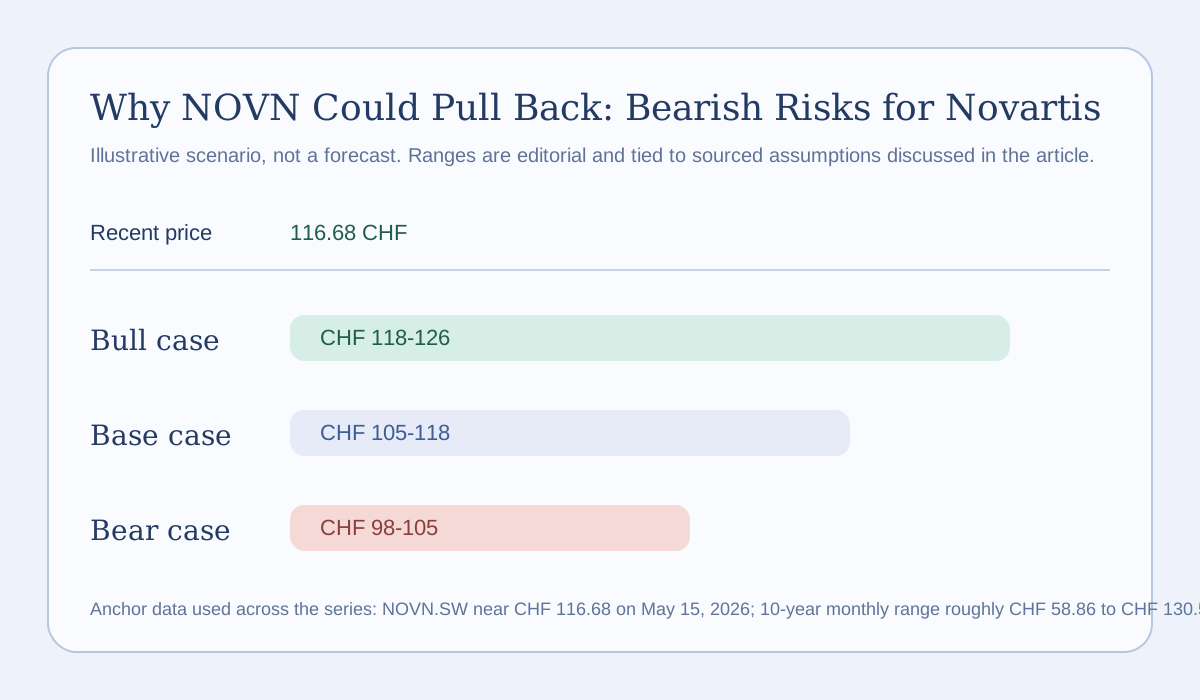
| Bear rebuttal holds | CHF 118-126 | Launch strength and pipeline momentum are enough to absorb market anxiety and keep the stock stable. | 31% |
| Correction | CHF 105-118 | The market marks down the stock as patent-loss uncertainty and valuation concerns dominate. | 39% |
| Bear market | CHF 98-105 | Several disappointments combine into a deeper de-rating. | 23% |
| Crash tail risk | Below CHF 98 | Would likely need severe pipeline disappointment or a broad market shock on top of company-specific problems. | 7% |
| Outcome | Probability | Interpretation |
|---|---|---|
| Rising | 33% | There is still a credible bullish rebuttal because the growth drivers are real. |
| Falling | 38% | Downside odds are elevated while the market is testing the transition narrative. |
| Moving sideways | 29% | Plausible if launches and erosion keep offsetting each other. |
| Risk | Why it matters | What to monitor |
|---|---|---|
| Sharper-than-expected generic erosion | Could trigger estimate cuts and valuation compression. | Quarterly U.S. sales and management guidance language. |
| Clinical setbacks | Would weaken the replacement-power narrative. | Late-stage data and regulatory decisions. |
| Access and reimbursement delays | Could slow the monetization of new brands. | Payer behavior, fill rates, and launch trajectory detail. |
| Defensive-sector derating | Even good pharma can pull back if market preferences shift. | Rates, sector multiples, and peer commentary. |
| Condition | Why it would change the view |
|---|---|
| Faster stabilization of Entresto erosion | That would remove the cleanest pillar of the near-term bear case. |
| Strong multi-quarter launch performance and pipeline wins | That would show the market’s current concern is too narrow and likely too temporary. |
| Material multiple support from capital returns | A stronger buyback and cash-return effect could limit downside more than assumed here. |
06. Investor Positioning
How investors might respond if they respect the Novartis bear case
The right response to a bear case is usually risk management, not panic. A careful investor can acknowledge the pullback risk without pretending the company has lost its long-term quality.
| Investor type | Prudent stance | Why |
|---|---|---|
| Investor already in profit | Trim or rebalance if the position has become large after a strong run | The downside case is most relevant when the valuation cushion looks thinner. |
| Investor currently at a loss | Do not average down mechanically; wait for the key risks to stabilize | Patience matters more than price anchoring in transition periods. |
| Investor with no position | Wait for either cleaner proof or a cheaper entry | There is no need to chase a stock with visible near-term uncertainty. |
| Trader | Use stop-losses and define whether you are trading a correction, a bear trend, or a bounce | Those are different setups and should not be conflated. |
| Long-term investor | Review whether the innovation thesis still dominates the patent-loss thesis | The answer to that question determines whether a pullback is noise or signal. |
| Risk hedger | Use market hedges and watch company-specific catalysts closely | Some of the risk here is business-specific rather than macro-only. |
07. Conclusion
Novartis could pull back without the bull case fully breaking
That is the most credible bearish point. The company still has real strengths, but the market may be underestimating how messy a patent-loss transition can look quarter to quarter.
A correction is therefore easier to justify than a crash thesis. If launches and pipeline wins keep accumulating, the bear case weakens. If the transition stays rough, the stock can pull back further before longer-term bulls regain control.
Disclaimer: This article is an editorial scenario analysis based on public information available as of May 16, 2026. It is not personalized investment advice, and the ranges above should be read as conditional outcomes rather than promises.
08. FAQ
Frequently asked questions
Could Novartis correct even if the business remains strong?
Yes. High-quality pharma stocks can still correct when earnings visibility weakens or investors decide too much good news is already priced in.
What is the difference between a correction and a bear market for NOVN?
A correction is usually a 10% to 20% pullback. A bear market is deeper and more sustained, often tied to multiple disappointments rather than one rough quarter.
What is the main bearish catalyst today?
The main bearish catalyst is that Entresto generic erosion may stay stronger or more unpredictable than current bulls expect.
What would make the Novartis bear case wrong?
Faster stabilization in erosion plus strong launch and pipeline execution would weaken the case for further downside.
References
Sources
- Yahoo Finance chart API for NOVN.SW 10-year monthly price history and recent price data
- Novartis annual results hub
- Novartis Annual Report 2025 landing page
- Novartis Annual Report 2025 PDF
- Novartis quarterly results hub
- Novartis Q1 2026 press release
- Novartis Q1 2026 interim financial report PDF
- Novartis mid-term outlook update, November 20, 2025
- Novartis San Diego research center press release
- Novartis Carlsbad radioligand therapy manufacturing press release
- Novartis remibrutinib positive CHMP opinion press release
- Novartis ianalumab FDA Breakthrough Therapy designation press release
- IQVIA U.S. Medicine Use Trends 2026
- Reuters coverage of Q1 2026 pressure from generics
- Reuters report on Novartis losing bid to block U.S. Entresto generic through 2026