01. Quick Answer
Platinum can fall meaningfully if the market starts believing that scarcity is easing faster than the price implies
NYMEX platinum futures (PL=F on Yahoo Finance) were trading around $1,983.5/oz on 2026-05-18. The same 10-year monthly series started near $1,021.5/oz on 2016-06-01 and most recently showed $1,983.5/oz, with a 10-year monthly range of roughly $785.9 to $2,102.8 and a price-only CAGR near 8.04% (10-year monthly data).
The immediate bearish argument is simple: platinum already rallied hard, and the World Bank explicitly expects prices to moderate after the 2026 spike. If the market begins to focus more on weaker jewellery demand, auto uncertainty, and improving recycled supply than on raw deficit headlines, PL can reprice lower quickly.
The more serious bear case is structural. WPIC's medium-term work still sees deficits through 2030, but narrower ones than the market just experienced. If investors conclude that the shortage era is shrinking rather than deepening, the risk premium embedded in platinum prices can compress even before balances actually flip to surplus.
| Point | Why it matters |
|---|---|
| Bearish logic | The cleanest downside story is not surplus alone; it is a shrinking scarcity premium in a market that already ran far. |
| Demand sensitivity | Jewellery, automotive, and investor demand can all soften at the same time when prices get too high. |
| Supply response | Recycling is the most practical source of incremental relief and a major bear-case variable. |
| Counterpoint | A bear case still has to respect the fact that the physical market is not obviously loose yet. |
02. Historical Context
Platinum's long-term setup only makes sense when current tightness is compared with a decade of false starts, sharp drawdowns, and renewed scarcity
Platinum has a long history of disappointing bullish narratives, which is why a bearish article cannot be dismissed as contrarian theater. Even strategically important metals can trade poorly for years when the market expects demand erosion to outpace supply stress.
The current backdrop is different, but not immune to reversal. Platinum reached a 52-week high of 2,852.4/oz, and WPIC acknowledged that investor demand and exchange-stock flows were major contributors to the 2025 deficit story. That means part of the premium is vulnerable if investor behavior changes.
Bearish investors therefore do not need to prove that platinum is abundant. They only need to show that the market has gotten ahead of what the next two to four years can realistically deliver.
| Metric | Latest reading | Why it matters |
|---|---|---|
| Current platinum price | $1,983.5/oz | Every forecast range needs a live anchor because platinum already repriced sharply in 2025 and early 2026. |
| 52-week range | $1,004.5 to $2,852.4 | This range shows how quickly platinum can move when physical tightness meets speculative demand. |
| 10-year monthly range | $785.9 to $2,102.8 | Useful for separating a normal correction from a full regime shift. |
| 10-year price CAGR | 8.04% | Long-run compounding has been positive, but still uneven enough to punish lazy extrapolation. |
| Latest WPIC 2026 deficit | 297 koz | The latest published WPIC update still points to undersupply despite softer investment demand than in 2025. |
| Editorial base range | $1.3k-$1.7k | Scenario ranges are more honest than pretending platinum has one inevitable destination. |
| Line item | Latest official reading | Interpretation |
|---|---|---|
| High starting price | $1,983.5/oz | The more elevated the starting point, the easier it is for disappointment to matter. |
| Recycling growth | +9% in 2026 forecast | More scrap supply is one of the most direct bearish forces available. |
| Jewellery demand | -12% in 2026 forecast | This shows one demand channel is already price sensitive. |
| Automotive demand | -2% in 2026 forecast | A steeper auto decline than expected would increase bearish pressure. |
| World Bank 2027 direction | -13% y/y after 2026 | A major macro institution already expects pullback after the spike year. |
| Policy risk | Tariff unwind risk | If policy-driven inventory distortions ease, prices may lose a temporary source of support. |
03. Main Drivers
Five bearish forces could drag PL lower even if the market stays technically tight
1. Higher prices can solve part of the shortage
WPIC already expects recycling to increase 9% in 2026. If that proves conservative, more metal reaches the market without requiring a mine-supply miracle.
2. Jewellery demand is already under pressure
The latest WPIC forecast calls for a 12% drop in jewellery demand for 2026. That matters because bulls sometimes assume substitution from gold will offset any price sensitivity. The evidence so far is more mixed.
3. Automotive demand can weaken faster than expected
Even a market that believes in hybrids still has to respect EV adoption and auto-cycle risk. WPIC's own long-run framework already assumes declining auto demand by 2030.
4. Investor flows may have done too much of the work
The Reuters poll and LBMA commentary both imply a market where positioning matters. If platinum stops attracting fresh money, the price can fall faster than the physical market alone would justify.
5. Macro normalization would hurt the safe-haven component
The World Bank says platinum's surge was helped by speculative demand and geopolitical uncertainty. A softer geopolitical backdrop or a firmer dollar could remove that support, leaving the metal to trade more like an industrial cyclical.
04. Institutional Forecasts and Analyst Views
Institutional evidence supports a tighter platinum market, but the range of fair-value assumptions is still unusually wide
The bearish case actually has institutional support. The World Bank expects platinum prices to retreat in 2027 after a very strong 2026. The Reuters survey also remains far below the most aggressive bullish takes, implying that many analysts still see normalization rather than persistent squeeze conditions.
Even some constructive institutions embed caution. LBMA analysts often cite structural tightness but still present wide ranges rather than one-way upside targets, and Deutsche Bank explicitly notes that if tariffs are not imposed, inventory unwind could soften both lease rates and prices.
The bearish takeaway is not that platinum's fundamentals are fake. It is that the market may already discount more tightness than the next phase of the cycle can actually deliver.
| Source | Published view | Why it matters |
|---|---|---|
| WPIC Q1 2026 update | 2026 deficit revised to 297 koz | The latest fundamental update still says the market is undersupplied despite price volatility. |
| WPIC January 2026 five-year outlook | Average deficits of about 348 koz a year from 2027 to 2030 | This is one of the few published medium-term platinum balance frameworks. |
| LBMA 2026 analyst panel | Analyst averages shown around $2.1k-$2.3k with wide ranges | The range matters because platinum is still a small market where flows can overwhelm smooth modeling. |
| Reuters poll | $1,550 average for 2026 | Useful as a conservative institutional baseline captured before the latest rerating ran further. |
| BofA | $2,450 average for 2026 | Represents one of the stronger bank views tied to deficits, tariff risk, and Chinese demand. |
| Johnson Matthey 2026 PGM report | Platinum demand should again exceed supply in 2026 | Adds an industry operator's view, not just a macro strategist's opinion. |
| World Bank April 2026 outlook | Platinum prices projected up about 53% in 2026, then down 13% in 2027 | A macro commodity house case that explicitly assumes moderation after the spike. |
| Deutsche Bank | Tariff outcomes could either trigger a rally or soften prices via inventory unwind | Useful because it frames policy uncertainty as a genuine swing factor rather than background noise. |
05. Bear, Base, and Counter-Bull Cases
The platinum bear case is strongest when its own failure conditions are stated clearly
Bullish scenario
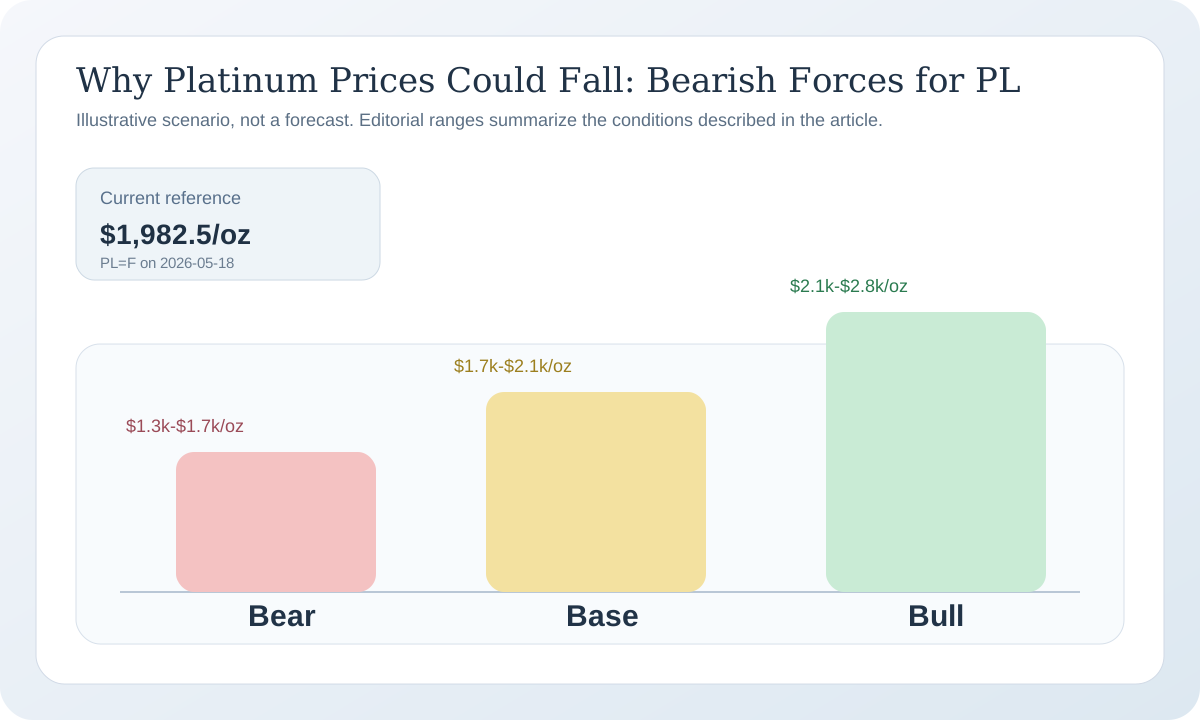
The counter-bull case is $2,100 to $2,800. It requires deficits to remain stubborn, inventory cover to stay thin, and any correction to attract patient buyers rather than trigger liquidation.
Base-case scenario
The base case for a bearish article is $1,700 to $2,100. That range assumes platinum gives back some premium but remains above the old low-expectation regime because physical balances are still not comfortable.
Bearish scenario
The main bear case is $1,300 to $1,700. That becomes more likely if recycling accelerates, jewellery and auto demand soften further, and speculative support fades faster than industrial demand can offset it.
Risks to watch
Key downside catalysts include stronger scrap flows, softer Chinese demand, greater palladium substitution, weaker manufacturing activity, and a policy or macro environment that reduces the need to hoard platinum as a strategic metal.
What could invalidate the forecast
The bearish view would be wrong if deficits remain large enough to keep above-ground stocks critically low, or if industrial and bar-and-coin demand stay strong enough to absorb weaker jewellery demand without much price damage.
Conclusion
A platinum bear case does not need total oversupply to work. It only needs the market to decide that the metal no longer deserves the same scarcity premium it did during the sharpest phase of the squeeze.
The probability table below is an editorial framework built from the live price anchor, the latest WPIC balance data, the World Bank macro path, and the dispersion in LBMA and bank forecasts. It is not a statistical guarantee.
| Scenario | Illustrative range | Conditions | Probability |
|---|---|---|---|
| Bear | $1,300-$1,700 | Scarcity premium compresses as supply relief and softer demand emerge. | 35% |
| Base | $1,700-$2,100 | Premium fades partly, but tightness prevents a full collapse. | 40% |
| Counter-bull | $2,100-$2,800 | Physical tightness stays dominant and buyers treat pullbacks as opportunities. | 25% |
| Path | Estimated probability | Comment |
|---|---|---|
| Probability of rising | 25% | Further upside is still possible, but not the default in a bearish framing. |
| Probability of falling | 40% | Downside risk is elevated because price already moved far ahead of its old regime. |
| Probability of moving sideways | 35% | A broad, choppy consolidation is also plausible if neither side fully wins. |
06. Investor Implications
A platinum forecast is only useful if it changes how different investors manage risk, timing, and position size
A bearish article is not a call for certainty. It is a reminder that platinum remains a volatile market where tightening narratives can reverse once the market senses enough relief on the margin.
That means defensive behavior matters: trimming oversized winners, refusing to average blindly, and waiting for proof before assuming every dip is a bargain.
| Investor type | Cautious approach | What to watch |
|---|---|---|
| Investor already in profit | Hold part of the core position if the deficit thesis still fits, but trim or rebalance if platinum has become too large a portfolio weight. | Lease-rate tightness, exchange inventories, and whether the market keeps rejecting rallies above the current zone. |
| Investor currently at a loss | Separate a broken thesis from a poor entry. Add only gradually if deficits, stock depletion, and industrial demand still support the long-run case. | Whether downside comes from looser physical balances or only from macro de-risking. |
| Investor with no position | Avoid chasing vertical rebounds. Prefer staged buying, wait-for-pullback plans, or dollar-cost averaging. | Chinese jewellery substitution, ETF flows, and whether recycled supply starts responding more aggressively. |
| Trader | Use stop-losses and respect headline risk. Platinum is too thin a market for oversized conviction when tariffs and positioning can move price quickly. | Dollar moves, exchange-for-physical stress, South African supply headlines, and auto-sector news. |
| Long-term investor | Focus on scenario ranges, rebalance bands, and the structural supply story instead of one exact price target. | Whether 2027-2030 deficits persist and whether hydrogen and industrial uses become material rather than symbolic. |
| Reader seeking a hedge | Treat platinum as a specialist hedge with industrial sensitivity, not as a pure crisis hedge like gold. | Correlation behavior during equity selloffs and whether platinum trades as a precious metal or an industrial metal in the next shock. |
Disclaimer: This article is for informational purposes only. It is not a personalized recommendation or a guarantee that platinum prices will decline.
07. FAQ
Frequently asked questions about the platinum bear case
Can platinum fall even if the market is still in deficit?
Yes. Prices can fall if the deficit shrinks, inventories stop looking critical, or investors simply decide the scarcity premium became excessive.
What is the biggest bearish variable right now?
Recycling is one of the biggest because it is the fastest realistic way for higher prices to bring more metal back to market.
What would make the bear case wrong?
If deficits remain large, stock cover stays tight, and industrial plus investment demand remain resilient, the market may hold much higher than bears expect.
References
Sources
- Yahoo Finance PL=F recent daily chart
- Yahoo Finance PL=F 10-year monthly chart
- WPIC Platinum Quarterly Q1 2026
- WPIC Q1 2026 summary press release
- WPIC Platinum Quarterly Q4 2025
- WPIC Platinum Essentials January 2026
- Johnson Matthey 2026 PGM Market Report release
- LBMA 2026 analysts forecasts
- Reuters poll on platinum forecasts
- BofA platinum forecast summary
- World Bank Commodity Markets Outlook April 2026
- IMF World Economic Outlook April 2026
- USGS Mineral Commodity Summaries 2026
- Deutsche Bank metals and strategic materials note