01. Downside Context
What a pullback would actually mean for Sanofi
The bearish case for Sanofi is not that the company looks weak today. It is that the stock still carries a familiar large-pharma vulnerability: if the market decides growth is too concentrated, pipeline confidence is too optimistic, or capital allocation is not translating into enough broad-based value, SAN can re-rate lower even while the operating business remains respectable.
| Risk | Why it matters |
|---|---|
| Correction risk is real | A quality pharma stock can still correct 10%-20% without any existential crisis. |
| Concentration remains a live issue | Too much reliance on one flagship asset can cap valuation and amplify disappointment. |
| Pipeline sentiment matters fast | Clinical and regulatory setbacks can change how the whole story is priced. |
| Bear cases need explicit triggers | Without real commercial or clinical pressure, a downside thesis is just generic negativity. |
For risk framing, it helps to separate a correction from a bear market and a crash. A correction usually means a decline of around 10% from recent highs. A bear market means a more sustained drop of 20% or more. A crash implies disorderly selling tied to panic or severe business impairment. For Sanofi, a correction or mild bear market is plausible. A crash would likely require a much larger clinical, legal, or regulatory shock than current public evidence suggests.
| Type | What it could look like from EUR 73.96 | Most plausible trigger |
|---|---|---|
| Correction | Around EUR 67 or lower | Weaker pipeline tone, launch disappointment, or market rotation away from the story. |
| Bear market | Around EUR 59 or lower | A more durable loss of confidence in concentration, commercialization, or the pipeline. |
| Crash | Far below EUR 59 | Would likely require an extreme and currently unsupported fundamental shock. |
That distinction matters because healthcare investors often create emotional distortions around large pharma. Bulls can underestimate downside because the business looks diversified and cash generative. Bears can overstate downside by assuming every stumble is a broken pipeline. A credible bear case should avoid both errors.
The evidence is mixed enough that bearishness on Sanofi must be earned. Yet the risk is real because confidence in large-cap pharma often erodes in stages: first the market questions one asset concentration, then it questions the pipeline, then it questions whether capital has been allocated effectively enough to fix the first two concerns.
That sequence matters because the stock can already be falling well before the business looks obviously weak in the income statement. Once investors begin to doubt the breadth of future growth, they usually demand a wider margin of safety.
Another reason the downside can surprise people is that optimism about big pharma transitions often becomes self-reinforcing near the top. Investors start assuming today's strongest asset will naturally fund tomorrow's broader success, and they underprice the possibility that the bridge takes longer to build.
02. Bearish Drivers
Five risks that could push SAN lower
1. Dupixent concentration could become a bigger problem
If the market starts to think that too much of Sanofi's growth case still depends on one asset, the stock can rerate lower even without a sudden collapse in fundamentals.
2. Pipeline setbacks can hurt sentiment quickly
Large-cap pharma multiples often depend on optionality. If readouts or regulatory progress disappoint, the market may cut back what it is willing to pay for future growth.
3. Launch momentum might not scale as hoped
Recent acceleration in launch sales is promising, but if commercial uptake slows, the broadening-growth story weakens materially.
4. Pricing, reimbursement, and competitive pressure
IQVIA and Deloitte both imply that demand remains solid but the broader environment is still shaped by pricing pressure, policy, and execution quality. That can weigh on rerating potential.
5. Capital redeployment can be questioned
Acquisitions, buybacks, and R&D spending can all help if well executed. If not, investors may start to see Sanofi as spending for optionality without enough visible payoff.
03. Bearish Framework
How a credible downside thesis for Sanofi should be built
A credible bearish framework has to acknowledge that Sanofi starts from a stronger position than its old market stereotype implies. FY 2025 was solid, Q1 2026 was strong, and guidance was reaffirmed. That means the downside thesis is not about fragility. It is about whether expectations for a broadening growth story become too optimistic relative to what Sanofi can realistically deliver.
| Condition | Current evidence | Bearish implication |
|---|---|---|
| Concentration concern persists | Still visible despite progress elsewhere | Valuation may stay capped or compress. |
| Pipeline or regulatory flow softens | Always possible in biopharma | Optionality would be repriced downward. |
| Launch breadth underwhelms | Positive now, but not proven over multiple years | The diversification narrative weakens. |
| Capital allocation disappoints | Too early to judge fully | Investors may decide the growth transition is less efficient than advertised. |
In practical terms, the downside case is strongest when weaker pipeline confidence and weaker diversification confidence reinforce each other. If only one appears, the pullback may stay limited. If both emerge together, the market can re-rate SAN lower for longer than bulls expect.
That is especially true for a company whose long-term chart has already taught investors to be cautious about assuming that operational progress automatically translates into valuation progress.
Bearish investors should also remember that most large-pharma drawdowns are not cinematic. They often unfold through a few middling updates, a less exciting pipeline tone, and slow multiple compression as the market decides the transition story deserves less credit than before.
04. Scenarios
Correction, bear-market, and invalidation framework
Bearish scenario
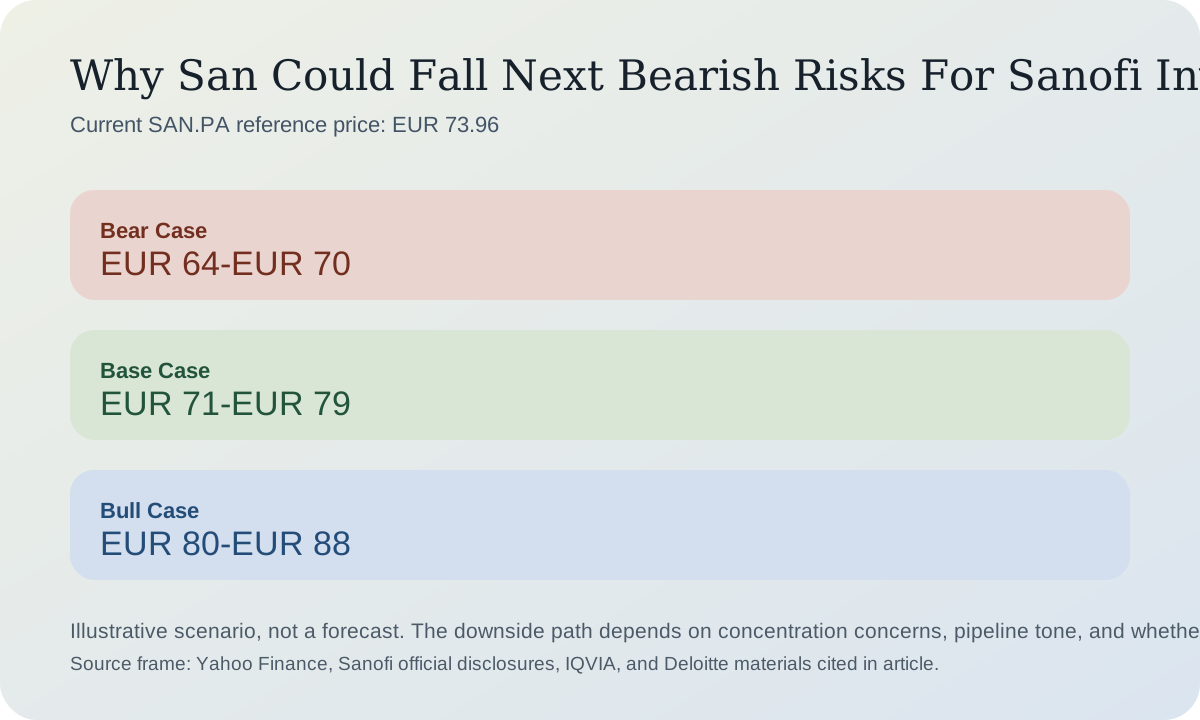
The main downside range is EUR 64 to EUR 70. That would fit a serious but not disorderly pullback driven by renewed concentration worries, pipeline disappointment, or a weaker-than-expected broadening of growth.
Base scenario
The base scenario is not actually bearish. It is that Sanofi remains fundamentally solid and any downside stays limited because the business is still profitable, global, and supported by a major growth engine.
What could make the bear case wrong
The bear case would weaken materially if Sanofi continues to show strong launch breadth, converts additional pipeline milestones into real commercial confidence, and demonstrates that the growth transition is becoming more diversified each quarter.
| Path | Probability | Interpretation |
|---|---|---|
| Meaningful pullback | 31% | Real, but not the base case while current growth remains strong. |
| Sideways consolidation | 33% | A common outcome if the market waits for more proof. |
| Recovery and renewed upside | 36% | Still slightly more likely if diversification keeps improving. |
| Investor type | Prudent move | Bear-case discipline |
|---|---|---|
| Investor already in profit | Trim if the Sanofi position is oversized and too dependent on one thesis. | Protect gains before assuming the pipeline solves all concerns. |
| Investor currently at a loss | Avoid panic selling unless the broadening-growth thesis is clearly weakening. | Focus on evidence, not old chart narratives. |
| Investor with no position | Wait for clearer support or better visibility on breadth of growth. | Do not chase a falling healthcare-transition story. |
| Trader | Use stop-loss rules and event-driven discipline. | Clinical and regulatory calendars matter. |
| Long-term investor | Stay patient if the business case is intact, but rebalance if concentration risk grows. | Long horizon does not excuse ignoring pipeline deterioration. |
| Risk-hedging investor | Prefer true hedges elsewhere; Sanofi is still an equity risk asset. | Do not mistake pharma for immunity from drawdowns. |
How this downside range was built: it combines Sanofi's current share level, prior drawdown behavior, the resilience implied by its scale and profitability, and the observation that large-cap pharma multiples compress quickly when optionality or concentration are questioned.
Risks to watch: pipeline setbacks, launch underperformance, pricing pressure, competitive data, and capital-allocation choices that do not visibly improve growth quality.
What would invalidate this forecast: sustained strength in broadening growth, stronger-than-expected clinical conversion, and repeated evidence that Sanofi deserves a better valuation than its old market reputation.
Disclaimer: This article is for informational purposes only and does not constitute personal investment advice. Bearish scenarios are editorial judgments built from public information and can prove wrong quickly.
Sanofi can absolutely fall without becoming a bad company. That is the essence of the bearish case: valuation and confidence can slip even while the operating business remains credible.
That is why prudent bearish positioning should stay evidence-led. The goal is not to deny Sanofi's progress, but to recognize that improving businesses can still be disappointing stocks when the market expected faster broadening of growth.
For bearish investors, the key is to separate temporary valuation reset from true thesis break. Sanofi can be worth less for a period without becoming structurally broken, and that distinction matters for both timing and risk management.
That distinction can keep bearish analysis grounded instead of emotional, reactive, sloppy, impatient, or overstated.
05. FAQ
Frequently asked questions about Sanofi downside risk
Is Sanofi at risk of a crash?
Current public evidence points more to correction risk than crash risk. A crash would likely require a much larger clinical or legal shock.
What is the biggest bearish trigger?
A combination of concentration worries and weaker pipeline or launch confidence would likely be the most damaging mix.
Can strong Dupixent sales prevent a selloff?
They can cushion sentiment, but they cannot completely offset valuation concerns if diversification progress stalls.
Why mention capital allocation in a bear case?
Because investors may question whether acquisitions, buybacks, and R&D spending are creating enough broad-based value.
06. Sources
Reference list
- Yahoo Finance chart API for SAN.PA, 10-year monthly history
- Yahoo Finance chart API for SAN.PA, recent daily closes
- Sanofi Full Year 2025 results release
- Sanofi First Quarter 2026 results release
- Sanofi 2025 Form 20-F / annual report
- Sanofi acquisition of Dynavax press release
- Dupixent US approval press release
- Dupixent EU approval press release
- Venglustat phase 3 readout
- Duvakitug phase 2b data release
- IQVIA Global Medicine Use Trends 2026
- Deloitte 2026 Life Sciences Outlook