01. Quick Answer
SOL does not need a broken long-term thesis to suffer another sharp selloff
A crash thesis is not the same thing as saying Solana has no future. SOL can remain an important crypto asset and still fall hard if leveraged positioning rebuilds too quickly, if institutional wrappers fail to bring sticky demand, or if traders conclude that the strongest visible activity is too speculative to support valuation (Coinbase Institutional) (CME Group).
Traders should separate three different events. A correction is often a 10% to 20% pullback. A bear market is a deeper and more persistent decline. A crash is faster, more reflexive, and usually 30% or more in a short period. Solana's own history shows that all three are possible (Yahoo Finance).
| Question | Short answer | Why |
|---|---|---|
| Can SOL fall again from here? | Yes | The asset remains high beta and still depends partly on cyclical flows |
| Would that require the network to fail? | No | Price can fall much faster than ecosystem usage changes |
| What matters most? | Positioning, activity quality, and macro liquidity | Those variables usually drive near-term selloffs |
| Working downside base | $65-$95 | Consistent with a weak but non-catastrophic path |
The central point is that downside risk is still meaningful even after a large drawdown. Traders who assume the previous fall itself is a sufficient risk reducer are often the same traders who get caught in the next air pocket.
02. Historical Context
Crash risk should be judged against SOL's actual drawdown record, not against bullish hopes
The available Yahoo record makes the core point clear: SOL has already traded through multiple deep resets after periods of enthusiasm (Yahoo Finance). That matters because the market often treats the most recent recovery narrative as if it erased prior behavior. It did not.
At the same time, the network itself looks stronger than in prior stress windows. Solana's 2025 health report emphasized uptime and validator resilience, which means a price crash today would more likely be a market-structure event than a simple replay of old outage-driven fears (Solana Foundation). That distinction matters for how downside should be interpreted and traded.
| Event type | Approximate price path | Interpretation |
|---|---|---|
| Correction | 10%-20% pullback from a local high | Can be normal volatility in SOL |
| Bear market | 20%-50% decline over a longer period | Usually reflects deeper narrative or macro stress |
| Crash | 30%+ rapid decline | Typically involves liquidations, panic, or a sudden thesis shock |
| Late-2024 peak to May 2026 | ~$253 to ~$85 | A reminder that severe drawdowns are part of the asset's history |
| Old fear | Current reading | Trader implication |
|---|---|---|
| Frequent outages | Reliability evidence improved meaningfully | A selloff may now be more flow-driven than operationally driven |
| Thin institutional access | Futures and ETF-style wrappers exist | More liquid hedging can speed both declines and recoveries |
| Purely crypto-native story | Payments and tokenization use cases are broader | Some buyers may be stickier, but not guaranteed |
The best bearish work therefore distinguishes between a broken network thesis and a broken market setup. Traders can lose money in either case, but the response is different.
03. Main Drivers
Five risks could trigger the next SOL selloff
A good bear case should identify mechanisms, not just negative adjectives.
1. Trading concentration remains a structural fragility
Coinbase Institutional found that trading-linked activity often accounted for 75% to 90% of Solana's successful transaction fees (Coinbase Institutional). If that activity cools before payments and tokenization take over, the market can reprice harshly.
2. Derivatives depth can amplify liquidation risk
CME's growing Solana suite is healthy for access, but any more mature derivatives complex also makes it easier for crowded positioning to unwind violently (CME Group).
3. The market may decide value capture is still unresolved
VanEck's older criticism of Solana's cost-versus-revenue problem remains relevant whenever enthusiasm outruns economics (VanEck).
4. Macro stress can hit all high-beta crypto assets together
SOL is not insulated from rates, liquidity, or broader risk appetite. In genuine risk-off windows, network-specific good news can stop mattering for a while.
5. Execution disappointment on upgrades or enterprise rollouts
If major upgrades, settlement pilots, or tokenization initiatives underdeliver, the downside can be amplified because a meaningful part of the present Solana bull case now depends on those narratives (Solana Foundation) (Solana Foundation) (Visa).
The most serious crash setups are usually the ones where several of those factors hit together. That is why traders should think in scenarios rather than slogans.
04. Institutional Forecasts and Analyst Views
Bearish analysis is stronger when it still respects the bullish evidence
No major source in this research set argues that Solana is worthless. The more credible bearish views are structural and tactical. Coinbase highlighted activity concentration; VanEck emphasized the challenge of cheap blockspace translating into durable economics; and Yahoo's own history shows how brutally SOL can de-rate between narrative peaks (Coinbase Institutional) (VanEck) (Yahoo Finance).
The bullish counterpoint is also real: official Solana reporting, Visa settlement work, Franklin Templeton's product launch, and tokenization adoption all suggest the network is meaningfully more institutionally embedded than it was before (Solana Foundation) (Visa) (Franklin Templeton) (Solana Foundation). A serious bear thesis therefore has to explain why price can still fall even if the ecosystem survives.
| Issue | Bearish reading | Bullish rebuttal |
|---|---|---|
| Fee concentration | Too much activity is still trading-led | Payments and RWAs are broadening the use-case mix |
| Value capture | Cheap fees can cap token economics | More monetized applications and block-revenue reforms could help |
| Macro sensitivity | SOL remains high beta | A better institutional demand stack may improve resilience over time |
| Drawdown history | Prior crashes show how fast sentiment can unwind | Past recoveries show the asset is not automatically broken after large falls |
That tension is exactly why the better bearish framework is conditional. The goal is not permanent negativity. It is understanding what combination of factors would turn weakness into a more serious breakdown.
05. Scenarios, Risks, and Positioning
Downside scenarios are most useful when they distinguish a reset from a true crash
The following matrix separates normal weakness from deeper stress. That distinction is important for both traders and longer-term investors.
| Scenario | Illustrative range | Conditions | Probability |
|---|---|---|---|
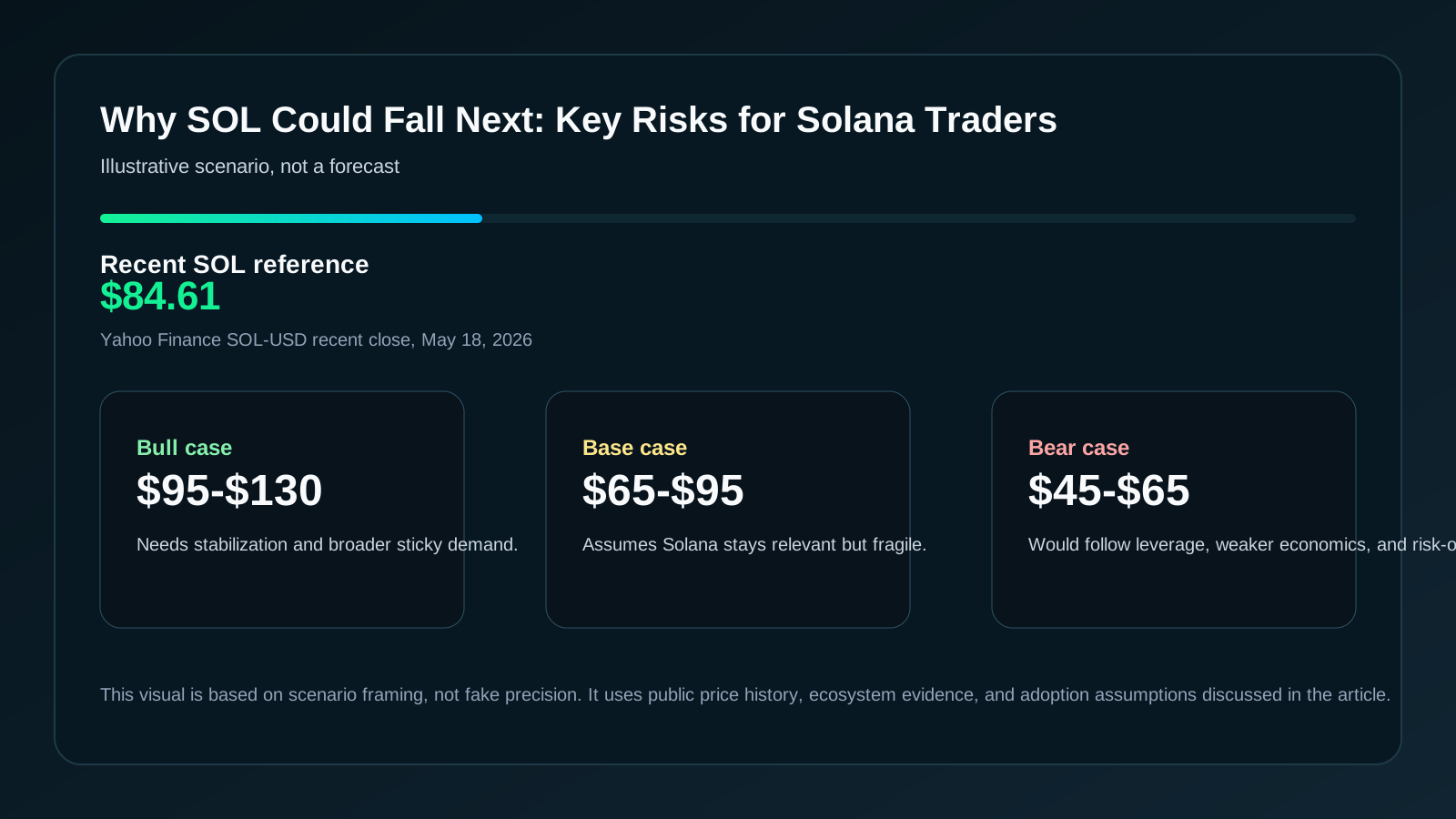
| Crash | $45-$65 | Macro stress, weak spot demand, activity concentration, and forced selling hit together | 27% |
| Fragile base | $65-$95 | SOL remains under pressure while the market debates economics and adoption quality | 46% |
| Recovery | $95-$130 | Institutional and payments narratives attract enough demand to stabilize the tape | 27% |
| Direction | Probability | Why |
|---|---|---|
| Lower from current levels | 38% | Crash risk remains meaningful because SOL is still a cyclical high-beta asset |
| Higher | 30% | A rebound is still possible if adoption evidence gets more credit |
| Sideways but volatile | 32% | A realistic path if the market stays divided on economics |
| Investor type | Prudent approach | Main watchpoints |
|---|---|---|
| Investor already in profit | Trim if gains made the position too large, and do not confuse a winning trade with a safe asset | Stop discipline and concentration |
| Investor currently at a loss | Do not use fear or hope as the decision rule; define what would prove the thesis wrong | Whether weakness is market-led or thesis-led |
| Investor with no position | Wait for stabilization rather than trying to catch every knife | Volume, support behavior, and macro tone |
| Trader | Use stop-losses and avoid overconfidence around rebounds | Liquidation risk, futures positioning, and headline flow |
| Long-term investor | Only add slowly if you still believe the long-run infrastructure case is intact | Payments, tokenization, and validator economics |
| Risk-hedging investor | Hedge with cash, options, or lower-beta assets rather than with another crypto narrative | Correlation spikes in stress |
| Trigger | Why it matters | Warning sign |
|---|---|---|
| Sharp rise in leverage | Makes crashes more reflexive | Large open-interest buildup without spot confirmation |
| Weakening fee quality | Suggests activity is losing depth | Speculation falls faster than other use cases rise |
| Policy headlines | Can shift access assumptions quickly | Product delays or tighter restrictions |
| Macro risk-off | Often overwhelms chain-specific progress | Equity and crypto beta correlations jump together |
Bullish scenario
The bullish rebuttal is that Solana is materially stronger operationally than in prior stress windows and has more real-world adoption threads than many bearish traders admit. That is why a selloff would not automatically invalidate the long-term thesis.
Bearish scenario
The bearish case is that market structure still matters more than believers want to admit. If too much of the demand stack is speculative and too little of it is sticky, SOL can still fall hard even while the chain stays busy.
Base-case scenario
The base case is not catastrophe. It is a choppy, fragile market where Solana remains relevant but the token struggles to regain a cleaner premium valuation.
What could invalidate this forecast
The crash thesis weakens if stable demand broadens through settlement, tokenized funds, and deeper enterprise use while price action stabilizes. The bullish defense weakens if those narratives stay visible in headlines but fail to show up in a healthier activity mix or better economic quality.
Conclusion
Why could SOL fall next? Because high-beta assets do not need a terminal fundamental failure to suffer another severe repricing. The right lesson is not permanent bearishness. It is respect for how quickly confidence can change when price, positioning, and narrative all turn together.
06. FAQ
Frequently asked questions about a SOL downside case
What is the difference between a correction and a crash in SOL?
A correction is usually a routine pullback of roughly 10% to 20%. A crash is faster, deeper, and more liquidation-driven, often 30% or more in a short period.
Why can SOL fall even if Solana remains important?
Because price is driven by marginal flows, liquidity, leverage, and confidence in token economics, not just by whether people still build on the network.
Does a bearish article mean Solana is a bad long-term network?
No. A bearish article can still acknowledge that the network is relevant while arguing that the token may be vulnerable over the next move.
What would make the bear case wrong?
Broader sticky demand, cleaner fee quality, and stronger market structure would all weaken the downside thesis.
07. Methodology and Invalidation
How to use this SOL crash-risk framework
The forecast ranges in this article are scenario bands, not promises. They combine live SOL price data from Yahoo Finance, official Solana Foundation disclosures, institutional market commentary, and editorial judgment about how network usage, fee capture, adoption, and regulation interact. Solana is not a traditional equity or commodity, so no single metric can support a defensible long-range target by itself.
The probability tables are editorial estimates rather than statistical certainties. They are built by weighing network resilience, developer momentum, tokenized-asset and stablecoin adoption, derivatives access, and the risk that SOL remains structurally too dependent on trading cycles or speculative bursts. Where the evidence is mixed, the range stays intentionally wide.
This framework is designed to help distinguish a normal pullback from a more serious breakdown. The key is not predicting every move. It is recognizing which variables deserve respect before the move becomes obvious.
Disclaimer: The most important discipline is to state what would invalidate the working view. Investors who are already in profit, investors sitting on losses, traders, hedgers, and long-term allocators do not need the same playbook, so the positioning table separates horizon and risk tolerance instead of pretending one answer fits everyone. Disclaimer: This article is for informational and research purposes only and does not constitute personalized financial advice.
References
Sources
- Yahoo Finance SOL-USD chart API, recent daily closes
- Yahoo Finance SOL-USD chart API, available weekly history
- Solana Foundation, Network Health Report: June 2025
- Coinbase Institutional, Analyzing Solana Activity
- CME Group, Q1 2026 cryptocurrency highlights
- VanEck, Base, Bear, Bull Case: Solana Valuation by 2030
- Solana Foundation, Solana Network Upgrades
- Solana Foundation, Solana Developer Platform launch
- Visa, U.S. stablecoin settlement launch
- Franklin Templeton, launch of Franklin Solana ETF (SOEZ)
- Solana Foundation, WisdomTree expands tokenization ecosystem to Solana