01. Quick Answer
A bearish Sony case does not require a broken business, only a reset in expectations around quality and timing
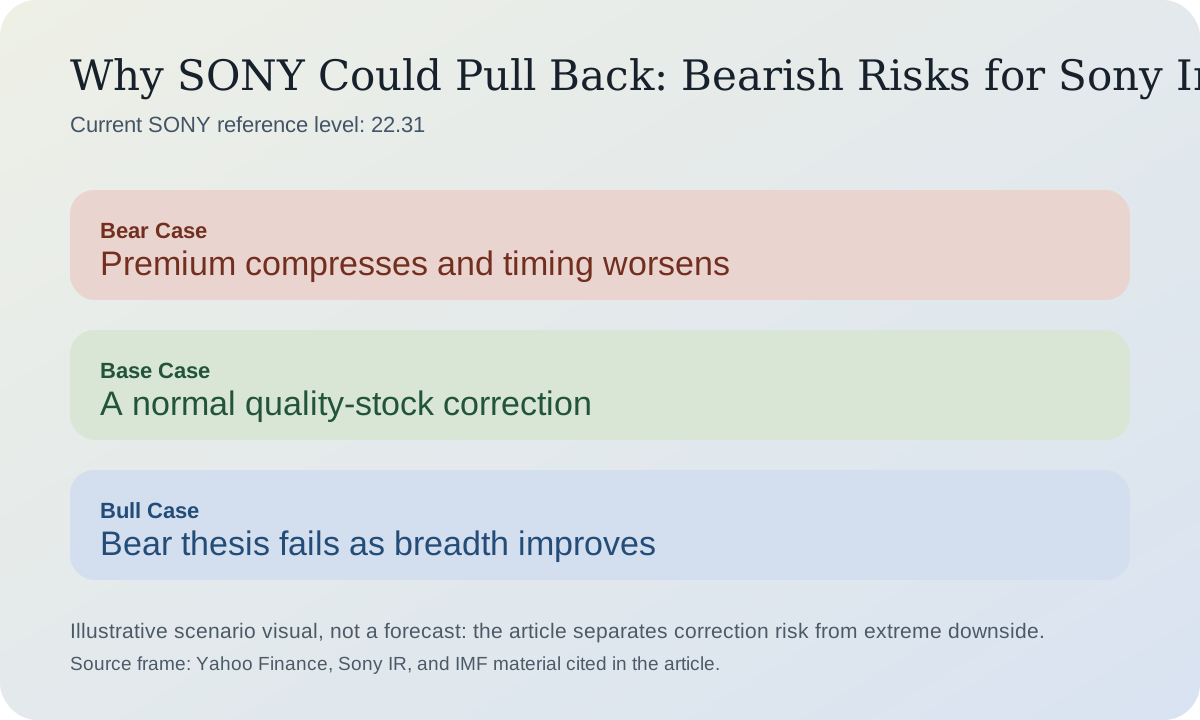
SONY closed at 22.31 on 2026-05-15 after trading between 19.64 and 30.26 over the last year (Yahoo Finance chart API for SONY, recent daily closes; Yahoo Finance chart API for SONY, 10-year monthly history). That range already shows the stock can pull back meaningfully without the company itself being in trouble.
The bearish setup starts with valuation discipline and segment timing. Sony's FY2025 continuing operations were strong, but Q4 operating income fell 24% year over year and several businesses still rely on release timing, platform engagement, or cyclically sensitive demand Sony FY2025 presentation Sony FY2025 financial summary. That mix is enough to build a credible bear case even without assuming any existential breakdown.
| Point | Why it matters |
|---|---|
| The bear case is about expectations, not survival | Sony does not need to be broken for the stock to underperform. |
| Several segments still face timing and cycle risk | Good portfolios can still generate messy year-to-year earnings paths. |
| One-off items matter | Restructuring costs, impairment charges, and equity-method losses can change sentiment quickly. |
| The bear case still has an invalidation path | If Sony's quality assets beat expectations, the downside thesis weakens. |
02. Historical Context
Downside analysis should separate correction risk from structural failure
For practical investing, a correction usually means a decline of roughly 10% to 20%, a bear market means more than 20%, and a crash is a deeper, faster drawdown often closer to 30% or worse. Those are market conventions, not legal definitions, but they matter because Sony's most plausible downside path is a correction or cyclical bear phase, not a business-collapse scenario.
The 10-year share history also matters. A stock that moved from 5.87 to 22.31 is not a fragile speculation, but that does not make it invulnerable. Premium portfolios often correct when the market decides that quality is fully priced while earnings visibility gets murkier.
| Type | Typical size | What it would likely mean for Sony |
|---|---|---|
| Correction | 10% to 20% | Normal reset driven by guidance or segment worries. |
| Bear market | More than 20% | Usually needs sustained concerns around business quality or demand. |
| Crash tail | Roughly 30% or more, often quickly | Would likely require multiple shocks at once. |
| Risk factor | Why it matters | Downside channel |
|---|---|---|
| Platform and release timing | Gaming and film economics are not perfectly smooth | Sentiment can change fast if timing slips. |
| Sensor cyclicality | Mobile demand and memory conditions remain relevant | Can pressure margins or expectations. |
| Valuation quality premium | Sony trades better than many old-style electronics peers | A premium can compress if confidence weakens. |
| Macro and FX shocks | Global consumer and currency swings still matter | Can drag several segments at once. |
03. Bearish Drivers
Six threats could push SONY lower from here
1. PlayStation quality may stay good, but not exciting enough. If software and network monetization merely hold instead of accelerating, the market may decide that a premium multiple is already generous Sony G&NS data.
2. Sensor-market caution could last longer. Sony's own I&SS forecast assumes lower sales in FY2026 because of caution around the mobile-sensor market and memory conditions. If that caution proves too mild, estimates could still come down Sony I&SS forecast.
3. The Pictures business still carries volatility. Management is expecting better FY2026 Pictures results, but film and television economics are inherently slate-dependent and can create uneven quarters even in a fundamentally solid franchise Sony Pictures outlook.
4. One-time costs can keep muddying the story. Sony's FY2025 materials include additional losses associated with Sony Honda Mobility's EV-model discontinuation and downsizing, Pixomondo-related impairment, and other non-recurring items. A market that wants cleaner narratives may punish repeated complexity Sony FY2025 one-time items.
5. Macro conditions can still hit multiple segments at once. IMF commentary on Japan remains cautious on external demand and financial conditions, while Sony's own strategy release flags geopolitical and tariff risks IMF Japan 2026 Sony macro-risk framing.
6. Quality can be priced in. A stock does not need bad fundamentals to fall. It only needs the market to decide that its good fundamentals are no longer underappreciated.
04. Institutional Forecasts and Analyst Views
The bearish case is credible because Sony still has real timing and portfolio risk
This is not a fabricated downside story. Sony itself describes a business exposed to platform investment, memory-market conditions, tariff policy, and global disruption. The FY2025 presentation also shows multiple businesses where higher-quality long-run narratives coexist with near-term earnings noise Sony FY2025 presentation.
That does not make Sony a weak company. It makes Sony a strong company with enough moving pieces that short-term disappointment is plausible. For a bear case, that is enough. Premium portfolios can still correct when the market wants cleaner evidence from management and segment trends.
The probability framework here is deliberately practical. It weighs the current price anchor, the stock's recent trading range, and the specific segment risks management has already acknowledged in public materials. In other words, this is a downside framework for a quality company in a complicated environment, not a sensational claim that Sony is structurally impaired.
| Source | Caution signal | Why it matters |
|---|---|---|
| Sony FY2025 presentation | Q4 profit softness and one-time items | Shows that annual quality does not remove quarter-level volatility. |
| Sony I&SS forecast | Cautious sensor-market assumptions | Important because sensors are strategically valuable. |
| Sony strategy release | Geopolitical, tariff, and memory risk are explicit | Management itself is not pretending the environment is easy. |
| IMF Japan 2026 | Downside risks remain present | Supports correction and bear-case scenarios. |
05. Scenarios, Risks, and Invalidation
A serious bearish framework should separate normal downside from extreme downside
Correction scenario
A correction zone of roughly $19 to $21 would be the mildest bearish path. That could happen through a segment-mix disappointment or a market-wide de-rating of premium cyclical names.
Bear-market scenario
A bear-market zone of $16 to $18 would likely require a more visible slowdown in games, sensors, or consumer demand and a market view that Sony's portfolio premium was overstated.
Crash tail
A crash-tail zone below $15 is an extreme scenario, not a base case. It would likely require multiple shocks at once, such as severe macro deterioration, materially worse demand, and additional strategic disappointments across several businesses.
What could invalidate the bearish thesis
The downside case weakens materially if Sony beats FY2026 expectations, keeps capital returns credible, and shows stronger-than-feared segment breadth across games, music, pictures, and sensors.
It also weakens if the market decides that recurring revenue quality in Music, PlayStation services, and anime deserves a larger role in valuation than hardware or near-term consumer cyclicality. That is an important rebuttal, because bear cases often fail when the market starts reclassifying what kind of business it thinks it is looking at.
Conclusion
SONY could pull back from here. The key issue is not whether Sony is a good company, but whether current expectations leave enough room for earnings or portfolio-quality disappointment over the next several reporting cycles ahead globally.
Disclaimer: This article is for research and informational purposes only. Bearish scenarios are conditional risk cases, not certainties or personalized advice for any individual investor.
| Scenario | Range | Conditions | Probability |
|---|---|---|---|
| Correction | $19-$21 | Normal reset in expectations | 35% |
| Bear market | $16-$18 | Broader de-rating and weaker execution | 25% |
| Crash tail | Below $15 | Multiple shocks hit together | 10% |
| Bear thesis fails | $24-$28 | Guidance proves conservative and segment quality improves | 30% |
| Path | Estimated probability | Comment |
|---|---|---|
| Rising | 25% | The bear article still acknowledges upside if execution improves. |
| Falling | 45% | Enough timing and mix risk exists to support a downside case. |
| Sideways | 30% | A digestion phase is also realistic for a premium cyclical stock. |
06. Investor Positioning
A bearish SONY article still needs practical guidance
| Investor type | Cautious approach | What to watch |
|---|---|---|
| Investor already in profit | Trim or hedge part of the position rather than assuming Sony is too high quality to correct. | Trailing stops and rebalancing may be more prudent than conviction alone. |
| Investor currently at a loss | Avoid averaging down until it is clearer whether the weakness is cyclical or more structural. | Segment-quality evidence matters more than comfort narratives. |
| Investor with no position | Wait for either a better entry point or stronger earnings proof. | The first dip is not always the best dip. |
| Trader | Use stop-losses and respect earnings, FX, and macro risk. | Premium names can still unwind fast. |
| Long-term investor | Only keep adding if the long-run thesis still holds and sizing remains disciplined. | Use staged entries, not heroic bottom calls. |
| Risk-hedging investor | Consider simple hedges if global tech and entertainment exposure is already large. | Macro and currency risks are the main early warnings. |
07. FAQ
Frequently asked questions about a possible SONY pullback
Does a bearish Sony article mean the company is broken?
No. It means the stock could still reprice lower if timing, margins, or expectations weaken.
What is the difference between a correction and a bear market for SONY?
A correction is usually a 10% to 20% decline, while a bear market generally means more than 20% down from prior levels.
What would make the bearish thesis wrong?
A clear guidance beat, stronger segment breadth, and better-than-feared macro conditions would all weaken the downside case.
References
Sources
- Yahoo Finance chart API for SONY, 10-year monthly history
- Yahoo Finance chart API for SONY, recent daily closes
- Sony FY2025 consolidated financial summary
- Sony FY2025 earnings presentation
- Sony Group Corporate Strategy 2026 press release
- Sony IR news archive for 2026
- Sony Business Segment Presentation and Fireside Chat 2025
- Sony Corporate Report 2025
- IMF Japan 2026 Article IV mission statement