01. Downside Framing
Why Tencent could fall next even if the business is not broken
The hardest mistake investors make with Tencent is assuming that a strong business and a rising stock must arrive together. They do not. Tencent could fall next because valuation, macro, and policy variables can overwhelm quarter-to-quarter operating quality. The ADR reference closed at $58.69 on May 15, 2026, only slightly above its 52-week low, which tells you the market is still withholding full trust from the recent operational recovery (Stock Analysis TCEHY quote).
This article is intentionally downside-focused, but it is not a crash call. A prudent bear case has to distinguish between a correction, a bear market, and a structural break. A correction would likely mean a 10% to 15% move lower on sentiment or macro pressure. A bear market would mean a deeper drawdown tied to renewed policy fear or earnings disappointment. A structural break would require evidence that Tencent's ecosystem itself is weakening.
02. Current Market Snapshot
The business is improving, but the market is focused on what could go wrong
FY2025 revenue rose 14%, non-IFRS operating profit rose 18%, and 1Q2026 showed continued growth in games, fintech, and business services. Those are not crisis numbers. Yet the stock still trades far below its 2021 peak because investors worry that AI spending could dilute returns, China's macro growth is slower, and policy or geopolitics can reprice the stock overnight (Tencent FY2025 results; Tencent 1Q2026 results; IMF China 2025 Article IV).
This creates the classic setup for a downside article: the fundamentals look decent enough that many investors feel comfortable, but the market's trust is shallow. Shallow trust means adverse headlines can still hit the stock harder than the income statement alone would justify.
Historical drawdowns matter here. Tencent has already shown that valuation can compress dramatically even when the company remains relevant and profitable. The old lesson from 2021-2022 is that market structure, regulation, and macro sentiment can dominate stock performance for longer than fundamental investors initially expect. That is why a downside article must begin with risk premium, not with a broken-business claim (CompaniesMarketCap Tencent price history; Tencent 2024 Annual Report PDF).
| Risk signal | Current evidence | Why it matters for downside |
|---|---|---|
| AI capex surge | 1Q2026 capex reached RMB31.9B | Raises the burden of proof on future returns |
| China macro slowdown | IMF and World Bank both see slower 2026 growth | Ad budgets and payments can feel softer demand |
| Regulatory memory | 2023 draft gaming rules shocked the sector | Tencent still carries scar tissue in valuation |
| Geopolitical review risk | US scrutiny of Tencent-linked assets has resurfaced | Keeps the discount rate elevated |
03. Main Risks
Five reasons TCHEY could fall next
1. AI spending outpaces visible monetization. This is the cleanest near-term risk. Tencent can post respectable revenue growth and still fall if investors decide AI economics are too front-loaded (Reuters on Tencent AI investment plans; Tencent 1Q2026 results).
2. Another policy scare around gaming or internet platforms. The market does not need a full crackdown to reprice Tencent lower. A draft rule, consultation paper, or licensing change can do the job, as 2023 showed (CNBC on China draft gaming rules).
3. A weaker China macro environment. Slower consumption, weaker merchants, or softer enterprise demand can hurt ads, payments, and business services even if user numbers remain large (IMF China 2025 Article IV; World Bank China Economic Update).
4. Geopolitical or security friction. Any sign that Tencent's overseas gaming stakes or cloud ambitions face tighter scrutiny could pressure valuation even without directly hurting current earnings (US security review risk coverage).
5. Sentiment exhaustion after a rebound. A stock can fall simply because expectations moved faster than earnings revisions.
One subtle risk is that Tencent is now being evaluated on two narratives at once. The older narrative is regulatory and geopolitical risk. The newer one is AI upside. If the second narrative cools before the first one fades, the market can remove the AI premium without removing the China discount. That combination is exactly how good operating companies can slide even while reported revenue still looks acceptable.
| Risk factor | Could cause a correction? | Could cause a bear market? | Could cause a structural break? |
|---|---|---|---|
| AI monetization disappointment | Yes | Yes, if persistent | Only if returns stay weak for years |
| Gaming regulation surprise | Yes | Yes | Unlikely unless broad and lasting |
| China macro slowdown | Yes | Potentially | No, by itself |
| Geopolitical escalation | Yes | Yes | Possible if it materially restricts assets or capital access |
| Execution stumble | Yes | Possible | Only if it hits multiple segments at once |
04. Analyst View And Context
Why the downside case can coexist with constructive analyst commentary
Recent institutional and media coverage has generally acknowledged Tencent's stronger operating trends. That does not eliminate downside risk. In fact, downside often appears when the operating story is solid enough to pull investors in, but not solid enough to neutralize external risk. Analysts remain divided on how quickly AI investment should be capitalized into higher long-term multiples (CNBC Tencent Q1 2026 earnings; Reuters on Tencent AI investment plans).
That is why a downside article should not promise collapse. The more defensible claim is that Tencent remains vulnerable to a re-pricing lower if the market decides near-term risks deserve a wider margin of safety.
The scenario ranges below are author-built ranges rather than broker price targets. They are anchored to Tencent's current ADR reference price of $58.69 on May 15, 2026, the Hong Kong line's 52-week range of HK$316.8 to HK$614.0, Tencent's past-decade trading history from roughly the mid-teens to a peak near $89.03, reported revenue and profit growth, and a qualitative assessment of regulation, macro conditions, AI monetization, and capital intensity (Stock Analysis TCEHY quote; CompaniesMarketCap Tencent price history; Tencent Investors). The probability table separates three paths: rising, falling, and sideways. 'Sideways' means a result that does not decisively confirm either a major rerating or a major derating.
05. Downside Scenarios
What a near-term decline could look like
| Scenario | Reference range | What triggers it | Meaning |
|---|---|---|---|
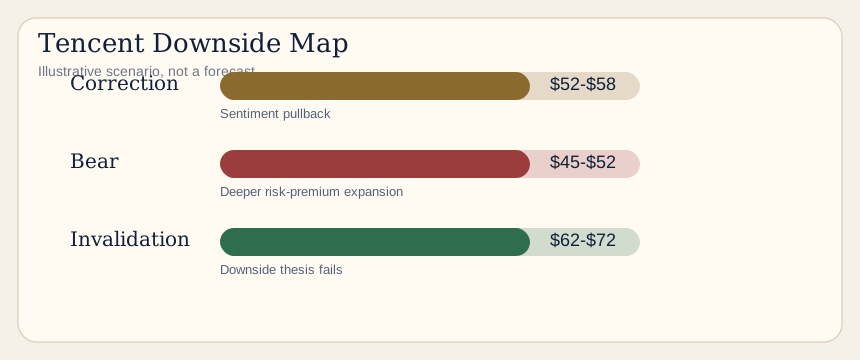
| Correction | $52 to $58 | Profit taking, macro wobble, or softer-than-hoped AI payoff | A pullback within a still-intact thesis |
| Bear case | $45 to $52 | Policy shock, weaker China demand, or capex anxiety | A more serious rerating lower |
| Upside invalidation | $62 to $72 | Stronger monetization, cleaner policy backdrop, and better AI read-through | Shows the bear case was too cautious |
| Path | Probability | Comment |
|---|---|---|
| Probability of rising | 30% | Possible, but the article's focus is on near-term downside risk |
| Probability of falling | 40% | There are enough external risks to justify caution |
| Probability of moving sideways | 30% | Tencent often digests news in broad ranges before breaking out |
| Investor type | Prudent downside playbook | Why |
|---|---|---|
| Investor already in profit | Trim part of the position, tighten risk controls, rebalance | Protect gains while keeping upside exposure |
| Investor currently at a loss | Do not capitulate blindly; map your tolerance against the bear range | A forced sell at the wrong level can compound mistakes |
| Investor with no position | Wait for pullback confirmation | There is no need to chase a stock with unresolved external risk |
| Trader | Use stop-losses and respect volatility | Tencent can move on headlines before fundamentals catch up |
| Long-term investor | Hold only if comfortable with geopolitical and ADR risk | The business quality alone does not eliminate external shocks |
| Risk-hedging reader | Pair exposure with defensive assets or broad diversification | This is a risk management story as much as an equity story |
06. What Could Make The Bear Case Wrong
The downside thesis is not bulletproof
A serious bear call would be wrong if Tencent continues to post solid game, ad, and services growth while demonstrating that AI spending is improving monetization quality. It would also be wrong if policy stays relatively calm and macro data stabilize enough that the market begins to pay more attention to free cash flow than to politics.
In other words, the bear case depends heavily on risk premium expansion. If the risk premium compresses instead, Tencent can rise even without heroic growth. That is why prudent investors should treat this as a scenario article, not as an absolute sell command.
Investors who are already in the name should therefore watch for invalidation signs, not just danger signs. If Tencent keeps beating expectations in games and advertising, if business-services growth remains firm, and if new AI features start to show measurable merchant or user adoption inside WeChat, the most bearish version of this article becomes harder to defend. A risk-aware process requires updating both ways.
The practical takeaway is not that downside is certain. It is that Tencent remains one of those stocks where external perception can move faster than internal fundamentals. That asymmetry is exactly why risk management matters so much for anyone sizing the position around a near-term outlook.
Disclaimer: This article is for research and educational purposes only. It is not individualized investment advice, and all scenario ranges are conditional estimates rather than promises of future performance.
07. FAQ
Frequently asked questions
Does a downside article mean Tencent is a bad company?
No. It means a good company can still face a poor short-term setup.
What is the difference between a correction and a bear market here?
A correction is a more ordinary pullback. A bear market implies a deeper, more persistent rerating tied to policy, macro, or earnings concerns.
What would be the clearest warning sign?
Evidence that AI-related spending keeps rising while monetization and margins fail to respond.
What is the simplest bullish rebuttal?
Tencent's ecosystem is still huge, cash generative, and increasingly diversified, so a valuation reset lower may prove temporary rather than structural.
References
Sources
- Tencent Investors
- Tencent 1Q2026 results
- Tencent FY2025 results
- Stock Analysis TCEHY quote
- CompaniesMarketCap Tencent price history
- IMF China 2025 Article IV
- World Bank China Economic Update
- CNBC Tencent Q1 2026 earnings
- CNBC on China draft gaming rules
- Reuters on Tencent AI investment plans
- US security review risk coverage
- Reuters on WeChat AI agent integration