01. Quick Answer
The AEX bear case is mainly about concentration and multiple compression, not about a Dutch macro implosion
The AEX closed at 1,010.44 on 2026-05-15, up from 435.88 at the start of its 10-year Yahoo Finance monthly series on 2016-06-01, for a price-only CAGR of about 8.77% (Yahoo Finance 10-year history; recent daily closes). A market that has already compounded this well does not need a national crisis to fall. It only needs a change in how investors value its most important quality and technology leaders.
That possibility remains real because IMF and OECD analysis still treats the Netherlands as open, resilient, and externally exposed rather than insulated. That does not prove a slide, but it does justify a serious downside framework.
| Point | Why it matters |
|---|---|
| The biggest bear risk is concentration | If ASML or a few premium names wobble together, the whole benchmark feels it quickly. |
| High quality does not eliminate drawdown risk | Expensive compounders can still correct hard when rates, growth, or sentiment shift. |
| Dutch trade exposure matters | An export-sensitive economy and index are vulnerable to global policy or demand shocks. |
| A correction is not a crash | The evidence currently supports a correction-risk discussion more than a disorderly collapse thesis. |
02. Historical Context
The AEX now has enough gains behind it to make a setback plausible even if the long-run thesis survives
Bear-case work starts with context, not drama. The AEX closed at 1,010.44 on 2026-05-15, up from 435.88 at the start of its 10-year Yahoo Finance monthly series on 2016-06-01, for a price-only CAGR of about 8.77% (Yahoo Finance 10-year history; recent daily closes). That kind of recovery is exactly the sort of move that can create vulnerability to a normal correction or mild bear market.
A correction typically means a meaningful but not catastrophic retreat from a rally. A bear market implies a larger and more durable decline. A crash implies fast and disorderly selling. The evidence today points more clearly to correction or mild bear-market risk than to crash risk because Dutch institutions remain strong, the economy remains stable, and the benchmark still contains very high-quality businesses.
The important lesson is that the AEX now has room to disappoint. When expectations and quality premiums are high, even ordinary demand slowing can produce a sharp re-pricing.
| Risk factor | Why it matters | Bear-case relevance |
|---|---|---|
| ASML slowdown | Semiconductor exposure is central to the index | High |
| Quality-multiple compression | RELX, Wolters, Adyen, and other premium names are not cheap at all times | High |
| Trade or export friction | The Dutch market is open and globally exposed | Medium to high |
| Energy-price shock | Shell can help, but broader valuation sentiment can still weaken | Medium |
| Consumer and internet softness | Prosus and payments exposure can amplify cyclical caution | Medium |
| Term | Typical meaning | How it applies here |
|---|---|---|
| Correction | A normal but painful retreat from a rally | The most plausible downside framework for the current AEX setup. |
| Bear market | A deeper and longer period of lower prices | Possible if semiconductors and premium quality names both derate. |
| Crash | Fast, disorderly selling | Less supported by current evidence unless a much larger global shock appears. |
03. Main Drivers
Five specific threats could drag Amsterdam lower even without a Dutch recession
1. The chip cycle cools faster than investors expect. ASML is the clearest risk channel because it anchors both growth optimism and valuation support.
2. Premium quality stops protecting valuation. Even excellent companies like RELX and Wolters Kluwer can fall if the market decides it has already overpaid for resilience.
3. Dutch trade exposure becomes a liability. The economy is open and competitive, but that also means external weakness can travel through the benchmark quickly.
4. Internet and fintech sentiment weakens. Adyen and Prosus are both valuable in a bull tape and volatile in a nervous tape.
5. Defensive breadth may prove narrower than it looks. Ahold, Unilever, RELX, and Wolters help, but they cannot fully offset a large semiconductor or valuation unwind.
04. Institutional Forecasts and Analyst Views
The institutional evidence supports caution, but not a deterministic collapse narrative
Official institutions do not support a dramatic doom story. They do, however, support caution. IMF, OECD, and DNB all imply stable growth but enough external vulnerability that negative surprises can still matter.
Analysts remain divided because the evidence is mixed. The AEX has genuine quality, yet quality does not cancel valuation risk. The bear case is therefore best framed as a plausible correction or shallow bear-market scenario, not as a guaranteed collapse call.
That distinction matters for investors who confuse a high-quality index with an always-safe index. Amsterdam can be home to excellent companies and still deliver a painful twelve-month drawdown if enthusiasm around semiconductors, software-like margins, or digital platforms cools at the same time. That is the core bear-case logic here for now.
| Condition | Current status | Why it matters |
|---|---|---|
| ASML demand disappoints | Possible if AI capex slows or timing shifts | Would hit the index's clearest structural growth engine. |
| Premium quality derates | Always possible in a higher-rate or slower-growth mood | Would broaden the downside beyond semiconductors. |
| Trade friction rises | A live risk for an open economy | Can pressure both macro sentiment and technology exports. |
| Payments and internet soften | Evidence remains mixed | Would remove another layer of growth support. |
05. Scenarios, Risks, and Invalidation
The most credible downside path is a correction or shallow bear market, not a sensational crash call
Bearish scenario
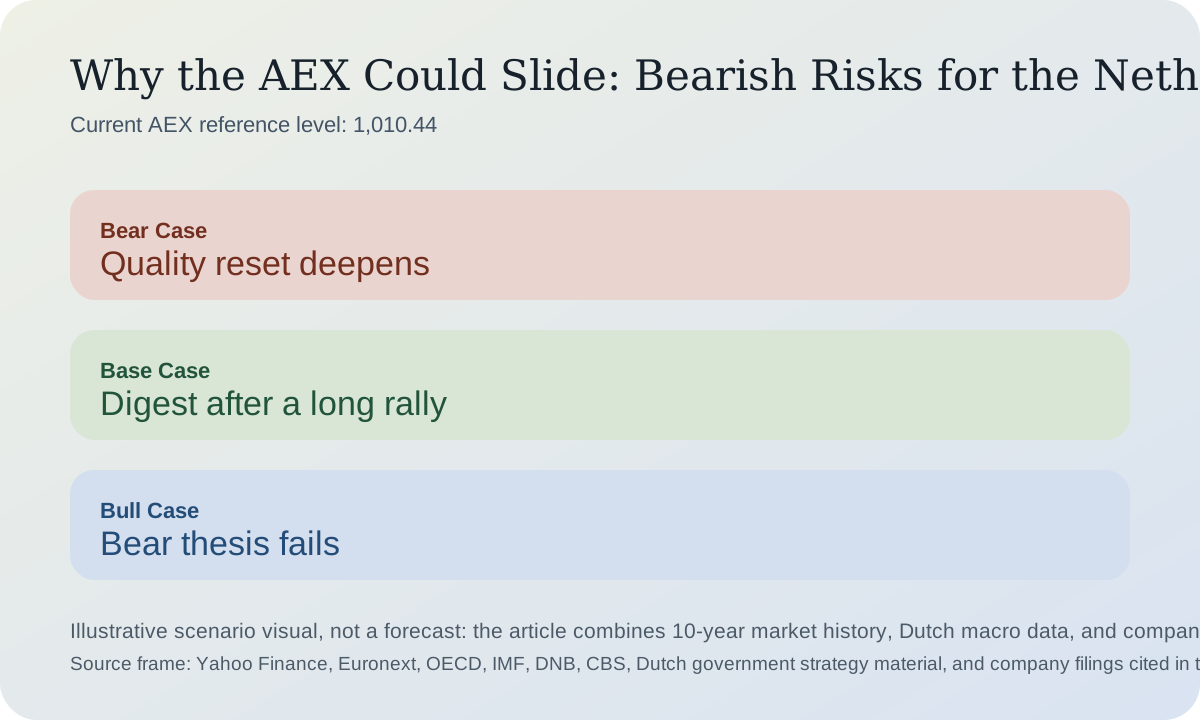
The primary bear case is 900 to 960. That range implies the index gives back part of its rerating as semiconductor enthusiasm cools and quality multiples compress.
Base-case scenario
The base case is a more mixed 970 to 1,030 range where the market corrects, consolidates, and then looks for support from its defensive and information-service constituents.
Bullish counter-scenario
The bear case fails if AI capex remains stronger than feared, premium defensives keep delivering, and the index broadens enough that Amsterdam is no longer treated as a narrow chip proxy.
Risks to watch
Watch ASML order commentary, export-control developments, digital-consumption signals, rate expectations, and whether valuations keep stretching faster than earnings.
What could invalidate the downside view
This bearish framework would be too harsh if AI-related demand remains durable and if information-service leaders continue to justify their premium valuations. It would also be too harsh if the market broadens more than expected into consumer and defensive leadership.
Conclusion
The AEX could slide from here without proving the long-term Dutch market thesis wrong. The key distinction is that a correction or mild bear market is plausible even when a full crash is not the evidence-based base case.
Disclaimer: This article is for research and educational use only. It is not a short recommendation or a claim of certainty about future market direction.
| Scenario | Range | Conditions | Probability |
|---|---|---|---|
| Deep bear | 860-900 | Semiconductors weaken sharply and quality multiples compress together | 15% |
| Correction / primary bear case | 900-960 | Valuation reset and softer growth expectations | 35% |
| Base / choppy consolidation | 970-1,030 | No crisis, but gains digest | 35% |
| Bullish invalidation | 1,040-1,120 | Broad leadership and durable AI spending | 15% |
| Path | Estimated probability | Why |
|---|---|---|
| Rising from current levels | 30% | The index is high quality, but also already expensive in places. |
| Falling from current levels | 45% | Correction risk is meaningful given concentration and valuation sensitivity. |
| Moving sideways | 25% | Possible if semiconductors cool while defensives hold the floor. |
06. Investor Positioning
A bear-case framework is about discipline rather than drama
| Investor type | Cautious approach | What to watch |
|---|---|---|
| Investor already in profit | Trim oversized winners and rebalance before concentration becomes the whole thesis. | Whether gains are overly dependent on ASML or one growth factor. |
| Investor currently at a loss | Do not average down blindly into a weakening tape. | Test whether the thesis was quality compounding or only momentum. |
| Investor with no position | Wait for confirmation or for a better entry after volatility. | There is no need to chase a quality-heavy index into a correction risk window. |
| Trader | Use stop-losses and respect volatility around major earnings and export-control news. | The AEX can gap quickly on technology headlines. |
| Long-term investor | Keep cash for staged entries instead of trying to pick the exact bottom. | Corrections can improve long-run entry points if the structural thesis survives. |
| Risk-hedging investor | Use explicit hedges rather than assuming cash is enough. | Global tech sentiment, trade policy, and rates. |
07. FAQ
Frequently asked questions about the AEX outlook
Does a bearish AEX view mean the Dutch market is broken?
No. The more evidence-based downside case is a correction or mild bear market, not necessarily a structural breakdown.
Why focus so much on ASML?
Because semiconductor exposure is one of the index's clearest differentiators and one of its largest concentration risks.
What would make the bear case wrong?
Durable AI-related demand, stable quality premiums, and broader leadership from defensives and information services.
References
Sources
- Yahoo Finance chart API for ^AEX, 10-year monthly history
- Yahoo Finance chart API for ^AEX, recent daily closes
- Euronext AEX index factsheet
- Euronext Amsterdam market page
- OECD economic snapshot for the Netherlands
- OECD Economic Survey of the Netherlands 2025
- IMF 2025 Article IV consultation for the Netherlands
- De Nederlandsche Bank economic outlook, March 2026
- Statistics Netherlands consumer prices archive
- Dutch government Semiconductor Vision 2035
- Dutch government Generative AI vision
- Dutch Authority for the Digital Infrastructure AI supervision update
- ASML Q1 2026 results
- Adyen Q1 2026 business update
- ING Q1 2026 results
- ABN AMRO Q1 2026 results
- RELX trading update 2026
- Wolters Kluwer 2026 trading update
- Shell first quarter 2026 results
- Philips Q1 2026 results
- Prosus annual results 2026