01. Quick Answer
The ASX 200 could slide if inflation, rates, and cyclicals all start working against it at once
The ASX 200 does not need a domestic recession to fall. Because the benchmark is dominated by financials and materials, a relatively ordinary combination of sticky inflation, delayed rate relief, softer commodity demand, and tighter credit conditions can be enough to produce a material pullback. That is especially true after a period in which the market had already reached a record around 9,202.90 before easing back to 8,630.80 (Yahoo Finance chart API for ^AXJO, one-year daily history).
It is also important to separate terms properly. A correction usually means roughly 10% down from a recent high. A bear market is closer to 20%. A crash implies something sharper and more disorderly. Historical data show the ASX can experience all three, but they do not happen for the same reasons (Yahoo Finance chart API for ^AXJO, 10-year monthly history).
| Risk | Why it can drag the ASX lower |
|---|---|
| Sticky inflation | It delays easing, compresses valuations, and raises pressure on households and leveraged firms. |
| Weaker China demand | The materials complex remains too important for the index to ignore a commodity downturn. |
| Bank de-rating | Financials carry 34.5% of the benchmark, so even modest weakness matters. |
| Concentration risk | A narrow benchmark can fall faster than investors expect when leadership breaks. |
02. Historical Context
Past drawdowns show that the ASX does not need exotic catalysts to correct
The 10-year series contains a monthly drawdown of more than 27% during the 2020 shock, proving that the benchmark can reprice hard when macro fear and cyclicals align (Yahoo Finance chart API for ^AXJO, 10-year monthly history). More importantly for today's market, smaller setbacks have often come from much less dramatic conditions: concern about China, tighter financial conditions, or a bank-led de-rating.
The official index structure compounds that vulnerability. The top 10 holdings make up 48.6% of the benchmark, with major banks, BHP, Rio, Woodside, Wesfarmers, and Goodman all central to the tape (S&P Dow Jones Indices, S&P/ASX 200 Index (AUD) Factsheet, as of April 30, 2026). If those sectors all start deteriorating together, downside can spread quickly even if a few defensive pockets hold up.
| Market state | Approximate level | Meaning |
|---|---|---|
| Routine pullback | 8,500-8,700 | Normal volatility inside the recent range. |
| Correction | 8,100-8,300 | About 10% below the February high; still painful but not unusual. |
| Bear market | 7,200-7,900 | Usually requires broader earnings or policy stress. |
| Crash zone | Below 7,200 | Would likely need a more disorderly domestic or global shock. |
| Mechanism | How it hits the ASX | Signals to watch |
|---|---|---|
| Rate pressure | Banks, REITs, and household confidence all feel it. | RBA pricing and guidance |
| Commodity rollover | Materials and energy earnings weaken. | Westpac commodities outlook |
| Housing stress | Credit quality and spending may soften together. | OECD housing affordability discussion |
| Global risk-off | Foreign investors de-risk cyclical and value-heavy markets. | BlackRock Australia outlook |
03. Main Drivers
Five downside channels deserve the closest attention
1. Inflation remains too high for comfort. The ABS showed headline CPI at 4.6% in March 2026 and trimmed mean at 3.3% (Australian Bureau of Statistics, Consumer Price Index, Australia, March 2026). That is not a benign backdrop for a richly owned income market.
2. The RBA stays restrictive longer than expected. The May 2026 SMP showed markets pricing the cash rate to rise further, not fall (Reserve Bank of Australia, Statement on Monetary Policy, May 2026). Higher-for-longer policy would pressure valuation and confidence.
3. China-sensitive resources lose momentum. ANZ's work on decarbonisation and trade makes clear that Australia's commodity mix is changing, but the transition is not risk-free (ANZ, How China’s decarbonisation is reshaping Australia’s trade outlook).
4. Banks lose their premium. If funding costs, regulation, mortgage stress, or slower loan growth hit sentiment, a 34.5% sector weight becomes a downside amplifier (S&P Dow Jones Indices, S&P/ASX 200 Index (AUD) Factsheet, as of April 30, 2026).
5. Budget support fails to offset cyclical drag. The budget is supportive at the margin, yet it cannot neutralize a simultaneous inflation, housing, and external-demand shock (Australian Government Budget 2026-27 overview).
04. Institutional Forecasts and Analyst Views
The bear case is credible precisely because bullish institutions still see real risks
AMP is constructive on Australian shares overall, but explicitly warns that valuations, a hawkish RBA, and global risks should make the ride bumpy. That caveat matters because it means the downside argument does not require inventing a new problem; it only requires current risks to persist. BlackRock Australia likewise emphasizes that the RBA abruptly returned to tightening in early 2026 and that the domestic inflation outlook became more complicated. The macro institutions also describe a soft landing, not a guaranteed one (IMF Executive Board Concludes 2025 Article IV Consultation with Australia, published February 15, 2026; OECD Economic Surveys: Australia 2026).
In other words, analysts are not uniformly bearish, but they are also not dismissing the downside. That is exactly the setup where a correction can surprise investors who have become too comfortable with dividends and incumbent cash flow.
| Condition | Current status | Why it matters |
|---|---|---|
| Inflation re-acceleration | Already visible in March 2026 ABS data | Limits hopes for easier policy. |
| Rates stay restrictive | Still a live RBA risk | Pressures valuations and household demand. |
| Resources weaken | Possible if external demand softens | Hits one-quarter of the index directly. |
| Bank multiples compress | Not the base case, but always relevant in concentrated markets | Affects more than one-third of the benchmark. |
05. Scenarios, Risks, and Invalidation
The downside thesis should distinguish correction, bear market, and crash
Correction scenario
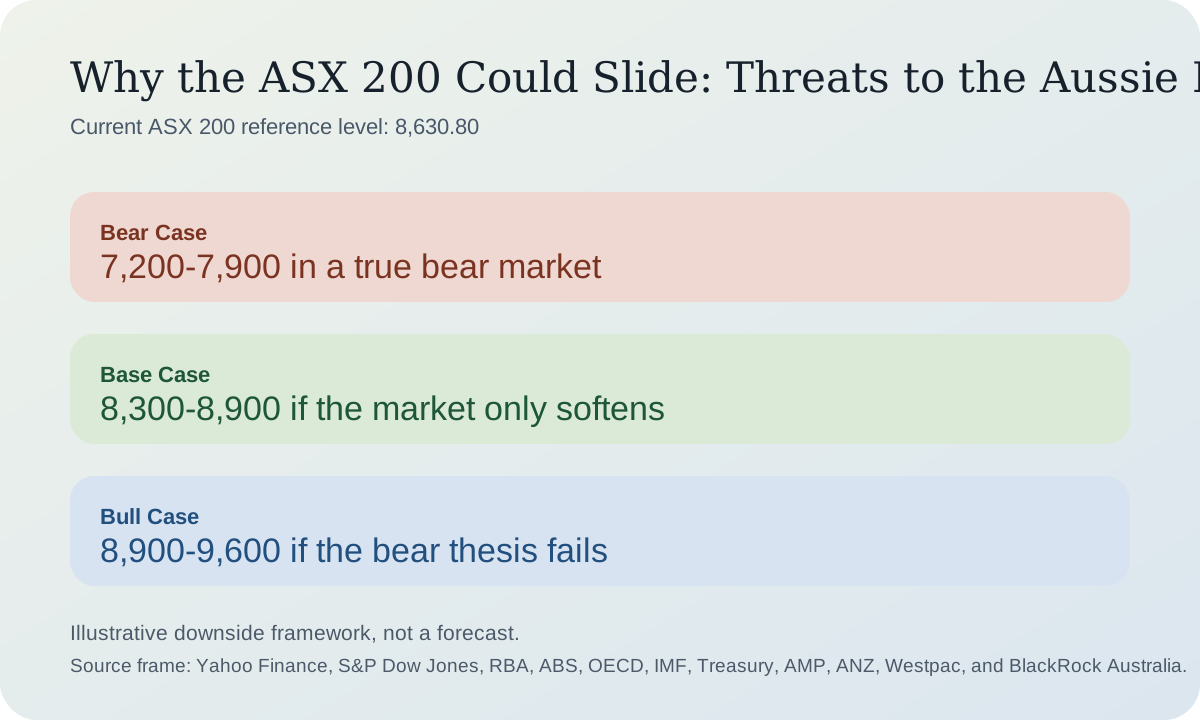
A correction range of 8,100 to 8,300 is entirely plausible if inflation stays sticky and the market merely loses some confidence in near-term easing. That would be painful but normal.
Bear-market scenario
A bear-market range of 7,200 to 7,900 would likely require broader earnings deterioration across banks and resources, not just one weak data print.
Base-case scenario
The base case for a bearish article is not collapse. It is a mixed-to-soft outcome where the ASX struggles to regain the highs and spends time between 8,300 and 8,900 while investors digest rates, inflation, and sector concentration.
| Scenario | Likely range | Conditions | Probability |
|---|---|---|---|
| Correction | 8,100-8,300 | Sticky inflation and cautious policy, but no major earnings break | 35% |
| Bear market | 7,200-7,900 | Weaker resources, bank de-rating, and broader domestic slowdown | 20% |
| Bear invalidation | 8,900-9,600 | Disinflation returns and cyclicals regain traction | 45% |
| Direction | Probability | Comment |
|---|---|---|
| Lower | 35% | The downside case is real because several pressure points are already visible. |
| Higher | 25% | The bear view fails if inflation eases and the index regains confidence quickly. |
| Sideways | 40% | Still the likeliest single outcome if the market weakens but does not break. |
Risks to watch
Inflation, mortgage stress, credit quality, commodity prices, and whether global investors keep rewarding value-heavy markets when policy risk is rising.
What could invalidate the bear case
The downside thesis would weaken materially if headline and underlying inflation both roll over, the RBA stops sounding restrictive, and bank earnings continue to absorb slower demand without a quality problem.
Conclusion
The ASX 200 could slide even without an outright economic crisis. But the most honest bear case is conditional, not inevitable, because dividends and sector cash flow still provide real support.
Disclaimer: This article is for research purposes only. Downside ranges are editorial scenario estimates based on public data and are not guarantees or individualized advice.
06. Investor Positioning
Different investor profiles need different levels of patience and risk control
| Investor type | Cautious approach | Why it fits the setup |
|---|---|---|
| Investor already in profit | Trim outsized winners and rebalance before downside becomes forced rather than elective. | The bear case is most dangerous for concentrated portfolios. |
| Investor currently at a loss | Avoid panic selling, but do not average blindly into a weakening thesis. | Bear phases usually punish denial more than patience. |
| Investor with no position | Wait for a clearer pullback or better inflation evidence before entering. | In a downside setup, patience can be a position. |
| Trader | Respect stop-losses and distinguish a correction from a full bear market as data evolve. | Downside accelerations can happen quickly in concentrated indices. |
| Long-term investor | Hold core quality positions, but keep cash or hedges available for deeper volatility. | Long-run compounding is easier when liquidity is preserved during stress. |
| Risk-hedging investor | Use the ASX selectively and combine it with less cyclical exposures or explicit hedges. | The index is not a pure defensive safe haven when rates and resources both wobble. |
07. FAQ
Frequently asked questions about the ASX bear case
What is the difference between a correction and a bear market?
A correction is usually around 10% below a recent high. A bear market is closer to 20% or more. They imply different levels of stress and usually require different catalysts.
Can the ASX fall even if banks keep paying dividends?
Yes. Dividend support can soften drawdowns, but it does not eliminate valuation risk or cyclical earnings pressure.
What is the fastest way for the bear case to fail?
A cleaner inflation picture combined with steady resource earnings and resilient bank asset quality would undermine the strongest bearish arguments.
References
Sources
- Yahoo Finance chart API for ^AXJO, one-year daily history
- Yahoo Finance chart API for ^AXJO, 10-year monthly history
- S&P Dow Jones Indices, S&P/ASX 200 Index (AUD) Factsheet, as of April 30, 2026
- Reserve Bank of Australia, Statement on Monetary Policy, May 2026
- Australian Bureau of Statistics, Consumer Price Index, Australia, March 2026
- Australian Bureau of Statistics, Labour Force, Australia, March 2026
- OECD Economic Surveys: Australia 2026
- IMF Executive Board Concludes 2025 Article IV Consultation with Australia, published February 15, 2026
- Australian Government Budget 2026-27 overview
- AMP, The outlook for Australian shares – is the long underperformance over?
- BlackRock Australia, Outlook Q2 2026 and Quarterly Review
- Westpac IQ, Commodities Update February 2026
- ANZ, How China’s decarbonisation is reshaping Australia’s trade outlook