01. Quick Answer
The most credible CAC 40 downside case is a correction or mild bear market driven by concentration and macro stress
The bearish case for the CAC 40 is not that France's blue-chips are weak businesses. It is that a concentrated index can still slide when too many important sectors face the wrong macro and earnings mix at the same time. After a record-zone peak in early 2026, the French benchmark has enough exposure to luxury, rates, and geopolitics that a meaningful correction remains plausible (Yahoo Finance; Reuters on LVMH).
| Risk | Why it matters |
|---|---|
| A correction is easier to imagine than a crash | The index can fall materially without implying a balance-sheet disaster across its constituents. |
| Luxury remains the clearest downside vector | The benchmark is unusually exposed to premium consumption and China-sensitive spending. |
| Rates and energy can amplify the fall | ECB hawkishness and oil spikes can hit valuation multiples and macro sentiment together. |
| Bear cases need explicit triggers | A rigorous downside thesis must explain what changes, not just what could go wrong in theory. |
02. Historical Context
It is important to distinguish a correction, a bear market, and a crash before discussing French blue-chip downside
Before discussing downside, it helps to separate three market concepts. A correction is typically a drop of around 10% from recent highs. A bear market is a more sustained decline of 20% or more, usually linked to an actual deterioration in earnings or valuation support. A crash implies a fast, disorderly collapse associated with panic or systemic stress. For the CAC 40, the most credible negative case is a correction or a mild bear market, not an outright crash, because the benchmark is filled with large, liquid multinational businesses rather than weak speculative names.
| Type | Approximate level from 7,952.55 | Most plausible trigger |
|---|---|---|
| Correction | Around 7,150 or lower | Luxury disappointment, hawkish ECB, or renewed energy shock. |
| Bear market | Around 6,350 or lower | A broader valuation reset driven by weak earnings and persistent macro stress. |
| Crash | A disorderly break far below 6,350 | Would likely require a systemic shock well beyond the current evidence base. |
The distinction matters because many bearish arguments jump too quickly from "macro is difficult" to "the index could collapse." Available data does not support that leap. It does support a disciplined downside case in which concentration works against the benchmark if luxury, rates, and confidence all weaken together.
That nuance is essential because corrections in high-quality indices often feel worse than they are. When investors have grown used to resilience from flagship names like LVMH, Hermès, Schneider, or TotalEnergies, even a normal repricing can feel like a regime change. A rigorous bear case avoids that emotional exaggeration.
03. Main Risks
Five threats could drag the CAC 40 lower even without a full-blown crisis
1. Luxury demand could stay weaker for longer
Reuters-linked reporting has shown continued doubts around luxury recovery, especially where Chinese demand and aspirational consumers remain fragile (Reuters January 2026 luxury coverage; Reuters on luxury volatility).
2. ECB policy may remain less supportive than equity bulls want
If inflation proves sticky, higher-for-longer rates could pressure the valuation of European equities, especially after a strong multi-year rerating (Reuters on ECB risk; ECB speech).
3. France's fiscal story can still unsettle investors
Reuters' budget factbox shows that Paris is still trying to reduce a large deficit. If markets start to doubt the path, the French equity risk premium could rise.
4. Energy shocks can hurt more than they help
TotalEnergies can cushion some of the damage, but higher oil prices can still weigh on consumer confidence, margins, and inflation expectations across the index (Reuters on oil and European equities).
5. The index is concentrated enough that a few weak sectors can dominate
Euronext's own factsheet shows the top ten make up nearly 60% of the benchmark. That means several large disappointments can drag the whole index even if smaller constituents are doing fine.
04. Institutional Forecasts and Analyst Views
A credible bear case needs explicit conditions, not just a negative tone
A credible bearish framework should be rooted in current evidence, not in generic pessimism. INSEE's GDP release, weak confidence readings, Reuters' repeated focus on luxury fragility, and the risk of a more hawkish ECB all give the downside case substance (INSEE; Reuters; Reuters ECB coverage). The evidence is mixed, however, because industrial and defense names are still providing genuine support.
| Condition | Current evidence | Bearish implication |
|---|---|---|
| Luxury remains weak | Plausible and already visible in sentiment | Can weigh heavily on the benchmark. |
| Rates stay restrictive | Still possible | Would compress multiples and hurt cyclical confidence. |
| Growth stays soft | Q1 2026 already stalled | Makes earnings beats harder to sustain. |
| Industrial offsets fade | Not evident yet | Would remove one of the market's best counterweights. |
Put differently, the bear case is strongest when it stays conditional. It does not require every part of France Inc. to weaken. It only requires the wrong concentration of stress in the largest sectors.
It also means the downside case can develop in stages. First sentiment weakens, then valuation compresses, and only later do investors start debating whether earnings themselves are peaking. That sequence matters because it affects how quickly a prudent investor should react.
For the CAC 40 specifically, this staged process is especially important because the index's largest constituents are widely held and highly liquid. They can be sold quickly by global investors when a macro narrative deteriorates, which can magnify the speed of a correction before fundamentals fully settle.
05. Bear, Base, and Counter-Bull Cases
The downside case is real, but so is the risk of becoming too dramatic
Bearish scenario
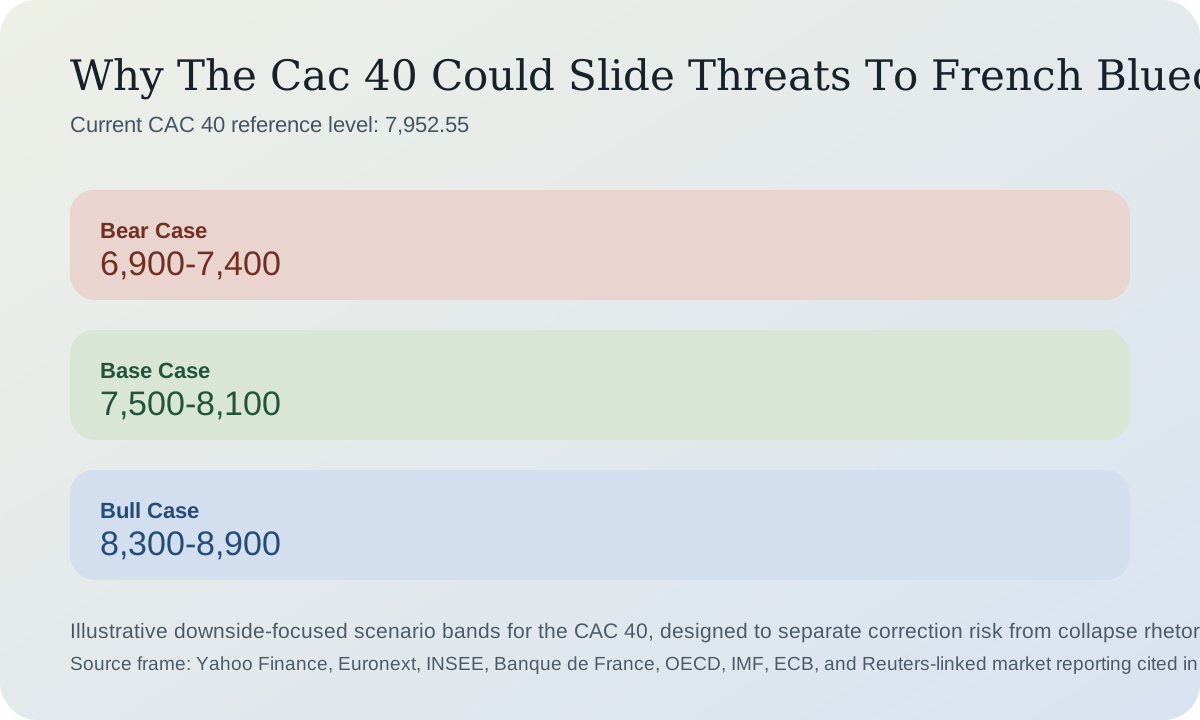
The main downside range is 6,900 to 7,400. That would fit a significant correction or mild bear market driven by weak luxury, tough rates, and fading confidence.
Base scenario
A more balanced range is 7,500 to 8,100, where the index drifts or chops sideways while investors wait for macro clarity.
Counter-bull scenario
The bull case that would invalidate the bearish thesis is 8,300 to 8,900 if luxury stabilizes, industrials hold up, and rates stop getting worse.
| Scenario | Range | What it means | Probability |
|---|---|---|---|
| Bear | 6,900-7,400 | A serious but non-disorderly pullback in French blue-chips. | 45% |
| Base | 7,500-8,100 | Range-bound trading while the market reassesses sector risks. | 35% |
| Bull | 8,300-8,900 | The bearish call fails because enough large sectors stabilize. | 20% |
| Path | Estimated probability | Comment |
|---|---|---|
| Rising | 30% | Possible if the luxury and rate backdrop improves faster than feared. |
| Falling | 45% | The setup is vulnerable enough that downside deserves real weight. |
| Sideways | 25% | High-quality indices often consolidate after record highs. |
Risks to watch
Luxury earnings, Chinese demand, ECB communication, oil prices, and fiscal headlines are the most important downside indicators.
What could invalidate the bear case
A bearish thesis would weaken quickly if luxury stabilizes, ECB pressure eases, and industrial AI or defense winners keep broadening the market's leadership.
Conclusion
The CAC 40 could absolutely slide, but the most rigorous downside view is a correction or a mild bear market, not a crash narrative built on exaggeration.
Bearish investors should therefore look for confirmation rather than drama: weaker luxury spending, a firmer rate path, and broader evidence that confidence is not recovering. Without those signals, the downside thesis remains incomplete.
That also means bearish positioning should be sized cautiously. French blue-chips can rebound hard when sentiment shifts, so a disciplined downside view is more defensible than an extreme one.
In practical terms, the better bear case is tactical, evidence-based, and humble about timing, reversals, policy surprises, valuation resets, crowded positioning, liquidity, and sentiment.
Disclaimer: This downside framework is for informational research only. It is not a recommendation to short or avoid French equities categorically.
06. Investor Positioning
Different investor types should react differently to a possible CAC 40 slide
| Reader type | Cautious approach | Risk control |
|---|---|---|
| Investor already in profit | Trim oversized positions or rebalance if concentration is high. | Take profits methodically rather than emotionally. |
| Investor currently at a loss | Separate thesis damage from volatility. | Use pre-defined review or stop-loss levels if your horizon is short. |
| Investor with no position | Wait for confirmation or deeper pullbacks. | Avoid catching a falling knife in a concentrated index. |
| Trader | Respect downside momentum and event risk. | Use stop-losses around ECB and earnings dates. |
| Long-term investor | Keep dry powder and scale gradually. | Long-run quality does not remove entry-price risk. |
| Risk-hedging investor | Use dedicated hedges, not just tactical underweights. | Macro hedges matter if energy or rates are the concern. |
07. FAQ
Frequently asked questions about the CAC 40 bear case
Could the CAC 40 crash?
Current public evidence supports a correction or mild bear market more than a crash. A disorderly collapse would likely need a much larger systemic shock.
What is the single biggest downside trigger?
Persistent luxury weakness combined with restrictive rates is the cleanest downside trigger because it hits both earnings and multiples.
Why include a bull case in a bearish article?
Because a serious bearish analysis should also explain what would make it wrong.
References
Sources
- Yahoo Finance chart API for ^FCHI, 10-year monthly history
- Yahoo Finance chart API for ^FCHI, recent daily closes
- Euronext CAC 40 factsheet, March 31, 2026
- INSEE economic dashboard for France
- INSEE Q1 2026 GDP release
- Banque de France macroeconomic projections page
- Banque de France March 2026 macroeconomic projections
- OECD Economic Outlook landing page
- OECD Economic Outlook Volume 2025 Issue 2
- IMF 2025 Article IV consultation for France
- ECB April 2026 economic outlook and monetary policy speech
- Reuters factbox on France's 2026 budget
- Reuters on luxury recovery doubts
- Reuters on luxury volatility
- Reuters on ECB hike risk
- Reuters on oil and European equities