01. Quick Answer
The bear case for the FTSE MIB is mainly about multiple compression and earnings normalization, not about replaying the euro crisis
The FTSE MIB closed at 49,116.47 on 2026-05-15, up from 16,198 at the start of its 10-year Yahoo Finance monthly series on 2016-06-01, for a price-only CAGR of about 11.73% (Yahoo Finance 10-year history; recent daily closes). A market that has already rerated this far does not need a national disaster to fall. It can slide if the earnings cycle cools and investors decide the premium they recently granted to Italian assets has moved too far ahead of fundamentals.
The macro backdrop is mixed enough to keep that concern alive. The IMF still flags very high debt and low medium-term growth potential, while the OECD argues that productivity and demographic constraints remain real. That does not prove a slide, but it does justify a serious bear-case framework.
| Point | Why it matters |
|---|---|
| The biggest bear risk is not systemic panic | It is a calmer but still painful mix of lower bank earnings, wider spreads, and multiple compression. |
| Italy's debt still matters | Even if no crisis emerges, higher risk premia can reduce foreign appetite for the whole market. |
| Manufacturing and autos can amplify downside | Weak industrial demand and Stellantis pressure can reinforce macro caution. |
| A correction is not the same as a crash | The evidence today supports a correction-risk discussion more than a collapse thesis. |
02. Historical Context
Markets often correct after strength, and the MIB now has enough gains behind it to make a setback plausible
Bear-case work starts with context, not fear. The FTSE MIB closed at 49,116.47 on 2026-05-15, up from 16,198 at the start of its 10-year Yahoo Finance monthly series on 2016-06-01, for a price-only CAGR of about 11.73% (Yahoo Finance 10-year history; recent daily closes). That kind of recovery is exactly the sort of move that can create vulnerability to a normal correction or mild bear market even if the broader long-term thesis remains intact.
A correction typically means a drop of around 10% or more from a recent high. A bear market usually implies a larger and more durable drawdown. A crash implies disorderly and rapid selling. The evidence today points more clearly to correction risk than to crash risk, because Italian banks remain profitable, the ECB is not in emergency mode, and there is no obvious funding breakdown. But correction risk should not be minimized just because the systemic setup is calmer than in the early 2010s.
The important lesson from the recent rally is that the index now has room to disappoint. When expectations rise, even ordinary macro deterioration can produce a meaningful re-pricing.
| Risk factor | Why it matters | Bear-case relevance |
|---|---|---|
| Italian sovereign spreads | Spreads affect bank valuations and foreign flows | High |
| ECB easing pace | Too-slow easing keeps pressure on growth; too-fast easing can signal trouble and cut bank income | High |
| Manufacturing softness | Italy remains exposed to export and industrial cycles | Medium to high |
| Energy shock | Oil and gas spikes can hurt domestic confidence and margins | Medium |
| Auto weakness | Stellantis remains a visible cyclical drag channel | Medium |
| Term | Typical meaning | How it applies here |
|---|---|---|
| Correction | A meaningful but normal retreat from a rally | The most plausible downside framework for the current MIB setup. |
| Bear market | A deeper and longer period of lower prices | Possible if bank earnings and spreads both worsen materially. |
| Crash | Fast, disorderly, panic-like selloff | Less supported by current evidence unless a new systemic shock emerges. |
03. Main Drivers
Five specific threats could drag Milan lower even without a full-blown crisis
1. Bank earnings normalize faster than investors expect. The recent rally has leaned heavily on financials. If lower euro rates, stiffer deposit competition, or higher credit costs hit profitability, the MIB loses its most important support.
2. Debt and spread anxiety returns. Italy does not need a sovereign crisis for spreads to widen enough to pressure valuation. The market only needs investors to demand a higher premium for holding the country risk.
3. Manufacturing and autos remain weak. Stellantis remains an obvious reminder that Europe-facing cyclicals can disappoint even while banks look healthy.
4. Energy and geopolitical shocks hit confidence. Italy remains sensitive to imported energy costs and euro-area risk appetite. A higher-energy-cost environment can weigh on consumers, industrial margins, and macro confidence simultaneously.
5. Foreign ownership stays tactical rather than strategic. If Italy is still treated as a trade rather than a core allocation, sentiment can reverse quickly when conditions soften.
04. Institutional Forecasts and Analyst Views
The institutional evidence supports caution, but not a deterministic collapse narrative
Official institutions do not support a dramatic doom story. They do, however, support caution. The IMF, OECD, and Banca d'Italia all imply a slow-growth environment where negative surprises can matter. That is enough to justify the idea that the MIB could slide even without systemic stress.
Analysts remain divided because the evidence is mixed. Defense, utilities, and grid names can soften the downside, while banks may still generate substantial capital return. The bear case is therefore best framed as a plausible medium-term correction scenario, not as a guaranteed collapse call.
| Condition | Current status | Why it matters |
|---|---|---|
| Bank earnings disappoint | Possible as rates ease | Would hit the market's largest leadership group. |
| Spreads widen materially | Not the base case, but always relevant for Italy | Would compress valuation across the benchmark. |
| Industrial weakness broadens | Evidence remains mixed | Would remove support from cyclicals and exporters. |
| Energy shock persists | Geopolitical risk remains live | Would pressure confidence and costs. |
05. Scenarios, Risks, and Invalidation
The most credible downside path is a correction or shallow bear market, not a sensational crash call
Bearish scenario
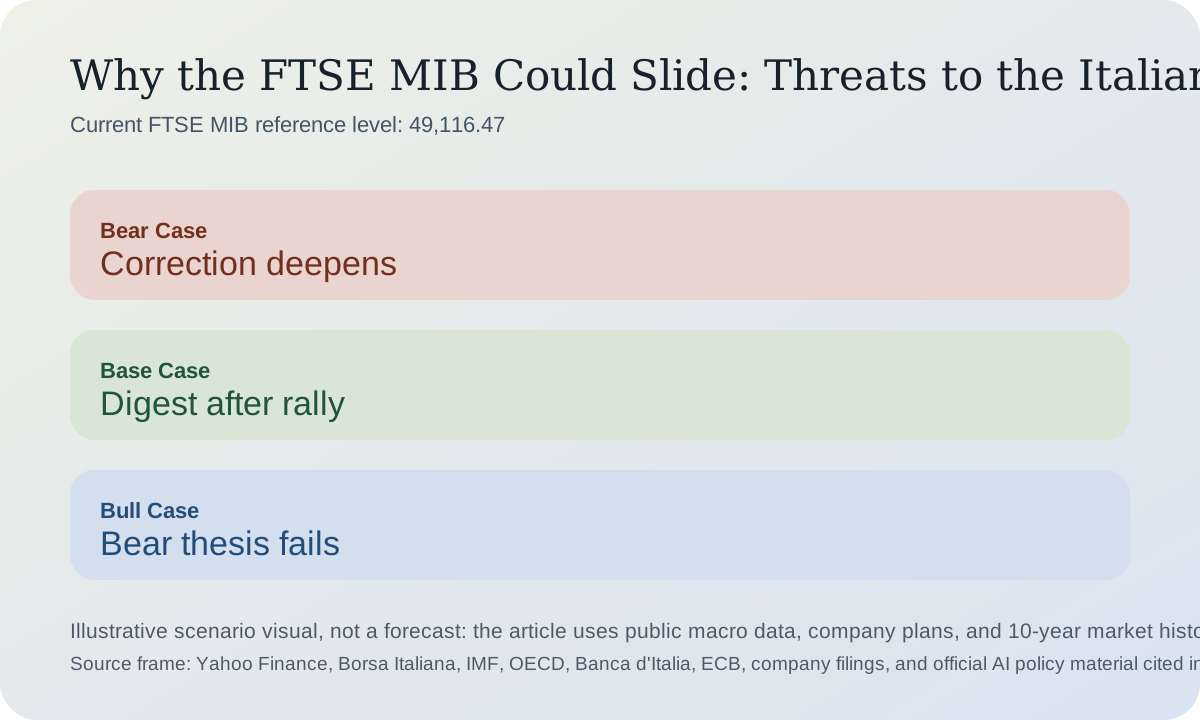
The primary bear case is 41,000 to 45,500. That range implies the index gives back part of its rerating as bank earnings peak, spreads edge wider, and industrial softness persists.
Base-case scenario
The base case is not full bearish capitulation. It is a more mixed 46,000 to 52,000 range where the market corrects, consolidates, and then seeks new support from utilities, defense, and cash-return stories.
Bullish counter-scenario
The bear case fails if rates ease without a hard earnings reset, if sovereign spreads remain contained, and if industrial infrastructure names keep broadening leadership. In that case the index can move back toward the high end of its recent range.
Risks to watch
Watch bank guidance, BTP-Bund spreads, Italian budget headlines, energy prices, and whether export-sensitive companies begin to cut expectations more aggressively.
What could invalidate the downside view
This bearish framework would be too harsh if the market proves less dependent on banks than feared and if defense, utilities, and AI-adjacent infrastructure keep delivering positive revisions. It would also be too harsh if Italy's fiscal credibility continues improving.
Conclusion
The FTSE MIB could slide from here without proving the long-term Italy thesis wrong. The important distinction is that a correction or mild bear market is plausible even when a full-scale crash is not the evidence-based base case.
Disclaimer: This article is for research and educational use only. It is not a short recommendation or a claim of certainty about future market direction.
| Scenario | Range | Conditions | Probability |
|---|---|---|---|
| Deep bear | 38,000-41,000 | Spreads widen sharply and bank profits reset hard | 15% |
| Correction / primary bear case | 41,000-45,500 | Earnings normalization plus multiple compression | 35% |
| Base / choppy consolidation | 46,000-52,000 | No crisis, but gains digest | 35% |
| Bullish invalidation | 52,000-57,000 | Broad leadership and benign spreads | 15% |
| Path | Estimated probability | Why |
|---|---|---|
| Rising from current levels | 30% | The market already carries a lot of good news and is more vulnerable than it was two years ago. |
| Falling from current levels | 45% | Correction risk is meaningful given bank sensitivity and the rally already achieved. |
| Moving sideways | 25% | Possible if bank softness is offset by utilities, defense, and cash returns. |
06. Investor Positioning
A bear-case framework is about discipline, not drama
| Investor type | Cautious approach | What to watch |
|---|---|---|
| Investor already in profit | Trim winners, rebalance, and avoid letting one thesis dominate after a long rally. | Whether your gains are mostly bank-driven and therefore rate-sensitive. |
| Investor currently at a loss | Do not average down blindly into a weakening tape. | Test whether the original thesis depended on easy rerating that may already have happened. |
| Investor with no position | Wait for confirmation or for a better entry after volatility. | There is no need to chase a market when the bear case is still credible. |
| Trader | Use stop-losses and respect volatility around macro events. | This is the profile most exposed to sudden spread moves. |
| Long-term investor | Keep cash for staged entries instead of trying to pick the exact bottom. | A correction can improve long-run entry points if the structural thesis survives. |
| Risk-hedging investor | Use explicit hedges rather than assuming cash alone is enough. | Energy shocks, spread moves, and euro-area sentiment. |
07. FAQ
Frequently asked questions about the FTSE MIB outlook
Does a bearish FTSE MIB view mean a euro-crisis repeat?
No. The more evidence-based downside case today is a correction or mild bear market, not necessarily a systemic funding crisis.
Why focus so much on banks?
Because they have been a major part of the rerating. If they weaken, the whole index feels it.
What would make the bear case wrong?
Contained spreads, resilient bank capital return, and broader leadership from utilities, defense, and infrastructure names.
References
Sources
- Yahoo Finance chart API for FTSEMIB.MI, 10-year monthly history
- Yahoo Finance chart API for FTSEMIB.MI, recent daily closes
- Borsa Italiana FTSE MIB performance page
- Borsa Italiana monthly market report, March 2026
- IMF 2025 Article IV consultation for Italy
- OECD Economic Surveys: Italy 2026
- European Commission Spring 2026 forecast for Italy
- Banca d'Italia Economic Bulletin 2/2026
- ECB monetary policy decisions, April 2026
- ISTAT consumer prices, April 2026
- UniCredit first quarter 2026 results
- Intesa Sanpaolo first quarter 2026 results
- Leonardo industrial plan update, March 12 2026
- Enel 2026-2028 strategic plan
- Prysmian first quarter 2026 results
- STMicroelectronics first quarter 2026 results
- Stellantis 2025 second-half preliminary results
- AgID Italian artificial intelligence strategy 2024-2026
- IT4LIA AI Factory official page