01. Quick Answer
The HSI can still fall even without being obviously expensive
That is the central bear argument. The HSI does not need to be at a bubble multiple to suffer another leg down. It only needs weak confidence, earnings misses, tighter financial conditions, or renewed derating. The IMF still lists external downside risks such as geopolitical tensions, higher global rates, and market volatility, and it separately warns that further commercial real estate weakness could affect banks and the broader economy. The Property Review 2026 shows why that is not theoretical: office vacancy reached 17.6% and office prices fell 13.6% year over year. In short, the evidence supports a real bear thesis, even if it does not prove that one must happen.
| Point | Why it matters |
|---|---|
| Historical data still matters | The HSI's 2.25% 10-year price CAGR shows why scenario analysis is more credible than one-line optimism. |
| Current conditions are better, not solved | GDP, turnover, and market activity improved, but CRE and geopolitics still limit certainty. |
| Institutional views are constructive but conditional | Public research from IMF, Invesco, UBS, Goldman Sachs, and J.P. Morgan supports nuance rather than hype. |
| Forecast ranges must separate bull, bear, and base cases | The evidence is mixed enough that any serious HSI forecast should explain why probabilities differ across scenarios. |
02. Historical Context
The HSI's last decade explains why long-run forecasting must stay humble
The Hang Seng Index has not behaved like a simple developed-market benchmark. Yahoo Finance data show a move from 20,794.37 on 2016-05-31 to 25,962.73 on 2026-05-15, a price CAGR of only 2.25%. That flat-looking long-run path hides extremely large cycles inside the range: the index fell as low as 14,687.02 and reached 32,887.27 during the same decade. In other words, the HSI has been much better at repricing macro expectations than at compounding smoothly.
| Metric | Latest reading | Why it matters |
|---|---|---|
| Recent close | 25,962.73 | Every scenario in this article starts from the most recent Yahoo Finance close on 2026-05-15. |
| 10-year starting point | 20,794.37 | Anchors the long-run compounding math rather than assuming a straight line from the last rally. |
| 10-year price CAGR | 2.25% | Shows that HSI has been a low-compounding but highly cyclical index over the last decade. |
| 10-year range | 14,687.02 to 32,887.27 | Defines realistic historical boundaries for bullish and bearish scenario work. |
| Recent 1-month range | 25,679.78 to 26,626.28 | Captures the current trading regime and the market's near-term volatility. |
| Fact | Latest public evidence | Interpretation |
|---|---|---|
| Constituent count | 90 stocks | The benchmark is broader than the old 50-stock HSI, which changes sector balance and stock-specific concentration. |
| Total market value | HK$30.94 trillion | The HSI still captures the core investable Hong Kong blue-chip complex. |
| Market-cap coverage | 64.26% | The index remains the clearest public barometer for the HKEX main-board large-cap market. |
| Dividend yield | 3.04% | Income still matters in total-return math, even if the price chart looks unimpressive. |
| P/E ratio | 14.08x | Valuation is not distressed in the absolute sense, but it remains below many developed-market growth benchmarks. |
| Composition signal | Official review evidence | Forecast implication |
|---|---|---|
| Hong Kong companies | 23 names, 26.83% weight after the February 2026 review | Local banks, insurers, developers, and utilities still matter, but they no longer dominate the whole benchmark. |
| Mainland-related companies | 67 names, about 73% combined weight across H-shares, red chips, and other mainland companies | Mainland growth, regulation, and sentiment remain the biggest index-level drivers. |
| Top weights | HSBC 8.26%, Alibaba 7.48%, Tencent 7.33%, AIA 5.51% | The HSI is simultaneously a financials index, a China internet index, and a Hong Kong confidence barometer. |
The official HSI factsheet and February 2026 review materials show why. The benchmark now has 90 constituents, a 3.04% indicated dividend yield, a 14.08x P/E ratio, and a weight structure where Hong Kong names represent only 26.83% after the latest review while mainland-related companies make up the balance. That mix means the HSI depends on Hong Kong as a financial hub, but it also depends heavily on China's earnings cycle, internet-platform regulation, southbound flow momentum, and the durability of offshore-fundraising demand. Investors who treat it as only a Hong Kong property or bank proxy usually miss the bigger picture.
03. Bearish Drivers
Five risks could drag the HSI lower
1. Commercial real estate can still poison sentiment
Hong Kong offices are not just a property story. They are a confidence story, a bank-risk story, and a local-demand story. The official property review showed 17.6% office vacancy at end-2025, falling prices, and more completions still coming in 2026 and 2027. If that overhang persists or worsens, it can keep local risk appetite weak.
2. Higher-for-longer global rates still matter
Under the currency peg, Hong Kong does not escape U.S. rate pressure. The HSI can therefore struggle even with decent local GDP prints if global rates stay restrictive and funding conditions remain tight.
3. China disappointments would hit the benchmark quickly
Because the HSI is majority mainland-related by weight, weaker China earnings or policy disappointment would likely hit the index faster than local Hong Kong data could offset.
4. The market is vulnerable to a sentiment reversal in internet heavyweights
Alibaba, Tencent, Meituan, JD, Baidu, and Xiaomi help drive the benchmark. If the market stops rewarding their AI, cloud, and consumer narratives, the HSI can de-rate quickly even if old-economy names remain stable.
5. A financial-hub story can improve slowly and break quickly
Capital-market volumes, IPO activity, and Stock Connect are real supports, but confidence can still reverse rapidly if global investors reprice geopolitical or regulatory risk. Bear markets often begin with a loss of confidence before official activity data fully reflect it.
| Type | Typical size | What it would likely mean here |
|---|---|---|
| Correction | 10% to 20% | A normal macro or earnings reset without implying structural failure. |
| Bear market | More than 20% | A broader repricing of Hong Kong and China risk, probably involving both earnings and discount-rate pressure. |
| Crash tail | 30% or more, often quickly | Would likely require several shocks at once, such as geopolitics, funding stress, and deep earnings disappointment. |
04. Institutional Forecasts and Analyst Views
Public sources already identify the core bearish fault lines
The bearish case is credible because the main risks are not invented by punditry. They are already present in official and institutional documents. The IMF highlights elevated external and domestic risks. The HKMA keeps CRE and tighter conditions on the radar. UBS still says China's property adjustment needs more time. Even constructive equity institutions such as J.P. Morgan AM explicitly note that AI sentiment and regulation could derail the China rally. That does not make collapse likely, but it does mean the downside case has a real evidence base.
| Source | Caution signal | Why it matters |
|---|---|---|
| IMF | External volatility and CRE risk could tighten conditions quickly | Supports downside scenario credibility. |
| HKMA | Financial stability is resilient but not risk free | Shows authorities are still managing vulnerabilities, not declaring victory. |
| RVD | Office vacancy and price declines remain heavy | Local property stress is still unresolved. |
| UBS | China property still needs time | Supports the view that old drags have not disappeared. |
05. Scenarios, Risks, and Invalidation
A bearish HSI article still needs precision, not fear theater
Correction scenario
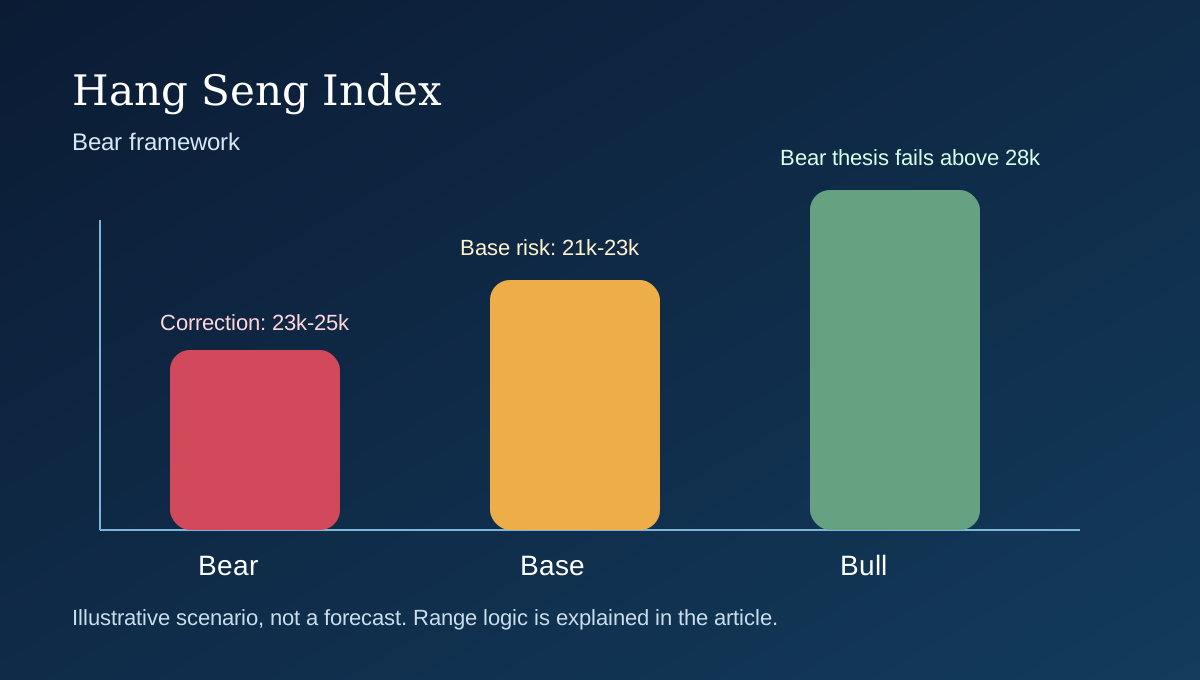
A correction to roughly 23,000 to 25,000 would be the mildest bearish path. That could happen through ordinary earnings disappointment or a broad risk-off move without requiring systemic stress.
Bear-market scenario
A bear-market zone of 21,000 to 23,000 would likely require a more meaningful repricing in China or Hong Kong risk, with local property weakness and weaker liquidity both contributing.
Crash tail
A move materially below 20,000 is an extreme tail scenario, not a base case. It would likely require several shocks arriving together, such as global rate stress, severe geopolitical escalation, and a new collapse in earnings confidence.
| Scenario | Range | Conditions | Probability |
|---|---|---|---|
| Correction | 23,000-25,000 | Routine risk-off repricing | 35% |
| Bear market | 21,000-23,000 | Broader earnings and discount-rate pressure | 25% |
| Crash tail | Below 20,000 | Multiple shocks at once | 10% |
| Bear thesis fails | 28,000-31,000 | Earnings and liquidity overwhelm the negatives | 30% |
| Path | Estimated probability | Comment |
|---|---|---|
| Rising | 30% | The bear article still acknowledges that the downside case can fail. |
| Falling | 45% | The evidence supports caution more than complacency. |
| Sideways | 25% | Another prolonged digestion phase is plausible. |
Risks to watch
Office-market data, banks' asset-quality commentary, China earnings guidance, and global rate expectations remain the most practical early-warning indicators.
What could invalidate the bearish thesis
The bear case weakens sharply if Hong Kong's capital-market recovery persists, CRE stops worsening, and heavyweights keep delivering better-than-feared earnings and buyback support.
Conclusion
The HSI could slide again without violating any historical pattern. The bearish thesis is credible precisely because the risks are already visible in official and institutional material.
Disclaimer: This article is for research and informational purposes only. Bearish scenarios are conditional risk cases, not certainties or personalized advice.
06. Investor Positioning
Different readers should respond to the same forecast in different ways
| Investor profile | Cautious approach | What to monitor |
|---|---|---|
| Investor already in profit | Hold a core position but consider trimming into strength if the move is running well ahead of earnings revisions. | Southbound flow momentum, EPS revisions, and whether the rally broadens beyond a few heavyweights. |
| Investor currently at a loss | Avoid averaging down automatically; first decide whether the original thesis was valuation mean reversion, income, China tech recovery, or Hong Kong reopening. | Policy follow-through, index breadth, and whether downside is cyclical or structural. |
| Investor with no position | Use staggered entries or wait for pullbacks instead of chasing breakouts after sentiment spikes. | Valuation discipline, U.S. rate path, and cross-border flow data. |
| Trader | Use stop-loss discipline and treat HSI as a macro-sensitive trading instrument rather than a low-volatility income index. | Geopolitics, earnings season, and U.S.-China rate and policy headlines. |
| Long-term investor | Dollar-cost averaging is more defensible than heroic point forecasting, but only if the portfolio can tolerate multi-year drawdowns. | Dividend resilience, structural earnings mix, and capital-market reforms. |
| Risk-hedging investor | Rebalance or hedge if Hong Kong and China exposure is already large elsewhere in the portfolio. | Correlation spikes, USD strength, and commercial real estate stress. |
07. FAQ
Common questions investors ask about this HSI outlook
Is a bearish HSI view the same as predicting a crash?
No. A correction, a bear market, and a crash tail are different things. The most credible downside cases involve a correction or bear-market repricing before any extreme crash scenario.
Why does commercial real estate matter so much?
Because it affects collateral, bank confidence, office demand, local sentiment, and the narrative around Hong Kong's broader recovery.
What would be the earliest sign that the bear case is failing?
A combination of stronger earnings revisions, sustained Stock Connect support, and evidence that office-market stress is stabilizing rather than worsening.
08. Sources
Primary and high-credibility references used in this article
- Yahoo Finance chart API for ^HSI, 10-year monthly history
- Yahoo Finance chart API for ^HSI, recent daily closes
- Hang Seng Index factsheet, data as at April 30, 2026
- Hang Seng Indexes Company February 2026 index review results
- HKEX Monthly Market Highlights, April 2026
- HKEX Q1 2026 Hong Kong Market Update
- HKEX Stock Connect 2025 Review
- HKEX 2025 annual results presentation
- IMF staff concluding statement for Hong Kong SAR, May 15, 2026
- Hong Kong 2026-27 Budget speech, economic outlook section
- Hong Kong advance GDP estimates for Q1 2026
- Hong Kong retail sales statistics for March 2026
- HKMA Half-Yearly Monetary and Financial Stability Report, March 2026
- Hong Kong Property Review 2026 preliminary findings
- Invesco 2026 investment outlook for Chinese equities
- Invesco China outlook for 2026
- UBS China Outlook 2026-27: Resilience and Rebalancing
- Goldman Sachs view on China's 2026 growth outlook
- J.P. Morgan Asset Management global ex-US equities outlook, China section