01. Quick Answer
The KOSPI could slide if cyclical profits, energy vulnerability, and foreign-risk appetite all turn at once
The KOSPI closed at 7,493.18 on 2026-05-15 after starting the current 10-year Yahoo Finance series at 1,970.35 on 2016-05-31, implying a price-only CAGR of roughly 14.36% (Yahoo Finance chart API for ^KS11, 10-year monthly history; Yahoo Finance chart API for ^KS11, recent daily closes). That is an extraordinary run for a market long associated with the so-called Korea discount. It also means the easy part of the rerating is probably over. Any serious forecast now has to weigh a real semiconductor and AI earnings engine against Korea's cyclical exposure to trade, oil, geopolitics, and currency shocks. The bearish argument is not that Korea is weak by default. It is that a market so dependent on semiconductors, foreign flows, and imported energy can reprice quickly when several macro pressures line up. Reuters already showed how fast sentiment can swing during the March shock before recovering again.
| Point | Why it matters |
|---|---|
| A correction, bear market, and crash are not the same | The downside framework should separate modest profit-taking from structural damage. |
| Korea's bear case is usually external first | Oil, the dollar, trade, and chip demand often matter more than domestic recession alone. |
| High-quality companies do not eliminate index risk | Samsung and SK hynix can remain excellent businesses while the KOSPI still falls. |
| A credible bear case needs an invalidation test | If exports, AI capex, and reforms stay strong, the downside thesis weakens materially. |
02. Historical Context
History shows the KOSPI can fall hard even when its long-run strategic case remains intact
The KOSPI closed at 7,493.18 on 2026-05-15 after starting the current 10-year Yahoo Finance series at 1,970.35 on 2016-05-31, implying a price-only CAGR of roughly 14.36% (Yahoo Finance chart API for ^KS11, 10-year monthly history; Yahoo Finance chart API for ^KS11, recent daily closes). That is an extraordinary run for a market long associated with the so-called Korea discount. It also means the easy part of the rerating is probably over. Any serious forecast now has to weigh a real semiconductor and AI earnings engine against Korea's cyclical exposure to trade, oil, geopolitics, and currency shocks.
The 10-year range from 1,754.64 to 7,493.18 matters because it reminds investors that Korea does not trade like a low-volatility developed-market utility basket. It is a high-beta equity market. That distinction is crucial when discussing downside risk.
For this article, a correction means a decline of roughly 10% to 20% from a recent peak. A bear market means a decline of more than 20% sustained by deteriorating earnings or macro conditions. A crash would require disorderly repricing driven by a macro shock, liquidity event, or severe geopolitical escalation. Those categories should not be blurred.
| Metric | Latest reading | Why it matters |
|---|---|---|
| Recent close | 7,493.18 | Every forecast in this article starts from the latest available close, not an old cyclical trough. |
| 10-year starting point | 1,970.35 | Helps frame how much rerating has already happened. |
| 10-year price CAGR | 14.36% | Useful for calibrating whether a future range is conservative or aggressive. |
| 10-year observed range | 1,754.64 to 7,493.18 | Shows how cyclical KOSPI outcomes can be even across a strong decade. |
| Recent 1-month range | 6,091.39 to 7,981.41 | Confirms that the market is still moving in large swings, not a calm trend. |
| Signal | Evidence | Forecast implication |
|---|---|---|
| Energy-import dependence | IMF warns that larger energy shocks would hurt more import-dependent Asian economies. | Korea's margins and investor sentiment can deteriorate quickly when oil rises sharply. |
| Dollar beta and FX risk | MSCI highlights Korea's high dollar beta and the importance of KRW exposure for international investors. | A stronger dollar can amplify equity downside in USD terms and pressure flows. |
| Chip-cycle concentration | Samsung and SK hynix confirm how central AI-memory demand is to current earnings. | If the cycle fades, the index may lose both earnings and narrative support at once. |
| Domestic leverage constraint | The BOK still flags household debt even while easing. | Policy cannot be as aggressively supportive as some bulls assume. |
03. Main Drivers
Five threats could turn a hot KOSPI into a meaningful slide
1. An oil and energy shock. Korea is an exporter of advanced goods, not of energy. The IMF explicitly says bigger and longer-lasting energy shocks would hit import-dependent Asian economies harder. That matters because higher energy costs can squeeze margins even when nominal exports look okay.
2. A semiconductor demand reset. If hyperscaler capex slows or HBM supply finally catches up, earnings expectations for Korea's largest drivers could fall faster than consensus models currently assume.
3. A stronger US dollar and tighter global liquidity. Korea historically behaves like a high-beta equity market. If the dollar rises, the KRW weakens, and foreign investors turn defensive, the KOSPI can slide even before local fundamentals break.
4. Trade disruption. OECD notes higher tariff assumptions on Korean exports to the US. In a trade-sensitive market, worsening policy friction can matter almost immediately.
5. Disappointment on governance reform. If value-up disclosures fail to change payout ratios, capital allocation, or market trust, part of the rerating case disappears.
| Downside type | Illustrative move | What usually causes it |
|---|---|---|
| Correction | -10% to -20% | Positioning washout, valuation digestion, or a short-lived oil and rates scare. |
| Bear market | Below -20% | Earnings downgrades, weaker exports, a stronger dollar, and persistent risk aversion. |
| Crash | Much deeper, faster move | Severe geopolitical escalation, funding stress, or a sharp global growth shock. |
04. Institutional Forecasts and Analyst Views
Institutions mostly publish shorter-horizon inputs, so long-range KOSPI estimates need explicit translation
There is a practical problem with very long-range KOSPI forecasting: major institutions rarely publish exact 2030 or 2035 KOSPI targets with enough methodological detail to treat them as hard forecasts. What they do publish are the ingredients. J.P. Morgan Global Research sees emerging markets supported by lower local rates, earnings growth, attractive valuations, and governance improvements. J.P. Morgan Private Bank says global AI tailwinds should continue to support exporters such as South Korea. Invesco says Korea is accelerating governance reforms to strengthen shareholder value, while UBS keeps a favorable lens on Asia tech and a neutral to constructive view on Korea within Asia. MSCI adds that South Korean equities had still been trading around 10 times forward earnings in mid-2025, below the broader MSCI EM multiple near 13, even after strong performance.
Those inputs do not give a clean 2030 number. They do justify a scenario framework. In these articles, the range logic uses five building blocks: the current index level; the 10-year price CAGR; public macro forecasts from OECD, IMF, the BOK, and KDI; public evidence on earnings engines from Samsung, SK hynix, and Hyundai; and the probability that governance reform and foreign-access improvements keep narrowing the Korea discount through the decade.
| Source | What it says | How it influences the scenario work |
|---|---|---|
| IMF, OECD, BOK, KDI | Growth is recovering, but risks remain tilted to trade, energy, and domestic leverage. | Supports moderate earnings growth, not blind extrapolation. |
| J.P. Morgan and UBS | Asia tech and exporters such as Korea still benefit from AI and easing-cycle support. | Strengthens the bull and base cases for semiconductors. |
| Invesco and MSCI | Governance reforms and still-reasonable valuation remain important. | Supports the case for a lower structural discount versus history. |
| Company disclosures | Samsung, SK hynix, and Hyundai all provide evidence on capex, demand, and export sensitivity. | Grounds the index view in the earnings power of major constituents. |
Institutional views are not uniformly bearish today. That is exactly why the bear case must be conditional. It needs evidence that the supportive inputs from J.P. Morgan, Invesco, and MSCI are starting to fail in real time.
05. Bull, Bear, and Base Cases
Scenario ranges are more defensible than a single-number prediction
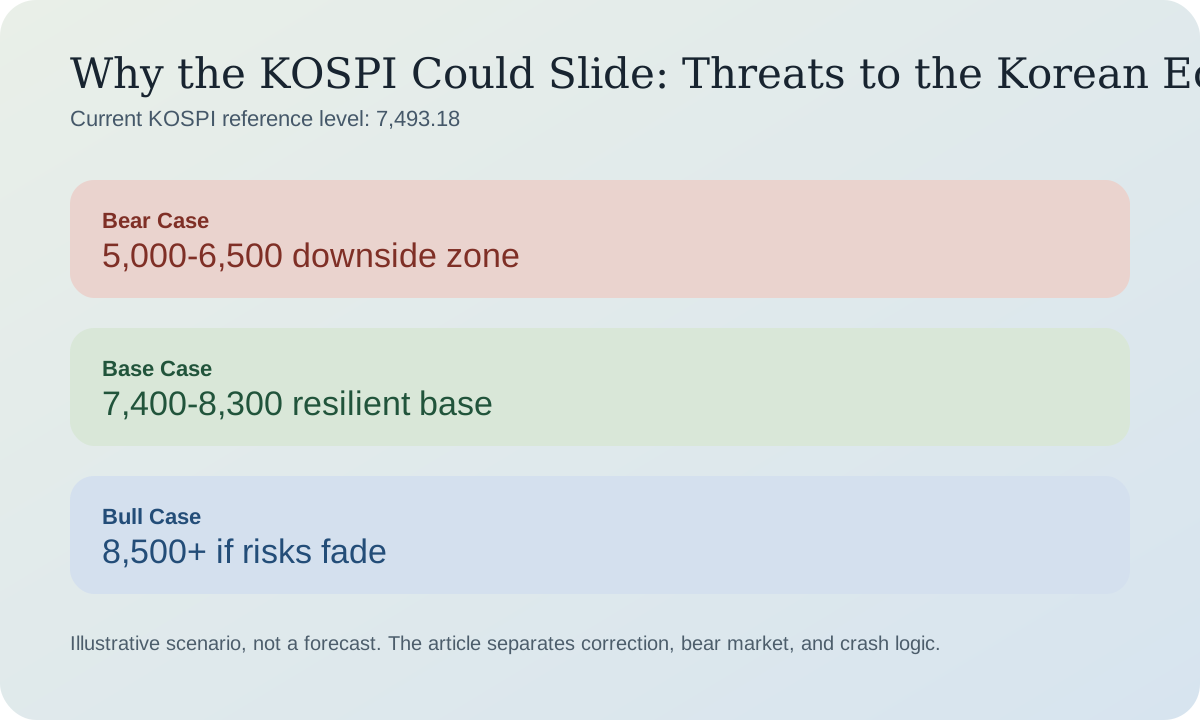
The editorial downside framework here centers on a bear-case zone of 5,000 to 6,500. That is not a base case. It is the range where the KOSPI could land if several threats align: weaker AI demand, higher oil, a stronger dollar, and falling foreign appetite for Korean risk assets.
| Scenario | Range | Conditions | Probability |
|---|---|---|---|
| Correction only | 6,700-7,200 | Momentum cools but earnings stay mostly intact. | 35% |
| Bear market | 5,700-6,500 | Exports soften, foreign flows reverse, and macro uncertainty persists. | 25% |
| Crash-style stress | 5,000-5,600 | Severe external shock, liquidity stress, or geopolitical escalation. | 10% |
| Base constructive path | 7,400-8,300 | Threats stay manageable and current earnings power largely holds. | 30% |
| Path | Estimated probability | Comment |
|---|---|---|
| Rising | 35% | The index can still rise, but this article deliberately focuses on downside drivers. |
| Falling | 40% | The current setup is vulnerable enough that downside cannot be treated as a tail risk. |
| Sideways | 25% | A sideways consolidation is another plausible way bullish enthusiasm deflates. |
Bullish counterargument
The strongest pushback to this bearish article is that current chip and AI demand are still real, not just speculative, and Korea's governance story is stronger than it used to be.
Bearish scenario
The bear scenario depends on crosswinds becoming synchronized: weaker exports, higher energy costs, tighter global liquidity, and renewed discounting of Korean corporate risk.
Base-case scenario
The evidence is mixed enough that a slide is possible without being inevitable. That is why the base path here still allows for resilience rather than collapse.
Risks to watch
Oil, the KRW, export orders, DRAM and HBM pricing, foreign flows, and whether household debt constrains further easing.
What could invalidate the forecast
The bearish thesis weakens sharply if AI-led exports remain exceptional, foreign investors keep returning, and governance reform supports a higher valuation floor. In that world, a correction may stay just a correction rather than turn into a bear market.
Conclusion
The KOSPI could slide, but the serious bear case is a conditional macro-and-earnings story, not a slogan. Investors should focus on whether the current support pillars are merely noisy or actually breaking.
Disclaimer: This article is for research and informational purposes only. Downside scenarios are risk frameworks, not guaranteed market outcomes.
06. Investor Positioning
Different investor profiles should react differently to the same KOSPI outlook
| Investor profile | Cautious approach | What to watch |
|---|---|---|
| Investor already in profit | Consider holding a core stake but trimming if one semiconductor or ETF has become too dominant. | Watch whether the downside-risk framework keeps broadening or becomes a narrow momentum trade. |
| Investor currently at a loss | Separate thesis from timing. Reassess balance between semiconductors, cyclicals, and Korea-specific governance catalysts before averaging down. | Monitor earnings revisions, FX moves, and whether the Korea discount is genuinely narrowing. |
| Investor with no position | Prefer staged entry or dollar-cost averaging rather than chasing a vertical rally. | Pullbacks linked to oil, rates, or trade headlines may offer cleaner entry points. |
| Trader | Use stop-loss discipline and respect event risk around chip earnings, BOK decisions, and export releases. | Short-term KOSPI moves can be amplified by foreign flows and KRW volatility. |
| Long-term investor | Focus on scenario ranges, governance progress, and the durability of AI and industrial policy support. | The long-run case improves only if earnings growth spreads beyond a handful of names. |
| Risk-hedging investor | Consider partial hedges or rebalancing if portfolio risk is already highly correlated with semiconductors and energy-import shocks. | Korea remains sensitive to oil, geopolitics, and the US dollar. |
07. FAQ
Frequently asked questions about this KOSPI outlook
Could the KOSPI enter a bear market even if Samsung and SK hynix stay profitable?
Yes. Index-level downside can still occur if multiples compress, foreign flows reverse, or profits fall short of already-high expectations.
What is the difference between a correction and a crash in this context?
A correction is a normal but sharp pullback, while a crash implies disorderly repricing caused by severe macro, liquidity, or geopolitical stress.
What is the most important invalidation signal for the bearish case?
Sustained export strength, resilient AI demand, and evidence that the market's valuation floor is being supported by real governance reform rather than just sentiment.
References
Sources
- Yahoo Finance chart API for ^KS11, 10-year monthly history
- Yahoo Finance chart API for ^KS11, recent daily closes
- Bank of Korea Economic Outlook, February 2026
- Bank of Korea base-rate decision, February 26, 2026
- Bank of Korea base-rate decision, May 2026
- Bank of Korea Q1 2026 GDP release
- IMF 2025 Article IV consultation with the Republic of Korea
- IMF blog: Asia's economic resilience is being tested by the energy shock
- OECD Economic Outlook, Korea chapter, Volume 2025 Issue 2
- KDI Economic Outlook Update, February 2026
- FSC first seminar on the Corporate Value-up Program
- FSC guidelines on Corporate Value-up Plans
- FTSE Russell reminder on South Korea's inclusion in the WGBI
- MSCI: 'Hallyu' Moment - how investors rode the Korean Wave
- MSCI Korea Index overview