01. Quick Answer
The Nikkei could slide even if Japan's long-run story remains broadly intact
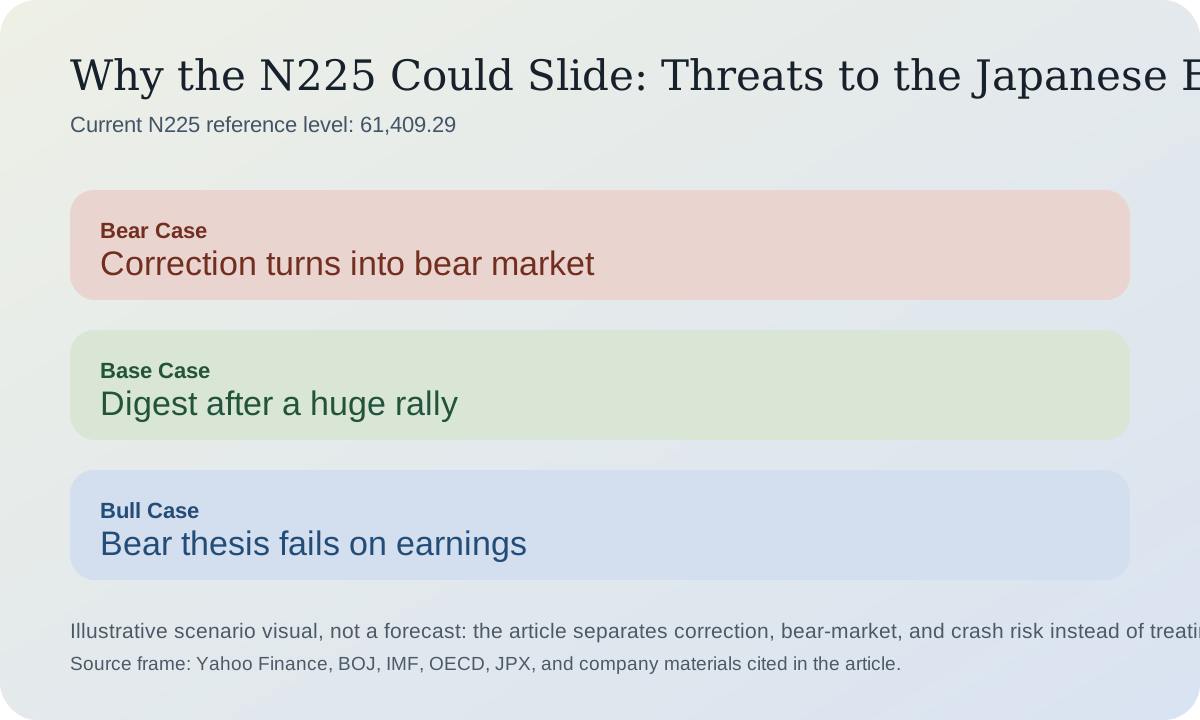
The Nikkei closed at 61,409.29 on 2026-05-15, after already delivering a 10-year price CAGR of about 14.78% (Yahoo Finance chart API for ^N225, 10-year monthly history; Yahoo Finance chart API for ^N225, recent daily closes). From that starting point, a normal correction does not need a dramatic narrative. It can happen simply because the market needs to digest large gains.
The more serious bearish cases are macro-driven. OECD warned that higher energy prices and Middle East uncertainty are already part of the 2026 slowdown narrative, while the IMF 2026 mission statement still highlights debt, policy discipline, and changing yen behavior. Add in the Nikkei's concentration in high-priced names, and the setup is fragile enough to merit a dedicated bear-case framework.
| Point | Why it matters |
|---|---|
| A slide does not require a broken Japan thesis | It can happen through valuation digestion, a stronger yen, or a global tech setback. |
| Correction, bear market, and crash are different | Investors should not treat every drawdown scenario as equally likely. |
| Imported inflation is a real macro threat | Japan remains exposed to oil and shipping shocks. |
| The bear case still has an invalidation path | If policy stays orderly and AI earnings stay strong, the downside thesis weakens materially. |
02. Historical Context
Downside analysis starts with defining what kind of decline is actually being discussed
For practical risk management, a correction is usually a decline of roughly 10% to 20%, a bear market is a drop of more than 20%, and a crash is a faster and deeper air pocket that often reaches 30% or more. Those are market conventions, not hard legal definitions, but they matter because each scenario implies different probability and different investor behavior.
The 10-year Yahoo Finance series for the Nikkei shows that sizable drawdowns are not unusual even inside a strong long-run uptrend (Yahoo Finance chart API for ^N225, 10-year monthly history). Available data suggests the benchmark experienced a meaningful 2018 correction, a deeper 2020 pandemic bear phase on closing data, and repeated air pockets tied to global rate or growth scares. A serious bear-case article therefore does not need to invent fragility. It only needs to identify what could trigger the next version.
| Type | Typical size | How it usually feels in practice |
|---|---|---|
| Correction | 10% to 20% | Painful but common inside longer uptrends. |
| Bear market | More than 20% | Usually needs earnings or macro stress, not only valuation fatigue. |
| Crash | Roughly 30% or more, often quickly | Typically tied to abrupt policy or external shocks. |
| Risk factor | Why it matters | Downside channel |
|---|---|---|
| High starting level | The market already priced in a lot of good news | Valuation digestion can happen even without a recession. |
| Price-weighted concentration | A few expensive names can move the headline benchmark sharply | Single-stock weakness becomes index weakness faster. |
| Energy sensitivity | Japan remains an energy importer | Margins, inflation, and policy expectations can all worsen together. |
| Global technology dependence | AI and semiconductor optimism is now embedded in the narrative | Capex disappointment could hit leadership groups first. |
03. Bearish Drivers
Six threats could drag the Nikkei lower from here
1. BOJ policy error or market surprise. A faster-than-expected tightening path or a communication misstep can compress valuations and strengthen the yen at the same time (Bank of Japan Outlook for Economic Activity and Prices, April 2026; IMF 2026 staff concluding statement for Japan).
2. Energy-import shock. OECD already linked slower growth to higher energy prices and Middle East uncertainty. For Japan, that is not a side issue. It is a direct threat to household spending and corporate margins.
3. A sharper yen. A stronger yen can help import costs, but in the short run it can also disrupt exporter earnings translation and the psychology of a market that got used to a weaker currency.
4. AI-cycle disappointment. The Nikkei now leans on a handful of semiconductor winners more than many global investors realize. If Advantest or Tokyo Electron start guiding to weaker demand, the benchmark can feel it quickly.
5. Reform fatigue. The TSE governance campaign has been a major support. If investors conclude the rerating from cost-of-capital reform is mostly behind us, the market loses one of its cleanest structural catalysts (TSE action to implement management conscious of cost of capital and stock price; TSE draft revisions to the Corporate Governance Code, April 10 2026).
6. External growth slowdown. Japan is still heavily linked to global trade and to Asian demand conditions. Weakness in the US or China does not stay outside the Nikkei for long.
04. Institutional Forecasts and Analyst Views
The bearish case is credible because official institutions still describe a fragile macro balance
The point of a bear case is not to deny that many institutions are positive on Japan. Goldman, UBS, and Invesco all remain constructive. The point is that even constructive institutions acknowledge policy risk, energy risk, and uneven growth.
The IMF still stresses that gross debt remains elevated and that fiscal policy should avoid further loosening. The BOJ Financial System Report also noted that crude prices and foreign high-tech stocks have been important external variables for Japan's financial conditions. That means a bearish Nikkei scenario does not need exotic assumptions. It needs a normal combination of crowded winners, external shock, and tighter financial conditions.
| Source | Caution signal | Why it matters |
|---|---|---|
| OECD | Growth is expected to slow and energy costs are a visible risk | Supports correction and bear-market scenarios. |
| IMF | Debt and policy discipline still matter in a normalized-rate world | Limits how carefree equity valuation can become. |
| BOJ FSR | Oil, global tech, and market leverage are active concerns | External shocks can spill quickly into Japanese markets. |
| JPX reform context | If reform momentum fades, one core rerating pillar weakens | The downside case becomes more plausible even without recession. |
05. Scenarios, Risks, and Invalidation
A serious bearish framework should separate correction risk from a true bear market
Correction scenario
A correction to 52,000-58,000 is the mildest downside case. It would likely come from valuation cooling, modest yen strength, or an earnings pause in a few heavyweights.
Bear-market scenario
A bear-market zone of 42,000-50,000 would probably require a deeper external shock, such as an energy spike, a tougher BOJ market reaction, or a meaningful AI-capex slowdown.
Crash scenario
A crash or air-pocket zone of 32,000-40,000 is an extreme tail, not a base case. It would likely need multiple stress events at once: abrupt policy tightening, external conflict escalation, and a synchronized selloff in global technology.
What could invalidate the bearish thesis
The bear case weakens materially if BOJ normalization stays smooth, imported-energy pressure fades, and semiconductor-linked earnings remain firm. It also weakens if the reform story broadens from headlines into a wider improvement in shareholder returns and capital efficiency.
Conclusion
The Nikkei absolutely can slide from here. The important question is not whether that is possible, but which form of decline is most plausible and which catalysts investors should monitor first.
Disclaimer: This article is for research and informational purposes only. Bearish scenarios are conditional risk cases, not certainties or personalized advice.
| Scenario | Range | Conditions | Probability |
|---|---|---|---|
| Correction | 52,000-58,000 | Valuation reset and softer earnings tone | 35% |
| Bear market | 42,000-50,000 | Macro shock, stronger yen, and capex weakness | 25% |
| Crash tail | 32,000-40,000 | Multiple shocks hit together | 10% |
| Bear thesis fails | 62,000-72,000 | Policy remains orderly and earnings stay resilient | 30% |
| Path | Estimated probability | Comment |
|---|---|---|
| Rising | 25% | The bear article acknowledges upside, but it is not the central focus. |
| Falling | 45% | High starting valuations and external risks make a downside move plausible. |
| Sideways | 30% | A long digestion phase is a realistic alternative to a clean selloff. |
06. Investor Positioning
A bearish article still needs practical guidance for different investor types
| Investor type | Cautious approach | What to watch |
|---|---|---|
| Investor already in profit | Trim or hedge partial exposure rather than assuming the trend will absorb every shock. | Use trailing stops or rebalance before concentration becomes a problem. |
| Investor currently at a loss | Avoid averaging down until the drawdown type is clearer. | Differentiate a normal correction from a true bear-market shift. |
| Investor with no position | Wait for confirmation or deeper pullbacks instead of buying the first dip automatically. | The first bounce in a falling market is not always the durable one. |
| Trader | Respect stop-losses and distinguish correction trades from trend reversals. | Policy headlines and global tech moves can reverse short-term setups fast. |
| Long-term investor | Keep adding only if the decade thesis still holds and sizing remains disciplined. | Use staged entries, not heroic bottom calls. |
| Risk-hedging investor | Consider index hedges, currency overlays, or simple rebalancing to reduce drawdown sensitivity. | Energy prices, yen moves, and semiconductor earnings are the main red flags. |
07. FAQ
Frequently asked questions about a possible Nikkei slide
What is the difference between a correction and a bear market?
A correction is typically a 10% to 20% decline, while a bear market generally means a drop of more than 20%. A crash is a deeper and faster air pocket.
Does a stronger yen always hurt the Nikkei?
Not always, but in the short run it can pressure exporter sentiment and change the market narrative quickly.
What would make the bearish thesis wrong?
Orderly BOJ policy, easing energy pressure, and stronger-than-expected AI-related earnings would all weaken the downside case.
References
Sources
- Yahoo Finance chart API for ^N225, 10-year monthly history
- Yahoo Finance chart API for ^N225, recent daily closes
- OECD Economic Survey of Japan press release, May 13 2026
- IMF 2026 staff concluding statement for Japan
- IMF 2025 Article IV consultation with Japan
- Bank of Japan Outlook for Economic Activity and Prices, April 2026
- Bank of Japan Financial System Report, April 2026
- TSE action to implement management conscious of cost of capital and stock price
- TSE draft revisions to the Corporate Governance Code, April 10 2026
- Advantest financial review for fiscal year ended March 2026
- Tokyo Electron investor relations and FY2026 earnings release
- UBS House View with Japan rated Attractive
- Goldman Sachs Japan Economic Outlook 2026
- Invesco 2026 investment outlook for Japan equities