01. Quick Answer
The SMI bear case is mainly about valuation, concentration, and franc pressure, not about a Swiss institutional breakdown
The SMI closed at 13,220.17 on 2026-05-15, up from 8,020.15 at the start of its 10-year Yahoo Finance monthly series on 2016-06-01, for a price-only CAGR of about 5.12% (Yahoo Finance 10-year history; recent daily closes). A market that trades as a quality refuge can still fall if investors decide the price of refuge has gone too far.
That possibility remains real because IMF, OECD, and KOF all imply a stable but not explosive Swiss economy. That does not prove a slide, but it does justify a serious bear-case framework when valuations are already full.
| Point | Why it matters |
|---|---|
| The biggest bear risk is defensive de-rating | The SMI can fall without any dramatic Swiss crisis if investors simply pay less for safety. |
| Franc strength can become a headwind | A stronger CHF can hurt multinational earnings translation even while the market remains safe-haven preferred. |
| Concentration matters | A few healthcare and staples names still do most of the work for the whole index. |
| A correction is not a crash | The evidence supports a correction-risk discussion more than a systemic-breakdown argument. |
02. Historical Context
The SMI now has enough gains and premium perception behind it to make a setback plausible
Bear-case work starts with context rather than drama. The SMI closed at 13,220.17 on 2026-05-15, up from 8,020.15 at the start of its 10-year Yahoo Finance monthly series on 2016-06-01, for a price-only CAGR of about 5.12% (Yahoo Finance 10-year history; recent daily closes). That kind of steady compounding is exactly what can create vulnerability to a normal correction or shallow bear market when investors become less willing to pay for defensiveness.
A correction typically means a meaningful but still ordinary retreat from a rally. A bear market implies a deeper and longer decline. A crash implies disorderly selling. The evidence today points more clearly to correction or shallow bear-market risk than to a crash because Switzerland's institutions remain strong and the benchmark still contains world-class franchises.
The important lesson is that a defensive market can still disappoint. Investors do not need to stop believing in Swiss quality for the SMI to pull back sharply.
That distinction matters because premium defensive indices often correct when the market's time horizon shortens. Investors stop paying for long-term stability and start focusing on the next few quarters of earnings growth, currency translation, and whether safer stocks simply look too expensive.
| Risk factor | Why it matters | Bear-case relevance |
|---|---|---|
| Defensive multiple compression | A premium quality market can de-rate even without recession | High |
| Swiss franc strength | Translation pressure can weigh on multinational earnings | High |
| Healthcare growth disappoints | Roche and Novartis carry large index influence | High |
| Nestlé recovery stalls | Staples weakness would weaken the defensive narrative | Medium to high |
| Safe-haven flows fade | Valuation support would weaken | Medium |
| Term | Typical meaning | How it applies here |
|---|---|---|
| Correction | A meaningful but normal retreat from a rally | The most plausible downside framework for the current SMI setup. |
| Bear market | A deeper and longer period of lower prices | Possible if defensives and CHF both work against earnings. |
| Crash | Fast, disorderly selling | Less supported by current evidence unless a much broader global shock emerges. |
03. Main Drivers
Five specific threats could drag Swiss stocks lower even without a domestic crisis
1. The market pays less for defensiveness. This is the cleanest bear-case mechanism for the SMI.
2. CHF strength becomes more damaging than helpful. Safe-haven inflows can eventually pressure multinational earnings too much.
3. Healthcare growth softens. If Roche or Novartis lose momentum, the whole benchmark feels it quickly.
4. Nestlé remains stuck in a slower-growth phase. That would weaken the staples pillar of the SMI story.
5. Global investors rotate away from safe-haven equities. In a more aggressive risk-on regime, the SMI can lag without any Swiss-specific failure.
6. Financial support proves narrower than expected. If UBS, Zurich, or Swiss Re fail to broaden the market's support base, concentration risk becomes more obvious.
04. Institutional Forecasts and Analyst Views
The evidence supports caution, but not a deterministic collapse narrative
Official institutions do not support a dramatic doom story. They do, however, support caution. IMF, OECD, KOF, and SNB all imply steady but not extraordinary growth conditions.
Analysts remain divided because the evidence is mixed. The SMI has genuine quality, yet quality does not cancel valuation risk. The bear case is therefore best framed as a plausible correction or shallow bear-market scenario, not as a claim that Swiss blue chips are suddenly broken.
In practical terms, the downside case works if investors stop paying for long-duration safety and start caring more about slower nominal growth and currency pressure. That shift alone can be enough to pull the index lower.
A defensive benchmark can therefore become vulnerable precisely when its narrative looks strongest. Once the premium is full, the hurdle for positive surprise rises and ordinary earnings softness can have a larger effect than investors expect.
| Condition | Current status | Why it matters |
|---|---|---|
| Healthcare growth disappoints | Possible if product momentum softens | Would hit the benchmark's biggest support pillar. |
| Nestlé recovery stalls | A live operational issue | Would weaken staples support and the defensive narrative. |
| CHF remains too strong | Always relevant for Swiss multinationals | Would weigh on reported growth and sentiment. |
| Defensive valuations compress | A live market-regime risk | Would broaden downside across the index. |
05. Scenarios, Risks, and Invalidation
The most credible downside path is a correction or shallow bear market, not a sensational collapse call
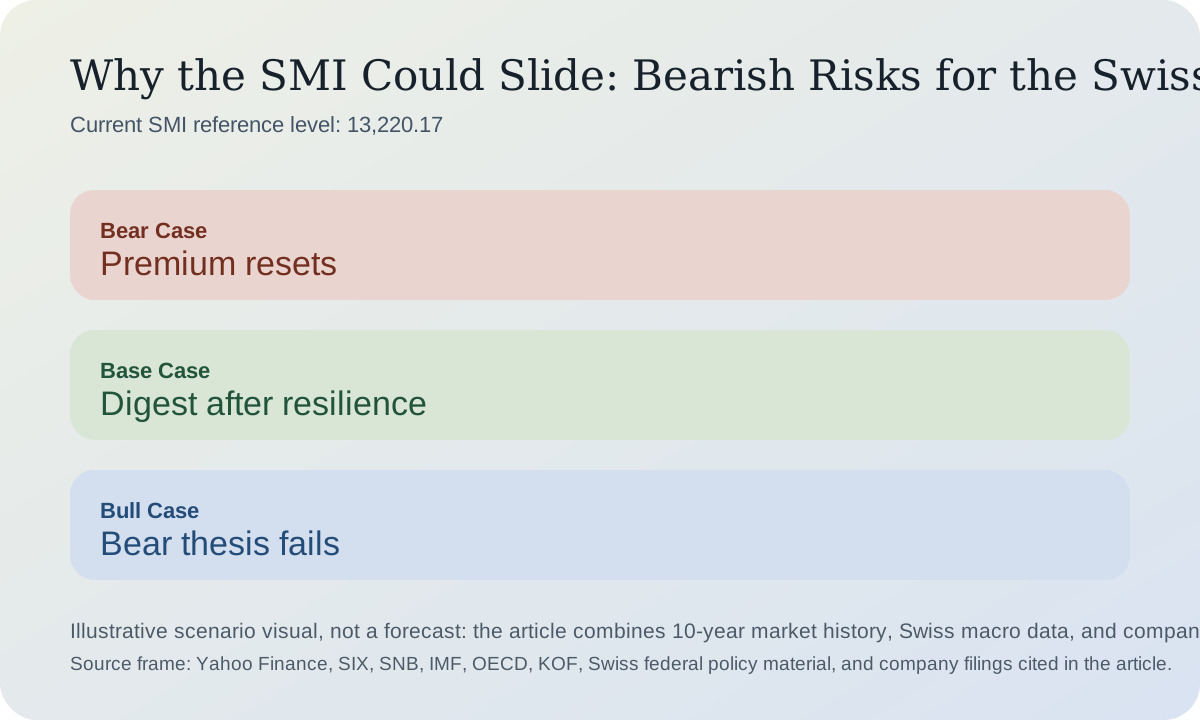
Bearish scenario
The primary bear case is 11,900 to 12,700. That range implies the index gives back part of its premium as defensive multiples compress and currency pressure weighs on earnings optics.
Base-case scenario
The base case is a more mixed 12,700 to 13,400 range where the market corrects, consolidates, and then looks for support from healthcare, insurance, and dividend credibility.
Bullish counter-scenario
The bear case fails if healthcare and staples execution remains cleaner than feared and if global investors continue paying for Swiss quality as a safe haven.
Risks to watch
Watch CHF strength, healthcare sales, Nestlé volume trends, insurance pricing, and whether capital keeps flowing toward defensive markets.
What could invalidate the downside view
This bearish framework would be too harsh if safe-haven demand stays firm while healthcare and financials both deliver stronger-than-expected results. It would also be too harsh if valuation discipline proves looser than skeptics assume.
Conclusion
The SMI could slide from here without proving the long-term Swiss market thesis wrong. The key distinction is that a correction or mild bear market is plausible even when the underlying institutional and franchise quality remains strong.
For that reason, bearish analysis here is less about denying Swiss stability and more about respecting how premium defensive markets behave when valuation, currency, and concentration all become less friendly at once.
Disclaimer: This article is for research and educational use only. It is not a short recommendation or a claim of certainty about future market direction.
| Scenario | Range | Conditions | Probability |
|---|---|---|---|
| Deep bear | 11,200-11,900 | Defensive de-rating and weaker healthcare-staples execution intensify together | 15% |
| Correction / primary bear case | 11,900-12,700 | Premium compresses while CHF pressure rises | 35% |
| Base / choppy consolidation | 12,700-13,400 | No crisis, but gains digest | 35% |
| Bullish invalidation | 13,500-14,400 | Quality premium persists and earnings hold up | 15% |
| Path | Estimated probability | Why |
|---|---|---|
| Rising from current levels | 30% | The index still has quality support, but valuations are already full. |
| Falling from current levels | 45% | Correction risk is meaningful given concentration and defensive premium. |
| Moving sideways | 25% | Possible if healthcare and dividends offset some valuation fatigue. |
06. Investor Positioning
A bear-case framework is about discipline rather than drama
| Investor type | Cautious approach | What to watch |
|---|---|---|
| Investor already in profit | Trim oversized winners and rebalance before a defensive de-rating does it for you. | How much of the gain depends on premium valuation rather than earnings growth. |
| Investor currently at a loss | Do not average down blindly into weakening momentum. | Test whether the thesis remains about defensive quality or only about perceived safety. |
| Investor with no position | Wait for confirmation or for a better entry after volatility. | There is no need to pay any price for safety. |
| Trader | Use stop-losses and respect volatility around earnings and CHF-sensitive headlines. | The index is defensive, but still concentrated. |
| Long-term investor | Keep cash for staged entries instead of trying to pick the exact bottom. | Corrections can improve long-run entry points if the structural thesis survives. |
| Risk-hedging investor | Use explicit hedges rather than assuming Swiss equities alone hedge all macro risk. | Currency, healthcare concentration, and valuation. |
07. FAQ
Frequently asked questions about the SMI outlook
Does a bearish SMI view mean Switzerland is losing its safe-haven status?
No. The more evidence-based downside case is about paying too much for safety, not about Switzerland suddenly becoming unstable.
Why focus so much on healthcare and staples?
Because the SMI remains concentrated enough that the largest defensive franchises drive much of the benchmark.
What would make the bear case wrong?
Continued safe-haven inflows, cleaner healthcare-staples execution, and a market still willing to pay a premium for Swiss quality.
References
Sources
- Yahoo Finance chart API for ^SSMI, 10-year monthly history
- Yahoo Finance chart API for ^SSMI, recent daily closes
- SIX SMI overview page
- SIX SMI methodology 2026
- SIX Exchanges Figures February 2026
- Swiss National Bank Quarterly Bulletin 1/2026
- IMF 2025 Article IV consultation for Switzerland
- OECD Switzerland economic snapshot
- KOF Spring 2026 economic forecast
- Federal Council adopts Digital Switzerland Strategy 2026
- Swiss AI regulation overview
- Nestlé three-month sales 2026
- Roche first quarter sales 2026
- Novartis Q1 2026 results
- UBS first-quarter 2026 results
- ABB Q1 2026 results
- Zurich Insurance May 2026 operating update
- Swiss Re Q1 2026 results