01. Quick Answer
The STOXX50 bear case is credible, but it points more to correction risk than to collapse
The bearish case for the STOXX50 does not require a European collapse. It only requires enough pressure on energy, inflation, margins, and global demand to interrupt a market that has already re-rated meaningfully. With the index at 5,827.76 and April 2026 inflation back at 3.0%, investors do not need apocalyptic assumptions to imagine a pullback (Yahoo Finance; Eurostat).
That matters because the distinction between a correction, a bear market, and a crash is often blurred. A correction usually means a decline of roughly 10% from a recent high, a bear market often means 20% or more, and a crash implies a much faster and more disorderly move. The current evidence supports talking about correction and bear-market risk more than crash risk.
| Headwind | Why it matters |
|---|---|
| Energy inflation | Europe remains vulnerable to higher imported energy costs and geopolitical stress. |
| Weak demand | A softer China or U.S. backdrop can hit exporters, luxury, and cyclicals. |
| Policy limits | Sticky inflation can reduce the ECB's room to support valuations quickly. |
| Narrow leadership | If only a few names hold up, the wider index can still slide. |
02. Historical Context
European drawdowns tend to be macro-driven, which is why context matters
Historical context matters because European drawdowns are usually macro-driven. The pandemic crash of 2020 was sudden, the 2022 decline was tied to inflation and energy, and later rebounds depended heavily on policy response and sector resilience. The current 10-year range from roughly 2,786.90 to 6,138.41 shows that the benchmark can swing hard even when the long-run trend is upward (10-year history).
That history argues against careless use of dramatic language. A decline from the recent high toward the mid-5,000s would be painful and would likely damage sentiment, but it would still be analytically different from a full systemic event. Investors who separate those categories usually make better decisions because they avoid treating every downside move as a once-in-a-generation collapse.
| Type | Typical trigger | What to watch now |
|---|---|---|
| Correction | Valuation reset or earnings disappointment | Recent highs near the top of the 52-week range. |
| Bear market | Macro slowdown plus tighter financial conditions | Inflation, energy, and weaker global demand. |
| Crash | Systemic shock or disorderly financial event | Not the base case from available evidence. |
| Metric | Reading | Bear-case relevance |
|---|---|---|
| Recent close | 5,827.76 | Pullback analysis should start from the live index, not from an old crisis low. |
| 52-week high | 6,199.78 | A 10% correction from this zone is not hard to imagine. |
| Euro area GDP Q1 2026 | 0.1% q/q | Growth is soft enough that shocks matter. |
| April 2026 inflation | 3.0% y/y | Inflation can restrict fast policy relief. |
03. Main Drivers
Five headwinds can still push the index lower
1. Energy is still Europe's first macro vulnerability
The ECB bulletin says higher energy prices linked to war helped push euro area inflation higher in April 2026. That is exactly the kind of shock that can squeeze margins while also limiting policy support (ECB bulletin).
2. A stronger dollar can tighten financial conditions
State Street's April 2026 currency commentary turned more favorable on the dollar under crisis conditions. That matters because a stronger dollar often coincides with pressure on global risk assets and imported inflation for Europe (State Street FX note).
3. Global demand risks remain real
The Euro Stoxx 50 depends on global sales. If U.S. activity slows or China demand remains uneven, the index can feel it through luxury, industrials, semiconductors, and capital goods.
4. Valuation support has limits
Europe often looks cheaper than the U.S., but cheap markets can stay cheap if earnings estimates fall. That is why bear cases are usually earnings stories, not only multiple stories.
5. Narrow leadership can mask fragility
If only semis or a few industrial champions keep working, the index can still lose altitude as banks, luxury, or cyclical exporters weaken.
04. Institutional Forecasts and Analyst Views
Even constructive houses leave room for a real downside scenario
Even constructive institutions admit the downside cannot be ignored. UBS is more positive on Europe, but it explicitly roots that view in stabilization, growth recovery, and sector opportunity, which means the thesis weakens if those conditions deteriorate (UBS). J.P. Morgan's more constructive eurozone call also depends on improving earnings and fiscal support (J.P. Morgan).
That leaves room for a credible bearish counter-view. BlackRock's neutral stance and State Street's emphasis on crisis-driven dollar strength provide a useful rebuttal to one-way optimism. Available data suggests the bear case is not dominant, but it is substantial enough that investors should treat it seriously.
The practical implication is that the downside thesis should be evaluated through indicators, not emotion. If inflation stays sticky, oil remains firm, and earnings revisions roll over together, the bear case becomes much easier to defend. If those indicators stabilize, the bearish setup becomes harder to sustain even if headlines remain noisy.
| Risk area | Mechanism | Potential market effect |
|---|---|---|
| Energy shock | Raises costs and inflation together | Hurts margins and compresses multiples. |
| Weak earnings revisions | Challenges the recovery narrative | Turns valuation support into a trap. |
| Dollar strength | Tightens global conditions | Pressures sentiment and relative returns. |
| Political or fiscal stress | Raises Europe's risk premium | Can widen discount again. |
05. Bear, Base, and Bull-Rebuttal Cases
A balanced bearish thesis still needs an honest invalidation path
Bearish scenario
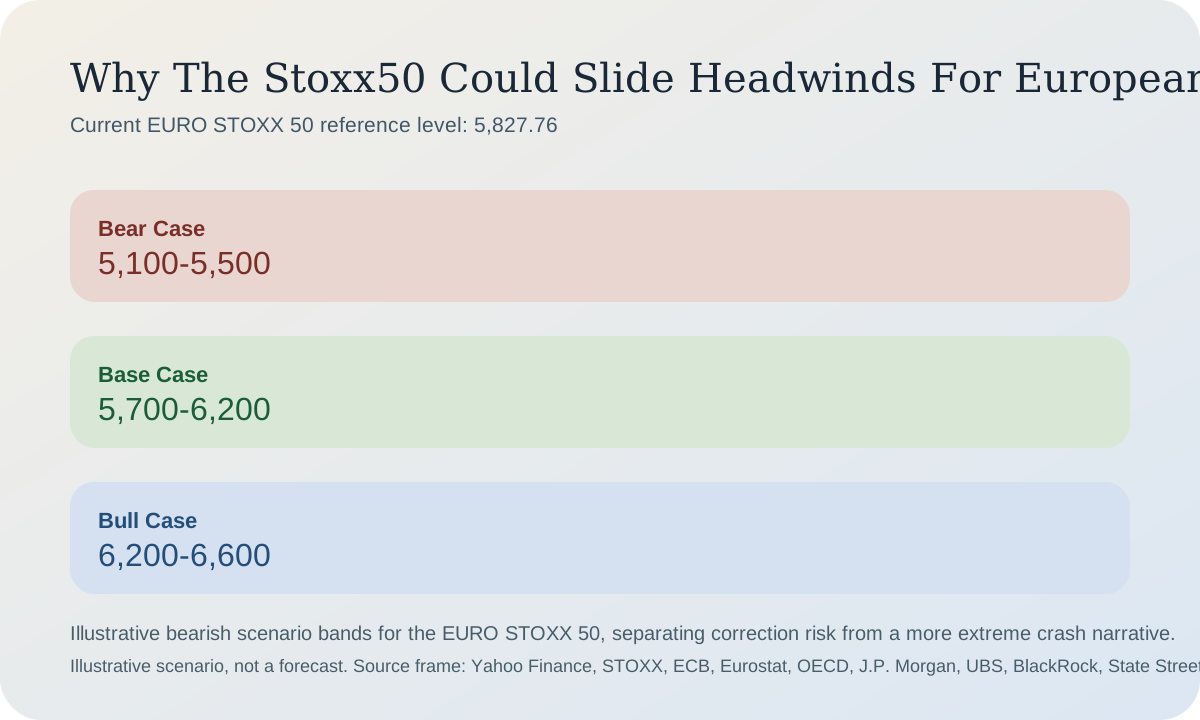
The core bear case is a slide toward 5,100 to 5,500. This would be consistent with a correction or mild bear-market setup rather than a disorderly crash.
Base-case scenario
The base case is a choppy 5,700 to 6,200 range. In this outcome, the market absorbs some headwinds but avoids a deep break because banks, industrials, or defensive sectors offset part of the weakness.
Bullish rebuttal
The bull rebuttal is that Europe still has valuation support, healthier banks than in prior cycles, and better fiscal backing than many critics assume. If that argument wins, the bear case fails.
| Scenario | Likely outcome | Conditions | Probability |
|---|---|---|---|
| Bear | 5,100-5,500 | Higher energy, sticky inflation, and weaker earnings. | 30% |
| Base | 5,700-6,200 | Mixed macro signals with selective resilience. | 45% |
| Bull rebuttal | 6,200-6,600 | Growth stabilizes and the earnings narrative holds. | 25% |
| Path | Probability | Comment |
|---|---|---|
| Falling | 35% | The headwinds are real enough to justify a meaningful downside probability. |
| Rising | 25% | Upside exists, but the burden of proof is on earnings resilience. |
| Sideways | 40% | A churny market is plausible when the evidence is mixed. |
The probabilities are based on the current inflation and GDP mix, the live chart position, and the fact that even bullish institutions keep their optimism conditional rather than absolute.
Put differently, the bearish case becomes more credible when several stress signals align at once. A single weak session or one disappointing headline is rarely enough. A more durable slide usually needs confirmation from inflation, earnings, and financing conditions together.
06. Investment Implications
Positioning should reflect whether investors fear a correction, bear market, or something worse
| Investor type | Prudent approach | Main watchpoints |
|---|---|---|
| Investor already in profit | Trim selectively or hedge rather than assume the rally is untouchable. | Oil, gas, and earnings revisions. |
| Investor currently at a loss | Avoid averaging down without a renewed thesis. | Support levels and macro confirmation. |
| Investor with no position | Wait for clarity or a better risk-reward entry. | Correction depth versus earnings outlook. |
| Trader | Use stop-loss levels and distinguish correction risk from crash narratives. | Volatility and headline risk. |
| Long-term investor | Rebalance and keep exposure aligned with broader portfolio goals. | Whether the setback is cyclical or structural. |
| Risk-hedging investor | Consider hedges if energy or FX risk escalates. | Dollar, oil, and eurozone volatility. |
Risks to watch: oil and gas spikes, inflation persistence, earnings downgrades, and renewed dollar strength.
What could invalidate the bear case: a calmer energy backdrop, better-than-feared global demand, and broader EPS upgrades would all weaken the slide thesis.
Conclusion: the STOXX50 could slide, and the headwinds are concrete rather than hypothetical. But the most likely downside is a correction or moderate bear-market path, not a guaranteed crash.
That distinction is what should keep investors analytical rather than emotional. Bearish frameworks are most useful when they define conditions clearly enough that the thesis can be updated quickly and calmly and rationally as new data arrives.
Disclaimer: This article is for informational research only and should not be treated as a recommendation to sell, buy, or short any security.
07. FAQ
Frequently asked questions about the bearish STOXX50 case
Could the STOXX50 crash?
Available data suggests a correction or moderate bear-market move is easier to justify than an outright crash scenario.
What is the biggest downside trigger?
The strongest near-term headwind is a renewed energy shock because it can weaken growth and raise inflation at the same time.
What would make the bear case wrong?
Improving earnings breadth, calmer energy prices, and steadier policy expectations would weaken the bearish thesis materially.
References
Sources
- Yahoo Finance chart API for ^STOXX50E, 10-year monthly history
- Yahoo Finance chart API for ^STOXX50E, recent daily closes
- STOXX index details page for the EURO STOXX 50
- STOXX Index Guide, April 2026
- iShares Core EURO STOXX 50 UCITS ETF fact sheet, March 2026
- State Street SPDR EURO STOXX 50 ETF benchmark page
- Eurostat flash GDP estimate for Q1 2026
- Eurostat euro area inflation release for April 2026
- ECB staff macroeconomic projections for the euro area, March 2026
- ECB Economic Bulletin Issue 3, 2026
- OECD Economic Outlook, euro area chapter
- Reuters market coverage on European shares and inflation worries, via Investing.com
- J.P. Morgan European Stocks Outlook
- UBS on Europe's stock markets
- BlackRock investment outlook
- State Street currency commentary