01. Quick Answer
A bearish Toyota case does not require betting against the whole company, only against current expectations
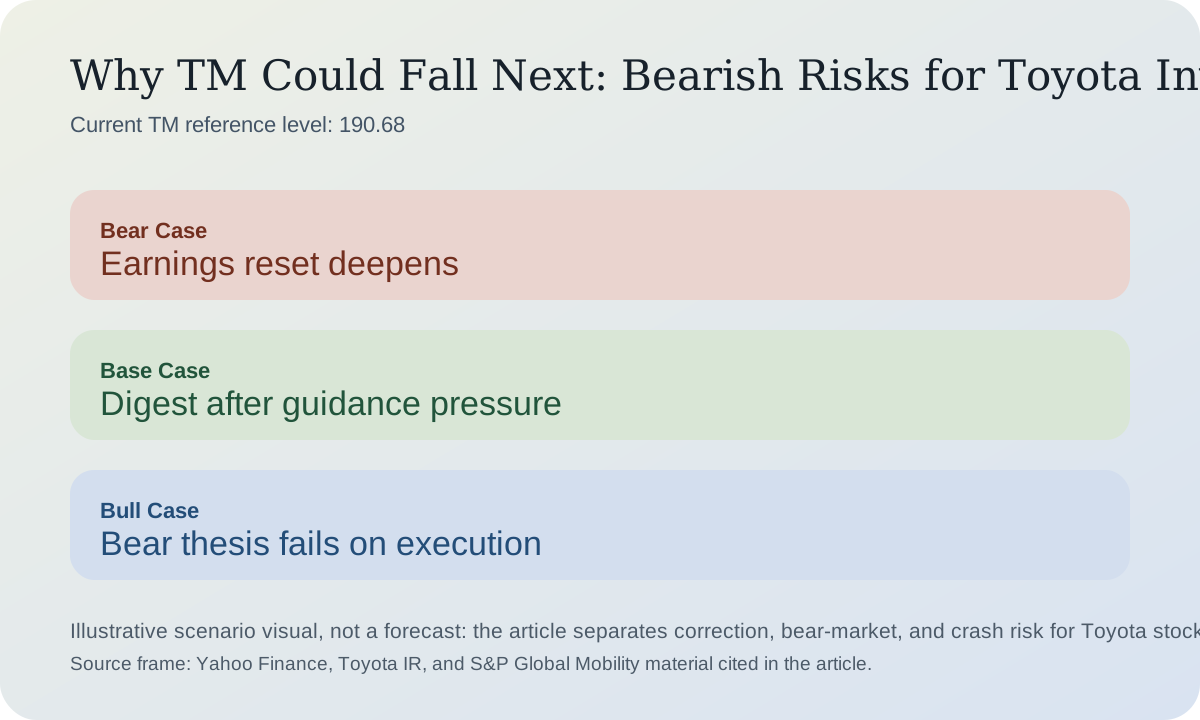
TM closed at 190.68 on 2026-05-15 after spending the last year between 167.18 and 248.90 (Yahoo Finance chart API for TM, recent daily closes; Yahoo Finance chart API for TM, 10-year monthly history). That range already shows the stock can reprice materially without the business being broken.
The bearish framework starts with profit quality. Toyota FY2026 results showed revenue growth, but operating income fell 21.5% and net income attributable to Toyota fell 19.2%. Then management guided FY2027 operating income down another 20.3% and net income down 22.0%. That is enough to build a credible bear case even before adding macro stress, tariffs, oil, or competitive pressure.
| Point | Why it matters |
|---|---|
| The bear case is about margins, not survival | Toyota does not need to be broken for the stock to underperform. |
| Guidance already leans cautious | Investors are not starting from a clean growth acceleration story. |
| Competition is intensifying | BEVs, Chinese exporters, and price pressure all raise execution risk. |
| The bear case still has an invalidation path | If Toyota beats guidance and transition execution improves, the downside thesis weakens. |
02. Historical Context
Downside analysis starts by separating correction risk from structural failure
For practical investing, a correction usually means a decline of roughly 10% to 20%, a bear market means more than 20%, and a crash is a deeper, faster drawdown often closer to 30% or worse. Those are market conventions, not legal definitions, but they matter because Toyota's likely downside path is much more plausibly a correction or cyclical bear phase than a true existential crash.
The 10-year ADR history from 99.99 to 190.68 (Yahoo Finance chart API for TM, 10-year monthly history) also matters because Toyota is not a speculative newcomer. It is a large, cash-generative automaker. A bearish thesis therefore has to focus on valuation, margins, competition, and macro pressure rather than on bankruptcy-style outcomes.
| Type | Typical size | What it would likely mean for Toyota |
|---|---|---|
| Correction | 10% to 20% | Normal auto-cycle reset, often driven by guidance or macro concerns. |
| Bear market | More than 20% | Usually needs sustained margin pressure or a deeper demand shock. |
| Crash tail | Roughly 30% or more, often quickly | Would likely require multiple shocks at once, not just normal competition. |
| Risk factor | Why it matters | Downside channel |
|---|---|---|
| Lower profit guidance | FY2027 guidance already points to weaker earnings | Creates a lower bar for disappointment if execution slips again. |
| Transition uncertainty | Toyota must fund hybrids, BEVs, batteries, and software in parallel | Capital intensity can pressure returns on equity. |
| Global industry pricing | Autos remain highly competitive and discount sensitive | Even strong brands can see margin pressure. |
| Macro and trade shocks | Oil, tariffs, and FX still hit Toyota's operating model | Can quickly change earnings expectations and investor sentiment. |
03. Bearish Drivers
Six threats could drag TM lower from here
1. A weaker margin profile than investors expect. FY2026 operating margin fell to 7.4% from 10.0% in FY2025 (Toyota FY2026 financial summary). If the market starts treating that compression as structural rather than temporary, the stock could de-rate.
2. Further cuts to FY2027 expectations. Toyota already guided FY2027 net income to ¥3.0 trillion (Toyota FY2026 financial summary). A miss against a lowered guide often hurts more than a miss against a high guide because it challenges the company's control narrative.
3. EV and battery competition keeps intensifying. Toyota's battery roadmap is ambitious, but that does not remove competitive risk. Slower-than-expected BEV traction or delayed battery economics would weaken the transition story (Toyota next-generation battery EV strategy; Toyota and Idemitsu cooperation on solid-state batteries).
4. Tariffs and policy friction. Toyota itself explicitly lists tariffs and trade policies among forward-looking risks (Toyota investor relations homepage). In a more protectionist world, global scale can turn into global complexity.
5. Oil and logistics shocks. S&P Global Mobility still describes a market exposed to energy and shipping disruptions, which can pressure demand and manufacturing costs simultaneously.
6. Capital gets trapped in a lower-return transition. The biggest strategic bear case is not that Toyota transitions at all. It is that it transitions expensively without generating a better long-term earnings mix.
04. Institutional Forecasts and Analyst Views
The bearish case is credible because public sources already point to pressure points
This is not a fabricated downside story. Toyota own results show lower year-on-year profitability and a weaker FY2027 forecast. S&P Global Mobility describes a near-flat industry with affordability and cost pressure. Its production outlook still points to energy and geopolitical risks affecting major production regions.
That does not make Toyota a broken company. It makes it a strong company operating in a harder environment. For a bear case, that is enough. Stocks can fall because expectations reset, even when the underlying franchise remains world class.
The probability framework here is built from public guidance, current valuation context, and the stock's own history of cyclical drawdowns rather than from dramatic insolvency assumptions. That matters because disciplined bearish analysis should distinguish between a high-quality company facing a hard year and a company facing permanent impairment.
| Source | Caution signal | Why it matters |
|---|---|---|
| Toyota FY2026 results | Revenue up, profits down | Shows that scale alone is not defending margin quality. |
| Toyota FY2027 guide | Management expects another profit decline | Creates a setup where the stock can fall on further disappointment. |
| S&P Global Mobility | Macro, energy, and tariff risks remain active | Supports correction and bear-market scenarios. |
| Battery transition roadmap | Execution still has to catch up with ambition | The market may penalize delay or cost overruns. |
05. Scenarios, Risks, and Invalidation
A serious bearish framework should separate normal downside from extreme downside
Correction scenario
A correction to roughly $165 to $175 would be the mildest bearish path. That could happen through modest earnings disappointment or a sector-wide multiple reset.
Bear-market scenario
A bear-market zone of $135 to $155 would likely require sustained margin pressure, weaker demand, and investor concern that Toyota's transition spending is not earning adequate returns.
Crash tail
A crash-tail zone below $125 is an extreme scenario, not a base case. It would probably require multiple stress events at once, such as severe trade escalation, deep consumer weakness, and sharper operational or recall-related setbacks.
What could invalidate the bearish thesis
The downside case weakens materially if Toyota beats FY2027 expectations, keeps dividends and buybacks credible, and shows improving BEV or solid-state execution. It also weakens if the industry's pricing environment proves firmer than feared.
Conclusion
TM could absolutely fall from here. The important issue is not whether Toyota is good or bad as a company, but whether current expectations still leave room for an earnings or transition reset.
For readers using this article as a risk-management tool, the most useful distinction is between temporary weakness and thesis damage. A short-lived correction can create opportunity. Repeated guidance cuts, worsening margin quality, and weaker transition economics would be more serious signals.
Disclaimer: This article is for research and informational purposes only. Bearish scenarios are conditional risk cases, not certainties or personalized advice.
| Scenario | Range | Conditions | Probability |
|---|---|---|---|
| Correction | $165-$175 | Modest earnings miss or sector-wide de-rating | 35% |
| Bear market | $135-$155 | Margin deterioration and cyclical demand weakness | 25% |
| Crash tail | Below $125 | Multiple shocks hit at once | 10% |
| Bear thesis fails | $195-$225 | Guidance proves conservative and execution improves | 30% |
| Path | Estimated probability | Comment |
|---|---|---|
| Rising | 25% | The bear article still acknowledges upside if execution improves. |
| Falling | 45% | Lower profit guidance and transition risk make downside plausible. |
| Sideways | 30% | A long digestion phase is also realistic for a high-quality cyclical stock. |
06. Investor Positioning
A bearish article still needs practical guidance for different investor types
| Investor type | Cautious approach | What to watch |
|---|---|---|
| Investor already in profit | Trim or hedge part of the position rather than assuming Toyota is too strong to correct. | Trailing stops and rebalancing can be more prudent than conviction alone. |
| Investor currently at a loss | Avoid averaging down until it is clearer whether the issue is cyclical or structural. | Guidance cuts and margin trends matter more than comforting narratives. |
| Investor with no position | Wait for either a clearer capitulation point or improving earnings signals. | The first dip is not always the best dip. |
| Trader | Use stop-losses and avoid treating Toyota as a low-volatility bond substitute. | Autos can move quickly on headline and earnings risk. |
| Long-term investor | Only keep adding if the long-run thesis still holds and sizing remains disciplined. | Use staged entries, not heroic bottom calls. |
| Risk-hedging investor | Consider simple index or sector hedges if cyclical downside would damage the wider portfolio. | Oil, tariffs, and pricing pressure are the main early warning signs. |
07. FAQ
Frequently asked questions about a possible TM pullback
Does a bearish Toyota article mean the company is broken?
No. It means the stock could still reprice lower if margins, guidance, or transition confidence deteriorate.
What is the difference between a correction and a bear market for TM?
A correction is usually a 10% to 20% decline, while a bear market generally means more than 20% down from prior levels.
What would make the bearish thesis wrong?
A clear guidance beat, stronger electrified execution, and better-than-feared industry pricing would all weaken the downside case.
References
Sources
- Yahoo Finance chart API for TM, 10-year monthly history
- Yahoo Finance chart API for TM, recent daily closes
- Toyota FY2026 financial summary
- Toyota FY2026 financial results presentation
- Toyota investor relations homepage
- Toyota next-generation battery EV strategy
- Toyota and Idemitsu cooperation on solid-state batteries
- S&P Global Mobility automotive industry outlook for 2026
- S&P Global Mobility 2026 light vehicle production forecast