01. Quick Answer
The most credible TTE downside case is a pullback driven by commodities and capital-return sensitivity, not a collapse of the company
The bearish case for TTE is not that TotalEnergies lacks quality. It is that the shares remain exposed to the classic energy-stock trap: strong recent cash flow can coexist with a sharp pullback if the market starts to price lower oil, thinner buybacks, or weaker confidence in transition returns. After touching a 10-year high in February 2026, the stock still has enough macro exposure to correct meaningfully.
| Risk | Why it matters |
|---|---|
| A correction is easier to imagine than a collapse | Strong cash flow reduces crash risk, but not valuation or commodity-cycle risk. |
| Buybacks can shrink fast | A lower return profile can weigh on sentiment even if the business stays profitable. |
| Integrated power could be viewed skeptically | If returns disappoint, transition capex may be seen as dilution rather than diversification. |
| Bear cases need explicit triggers | Without real macro or execution pressure, a downside thesis is just rhetoric. |
02. Historical Context
It is important to distinguish a correction, a bear market, and a crash before discussing TTE downside
Before discussing downside, it helps to distinguish three market terms. A correction usually implies a drawdown of around 10% from recent highs. A bear market means a deeper, more sustained drop of 20% or more. A crash implies a fast, disorderly collapse tied to panic or solvency fears. For TTE, the most plausible negative case is a correction or mild bear market, not a crash, because TotalEnergies still has large and diversified cash flows.
| Type | What it would look like from €78.68 | Most plausible trigger |
|---|---|---|
| Correction | Around €71 or lower | Oil softens, buyback support fades, or integrated-power skepticism grows. |
| Bear market | Around €63 or lower | A more durable oil and gas downturn compresses both cash flow and sentiment. |
| Crash | A disorderly break far below €63 | Would likely require an extreme system-wide energy or credit shock beyond current evidence. |
That distinction matters because energy stocks often trigger exaggerated narratives. Strong dividends and buybacks can make investors feel safer than they really are, while commodity drawdowns can make ordinary corrections feel like existential events. A disciplined bear case should avoid both errors.
In other words, high cash flow does not abolish cyclical equity risk.
It only changes the shape of the downside, not the fact that downside exists.
Another reason to stay precise is that downside in TTE can develop in stages: lower expected commodity prices, then lower expected buybacks, and then wider skepticism toward transition returns. That sequence matters for both timing and magnitude.
03. Main Risks
Five threats could pressure TotalEnergies despite its cash generation
1. Oil could normalize lower after the current tightness
If the EIA's expectation of lower prices later in 2026 proves directionally right, one of the biggest supports for the stock would weaken (EIA April 2026).
2. LNG margins may become less favorable
The gas story is strategically important, but not immune to oversupply or demand disappointment. If gas rebalances less favorably, TTE's differentiation narrows.
3. Buyback reductions can hit sentiment quickly
Reuters-linked February 2026 coverage made this very clear: capital returns are a real driver of the stock, and lower buybacks can change the tape fast (Reuters-linked February 2026).
4. Transition projects may face return skepticism
Integrated power can help the multiple if it works well. If returns disappoint, the market can interpret the same capex as value dilution.
5. Geopolitics can hurt as well as help
Higher prices from geopolitical stress can lift earnings, but they can also create demand destruction, policy backlash, and extreme volatility. The IEA's shifting 2026 oil commentary is a reminder that energy shocks are not one-way bullish.
04. Institutional Forecasts and Analyst Views
A credible bear case needs explicit conditions rather than vague energy pessimism
A credible bearish framework for TotalEnergies should be rooted in current public evidence, not generic energy pessimism. Lower buybacks when prices were weaker, the need to keep funding large capex, and the volatility of official oil outlooks all give the downside case real substance. At the same time, the company's integrated model and LNG position mean the downside thesis should stay conditional rather than absolute.
| Condition | Current evidence | Bearish implication |
|---|---|---|
| Oil prices ease materially | Plausible according to some official outlooks | Cash returns and earnings power would weaken. |
| LNG normalizes lower | Possible as supply expands | A key strategic differentiator would look less valuable. |
| Buybacks remain smaller | Already happened when prices softened | Support for the stock would weaken. |
| Integrated power earns skepticism | Always possible in transition capex stories | The multiple could compress rather than broaden. |
The evidence is mixed enough that the bear case should remain probabilistic. A downside view that ignores TotalEnergies' gas exposure, power optionality, and cash generation would be incomplete. But a bullish view that ignores how fast energy sentiment can reverse would be incomplete too.
In practical terms, the bearish setup is strongest when weaker hydrocarbons and transition skepticism reinforce each other. If only one of those appears, the pullback may stay limited.
If both appear at once, the derating can last much longer than income investors expect.
That is especially true when buybacks are falling at the same time.
Bearish investors should also remember that downside in large integrated energy names often unfolds through several quarters of disappointment rather than one dramatic collapse. A weaker commodity strip, lower expected cash returns, and rising doubts about transition project returns can combine into a slower but still meaningful derating cycle.
That kind of grind lower can be especially frustrating for yield-focused holders who assumed dividends alone would cap the downside.
05. Bear, Base, and Counter-Bull Cases
The downside case is real, but so is the risk of becoming too dramatic
Bearish scenario
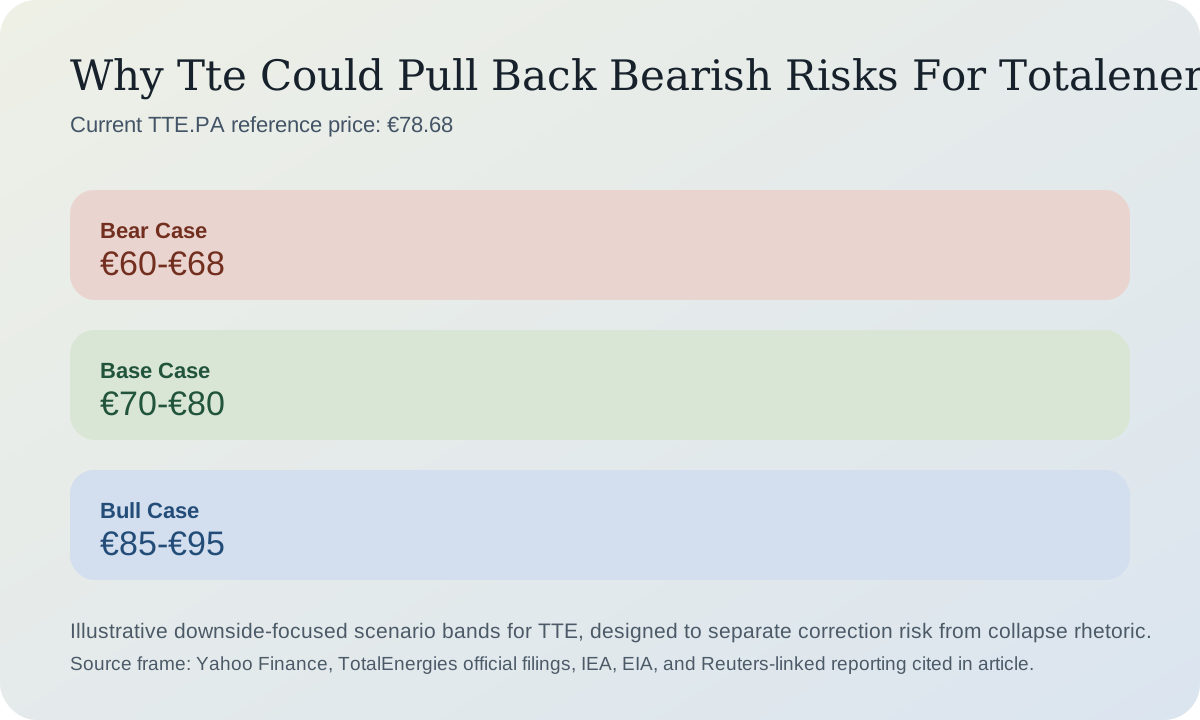
The main downside range is €60 to €68. That would fit a serious but not disorderly pullback driven by weaker hydrocarbons, thinner buybacks, and greater skepticism about non-hydrocarbon returns.
Base scenario
A more balanced range is €70 to €80, where the stock consolidates while investors reassess both commodity and strategy signals.
Counter-bull scenario
The bull case that would invalidate the bearish thesis is €85 to €95 if oil and LNG stay strong enough and power execution keeps improving.
| Scenario | Range | What it means | Probability |
|---|---|---|---|
| Bear | €60-€68 | A meaningful but non-catastrophic pullback in a capital-returning energy major. | 45% |
| Base | €70-€80 | Range-bound trading while the market reassesses the macro-energy setup. | 35% |
| Bull | €85-€95 | The bearish call fails because commodity and strategy support stay strong. | 20% |
| Path | Estimated probability | Comment |
|---|---|---|
| Rising | 30% | Possible if current macro energy support persists longer than expected. |
| Falling | 45% | The stock is still vulnerable to classic energy-cycle pullback dynamics. |
| Sideways | 25% | Cash returns can support consolidation even without a new rally. |
Risks to watch
Watch Brent, LNG, buyback guidance, capital intensity, and whether integrated power is seen as accretive or dilutive to returns.
What could invalidate the bear case
The bearish thesis would weaken if commodity conditions remain favorable, if buybacks re-accelerate, or if the market starts placing more value on power and LNG diversification than it does today.
Conclusion
TTE could pull back, but the most rigorous downside view is a correction or mild bear market, not a collapse narrative. The company is stronger than that. The stock, however, is still cyclical enough to reprice lower.
For that reason, bearish investors should look for confirmation rather than drama. Without weaker cash returns or lower confidence in execution, the downside thesis remains incomplete.
That restraint is part of what makes the bear case analytical rather than theatrical.
Commodity stocks punish drama as often as they reward it.
Bearish positioning therefore works best when it is evidence-led.
Without that, the thesis can become just another emotional oil call.
That is rarely a durable way to make money in cyclical equities.
Disclaimer: This downside framework is for informational research only. It is not a recommendation to short, sell, or avoid TTE categorically.
06. Investor Positioning
Different investor types should react differently to a possible TTE pullback
| Reader type | Cautious approach | Risk control |
|---|---|---|
| Investor already in profit | Trim if energy exposure became too large relative to your portfolio. | Rebalance rather than making an all-or-nothing macro call. |
| Investor currently at a loss | Separate thesis damage from normal commodity volatility. | Use thesis review points or stop-losses if your horizon is short. |
| Investor with no position | Wait for confirmation or deeper pullbacks. | Avoid catching a falling knife on commodity names. |
| Trader | Respect downside momentum and event risk. | Use stop-losses around earnings, OPEC, and macro reports. |
| Long-term investor | Keep dry powder and scale gradually. | Strong dividends do not remove entry-price risk. |
| Risk-hedging investor | Use dedicated hedges rather than a single bearish stock view. | Macro hedges matter if your concern is inflation or geopolitics. |
07. FAQ
Frequently asked questions about the TTE bear case
Could TTE crash?
Current public evidence supports a correction or mild bear-market path much more than a crash, because TotalEnergies still generates large cash flows.
What is the biggest downside trigger?
A combination of weaker oil, softer LNG, and smaller buybacks would be the clearest downside trigger.
Why include a bull case in a bearish article?
Because a serious bear case should also explain what would make it wrong.
References
Sources
- Yahoo Finance chart API for TTE.PA, 10-year monthly history
- Yahoo Finance chart API for TTE.PA, recent daily closes
- TotalEnergies annual financial reports page
- TotalEnergies 2025 Universal Registration Document
- TotalEnergies results page
- TotalEnergies Q1 2026 results press release
- Board statement on TotalEnergies strategy and 2026 buyback framework
- TotalEnergies two-pillar multi-energy strategy
- TotalEnergies energy-transition page
- TotalEnergies gas-to-power integration strategy in Europe
- IEA Oil Market Report, May 2026
- IEA Gas Market Report, Q1 2026
- EIA Short-Term Energy Outlook, April 2026
- Reuters-linked coverage of TotalEnergies cutting buybacks in February 2026
- Reuters-linked coverage of TotalEnergies Q1 2026 trading and earnings outlook