01. Quick Answer
The strongest Unilever bear case is not collapse, but a return to low-energy staples stagnation
The cleanest bearish case for Unilever is that slower markets, more stubborn inflation, or weaker category execution pull the stock back into a low-growth staples valuation trap. That would not mean the business is broken. It would mean the market no longer believes the post-separation company deserves more credit.
| Point | Why it matters |
|---|---|
| The downside case is mostly about slowing quality of growth | Unilever's equity story is more about steady execution and quality of growth than about dramatic multiple expansion. |
| Inflation can still squeeze the margin story | Volume, mix, and margin discipline are now more important than simple price-led sales growth. |
| A cleaner portfolio does not guarantee better results | The post-separation portfolio will be judged more directly, with fewer distractions. |
| The bearish case still needs rebuttals | Scenario ranges are more credible than a one-number target for a global staples company. |
02. Historical Context
Unilever remains a global staples compounder, but the modern investment case is increasingly about volume quality, portfolio focus, and execution after the ice cream separation
UL moved from roughly $53.95 to about $57.34 over the last 10 years based on Yahoo Finance monthly data, implying a 10-year CAGR of about 0.61%. That looks unimpressive next to technology leaders, but it also understates how staples stocks are judged. The Unilever case is less about explosive price appreciation and more about steady brand power, margin resilience, dividends, portfolio reshaping, and the ability to convert marketing and supply-chain discipline into volume-led growth. Available data suggests the company is trying to reset toward a simpler, more beauty-and-wellbeing-led profile, but the market still wants proof that better mix will translate into durable growth.
| Metric | Latest official reading | Why it matters |
|---|---|---|
| Q1 2026 underlying sales growth | 3.8% | Shows the company is delivering healthy top-line momentum despite slower markets and cost pressure |
| Q1 2026 volume growth | 2.9% | Volume-led growth is especially important for staples because it signals demand quality rather than just pricing power |
| Q1 2026 turnover | €12.6 billion | Useful baseline for judging whether the post-separation Unilever is maintaining scale and momentum |
| Productivity savings delivered by Q1 2026 | €750 million | Execution on savings matters for operating margin and reinvestment capacity |
| Feature | Unilever implication | Forecast effect |
|---|---|---|
| Large global staples portfolio | Dove, Vaseline, Knorr, Hellmann’s, and other Power Brands create recurring demand and category reach | Supports downside resilience but caps dramatic upside unless execution improves materially |
| Beauty and wellbeing tilt | Management is pushing toward faster-growing, higher-quality categories | Helps the bull case if growth quality improves without sacrificing margin discipline |
| Post-ice-cream simplification | A simpler structure should improve focus and capital allocation | Can support rerating if the cleaner portfolio delivers better volume and margin outcomes |
| Emerging-market sensitivity | Unilever benefits from emerging-market consumption growth but remains exposed to FX, inflation, and geopolitical shocks | Explains why scenario ranges should stay balanced rather than one-directional |
03. Main Drivers
Five forces are most likely to shape Unilever stock over the next several years
1. Volume-led growth is the most important quality signal right now
Unilever's Q1 2026 statement showed underlying sales growth of 3.8%, with 2.9% of that coming from volume and only 0.9% from price. That matters because staples investors usually trust growth more when it is volume-led rather than just inflation-led.
2. Beauty and wellbeing remain the strategic center of gravity
Reuters and Unilever materials both point to beauty, personal care, and wellbeing as the categories with the best mix of growth, margins, and brand strength. If that category tilt keeps working, the market may give Unilever more credit than it did during slower years.
3. The ice cream separation raises the quality bar for the remaining business
With the Magnum ice cream separation completed, the cleaner portfolio should be easier to judge. That is good if execution improves, but it also removes one excuse. Investors will now expect better consistency in growth and margin delivery.
4. Cost inflation and pricing discipline still matter
Reuters reported that Unilever expects total 2026 cost inflation of about €750 million to €900 million, partly due to logistics and factory pressure tied to Middle East disruption. That means pricing, mix, and savings still have to do real work to protect margins.
5. AI and digital execution may gradually improve innovation and commercial efficiency
Unilever's own communications highlight AI in beauty innovation, content supply chains, and broader digital infrastructure. For investors, the likely payoff is not sudden top-line acceleration, but better speed-to-market, marketing efficiency, and operating leverage.
04. Institutional Forecasts and Analyst Views
The best evidence base comes from recent Unilever disclosures, category mix, and Reuters reporting rather than from aggressive point targets
There are fewer credible long-range point forecasts for Unilever than for megacap growth stocks. The better approach is to combine the current price, the very modest 10-year CAGR, management's 2026 guidance, the post-ice-cream portfolio structure, and Reuters coverage of demand, inflation, and the beauty-led strategy. That naturally favors range-based scenario analysis rather than a single deterministic target.
| Source | What it says | Implication for UL |
|---|---|---|
| Q1 2026 full announcement | Unilever delivered 3.8% USG with 2.9% volume growth and maintained full-year guidance | Supports the idea that the underlying business is executing better than a flat 10-year stock chart suggests |
| 2025 annual report and full-year presentation | Management expects 2026 growth at the bottom end of the 4% to 6% range, with at least 2% volume growth and modest margin improvement | Provides a useful official base case for near-term scenario work |
| Reuters, April 2026 | Home care and beauty demand helped Unilever beat quarterly sales expectations, despite cost pressure tied to the Iran war | Confirms that better category mix is supporting the bull case, but inflation risk remains real |
| Reuters, February 2026 | Unilever warned that 2026 growth would sit at the bottom end of guidance as US and Europe slowed | Shows why the base case should stay constructive but not euphoric |
| Unilever AI and digital materials | AI is being used in innovation, content supply chains, and digital operating infrastructure | AI may support efficiency and speed, but probably changes the equity story gradually rather than dramatically |
05. Scenarios
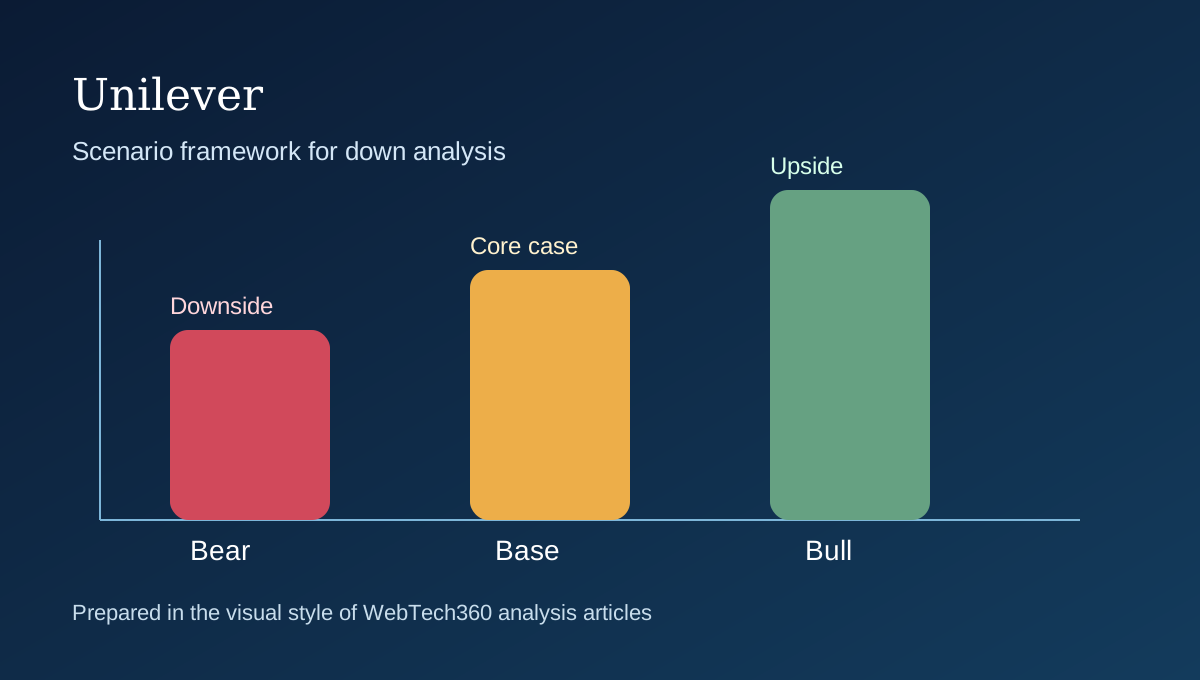
Bull, bear, and base-case scenarios for Unilever
| Scenario | Range | What would likely drive it | Editorial probability |
|---|---|---|---|
| Correction | $51-$55 | Volume or sentiment soften, but the business remains fundamentally sound | 35% |
| Bear market | $45-$51 | Cost inflation, weaker demand, and disappointing execution combine to compress the staples multiple | 20% |
| Bear invalidation | $60-$67 | Volume-led growth, better mix, and disciplined cost control keep investors constructive | 45% |
| Outcome | Probability | Interpretation |
|---|---|---|
| Correction | 35% | Most plausible if markets get nervous about slowing growth, but not about structural damage |
| Bear market | 20% | Less likely than in cyclical sectors, but still possible if margins disappoint or consumer demand weakens sharply |
| No major downside follow-through | 45% | Still possible because Unilever's brands, balance sheet, and global scale provide defensive support |
06. Investor Positioning
How different investors might respond
| Investor type | Prudent stance | Why |
|---|---|---|
| Investor already in profit | Hold core, trim only if the position has become too large relative to the rest of a defensive portfolio | Unilever can still compound slowly, but staples re-ratings are usually gradual rather than explosive |
| Investor currently at a loss | Reassess the thesis around volume growth, category mix, and margin recovery rather than price alone | The stock may stay range-bound if execution is decent but not strong enough to change sentiment |
| Investor with no position | Build slowly and avoid chasing after one strong quarter or one popular AI headline | Staples usually reward patience more than urgency |
| Trader | Use stop-losses and watch volume growth, inflation signals, category performance, and currency pressure | Short-term moves can turn quickly when staples guidance shifts |
| Long-term investor | Focus on brand quality, volume growth, emerging-market execution, and margin discipline; consider dollar-cost averaging | Unilever is most useful as a patient, global consumer-staples allocation |
| Hedging-focused investor | Use UL as one part of a broader defensive sleeve rather than as a complete hedge | It adds defensiveness, but still carries emerging-market, FX, and execution risk |
07. Risks to Watch
What could change the outlook quickly
The downside view is strongest when slower markets, weaker food or emerging-market momentum, and higher cost inflation hit at the same time. But the evidence is mixed because Unilever still has strong brands, good volume momentum, and improving portfolio focus.
| Potential invalidation | Why it matters |
|---|---|
| Volume growth stays above expectations while margin improves | Would strengthen the bull case by proving the cleaner portfolio can grow without relying heavily on pricing |
| Beauty and wellbeing outperformance broadens | Would support a higher-quality mix and justify a better staples valuation |
| AI and digital tools visibly improve speed, innovation, or marketing efficiency | Would support operating leverage and make the long-run case more compelling |
| Inflation pressure fades faster than expected | Would reduce one of the main near-term constraints on operating-margin improvement |
08. Conclusion
Bottom line
Unilever could pull back if investors decide the improvement story is overstated. But the bearish case remains conditional, not inevitable, because the operating base is still solid.
FAQ
Frequently asked questions
Why is volume growth so important for Unilever?
Because staples investors usually trust growth more when it comes from unit demand rather than just from price increases. Volume-led growth suggests the brands are winning with consumers rather than merely passing through inflation.
Did the ice cream separation improve the investment case?
Potentially, because it simplifies the group and sharpens focus. But it also raises the bar, since investors now expect the remaining portfolio to deliver cleaner growth and better capital allocation.
How were the forecast ranges built?
The ranges combine the current UL price, the 10-year CAGR, official 2026 guidance, Q1 2026 volume and sales trends, Reuters reporting on market conditions, and scenario analysis around beauty mix, inflation, and productivity.
Can AI materially change Unilever?
Yes, but mainly by improving innovation, content creation, supply-chain agility, and productivity. The most likely payoff is gradual efficiency improvement rather than a sudden revenue shock.
Methodology and Invalidation
How these Unilever ranges were built and what would change them
These scenario ranges are editorial frameworks, not guarantees or institutional targets. They start with the live UL price near $57.34` in mid-May 2026, then layer on the stock's 10-year CAGR of roughly 0.61%, the Q1 2026 trading statement, management's 2026 guidance, and the strategic shift toward a cleaner, more beauty-and-wellbeing-focused portfolio. A purely mechanical projection of the last decade would miss the role of portfolio simplification, category mix, volume quality, and digital productivity.
For downside language, a correction usually means around 10% down from a recent high, a bear market closer to 20%, and a crash something sharper tied to macro or company-specific dislocation. Unilever is less volatile than many cyclical names, but it can still de-rate if markets lose confidence in growth quality or margin discipline.
The evidence base here is intentionally current. Unilever reported 3.8% underlying sales growth in Q1 2026, including 2.9% volume growth, on turnover of €12.6 billion. Management maintained 2026 guidance at the bottom end of the 4% to 6% underlying sales growth range, with at least 2% underlying volume growth and a modest improvement in underlying operating margin from the 20.0% level reported for 2025. Reuters also highlighted 2026 cost inflation in the €750 million to €900 million range and the strategic importance of beauty and home care demand.
What would invalidate the constructive case? A weaker consumer environment, more stubborn cost inflation, or evidence that growth reverts back to pricing rather than volume would all matter. What would invalidate the bearish case? Continued volume-led growth, stronger beauty-and-wellbeing execution, a cleaner post-separation portfolio, and visible AI-driven productivity gains would weaken it. Investors should treat these articles as conditional research tools that need updating as categories, currencies, and inflation evolve.
Disclaimer: This material is for research and editorial purposes only, does not constitute investment advice, and should not be treated as a recommendation to buy, sell, or hold Unilever PLC or any related security.
References
Sources
- Yahoo Finance chart API, UL 10-year monthly history and current price
- Unilever latest results hub
- Unilever Q1 2026 full announcement PDF
- Unilever Q1 2026 presentation PDF
- Unilever Annual Report and Accounts 2025 PDF
- Unilever Full Year 2025 presentation PDF
- Unilever global corporate site
- Unilever Global Digital & Technology overview
- Reuters, Unilever Q1 2026 earnings beat on home care and beauty demand, April 30, 2026
- Reuters via Investing.com, Unilever beats sales forecasts as home and beauty demand drive growth, April 30, 2026
- Reuters via LSE, Unilever downbeat on 2026 sales growth amid US and Europe slowdown, February 2026
- Reuters via Investing.com, Unilever CFO comments on ice cream demerger timing, October 2025
- Reuters via Investing.com, Unilever to buy supplements brand Grüns, April 9, 2026
- Reuters Breakingviews, Unilever food troubles vindicate beauty makeover, April 30, 2026