01. Quick Answer
Why WTI Oil Could Fall: Bearish Forces for Crude Prices
The quick answer is that WTI could fall sharply without breaking the longer-run case for oil entirely. The cleanest bearish pathway is not a permanent collapse below every historical norm. It is a de-rating from a stretched, disruption-heavy starting point back toward a range more consistent with EIA's 2027 path, Goldman's lower long-run assumptions, and the World Bank's post-shock normalization logic (EIA, STEO current/previous forecast comparisons, May 12, 2026; Investing.com summary of Goldman Sachs cutting 2030-2035 Brent and WTI estimates to $75 and $71; World Bank, Commodity Markets Outlook, April 2026).
A practical downside framework is 55 to 75 dollars per barrel. That would still leave oil expensive versus the 2020 crash era and roughly aligned with some late-2025 and medium-term policy baselines. A true crash below 50 would likely need a deeper demand accident, a strong non-OPEC supply response, or a much faster unwind of the current geopolitical premium than official base cases assume (Yahoo Finance chart API, CL=F 10-year monthly data; Reuters/MarketScreener on Goldman seeing 2026 surplus and long-run Brent/WTI near $80/$76 by late 2028; Investing.com summary of JPMorgan seeing oil oversupply in 2026).
| Category | Evidence-based read | Implication |
|---|---|---|
| The bearish case is cyclical first | Most credible downside scenarios involve normalization and de-rating, not a claim that oil no longer matters. | That distinction changes both target ranges and investor behavior. |
| Starting point matters | Oil near the top of its 10-year range creates more downside asymmetry than upside asymmetry. | Late-cycle conditions make risk management more important. |
| Main bearish forces | Supply recovery, weaker demand, inventory rebuilding, and fading fear premium. | All can work faster than greenfield capex. |
| What limits the downside | OPEC+ discipline, underinvestment, and geopolitical tail risk. | Bearish analysis has to include its own rebuttal. |
02. Historical Context
Current market snapshot and historical context
WTI's 10-year range of $18.84 to $105.76 per barrel is the first reason any forecast has to be scenario-based rather than point-based. Oil is not a stable compounder. It is a clearing price for a system shaped by geology, OPEC+ policy, inventories, freight constraints, war risk, and global growth. The same benchmark that collapsed in 2020 recovered above $100 in both 2022 and 2026, which means investors should distinguish between a correction, a cyclical bear market, and a structurally lower oil regime (Yahoo Finance chart API, CL=F 10-year monthly data; IEA, Global Energy Review 2026: Oil).
The 2020 collapse is still the best reminder that oil can crash when demand, storage, and confidence all fail together. But that was a rare systems failure. A more likely bearish template today is a correction or bear market rather than a repeat of that crash. That distinction is important because a move from 103 to the 60s would be painful and still not historically cheap (Yahoo Finance chart API, CL=F 10-year monthly data; EIA, STEO current/previous forecast comparisons, May 12, 2026).
| Metric | Latest read | Why it matters |
|---|---|---|
| Current regime | Near 10-year highs | Bear cases matter more when valuation already reflects stress |
| Official 2027 anchor | $74.39 WTI | Suggests normalization already sits inside the mainstream base case |
| Late-2025 reference | $57.42 monthly close | Shows how recently the market traded on oversupply logic |
| Main floor under price | OPEC+ management plus underinvestment | Explains why correction and crash are not the same thing |
| Period marker | Approximate price | Interpretation |
|---|---|---|
| June 2016 monthly close | $48.33/bbl | WTI started the visible 10-year band in the high $40s as shale was still absorbing the 2014-2016 crash. |
| April 2020 monthly close | $18.84/bbl | The pandemic collapse shows how violently oil can break when storage, mobility, and sentiment all fail at once. |
| March 2022 monthly close | $100.28/bbl | Russia's invasion of Ukraine pushed crude back into a geopolitical scarcity regime. |
| December 2025 monthly close | $57.42/bbl | Before the 2026 supply shock, the market had already repriced toward oversupply and weaker demand expectations. |
| May 18, 2026 close | $103.37/bbl | Current scenarios start from an elevated, disruption-driven base rather than a neutral equilibrium. |
03. Main Drivers
Main drivers of price movement
1. The current spot price may simply contain too much fear premium
EIA's official 2027 average near 74 dollars and the World Bank's 2027 Brent baseline at 70 both imply that current three-digit WTI is not treated as a stable equilibrium by major institutions. If the shipping and production shock fades faster than feared, the premium can compress quickly (EIA, STEO current/previous forecast comparisons, May 12, 2026; World Bank, Commodity Markets Outlook, April 2026).
2. Demand destruction is no longer theoretical
IEA's May 2026 oil report explicitly says higher prices, a weaker economic environment, and demand-saving measures will increasingly affect fuel use. That matters because the bearish case does not require a deep recession if high prices themselves do enough work (IEA, Oil Market Report, May 2026; IMF, World Economic Outlook, April 2026).
3. Non-OPEC supply can reassert itself once the immediate shock passes
JPMorgan's oversupply framing and Goldman's 2026 surplus discussion both argue that outside current disruptions, the market still has a supply-growth problem for bulls. That means downside is not just about weaker demand; it can also come from better-than-expected output (Investing.com summary of JPMorgan seeing oil oversupply in 2026; Reuters/MarketScreener on Goldman seeing 2026 surplus and long-run Brent/WTI near $80/$76 by late 2028).
4. OPEC+ discipline is a support, but it is not infinite
OPEC can defend price better than it can force demand. If global consumption softens and spare capacity returns, the cartel's price-management power weakens at the margin. Bearish oil analysis should therefore watch not only cuts, but also the market's willingness to absorb them (OPEC, Monthly Oil Market Report demand table; OPEC, World Oil Outlook 2025).
5. Long-run consensus is not as bullish as current spot implies
Goldman's reduced 2030-2035 assumptions and EIA's real-price narrative both imply that three-digit oil is not the base case beyond the current shock window. That does not prove a fall is imminent, but it does support the idea that today's price sits above many medium- and long-run anchor points (Investing.com summary of Goldman Sachs cutting 2030-2035 Brent and WTI estimates to $75 and $71; EIA, Annual Energy Outlook 2026 narrative).
04. Institutional Forecasts and Analyst Views
Institutional forecasts and analyst views
The bearish case becomes more credible when so many institutional anchors already sit below spot. EIA, the World Bank, and Goldman differ on details, but none of them treat current WTI as the obvious steady-state price for the next few years (EIA, STEO current/previous forecast comparisons, May 12, 2026; World Bank, Commodity Markets Outlook, April 2026; Reuters on Goldman Sachs keeping 2026 Brent and WTI forecasts at $83 and $78).
That does not automatically make oil a short. It means the hurdle for fresh bullish positioning is higher. The market needs ongoing disruption or renewed tightening to justify keeping WTI close to the top of its 10-year band.
| Source | Forecast / signal | Interpretation |
|---|---|---|
| EIA STEO | WTI averages $74.39 in 2027 | Official downside anchor relative to current spot |
| World Bank | Brent averages $70 in 2027 | Supports a post-shock cooling thesis |
| Goldman Sachs | Long-run 2030-2035 WTI estimate cut to $71 | Current spot looks rich against the bank's medium-to-long-run anchor |
| JPMorgan | Oversupply risk remains part of the 2026 conversation | Bearish supply logic has not disappeared |
| IEA | Higher prices and weaker macro conditions hurt demand | Demand destruction is an active mechanism, not a theory |
| OPEC | Demand outlook stays robust | The strongest rebuttal to an aggressive bear view |
05. Bull, Bear, and Base Case
How the forecast range and probability table are built
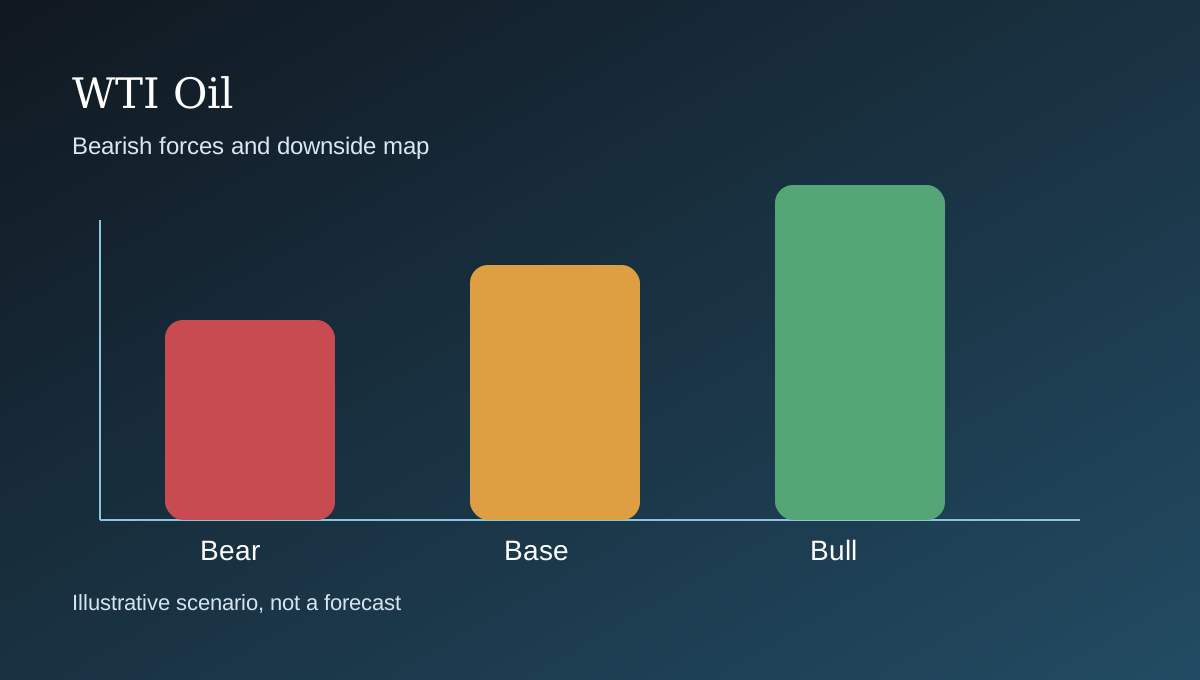
The bearish framework below distinguishes between a correction, a bear market, and a crash. A correction is a move back toward the upper 70s or low 80s. A bear market is a deeper repricing into the 60s. A crash below 50 would likely require a much larger demand accident or a far faster supply recovery than current official baselines assume.
That distinction is important because many investors confuse any sharp drop in oil with a structural collapse. In practice, oil can fall a lot and still remain expensive versus much of the last decade.
| Scenario | Price range | Conditions | Probability |
|---|---|---|---|
| Bear | $55-$75/bbl | Risk premium fades, demand slows, and supply normalization outpaces the market's current expectations | 40% |
| Base | $75-$90/bbl | Oil cools but stays somewhat elevated because OPEC+ discipline and underinvestment still matter | 35% |
| Bull | $90-$110/bbl | Disruptions prove persistent and inventories stay uncomfortably tight | 25% |
| Direction | Probability | Comment |
|---|---|---|
| Lower from current spot | 45% | The bearish case has more credibility when prices start from a stressed level |
| Higher from current spot | 20% | Requires continuing disruption rather than just a good long-run story |
| Sideways but volatile | 35% | A realistic path if bearish and structural supports offset one another |
| Investor type | Prudent approach | Main watchpoints |
|---|---|---|
| Investor already in profit | Consider holding a core allocation but trim into sharp spikes, especially when spot prices outrun medium-term fundamentals. | Watch whether prompt risk premium is fading faster than the narrative. |
| Investor currently at a loss | Reassess position size and thesis rather than averaging automatically. A cyclical commodity can stay volatile longer than expected. | Separate the long-term oil thesis from an entry-price mistake. |
| Investor with no position | Avoid chasing parabolic moves. Wait for pullbacks, stagger entries, or stay patient if the risk-reward no longer compensates for volatility. | High spot prices often compress future returns. |
| Trader | Use stop-loss discipline, monitor inventory data, OPEC+ signaling, and time spreads, and treat headlines as catalysts rather than investment theses. | WTI can overshoot both up and down when positioning becomes crowded. |
| Long-term investor | Dollar-cost averaging can make sense only if you accept long drawdowns and use a horizon long enough to absorb policy and macro cycles. | Long-run oil exposure should be sized as a cyclical asset, not a bond substitute. |
| Risk-hedging investor | Use crude as part of a broader inflation or geopolitical hedge basket, and rebalance when one shock turns a hedge into an outsized directional bet. | Oil can hedge some macro risks while creating others. |
WTI could fall materially from here without invalidating every long-run oil argument. The most credible bearish call is a re-rating from an overstretched starting point, not a declaration that oil is finished. Investors who ignore that distinction risk either underestimating downside or overestimating the probability of a full crash. Disclaimer: This article is for informational and research purposes only and does not constitute personalized financial advice.
06. FAQ
Frequently asked questions
Does a bearish WTI view mean oil's long-term role is broken?
No. It can simply mean current prices are above what medium-term balances can justify once disruption fades.
What is the biggest bearish catalyst right now?
A faster-than-expected normalization of supply and shipping flows, especially if demand also softens under high prices.
Why not call for a collapse back to 30 or 40 dollars?
Because underinvestment, OPEC+ management, and geopolitical risk still provide stronger structural support than in some prior oil bears.
What would invalidate the bearish setup?
If inventory draws persist, spare capacity stays thin, and disruptions keep removing barrels longer than expected, the downside case weakens quickly.
Methodology and Invalidation
How to interpret this framework and what would change it
This downside framework leans on the gap between current WTI and medium-term official anchors. The key inputs are the current spot price, EIA's 2027 average, the World Bank's 2027 Brent path, and Goldman's lower long-run WTI estimate (Yahoo Finance chart API, CL=F recent daily data; EIA, STEO current/previous forecast comparisons, May 12, 2026; World Bank, Commodity Markets Outlook, April 2026; Investing.com summary of Goldman Sachs cutting 2030-2035 Brent and WTI estimates to $75 and $71).
It also deliberately distinguishes correction, bear market, and crash because those outcomes require different mechanisms. The evidence currently supports the first two more easily than the third (IEA, Oil Market Report, May 2026; Investing.com summary of JPMorgan seeing oil oversupply in 2026).
Invalidation would be straightforward: a persistent shortage, ongoing production losses, or an inability to rebuild inventories would require moving the whole bearish range higher.
References
Sources
- Yahoo Finance chart API, CL=F recent daily data
- Yahoo Finance chart API, CL=F 10-year monthly data
- EIA, STEO current/previous forecast comparisons, May 12, 2026
- IEA, Oil Market Report, May 2026
- World Bank, Commodity Markets Outlook, April 2026
- OPEC, Monthly Oil Market Report demand table
- OPEC, World Oil Outlook 2025
- IMF, World Economic Outlook, April 2026
- Reuters on Goldman Sachs keeping 2026 Brent and WTI forecasts at $83 and $78
- Investing.com summary of Goldman Sachs cutting 2030-2035 Brent and WTI estimates to $75 and $71
- Reuters/MarketScreener on Goldman seeing 2026 surplus and long-run Brent/WTI near $80/$76 by late 2028
- Investing.com summary of JPMorgan seeing oil oversupply in 2026
- EIA, Annual Energy Outlook 2026 narrative