01. Quick Answer
A 2026 gold crash is possible, but the evidence currently supports a correction-risk framework more than a collapse call
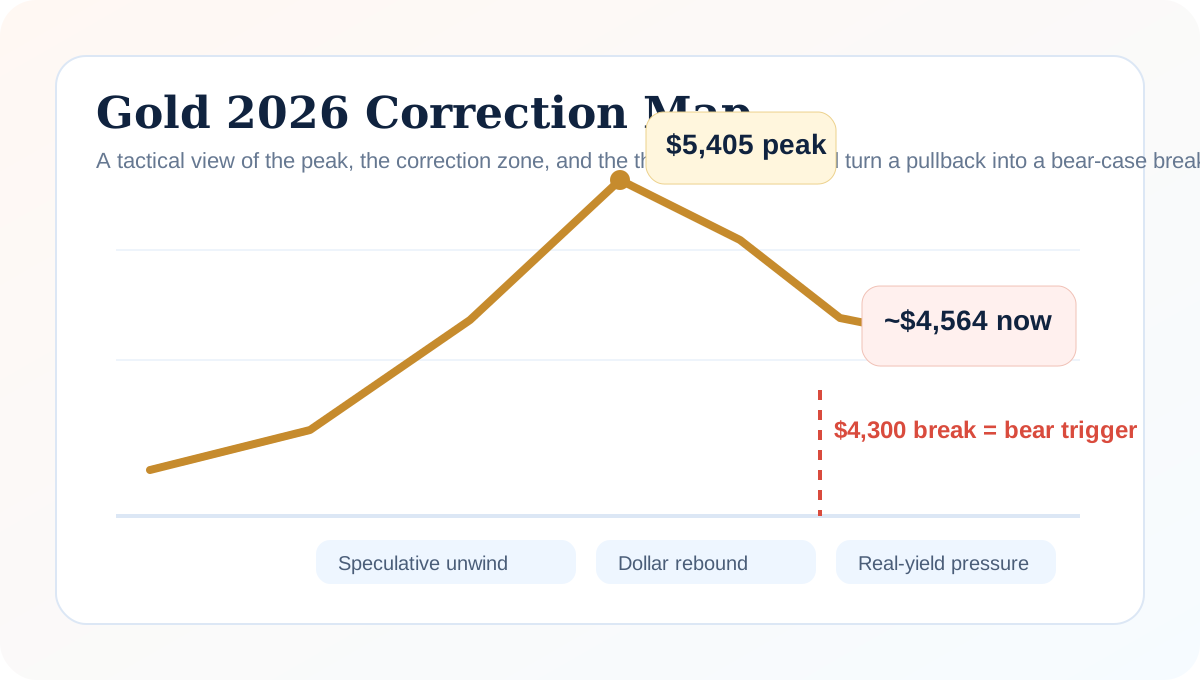
At this stage, the evidence suggests investors should think in layers. Layer one is a normal post-parabolic correction, which gold has already shown it can experience. Layer two is a deeper tactical unwind driven by real yields, ETF outflows, and broad deleveraging. Layer three is a true crash, which would likely require not just technical weakness but also a simultaneous deterioration in central-bank support, a stronger dollar, and a market conclusion that geopolitical and fiscal fears were overstated.
World Gold Council commentary in April 2026 is especially useful here because it is not sensational. It argued that gold was technically vulnerable, and that a sustained break below about $4,075 per ounce would confirm a more serious technical top. That is a very different statement from saying the structural bull case has failed.
In other words, investors should separate price damage from thesis damage. Gold can trade badly for months without disproving the strategic rationale for owning it. A crash call only becomes persuasive when both the tape and the underlying demand architecture deteriorate together.
| Question | Most defensible answer | Why |
|---|---|---|
| Can gold fall sharply in 2026? | Yes | Momentum, rates, and ETF flows can all reverse quickly |
| Does that mean the long-term thesis is dead? | No | Central-bank demand and fiscal stress remain supportive |
| What would make the selloff more dangerous? | A break in both technical and structural support | Price alone is not enough; flows and macro conditions matter |
| Base case | Volatile correction risk, not a permanent collapse | The current evidence is mixed, not decisively bearish |
02. Crash Risks
Five conditions could turn a normal pullback into a more serious 2026 drawdown
1. Real yields stay high or go higher
FRED data put the 10-year TIPS yield near 1.94% in early May 2026. Positive real yields are not automatically fatal for gold, but they raise the opportunity cost of owning a non-yielding asset. If real yields remain elevated while inflation expectations cool, gold loses one of its easiest cyclical supports.
2. ETF inflows stall or reverse for longer
WGC reported that global ETF holdings still rose 62 tonnes in Q1 2026, but the quarter was heavily front-loaded and March saw sharp selling. If gold cannot attract ETF inflows during periods of macro anxiety, the market may interpret that as evidence the investor base is saturated at higher prices.
3. The dollar rebounds materially
Gold often survives a stronger dollar for short periods. It struggles more when a stronger dollar lines up with rising real yields and improving risk appetite. A durable dollar rebound would reduce safe-haven urgency and make gold more expensive outside the U.S.
4. Liquidity stress forces deleveraging
WGC's March 2026 commentary argued that the selloff looked more like financial-market deleveraging than a fundamental rejection of gold. That matters because in cross-asset liquidations, investors often sell what they can, not only what they dislike. Gold can therefore fall even when the underlying macro case still exists.
5. Central banks turn price-sensitive or need liquidity
This is the least visible but most important structural risk. WGC still expects 700-900 tonnes of central-bank demand in 2026 and said Q1 buying looked robust. But the same commentary also acknowledged that gold can be mobilized for liquidity in stress. If official-sector activity shifted from accumulation to funding needs, sentiment would change quickly.
The important nuance is that official selling or gold mobilization does not need to become large in tonnage terms to matter psychologically. Gold is widely treated as the "clean" safe haven. If investors begin to think that even reserve managers are using it tactically rather than accumulating strategically, the market multiple attached to gold's scarcity can compress faster than usual.
| Risk factor | Current status | Bearish impact if it worsens |
|---|---|---|
| Real yields | Still elevated | High |
| ETF momentum | Positive but slowing | High |
| Dollar direction | Mixed | Medium to high |
| Central-bank demand | Still strong | Very high if it weakens materially |
| Geopolitical premium | Still present | Medium if it fades quickly |
Another reason to avoid simplistic crash language is that gold's downside drivers do not all operate on the same clock. Rates and ETF flows can change in days. Reserve policy and debt concerns evolve over quarters and years. That mismatch often produces sharp but incomplete selloffs, where short-term traders panic while long-term allocators continue treating weakness as noise rather than thesis failure.
03. Institutional Views
Most institutions still see downside as conditional, not inevitable
J.P. Morgan's December 2025 gold outlook remained explicitly bullish, seeing prices toward $5,000 by year-end 2026. World Gold Council's own 2026 framework allowed for either moderate gains or much stronger upside if risk aversion intensified. Meanwhile, the LBMA analyst survey showed substantial dispersion but not a consensus call for collapse. Even relatively cautious analysts were often discussing averages in the mid-$4,000s with downside ranges that still sat well above old-cycle norms.
This matters because a true crash normally requires a broad institutional reversal. Available data does not show that. It shows concern about volatility, speculative positioning, and correction risk.
That does not make the downside unimportant. It simply means the burden of proof is higher for anyone claiming that gold must implode. Institutional research to date is closer to "the rally can wobble badly" than "the strategic repricing is over."
| Source | What it implies | Crash takeaway |
|---|---|---|
| WGC April 2026 commentary | Technical vulnerability below key support | Correction risk is real |
| WGC Gold Outlook 2026 | Supportive base case, stronger upside in risk-off conditions | No default crash scenario |
| J.P. Morgan | Demand-led structural bull case extends into 2026-2027 | Large-bank view remains constructive |
| LBMA analyst survey | Wide ranges, but elevated averages | Analysts expect volatility more than collapse |
04. Scenarios
Bull, base, and bear case for 2026
| Scenario | Illustrative outcome | Required conditions | Probability |
|---|---|---|---|
| Bull | Gold resumes trend higher after correction | ETF inflows recover, rates ease, and geopolitical or fiscal stress reasserts | 35% |
| Base | Gold corrects, stabilizes, then ranges | Central-bank demand offsets weaker speculative momentum | 45% |
| Bear | Deeper drawdown toward lower support zones | Higher real yields, stronger dollar, and sustained ETF outflows hit together | 20% |
| Outcome | Probability | Comment |
|---|---|---|
| Higher | 35% | Needs macro support and recovering investor flows |
| Lower | 25% | Possible, but would likely be cyclical first and structural only later |
| Sideways | 40% | Most likely if official buying stays strong while speculative demand cools |
The evidence is mixed enough that investors should avoid binary language. If the macro backdrop worsens for growth and confidence, gold can recover quickly from technical damage. If markets instead stay calm while real yields remain sticky, the same chart can drift lower longer than recent bulls expect.
05. Investor Positioning
How different investors can respond prudently
| Investor type | Prudent action | What to monitor |
|---|---|---|
| Investor already in profit | Trim or hedge tactical exposure if position size has become too large | Real yields, dollar, and ETF redemptions |
| Investor currently at a loss | Avoid emotional averaging; reassess whether the thesis is tactical or long term | Whether support zones hold and official demand remains firm |
| Investor with no position | Wait for confirmation of stabilization or scale in slowly | Price behavior near key support and macro tone |
| Trader | Use stop-loss discipline; treat liquidity events as real risks | Options, CTAs, and Treasury volatility |
| Long-term investor | Rebalance rather than panic; gold may still serve portfolio diversification goals | Central-bank buying and reserve diversification |
| Hedge-focused investor | Maintain measured exposure, but do not assume gold hedges every shock perfectly | Whether inflationary shocks are hurting bonds and helping gold |
What could invalidate the crash thesis? Continued central-bank buying, a weaker dollar, a renewed ETF bid, or any macro event that revives inflation or fiscal anxiety. Those forces would turn a correction back into a buying opportunity. Conclusion: investors should respect crash risk in 2026, but the current evidence still points to a correction-risk environment, not an obvious secular reversal.
For practical portfolio decisions, that distinction matters. Investors do not need to choose between complacency and panic. They can reduce position size, hedge, rebalance, or wait for stabilization rather than making an all-or-nothing call on whether every pullback is a crash.
A final caution is that gold rarely rings a bell at the bottom or the top. Investors who wait for perfect clarity usually get it only after volatility has already done most of the work. That is another reason to prefer staged decisions over dramatic ones.
Disclaimer: This article is for general research and informational use only and does not provide individualized investment advice.
06. FAQ
Frequently asked questions
What counts as a gold crash?
Reasonable investors differ, but a crash usually implies more than a normal 10%-15% correction. It suggests a deeper break in both price structure and the underlying demand story.
Is a correction already happening?
Yes. WGC commentary shows gold has already experienced meaningful 2026 weakness after the January peak.
What is the most important downside indicator?
U.S. real yields are one of the cleanest tactical indicators because they directly affect gold's opportunity cost.
What protects gold from a full crash?
Central-bank buying, fiscal stress, and reserve diversification are the main structural supports.
References
Sources
- World Gold Council, Gold Market Commentary April 2026
- World Gold Council, Gold Market Commentary March 2026
- World Gold Council, Q1 2026 outlook
- World Gold Council, Q1 2026 investment data
- World Gold Council, Gold Outlook 2026
- World Gold Council, Full-Year 2025 central-bank demand
- J.P. Morgan Global Research, gold prices outlook
- LBMA, 2026 survey at a glance
- LBMA, 2026 analyst forecasts
- FRED, 10-year TIPS real yield
- IMF Data Brief, COFER Q4 2025