01. Quick Answer
The 2027 gold outlook is still constructive, but it depends more on the quality of demand than on absolute scarcity
Gold futures (GC=F on Yahoo Finance) were trading around $4,545.2/oz on 2026-05-18. The same 10-year monthly series started near $1,318.4/oz on 2016-06-01 and most recently showed $4,545.2/oz, with a 10-year range of roughly $1,150.0 to $4,713.9 and a price-only CAGR near 15.51% (10-year monthly data).
For a 2027 forecast, the key question is not whether there is enough gold in the ground. It is whether strategic and investment demand can stay stronger than normal while supply growth remains incremental. The 2025 and Q1 2026 data suggest that answer is still yes, but with more price sensitivity than the strongest bulls often admit (WGC supply data; Q1 2026 demand).
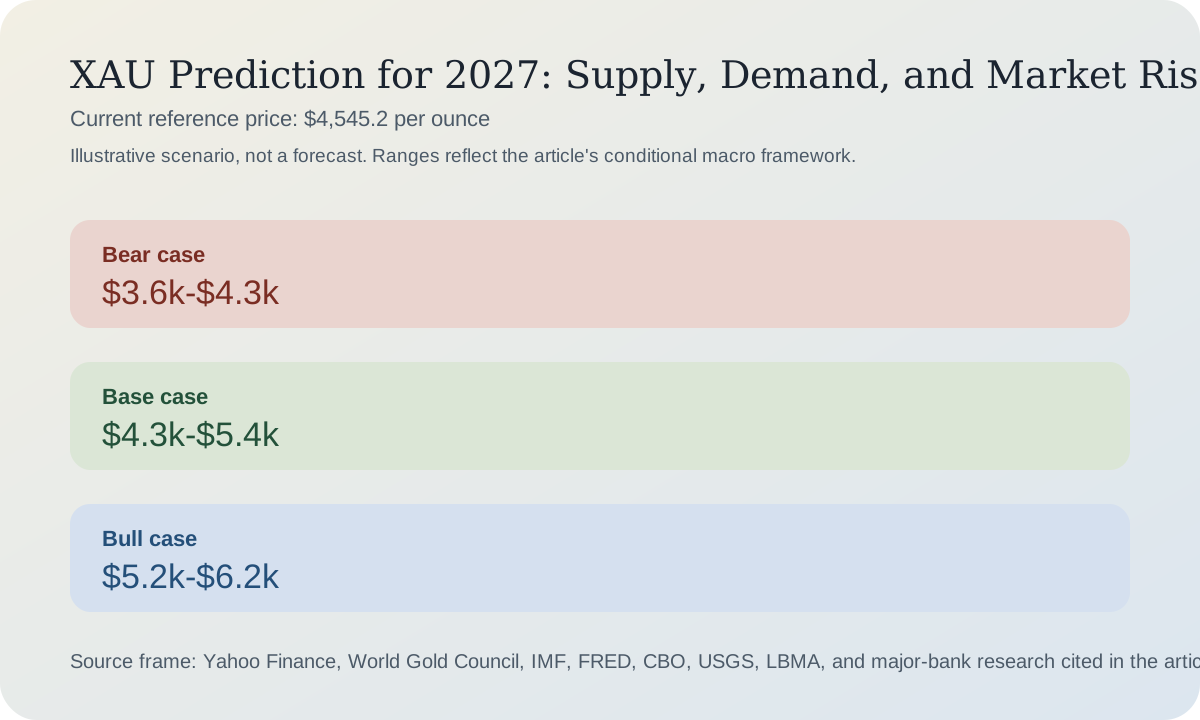
That leads to a base case of roughly $4,300 to $5,400 by 2027. The bull case still allows a retest of prior highs and beyond if ETF demand re-accelerates. The bear case remains credible if real yields stay high and central-bank buying cools materially.
| Point | Why it matters |
|---|---|
| Supply side | Mine output is rising, but only modestly, and recycling has not become an overwhelming cap on price. |
| Demand side | Central banks and bars-and-coins remain the strategic floor; ETFs still decide how steep the market's slope becomes. |
| Current conditions | Real yields remain restrictive enough that gold cannot rely on structural narratives alone. |
| 2027 base case | A $4.3k-$5.4k range implies resilience rather than a guaranteed breakout. |
02. Historical Context
The 2027 outlook is best understood through the latest supply-demand balance rather than through distant analogies
The latest full-year WGC table is unusually useful for a 2027 forecast. In 2025, gold demand was nearly balanced with supply in aggregate, but the composition was notable: investment demand jumped 84% year over year to 2,175.3 tonnes, ETFs added 801.2 tonnes, and central banks still bought 863.3 tonnes even after a record rally (WGC full-year 2025).
That is why 2027 is not just a supply story. Global mine production was estimated at 3,671.6 tonnes and recycled gold at 1,404.3 tonnes. Those are meaningful volumes, but they did not stop gold from repricing higher because the demand mix became more strategic and more geographically diversified.
Q1 2026 did show more nuance. Central banks still added 244 tonnes, total demand rose 2% year over year, and technology demand edged up to 81.6 tonnes, but ETF flows slowed versus the strongest 2025 pace. In other words, 2027 depends on whether gold stays broadly owned or becomes more dependent on official demand alone.
| Metric | Latest reading | Why it matters |
|---|---|---|
| Current gold price | $4,545.2/oz | Every long-range forecast needs a current anchor rather than an outdated cycle low. |
| 52-week range | $3,207.5 to $5,586.2 | Shows how much of the safe-haven and reserve-diversification story is already in the price. |
| 10-year monthly range | $1,150.0 to $4,713.9 | Useful for separating a normal correction from a genuine regime break. |
| 10-year price CAGR | 15.51% | A high recent compounding rate is a warning against naive straight-line extrapolation. |
| 10-year real yield | 2.00% on 2026-05-14 | Real yields remain one of the cleanest cyclical headwinds or tailwinds for a non-yielding asset. |
| Editorial base range | $4.3k-$5.4k | Scenario ranges are more defensible than a single number for a macro asset. |
| Line item | Latest official reading | Interpretation |
|---|---|---|
| 2025 total demand | 4,999.4t | Demand stayed broad even after gold entered a much higher price regime. |
| 2025 total supply | 5,002.3t | Supply kept up in aggregate, but only with help from recycling and modest mine growth. |
| 2025 mine production | 3,671.6t | Mine output inched higher, but not enough to invalidate the scarcity argument. |
| 2025 recycled gold | 1,404.3t | Higher prices encouraged more scrap, yet not a flood of secondary supply. |
| 2025 central-bank demand | 863.3t | Below 2024, but still far above the 2010-2021 average cited by WGC. |
| Q1 2026 central-bank demand | 244t | Official buying remained resilient even after gold touched record territory. |
| Q1 2026 ETF flows | +62t | Positive inflows continued, but at a slower rate than the prior risk-off surge. |
| Q1 2026 technology demand | 81.6t | Industrial demand remains a small but real part of the gold story. |
03. Main Drivers
Three demand channels and two supply realities dominate the 2027 forecast
1. Central banks still define the floor
WGC data shows that even after gold's repricing, official buyers stayed active. If 2026 and 2027 remain near the WGC full-year target range of 700-900 tonnes, the market's downside should stay more limited than it was in older cycles.
2. ETF flows define acceleration or exhaustion
ETF demand is the most visible, most tactical piece of the puzzle. Positive but slower Q1 2026 flows are supportive, yet they also show gold still needs investor conviction when prices approach extremes.
3. Bar and coin demand remains an underappreciated cushion
Retail investment in Asia helped offset weakness in jewelry demand. That matters because it means high prices do not automatically remove private demand; they can simply redirect it into lower-premium investment forms.
4. Mine supply is growing, but not fast enough to erase strategic demand
The WGC and USGS data both point to incremental supply growth rather than a production shock. That is consistent with a market where supply can lean against rallies but does not by itself define the terminal price.
5. Real yields and the dollar remain the risk factor that can overpower good micro data
The latest FRED reading near 2.00% is a reminder that macro opportunity cost still matters. If rates stay firm, a balanced supply-demand market can still trade poorly.
04. Institutional Forecasts and Analyst Views
Institutional views on 2026 and 2027 still lean positive, but they also imply a slower market than the peak rally phase
J.P. Morgan is the clearest anchor, with $5,055 for Q4 2026 and roughly $5,400 by end-2027. That is constructive, but not a prediction of endless monthly breakouts. LBMA survey data is more conservative on average, reinforcing the idea that the market can remain expensive while still delivering a choppy path.
World Gold Council scenario work also fits the 2027 frame. Its 2026 outlook allows upside if macro conditions deteriorate and downside if reflation and higher yields return (WGC Outlook 2026). By 2027, those same forces will still matter more than minor changes in mine supply.
This is also why Reuters summaries of Goldman Sachs and BofA are informative rather than definitive. They show that large institutions still see room to the upside, but they do not erase the path dependency created by real yields and ETF behavior.
| Source | Published view | Why it matters |
|---|---|---|
| J.P. Morgan Global Research | $5,055 average in Q4 2026 and roughly $5,400 by end-2027 | Official bank research remains constructive despite already-elevated prices. |
| J.P. Morgan scenario analysis | $6,000 if just 0.5% of foreign U.S. asset holdings diversify into gold | Useful as a stress-test for how powerful reserve shifts could become. |
| J.P. Morgan Private Bank | $6,000-$6,300 medium-term outlook | Adds a multi-asset allocation perspective rather than a pure commodities call. |
| LBMA 2026 survey | $4,269 average, with analyst ranges stretching roughly $3,700-$5,175 | Shows consensus still sees a high-price regime but not a one-way market. |
| World Gold Council 2026 outlook | +5%-15% in a softer-growth case; +15%-30% in a deeper risk-off case | WGC frames gold best through scenarios instead of point targets. |
| Goldman Sachs via Reuters | $5,400 by end-2026 | One of the stronger major-bank upside calls tied to ETF and central-bank demand. |
| BofA via Reuters | $5,000 in 2026 | Useful bullish reference, but still below the more aggressive extreme-bull narratives. |
| Deutsche Bank via Reuters | $6,000 bull-case discussion for 2026 | Illustrates how upside scenarios widen when reserve diversification is assumed to accelerate. |
05. Bull, Bear, and Base Case
The 2027 range is narrow enough to be practical, but wide enough to capture real macro uncertainty
Bullish scenario
The bull case is $5,200 to $6,200 by 2027. It requires ETF participation to broaden again, real yields to soften, and central-bank demand to stay near current strategic levels.
Base-case scenario
The base case is $4,300 to $5,400. That range assumes central banks keep supporting the floor, supply rises only gradually, and investors remain constructive but not euphoric.
Bearish scenario
The bear case is $3,600 to $4,300. That outcome becomes more plausible if ETF holdings turn negative, real yields remain close to 2%, and official buyers become more valuation-sensitive.
Risks to watch
Watch recycling sensitivity to price, the strength of Asian bar-and-coin demand, central-bank quarterly updates, and whether gold can attract fresh capital during bouts of equity-market stress.
What could invalidate the forecast
The constructive base case would be too optimistic if official buying drops sharply below WGC's expected range and investor flows do not replace it. It would be too conservative if reserve diversification and ETF demand both re-accelerate together.
Conclusion
For 2027, supply growth alone is unlikely to make or break gold. The more important question is whether demand stays broad enough to keep the market in a structurally higher regime. Available data suggests it can, but analysts remain divided on how much room there is above current highs.
| Scenario | Illustrative range | Conditions | Probability |
|---|---|---|---|
| Bull | $5,200-$6,200 | ETF demand re-accelerates and real yields ease. | 30% |
| Base | $4,300-$5,400 | Central-bank demand stays solid and supply remains incremental. | 50% |
| Bear | $3,600-$4,300 | High real yields and softer investor demand overpower the floor. | 20% |
| Path | Estimated probability | Comment |
|---|---|---|
| Probability of rising | 50% | Strategic demand still argues for resilience. |
| Probability of falling | 20% | A lower 2027 range likely needs both macro drag and softer official demand. |
| Probability of moving sideways | 30% | Gold can remain elevated while moving sideways if the floor holds but momentum cools. |
06. Investor Implications
Shorter-horizon gold positioning should focus on confirmation, not conviction slogans
The 2027 horizon is close enough that execution matters. Investors already in profit may want to protect gains through partial trims or rebalancing rather than assuming every pullback is a buying gift. Investors with no position should be especially careful about chasing upside after safe-haven spikes because the market still reacts quickly to rates and the dollar.
| Investor type | Cautious approach | What to watch |
|---|---|---|
| Investor already in profit | Hold a core allocation if the hedge thesis still fits, but trim or rebalance if gold has become oversized. | ETF flows, real yields, and whether gold keeps failing at resistance after macro shocks. |
| Investor currently at a loss | Separate a broken thesis from a bad entry. Average in only if the time horizon is long and the macro case is intact. | Reserve diversification, official buying, and whether corrections remain orderly rather than structural. |
| Investor with no position | Prefer staged entries, wait-for-pullback plans, or dollar-cost averaging over panic buying after spikes. | The relationship between rates, the dollar, and follow-through demand after geopolitical headlines. |
| Trader | Respect volatility, use stop-losses, and trade the macro tape rather than a single long-term narrative. | TIPS yields, the U.S. dollar, ETF flow data, and momentum around prior highs. |
| Long-term investor | Think in terms of portfolio role, rebalance bands, and scenario probabilities instead of one heroic target. | Debt trends, reserve allocations, and whether gold still diversifies stock-and-bond risk. |
| Reader seeking a hedge | Use gold as one hedge among several and avoid assuming it will respond perfectly to every inflation or recession scare. | Correlation with equities and bonds during stress, not just headline inflation. |
Disclaimer: This article is for research and informational purposes only. It does not constitute personalized financial advice or a recommendation to trade gold futures, ETFs, or related securities.
07. FAQ
Frequently asked questions about gold through 2027
What matters more for 2027: supply or demand?
Demand matters more. Supply growth has been incremental, while central-bank buying and ETF flows have had the larger impact on price direction.
Can gold fall even if central banks keep buying?
Yes. Persistent real-yield pressure and ETF outflows can still generate a weaker trading range even with official support in place.
Is the 2027 base case bullish or neutral?
It is mildly bullish relative to history, but more neutral relative to the recent rally because it assumes resilience rather than a new parabolic phase.
References
Sources
- Yahoo Finance GC=F recent daily chart
- Yahoo Finance GC=F 10-year monthly chart
- World Gold Council, Gold Demand Trends Q4 and Full Year 2025
- World Gold Council, Full-Year 2025 central banks
- World Gold Council, Full-Year 2025 supply
- World Gold Council, Gold Demand Trends Q1 2026
- World Gold Council, Q1 2026 outlook
- World Gold Council, Q1 2026 technology demand
- World Gold Council, Gold Outlook 2026
- World Gold Council, Why Gold in 2026? A cross-asset perspective
- World Gold Council, Gold Mid-Year Outlook 2025
- World Gold Council, Central Bank Gold Reserves Survey 2025
- IMF COFER Q4 2025 data brief
- FRED 10-year TIPS real yield series
- Congressional Budget Office, Long-Term Budget Outlook
- USGS Mineral Commodity Summaries 2026
- J.P. Morgan Global Research, gold price outlook
- J.P. Morgan Private Bank, Is it a golden era for gold?
- LBMA 2026 precious metals forecast survey
- LBMA 2026 analyst forecasts for gold