01. Quick Answer
AI could help Solana's adoption story more directly than it helps many other chains
Official Solana materials now make an explicit AI case. The Solana AI page highlights agent infrastructure, decentralized compute, and AI projects such as Inference.net, Grass, Gradient, and Eliza, while the Foundation's Pay.sh launch with Google Cloud created a concrete machine-payment and API-settlement use case (Solana Foundation) (Solana Foundation). That is more specific than a generic 'AI is bullish for crypto' slogan.
But AI does not automatically create sustainable token demand. It can increase experimentation, speculative trading, and infrastructure usage without cleanly translating into higher SOL valuation. The evidence is mixed because AI can also intensify competition, compress margins, and increase narrative-driven volatility across the entire crypto stack (Coinbase Institutional) (Visa).
| Question | Short answer | Why |
|---|---|---|
| Can AI help Solana adoption? | Yes | Solana is now building around agents, data, compute, and machine payments |
| Is AI automatically bullish for SOL price? | No | Adoption and token accrual are related but not identical |
| Could AI increase volatility? | Yes | Agents, headlines, and faster market reactions can amplify moves |
| Working base case | $90-$170 | AI helps, but not every benefit accrues cleanly to the token |
The practical conclusion is that AI is more likely to act as a force multiplier on existing Solana debates than as a magical one-way catalyst. It can make the chain more useful and still leave investors arguing over economics.
02. Historical Context
AI matters because it changes what Solana might be used for, not just who trades it
Solana's earlier identity was dominated by throughput, DeFi, NFTs, and meme-driven trading. The newer AI framing is different because it attaches Solana to workflows where software agents pay for APIs, settle small-value actions, and interact with services autonomously (Solana Foundation) (Solana Foundation). That pushes the discussion closer to infrastructure than to pure consumer speculation.
The market context still matters, though. Solana's price history shows that narrative power can cause fast repricings in both directions (Yahoo Finance). AI could amplify that feature, especially if traders start front-running every agent, compute, or tokenized-commerce headline without waiting to see whether the demand is durable.
| Building block | Evidence | Potential effect |
|---|---|---|
| Agent operating systems | Eliza supports 200+ plugins on Solana's AI page | Lowers friction for agent-native applications |
| Compute and inference | Inference.net and distributed AI projects are highlighted by Solana | Supports the idea of onchain-linked AI infrastructure |
| Machine payments | Pay.sh allows per-request API payments using stablecoins on Solana | Could create new transaction demand types |
| Enterprise APIs | SDP is AI-ready and API-based | Makes it easier for institutions to build around Solana |
| Concern | Why it matters | What would reduce the risk |
|---|---|---|
| Adoption without accrual | Apps may benefit more than the token | Clear evidence that machine payments and settlement support SOL demand |
| Speculative overcrowding | AI headlines can create unstable repricing | More utility-led usage and less pure narrative chasing |
| Competitive spillover | Other rails can also serve AI workflows | Solana wins meaningful share of live commercial traffic |
The result is a more interesting but also more complex thesis. AI gives Solana new ways to matter, but it also gives the market new ways to overreact.
03. Main Drivers
Five channels through which AI could affect Solana
The AI thesis is more credible when broken into specific mechanisms.
1. AI agents can increase payment and settlement demand
Pay.sh with Google Cloud is important because it ties Solana to pay-per-call API access, stablecoin settlement, and agent identity through wallets (Solana Foundation).
2. Open intelligence and decentralized compute can attract builders
Solana's AI page highlights distributed inference, data collection, and agent tooling, which can deepen developer mindshare if the ecosystem keeps shipping usable tools (Solana Foundation).
3. AI-ready enterprise tooling can shorten go-to-market time
Solana Developer Platform was explicitly launched as AI-ready and API-driven for enterprises and financial institutions (Solana Foundation).
4. AI can magnify trading velocity and narrative reflexivity
Coinbase's work on trading concentration already shows how market activity can cluster on Solana (Coinbase Institutional). AI-assisted trading and agent-led execution could make those bursts even faster.
5. AI-powered commerce can make stablecoins and tokenized assets more active
Visa's broader work on stablecoins and agentic commerce suggests that AI may increase transaction density and machine-led purchasing activity across digital payment rails (Visa) (Visa).
Those channels explain why AI is not just a branding exercise for Solana. The chain has at least a plausible technical and commercial path into agent-led workflows. The harder question is how much of that path benefits SOL holders directly.
04. Institutional Forecasts and Analyst Views
There are few formal AI-and-Solana price targets, so the best evidence is directional
No major institution in this source set offers a neat public price target for 'AI Solana.' That is sensible. The better evidence is indirect: Solana itself is shipping AI-specific infrastructure, Visa is framing agentic commerce as a real payments opportunity, and enterprise tooling is being built to meet AI-driven demand faster (Solana Foundation) (Solana Foundation) (Solana Foundation) (Visa).
The skeptical counterpoint is that AI can help application growth while leaving token-level economics unresolved. That mirrors the older Solana debate around cheap blockspace and activity quality, only now with AI as the accelerant (VanEck) (Coinbase Institutional).
| Evidence source | Main message | Implication for SOL |
|---|---|---|
| Solana AI page | The ecosystem already has agent, compute, and data projects | AI is not just aspirational branding |
| Pay.sh with Google Cloud | Agents can pay per request for APIs with stablecoins on Solana | Creates a plausible demand channel for machine payments |
| Solana Developer Platform | AI-ready APIs for institutions and financial products | Can shorten adoption friction |
| Visa stablecoin and agentic-commerce work | Firms increasingly need programmable settlement and machine-compatible commerce | Supports the long-run relevance of fast settlement rails |
The useful conclusion is that AI can plausibly improve Solana's adoption case more than it improves some other chains' cases. Whether it improves SOL price as much is still an open question.
05. Scenarios, Risks, and Positioning
A scenario matrix is the most honest way to frame AI's effect on Solana
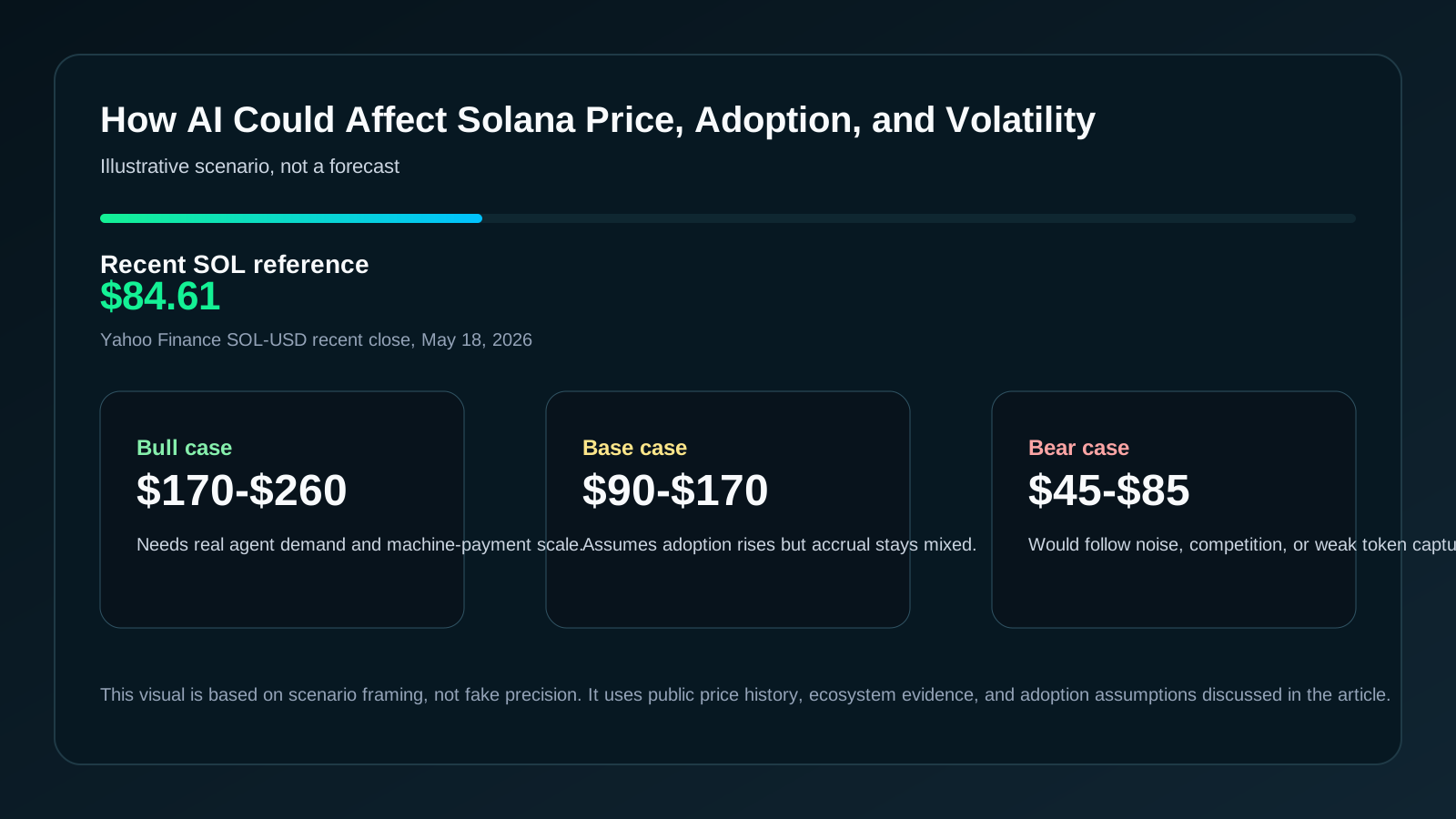
These ranges are medium- to long-horizon scenario bands, not claims of direct causation from AI alone.
| Scenario | Price zone | Conditions | Probability |
|---|---|---|---|
| AI-accelerated bull | $170-$260 | Agents, machine payments, and AI-linked infrastructure materially deepen Solana demand and token relevance | 24% |
| Mixed base case | $90-$170 | AI helps ecosystem growth, but token value capture stays mixed and volatility remains high | 51% |
| AI-risk-heavy bear | $45-$85 | AI increases speculation and competition faster than it creates durable SOL demand | 25% |
| Direction | Probability | Comment |
|---|---|---|
| Higher over the medium to long term | 46% | AI creates real optionality for Solana if agent and settlement workflows stick |
| Lower | 19% | A weaker path would likely follow poor accrual or broader crypto stress |
| Sideways with volatility | 35% | Plausible if AI raises attention more than durable token demand |
| Investor type | Prudent approach | Main watchpoints |
|---|---|---|
| Investor already in profit | Hold but rebalance if AI hype drives sharp repricing without better fundamentals | Narrative excess versus real usage |
| Investor currently at a loss | Do not use AI as a fresh excuse for a weak thesis; look for genuine adoption evidence | Whether machine-payment use cases are actually scaling |
| Investor with no position | Wait for either stronger adoption proof or better entry levels | Agent-wallet traction and enterprise integrations |
| Trader | Avoid headline chasing around every AI token or agent announcement | Sentiment, momentum, and derivatives activity |
| Long-term investor | Accumulate slowly only if you believe AI will increase demand for open, programmable settlement on Solana | Whether usage benefits the token, not just the apps |
| Risk-hedging investor | Treat AI-linked SOL exposure as speculative growth infrastructure, not as a hedge | Cross-asset beta and liquidity conditions |
| Risk | Why it matters | Would improve the picture if... |
|---|---|---|
| AI use stays offchain | Solana gets narrative credit but not transaction demand | More agent workflows settle onchain |
| Token capture remains weak | Apps benefit more than SOL | Machine-payment and settlement demand support the base asset |
| Speculation outruns utility | Volatility overwhelms adoption | Commercial use scales faster than meme reflexivity |
| Competing rails win key workloads | Solana's AI lead proves temporary | Ecosystem tools keep improving and retaining builders |
Bullish scenario
The AI-driven bull case is that Solana becomes the default public settlement and wallet layer for a meaningful slice of agentic commerce, API payments, and open-intelligence coordination.
Bearish scenario
The bear case is that AI mostly increases noise: more launches, more speculative attention, more fast trading, but not enough durable SOL demand to justify a better valuation regime.
Base-case scenario
The base case is that AI helps Solana's relevance and builder energy, but that price benefits remain uneven because the market still debates value capture and because volatility rises with attention.
What could invalidate this forecast
The constructive AI case would weaken if most valuable AI-commerce and agent workflows stay offchain or if Solana-linked machine payments fail to scale beyond niche experiments. The cautious case would be too bearish if agent payments, AI-ready enterprise products, and AI-linked settlement meaningfully deepen real usage while SOL remains economically central.
Conclusion
AI could matter a lot for Solana, but probably not in the simplistic way markets often prefer. It can boost adoption, deepen infrastructure relevance, and still leave the token's valuation path noisy. That is why AI should be treated as a force multiplier, not as a certainty machine.
06. FAQ
Frequently asked questions about AI and Solana
Why would AI matter for Solana at all?
Because AI agents need identity, payments, data, and settlement rails, and Solana is explicitly building around those functions.
Is there already official AI activity on Solana?
Yes. Solana's AI page and Pay.sh launch show active ecosystem and foundation-level work around agents, compute, and machine payments.
Could AI increase SOL volatility even if adoption improves?
Yes. Faster narratives, agent-led execution, and speculative crowding can amplify volatility even in a stronger adoption environment.
Is AI automatically bullish for SOL price?
No. AI can help Solana's relevance while still leaving open the question of how much value accrues to SOL itself.
07. Methodology and Invalidation
How to interpret this AI-and-Solana framework
The forecast ranges in this article are scenario bands, not promises. They combine live SOL price data from Yahoo Finance, official Solana Foundation disclosures, institutional market commentary, and editorial judgment about how network usage, fee capture, adoption, and regulation interact. Solana is not a traditional equity or commodity, so no single metric can support a defensible long-range target by itself.
The probability tables are editorial estimates rather than statistical certainties. They are built by weighing network resilience, developer momentum, tokenized-asset and stablecoin adoption, derivatives access, and the risk that SOL remains structurally too dependent on trading cycles or speculative bursts. Where the evidence is mixed, the range stays intentionally wide.
The biggest invalidators would be proof that AI-related economic activity prefers other rails, or that the incremental activity boosts usage statistics without creating meaningful token demand. The best positive evidence would be real machine-payment volume and enterprise adoption that persists beyond headlines.
Disclaimer: The most important discipline is to state what would invalidate the working view. Investors who are already in profit, investors sitting on losses, traders, hedgers, and long-term allocators do not need the same playbook, so the positioning table separates horizon and risk tolerance instead of pretending one answer fits everyone. Disclaimer: This article is for informational and research purposes only and does not constitute personalized financial advice.
References
Sources
- Yahoo Finance SOL-USD chart API, recent daily closes
- Yahoo Finance SOL-USD chart API, available weekly history
- Coinbase Institutional, Analyzing Solana Activity
- VanEck, Base, Bear, Bull Case: Solana Valuation by 2030
- Solana Foundation, AI on Solana
- Solana Foundation and Google Cloud, Pay.sh launch
- Solana Foundation, Solana Developer Platform launch
- Solana Foundation, Solana Ecosystem Roundup: April 2026
- Visa, U.S. stablecoin settlement launch
- Visa Consulting and Analytics, Stablecoin strategy
- Messari, State of Solana Q3 2025