Home
» Sports
»
New York Fishing in October 2026: Open Seasons, Limits, and Access Rules
New York Fishing in October 2026: Open Seasons, Limits, and Access Rules
For October 2026, many New York fisheries remain open, but October 15 is a key cutoff for trout and lake trout in several waters. From October 16, inland trout streams generally switch to catch-and-release with artificial lures only, while brook trout season closes on most lakes and ponds. Those dates are not universal: the exact water, reach, and governing section of the New York State Department of Environmental Conservation (NYSDEC) 2026 guide control. This summary reflects official materials available September 29, 2026; check the current regulation page again before a trip.
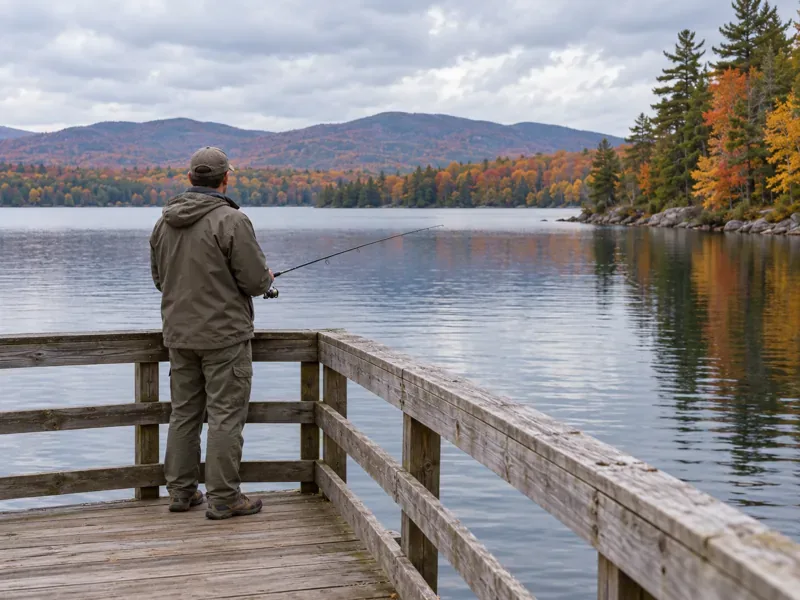
An angler fishes from a pier on a fall lake. Check the water-specific season and access rules before choosing a New York fishing spot.
First, identify which rules govern your water
New York’s 2026 freshwater guide separates statewide rules from special rules for named waters, counties, regions, Great Lakes and tributaries, Finger Lakes, Lake Champlain, the Hudson River, inland trout streams, and border waters. The statewide table applies only when no special regulation covers the water. DEC also says it is unlawful to fish for a species outside its open season, even if you plan to release it. Use the 2026 NYSDEC Freshwater Fishing Regulations Guide and open the relevant special-regulations page before relying on a general summary.
What is generally open in October?
Fishery or water
October rule in the general table
Key qualification
Black bass (largemouth and smallmouth)
Open through November 30; 12-inch minimum; 5 per day.
Special waters may set different dates, lengths, and limits.
Inland trout streams
Harvest season through October 15. October 16–March 31: catch-and-release only, artificial lures only.
Named reaches may have year-round catch-and-release or different limits.
Brook trout in lakes and ponds
Open through October 15; no minimum length; daily limit 5.
Most are closed beginning October 16, but special waters can differ.
Walleye, northern pike, pickerel
Generally open in October under statewide season dates.
Special-water size and bag limits can be substantially different.
Muskellunge
Statewide season runs June 1–November 30; 40-inch minimum; 1 per day.
Great Lakes waters have their own dates and a 54-inch minimum.
The numbers above are statewide defaults, not a promise that every lake or stream follows them. For example, the statewide walleye limit is 15 inches and 5 fish daily, but Lake Ontario and the St. Lawrence River have an 18-inch minimum and a 3-fish limit. Read the water-specific table before keeping a fish.
Why does October 16 matter for trout?
For inland trout streams covered by the statewide table, October 1–15 remains within the regular season: the daily limit is 5 trout, with no more than 2 longer than 12 inches. From October 16 through March 31, fishing becomes catch-and-release only and artificial lures only. That is a change in permitted methods and harvest, not a blanket closure of every trout stream.
The rule also does not turn every trout water into an inland stream. Great Lakes, Finger Lakes, and Lake Champlain tributaries to the first barrier impassable by fish have separate tables; tidal reaches and named sections may have their own rules. As a concrete example, NYSDEC’s rules for the New York–Pennsylvania portion of the Delaware River set trout harvest through October 15 at one fish daily with no minimum length, then catch-and-release with artificial lures only starting October 16. Meanwhile, the West Branch Delaware has multiple regulated reaches, including sections that are catch-and-release all year. Find the exact reach on the Inland Trout Stream Special Regulations or Border Waters regulations.
Popular waters can have different rules even for the same species
Lake Ontario and its tributaries
In the Lake Ontario, St. Lawrence River, and tributary section of the Great Lakes rules, brown trout, rainbow trout (including steelhead), coho salmon, and Chinook salmon are listed as open year-round, with a combined 3-fish daily limit and species-specific size and sublimits. In the lake, rainbow trout/steelhead must be at least 21 inches; in tributaries, 25 inches. Lake trout, by contrast, are open December 1 through September 30, so the general Lake Ontario rule closes them in October. Brook trout remain open only through October 15, with a 5-fish daily limit and no minimum size. Walleye are open May 1 through March 15, at least 18 inches, 3 daily; muskellunge and tiger muskellunge are open June 15 through December 15, at least 54 inches, 1 daily. These examples are from NYSDEC’s Great Lakes and Tributaries regulations; additional county and tributary exceptions apply.
Great Lakes tributary access and protected reaches
On Lake Erie tributaries, NYSDEC identifies seasonal regulation reaches that run September 1–March 31. For the listed reaches, fishing is limited to half an hour before sunrise through half an hour after sunset, and seasonal hook restrictions apply. The named boundary varies: Cattaraugus Creek’s listed reach runs from the Aldrich Street Extension Bridge in Gowanda upstream to Springville Dam; other tributaries use a bridge near the mouth and the first barrier impassable by fish. Some named sections, including portions of Chautauqua Creek and Eighteenmile Creek in Erie County, are catch-and-release for trout and salmon with artificial lures only. Do not extend one creek’s boundary to another; check the official reach description before entering.
Freshwater license, saltwater registry, and access are separate
Residents and nonresidents age 16 or older generally need a New York freshwater fishing license. A license does not grant entry across private land. For saltwater, anglers age 16 or older fishing for listed species in the Marine and Coastal District generally enroll in the no-fee Recreational Marine Fishing Registry; some species need separate permits. The registry is not a freshwater license, and it is not required solely to harvest crabs, lobsters, whelk, or shellfish. Check NYSDEC’s sporting license guidance and saltwater rules.
Access permission is another question. Fishing from a public launch, a posted public fishing rights corridor, or an authorized park site is different from crossing private property. NYSDEC explains that navigating a waterway does not authorize someone to cross private land to reach it or use private banks for unrelated recreation. A practical example: city-controlled reservoirs in the New York City watershed require a NYC Department of Environmental Protection access permit, and reservoir-specific fishing and boating rules still apply. Start with DEC’s waterway access guidance and NYC reservoir fishing page.
What changed for 2026—and what is not yet confirmed?
One common misunderstanding is that a proposed regulation automatically replaces the printed season table. NYSDEC’s regulatory status page lists 2026 Part 10 sportfishing changes for walleye, northern pike, tiger muskellunge, and chain pickerel among proposed rules with the comment period closed. The official page does not say that this proposal has taken effect. Treat the published 2026 guide and any later NYSDEC emergency or adopted notice as the operative sources; do not change your plan based on a proposal summary alone. Recheck the DEC regulations status page shortly before fishing.
Another easy mistake is to assume “catch-and-release” means fishing is always allowed. New York prohibits fishing for a species outside its season, including catch-and-release, unless the applicable regulation expressly provides a catch-and-release period. Also, endangered or threatened fish species are closed to fishing, including catch-and-release, under the statewide guide. If you cannot identify a fish or verify its legal season, do not target or retain it; consult the guide or contact the DEC regional office.
October trip checklist
Write down the waterbody and exact stream reach, county, and side of any state border.
Check the 2026 freshwater or marine table for dates, length, daily limit, special gear, and night-fishing restrictions.
Confirm your freshwater license or marine registry status and any separate species permit.
Confirm public entry, launch hours, parking rules, park restrictions, and any NYC DEP or other land-manager permit.
Carry a ruler; fish kept in a vehicle used to access the water count toward possession limits.
Recheck official notices on the day of the trip because DEC says regulations can change.
For an October plan, the reliable approach is to treat October 15/16 as a potential trout-rule pivot, then verify every water-specific exception. A season or limit that applies to one named river section, reservoir, or Great Lakes tributary should not be generalized to New York State as a whole.