01. Quick Answer
The most reasonable CAC 40 2030 forecast is constructive, but still tightly linked to luxury, rates, and French macro credibility
A serious CAC 40 forecast for 2030 starts with two competing truths. The first is that French blue-chips have already compounded from 4,237.48 in May 2016 to 7,952.55 on 2026-05-15, with the index touching 8,580.75 in January 2026 (Yahoo Finance 10-year history). The second is that the French macro backdrop is no longer effortless: INSEE says GDP stalled in the first quarter of 2026, while inflation picked back up to 2.2% year over year in April and business confidence darkened (INSEE GDP release; INSEE dashboard).
| Point | Why it matters |
|---|---|
| The CAC 40 is more global than many investors assume | Euronext and public market references emphasize that constituent companies generate a large share of revenue outside France, so the index is tied to global cycles as much as domestic GDP. |
| Luxury and industrials still dominate narrative risk | LVMH, Hermès, Kering, Schneider, Airbus, Safran, and TotalEnergies can swing sentiment more than French consumer data alone. |
| 2030 should be framed as a range | Available data suggests the right approach is scenario analysis, not a single heroic target. |
| French fiscal and ECB policy still matter | Rates, public finances, and energy costs can affect valuation multiples even when corporate franchises remain strong. |
02. Historical Context
The CAC 40 is a concentrated global-franchise index, not a pure domestic growth proxy
The Euronext factsheet shows the CAC 40 is a free-float market-cap weighted index with a top ten accounting for 59.64% of the benchmark as of March 31, 2026. TotalEnergies, Schneider Electric, LVMH, Air Liquide, Sanofi, Airbus, Safran, BNP Paribas, L'Oréal and AXA sit at the center of the benchmark (Euronext factsheet). That concentration matters for 2030 because the index is not a broad expression of the entire French economy. It is a concentrated expression of a few world-class multinationals exposed to energy, luxury, banking, health care, aerospace, electrification, and industrial automation.
| Metric | Latest reading | Why it matters |
|---|---|---|
| Current index level | 7,952.55 | Forecast ranges should be anchored to current reality, not to old highs. |
| 10-year price CAGR | 6.53% | The long-run growth rate provides a disciplined baseline for 2030 scenario building. |
| 2026 YTD return as of March 31 | -4.08% | Euronext's own factsheet shows the market entered 2026 with a softer tone despite the January record high. |
| Dividend yield | 2.96% | Income matters because French blue-chips often deliver a larger share of long-run return through cash distributions than U.S. tech-heavy indices do. |
| Feature | Implication | Forecast effect |
|---|---|---|
| Global revenue exposure | Luxury, aerospace, pharma, and energy earnings depend heavily on non-French demand | French GDP weakness does not automatically translate into index collapse. |
| Sector concentration | Top ten weights dominate | A few sectors can drive most of the five-year outcome. |
| Price index structure | Headline CAC 40 excludes dividends | Investors should distinguish price outlook from total-return outlook. |
| High foreign ownership | The benchmark remains sensitive to international capital flows and risk appetite | Macro shocks can affect valuations quickly. |
Historical data also warns against simplistic extrapolation. The 10-year price-only CAGR of 6.53% was earned through a very uneven path that included the 2018 global growth scare, the 2020 pandemic crash, the 2022 energy shock, and the 2025-2026 luxury and rate sensitivity cycle. A disciplined 2030 forecast therefore needs to separate historical compounding from forward-looking drivers: rates, fiscal policy, China-sensitive luxury demand, defense and aerospace spending, and the AI/electrification investment cycle now helping parts of industrial France.
03. Main Drivers
Five forces are most likely to shape the French benchmark into 2030
1. Luxury demand remains the index's most obvious swing factor
Reuters-linked reporting shows luxury shares remain vulnerable to Chinese demand uncertainty, Middle East disruption, higher energy costs, and the spending power of aspirational consumers (Reuters on LVMH January 2026; Reuters on LVMH April 2026). That matters because LVMH, Hermès, Kering, L'Oréal, and EssilorLuxottica carry enormous narrative and weight influence.
2. Defense and aerospace are a structural offset
Banque de France surveys have explicitly noted that computer, electronics, and machinery activity has been supported by defense and aerospace demand. Airbus, Safran, and Thales provide a real counterweight when global security spending rises or civil aerospace remains firm (Banque de France publication hub).
3. Banks, rates, and public finance shape valuation
BNP Paribas, Société Générale, Crédit Agricole, AXA, and broader financial conditions remain tied to ECB policy and France's fiscal path. Reuters' 2026 budget factbox underscores that Paris is still trying to narrow the deficit while preserving political stability (Reuters budget factbox).
4. Energy and industrial electrification remain two-sided drivers
TotalEnergies, Schneider Electric, Legrand, Vinci, and Saint-Gobain can benefit from capital expenditure cycles, infrastructure upgrades, electrification, and data center build-outs. But they are also rate- and commodity-sensitive.
5. AI is already influencing sector leadership
AI demand has become relevant for the CAC through companies like Schneider Electric, Capgemini, Publicis, Dassault Systèmes, and STMicroelectronics. Available data suggests AI may support a better mix of industrial and software earnings, even if it also increases volatility through hype and rotation (Reuters on Schneider).
04. Institutional Forecasts and Analyst Views
Public macro projections and index structure provide a better evidence base than forced long-range point targets
Public institutional 2030 point forecasts for the CAC 40 are limited, which is normal for national indices. The more credible way to build a 2030 range is to combine official macro projections, current index structure, and the specific earnings sensitivities of the heaviest sectors. Banque de France's March 2026 projections point to baseline GDP growth of 0.9% in 2026 with inflation of 1.7%, while the OECD's late-2025 outlook penciled in modest growth around 1% into 2026-2027 (Banque de France March 2026 projections; OECD 2025 Issue 2).
| Source | What it says | Implication for CAC 40 |
|---|---|---|
| Banque de France | France should still grow, but modestly, under the baseline scenario | Supports a constructive but not euphoric index outlook. |
| INSEE | Q1 2026 GDP stalled and trade detracted heavily from growth | Explains why the market can struggle even when some global champions keep executing. |
| Euronext | Top ten names account for nearly 60% of weight | 2030 depends heavily on a few global franchises, not on the median French company. |
| IMF France Article IV | Public finance and structural competitiveness remain central | The market multiple is partly a macro-governance story, not just an earnings story. |
Analysts remain divided because the evidence is mixed. Luxury could reaccelerate if China and the U.S. consumer stabilize, but it can also remain a drag. Defense, automation, and electrification could keep supporting the industrial side of the index, but the ECB and fiscal context can still compress valuation. The right answer is therefore a scenario range, not a slogan.
05. Scenarios, Risks, and Invalidation
Bull, bear, and base cases help frame a realistic CAC 40 range into 2030
Bullish scenario
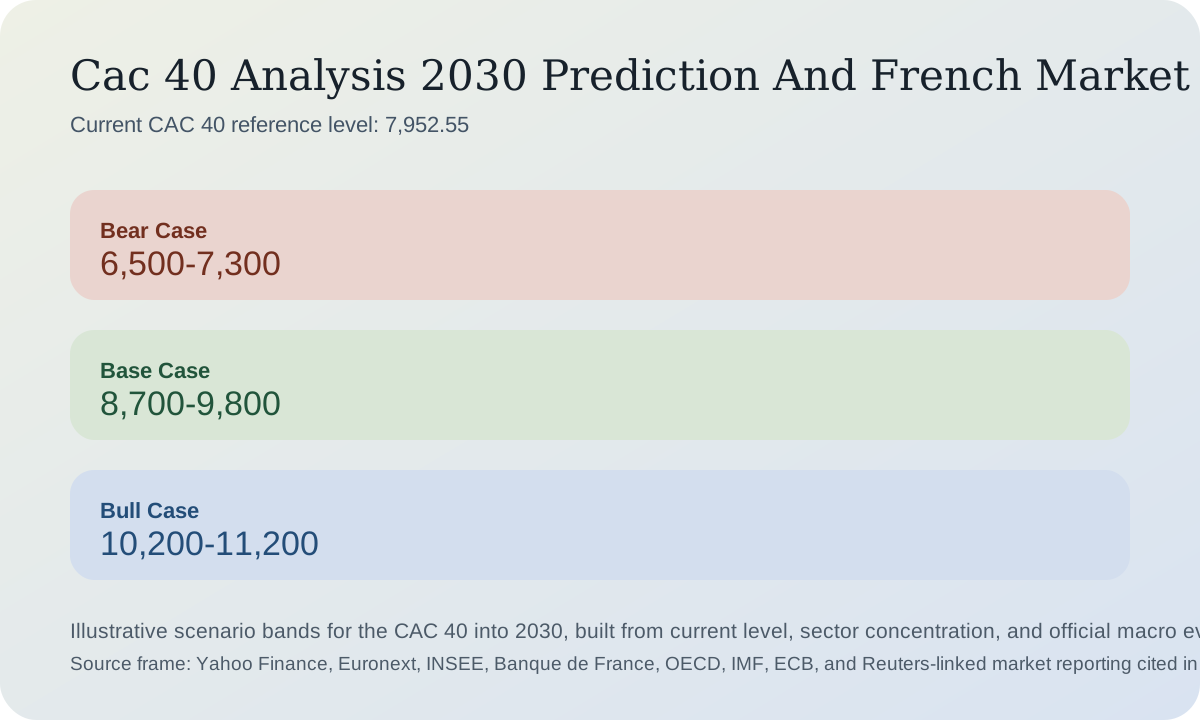
The bull case for 2030 is roughly 10,200 to 11,200. This scenario depends heavily on a luxury recovery, continued aerospace and defense momentum, supportive industrial capex, and a rate backdrop that does not punish European multiples. It also assumes France manages fiscal consolidation without crushing growth.
Bearish scenario
The bear case is 6,500 to 7,300. That does not imply a collapse of France Inc. It implies that luxury demand stays weak, rates remain restrictive, fiscal tightening weighs on domestic confidence, and the market decides that the 2025-2026 record zone was too generous for a low-growth macro environment.
Base-case scenario
The base case is 8,700 to 9,800. That range assumes moderate earnings growth, some luxury normalization, ongoing support from defense and electrification, and a macro path that is sluggish but not recessionary.
| Scenario | Range | Key conditions | Probability |
|---|---|---|---|
| Bull | 10,200-11,200 | Luxury recovery, industrial capex strength, stable ECB path, and no fiscal accident. | 25% |
| Base | 8,700-9,800 | Moderate growth, mixed sector rotation, and no major macro shock. | 50% |
| Bear | 6,500-7,300 | Luxury weakness persists and rates or geopolitics pressure valuations. | 25% |
| Path | Estimated probability | Why |
|---|---|---|
| Rising from current levels by 2030 | 55% | The index still contains multiple world-class franchises with real pricing power and capital return support. |
| Falling below current levels by 2030 | 20% | A lower 2030 level likely needs prolonged luxury weakness plus restrictive financial conditions. |
| Moving broadly sideways | 25% | A mature, diversified European index can spend years consolidating if earnings and multiples offset each other. |
Risks to watch
The biggest variables are Chinese luxury demand, ECB policy, French fiscal credibility, energy prices, and whether industrial AI and electrification beneficiaries keep offsetting softer consumer-facing sectors.
What could invalidate the forecast
This 2030 framework would be too conservative if the CAC's industrial and AI-linked names compound faster than the market expects while luxury rebounds cleanly. It would be too optimistic if France enters a more persistent low-growth, high-rate, high-deficit regime that compresses European equity multiples more broadly.
Conclusion
The most reasonable CAC 40 outlook into 2030 is constructive, but not reckless. France's flagship index still offers global franchises and sector depth, yet the benchmark is too concentrated and too macro-sensitive to justify one-number certainty.
Disclaimer: This article is for research and informational purposes only. Scenario ranges are editorial judgments based on public information, not guarantees or personal investment advice.
06. Investor Positioning
Different investor profiles should treat the CAC 40 differently
| Investor type | Cautious approach | What to watch |
|---|---|---|
| Investor already in profit | Hold core exposure and rebalance if luxury or industrial winners have made the position too concentrated. | Sector concentration and whether France's macro backdrop starts to erode valuation support. |
| Investor currently at a loss | Review whether the loss came from timing or from a broken thesis about French blue-chips. | ECB signals, luxury demand, and whether 2026 stagnation proves temporary. |
| Investor with no position | Consider staged entries or wait for pullbacks instead of chasing index rebounds. | Macro data and the relative strength of top-weight sectors. |
| Trader | Use stop-losses and trade around catalysts like ECB meetings, luxury earnings, and geopolitics. | Short-term volatility in large weights such as LVMH, Schneider, and TotalEnergies. |
| Long-term investor | Dollar-cost averaging is more defensible than all-in timing calls. | Total return, including dividends, and sector balance over time. |
| Risk-hedging investor | Use dedicated hedges rather than assuming a broad index position is defensive. | Energy shocks, rates, and France-specific policy risk. |
07. FAQ
Frequently asked questions about the CAC 40 outlook
Is the CAC 40 mainly a France GDP trade?
No. The benchmark is listed in Paris, but many constituents generate most of their revenue internationally, especially in luxury, energy, aerospace, and health care.
Why use ranges rather than a single 2030 target?
Because macro variables, luxury demand, and ECB policy can change meaningfully over five years. Scenario ranges are more credible than false precision.
What matters most right now for the CAC 40?
Luxury demand, rate expectations, defense and industrial momentum, and whether France can stabilize growth without losing fiscal credibility.
References
Sources
- Yahoo Finance chart API for ^FCHI, 10-year monthly history
- Yahoo Finance chart API for ^FCHI, recent daily closes
- Euronext CAC 40 factsheet, March 31, 2026
- INSEE economic dashboard for France
- INSEE Q1 2026 GDP release
- Banque de France macroeconomic projections page
- Banque de France March 2026 macroeconomic projections
- OECD Economic Outlook landing page
- OECD Economic Outlook Volume 2025 Issue 2
- IMF 2025 Article IV consultation for France
- ECB April 2026 economic outlook and monetary policy speech
- Reuters factbox on France's 2026 budget
- Reuters on LVMH first-quarter weakness
- Reuters on Schneider and AI-linked demand