01. Quick Answer
The best 2035 CAC forecast is a scenario map built around compounding quality, not a single bold number
A 2035 forecast for the CAC 40 is less about guessing next year's GDP and more about asking whether France's listed champions can keep compounding through another full market cycle. The benchmark has already risen from 4,237.48 in May 2016 to 7,952.55 in May 2026, but the next decade starts from a much richer valuation and a more concentrated structure (Yahoo Finance; Euronext factsheet).
| Point | Why it matters |
|---|---|
| 2035 should be scenario-driven | Nine-year forecasts require conditional thinking, not one-number certainty. |
| Sector concentration remains decisive | A handful of franchises will still drive most outcomes. |
| Long-run upside depends on total-return discipline | Dividends, not just price appreciation, remain central to French equity compounding. |
| The bear case is about weak compounding, not collapse | The CAC's multinational quality reduces but does not erase downside risk. |
02. Historical Context
The index's next decade will depend on how leadership evolves from luxury dominance toward a broader mix
The case for a constructive 2035 outlook begins with the benchmark's historical ability to recover from shocks. The index survived the pandemic, the energy crisis, and rate normalization, then pushed to a record high above 8,600 in February 2026 on a closing basis according to widely cited market references (Euronext Paris; Yahoo Finance history). But the case against complacency is equally strong: the Euronext factsheet shows a top ten weight close to 60%, meaning long-run outcomes are still heavily tied to a small group of sector leaders.
| Dimension | Short-horizon focus | Long-horizon focus |
|---|---|---|
| Macro | ECB meetings and next-year GDP prints | Whether France and Europe sustain a competitive investment climate. |
| Sector leadership | Current luxury and rate swings | Which sectors dominate the next decade: luxury, defense, electrification, AI, or health care. |
| Index structure | Recent earnings beats and misses | Whether concentration helps or hurts the benchmark over time. |
| Valuation | Near-term multiple rerating | Long-term total return and capital allocation quality. |
Available data suggests the long-run case depends on three broad questions. Can the CAC's luxury complex resume steady growth after a difficult cycle? Can industrial, defense, and AI-linked names take a larger share of index leadership? And can France narrow fiscal imbalances without undermining the confidence that global investors place in Paris-listed blue-chips?
Another reason to keep the long-range lens broad is that the CAC is a price index in headline form. Investors who focus only on the quoted level can underestimate how much of the total-return story comes from dividends and capital discipline. That makes 2035 less about dramatic point appreciation and more about whether Paris keeps producing reliable blue-chip compounding.
03. Main Drivers
Five structural forces are most likely to decide where the CAC is headed by 2035
1. The luxury complex will probably still define sentiment for years
Luxury is too important to ignore. Reuters-linked coverage shows that even when investors believe the sector will stabilize, they remain cautious about China, higher energy costs, and the spending habits of aspirational buyers (Reuters on luxury volatility; Reuters on LVMH Q1 2026).
2. Defense, aerospace, and industrial automation could broaden the index's leadership
Banque de France and market reporting both point to stronger momentum in aerospace, defense, and parts of industrial production. That could matter more by 2035 if Europe remains committed to defense spending and energy-system modernization.
3. AI and data-center electrification may change the composition of upside
Schneider Electric, Capgemini, Publicis, Dassault Systèmes, and STMicroelectronics give the index more AI sensitivity than many older stereotypes about France suggest (Reuters on Schneider; Capgemini AI partnership).
4. Fiscal credibility and the ECB still affect the multiple
The IMF and Reuters' budget coverage show why investors keep one eye on France's public finances. Long-run upside is easier to imagine if Paris stabilizes its deficit trajectory without forcing prolonged stagnation (IMF France Article IV; Reuters budget factbox).
5. Total return matters more than the headline price index
Euronext's factsheet shows the gross-return and net-return versions of the index materially outperform the price version over time. That is essential context for any 2035 discussion because a large share of long-run investor experience comes from dividends, not just price gains (Euronext factsheet).
04. Institutional Forecasts and Analyst Views
Official macro and index data matter more than thin long-range brokerage targets
There are few credible public 2035 point forecasts for the CAC 40, which is precisely why the analysis should start from official macro projections and current index structure. Banque de France, OECD, IMF, and ECB materials all support a restrained conclusion: France is not in a high-growth macro regime, but it still has globally competitive listed leaders and a functioning capital market (Banque de France; OECD; ECB).
| Source | Signal | Long-run implication |
|---|---|---|
| Banque de France | Baseline growth remains positive, but modest | Suggests the domestic macro backdrop is supportive but not explosive. |
| IMF | Public finance and competitiveness remain key policy issues | A stable policy framework matters for the equity multiple. |
| Euronext | The benchmark remains concentrated and high-quality | Leadership durability will matter more than breadth. |
| Reuters market reporting | Luxury, energy, and geopolitical sensitivity still move Paris | Long-run scenarios must allow for sector rotation and policy shocks. |
The evidence is mixed, which is exactly why a 2035 range needs to be wide. The right way to think about it is not whether the index can rise at all. It is whether its next decade looks more like moderate compounding, exceptional sector rotation into industrial winners, or a long period of mediocre returns as macro and luxury headwinds offset the strengths of France's best franchises.
05. Bull, Bear, and Base Cases
A long-horizon French index forecast has to be conditional and range-based
Bull case
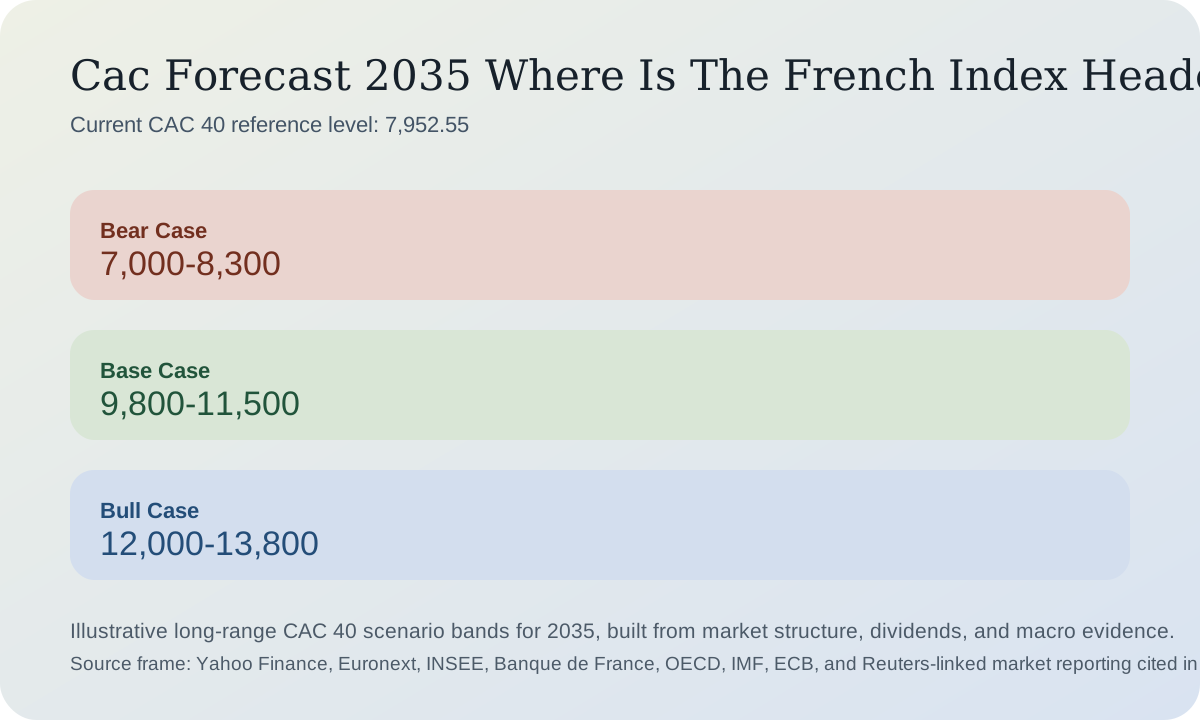
The bull range for 2035 is 12,000 to 13,800. That requires a cleaner luxury recovery, sustained defense and aerospace demand, ongoing energy and infrastructure investment, and AI-linked industrial and software winners taking a larger role in index leadership.
Base case
The base case is 9,800 to 11,500. This assumes a continuation of moderate price compounding from today's level, supported by dividends, mixed but positive earnings growth, and no major break in France's policy credibility.
Bear case
The bear case is 7,000 to 8,300. That path would likely reflect a long stretch in which luxury remains structurally weaker, fiscal or rate conditions keep valuations restrained, and industrial winners are not strong enough to carry the whole benchmark.
| Scenario | Range | Core assumptions | Probability |
|---|---|---|---|
| Bull | 12,000-13,800 | Luxury normalizes, AI and electrification winners lead, and policy remains credible. | 20% |
| Base | 9,800-11,500 | Moderate compounding with mixed sector performance and continued dividends. | 55% |
| Bear | 7,000-8,300 | A decade of weak luxury, restrained multiples, and low macro momentum. | 25% |
| Direction | Estimated probability | Interpretation |
|---|---|---|
| Higher by 2035 | 60% | The multinational quality of the benchmark still supports a positive long-run bias. |
| Lower by 2035 | 15% | A durable decline likely needs a long period of poor sector leadership and macro disappointment. |
| Mostly sideways | 25% | European indices can spend years consolidating when dividends offset low price appreciation. |
Risks to watch
The key risks are luxury stagnation, persistent fiscal stress, repeated geopolitical energy shocks, and an ECB or euro-area environment that keeps real rates structurally high.
What could invalidate the forecast
This framework would be too bearish if AI, electrification, and industrial sovereignty create a stronger earnings mix than the market currently assumes. It would be too bullish if France's listed leaders lose pricing power or if Europe enters a prolonged low-growth, high-politics equilibrium.
Conclusion
The long-run CAC outlook is more constructive than many simplistic "France growth is weak" narratives imply. But it is also less explosive than a U.S.-style tech benchmark. By 2035, the most likely story is measured compounding with large sector rotations along the way.
Disclaimer: This article is for informational purposes only. The 2035 ranges are scenario-based editorial judgments, not promises or personalized advice.
06. Investor Positioning
Time horizon and position size matter even more on a nine-year forecast
| Investor profile | Prudent stance | Key watchpoint |
|---|---|---|
| Investor already in profit | Let winners run, but rebalance if luxury or defense names dominate your exposure. | Concentration risk inside the index. |
| Investor currently at a loss | Reassess the thesis over a cycle, not over a quarter. | Whether the weakness is macro-temporary or structurally sector-driven. |
| Investor with no position | Scale in over time rather than chase a long-range narrative. | Dividend-adjusted total return expectations. |
| Trader | Treat 2035 narratives as background, not as trade signals. | Near-term catalysts still dominate price action. |
| Long-term investor | Dollar-cost averaging is the cleanest fit for a mature European index. | Sector leadership shifts over multiple years. |
| Risk-hedging investor | Use true hedges alongside any CAC position. | Energy and rate sensitivity can still surprise. |
07. FAQ
Frequently asked questions about the CAC 40 in 2035
Why is the 2035 bull case not more aggressive?
Because the CAC 40 is a mature, dividend-heavy benchmark, not a narrow high-growth technology index. Strong long-run outcomes are possible, but they usually come through compounding, not vertical rerating.
Does the 2035 outlook depend mainly on France?
No. Many constituents are multinational groups, so global demand and capital flows matter at least as much as domestic French GDP.
What is the biggest swing variable for the next decade?
Luxury remains the clearest swing variable, but AI-linked industrial winners could become a more important offset than the market currently prices.
References
Sources
- Yahoo Finance chart API for ^FCHI, 10-year monthly history
- Yahoo Finance chart API for ^FCHI, recent daily closes
- Euronext CAC 40 factsheet, March 31, 2026
- INSEE economic dashboard for France
- INSEE Q1 2026 GDP release
- Banque de France macroeconomic projections page
- Banque de France March 2026 macroeconomic projections
- OECD Economic Outlook landing page
- OECD Economic Outlook Volume 2025 Issue 2
- IMF 2025 Article IV consultation for France
- ECB April 2026 economic outlook and monetary policy speech
- Reuters factbox on France's 2026 budget
- Reuters on luxury-stock volatility
- Capgemini's OpenAI alliance