01. Quick Answer
Copper Forecast 2035: Bull, Bear, and Base Case Price Scenarios
The short answer is that 2035 probably requires a wider range than 2030. By then, today's announced projects will either be online, delayed, or canceled, while power-grid and data-center build-outs should be materially further along (IEA chart, mined supply and demand outlook for copper, 2026-2035; S&P Global, Copper in the Age of AI: Challenges of Electrification, January 2026; BHP Insights, How copper will shape our future).
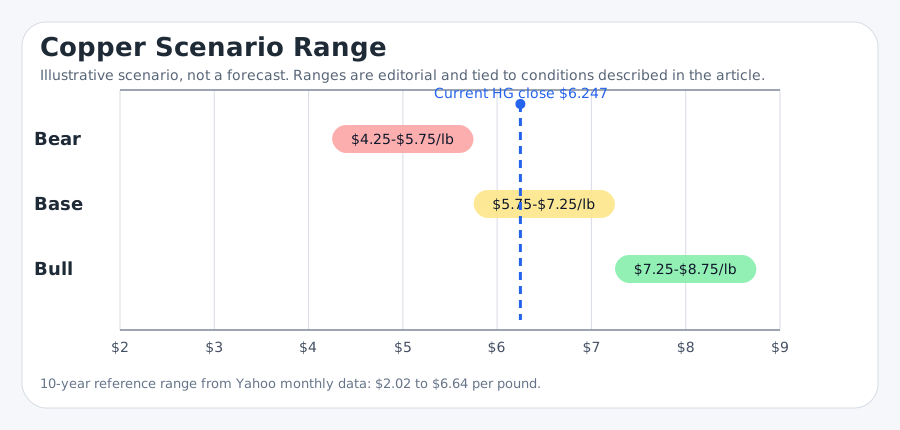
The most balanced editorial range is $5.75-$7.25/lb, with a bull case of $7.25-$8.75/lb if the supply gap worsens and a bear case of $4.25-$5.75/lb if substitution, scrap, and lower growth absorb the pressure. Analysts remain divided on how much of the shortage can be solved with higher prices alone.
| Category | Evidence-based read | Implication |
|---|---|---|
| Historical context | Copper already broke out of its old range, so 2035 starts from an elevated base. | Long-horizon upside now depends on scarcity persistence, not just mean reversion. |
| Institutional evidence | Goldman, IEA, S&P Global, BHP, and UBS all see supply strain lasting into the 2030s. | The debate is the degree of tightness, not whether tightness exists. |
| Most likely scenario | The evidence currently supports a high-but-not-explosive equilibrium more than either extreme. | Base case matters more than sensational targets. |
| Main risk to the thesis | Copper is still cyclical, and slower growth could delay rather than destroy the shortage story. | Time horizon matters as much as direction. |
02. Historical Context
Current market snapshot and historical context
The 2035 discussion should not ignore path dependency. Copper does not need to jump from $2/lb to $8/lb in one move because it already repriced dramatically over the last decade. That means 2035 outcomes are about the persistence of a new regime, not simply a rerun of the 2020-2026 rally.
| Metric | Latest read | Why it matters |
|---|---|---|
| 2035 demand backdrop | Electrification plus digital infrastructure | Creates more diversified copper demand than in prior cycles |
| IEA signal | Only about 70% of 2035 demand covered by existing and announced projects | Implies a meaningful development gap |
| BHP signal | 10 Mt of new supply needed by 2035 | Shows how large the industry response must be |
| Goldman long-run signal | $15,000/t by 2035 | A widely cited bank view of scarcity pricing |
| Period marker | Approximate price | Interpretation |
|---|---|---|
| 10-year low | $2.02/lb | The monthly series bottomed near this level during the 2016 industrial slowdown. |
| 2020 shock reset | around $2.10/lb | Copper sold off during the pandemic shock before reopening demand changed the trend. |
| 2021 reopening high | near $4.89/lb | Electrification optimism and supply friction started to re-rate the metal. |
| 2024–2026 re-rating | $5.20 to $6.64/lb | Tighter supply, tariffs, AI-related power demand, and mine disruptions pushed HG into a higher regime. |
| Latest close | $6.247/lb | Yahoo daily data puts HG near cycle highs on May 18, 2026. |
03. Main Drivers
Main drivers of price movement
1. The development timeline is the core variable
A 2035 forecast is really a statement about project execution. The IEA and BHP both argue that planned supply is not enough and that the gap is measured in millions of tons, not in marginal quarterly adjustments.
2. Scrap helps, but probably does not solve the problem
BHP expects scrap's share of supply to rise, and the IEA also sees recycling reducing part of primary requirements. But both still conclude that much more mined copper is required, especially because grade decline keeps eroding legacy assets.
3. AI can become a real 2030s demand layer, not just a 2026 trading story
S&P Global's work pushes data-center copper demand from 1.1 million tons in 2025 to 2.5 million by 2040, with AI-training-related demand accounting for much of the shift by 2030. That matters because it converts copper from an energy-transition story into a broader power-and-compute infrastructure story.
4. Macro growth still decides timing
The IMF's 2026 WEO reminds investors that slower world growth can delay commodity tightness. If growth undershoots for several years, a structural shortage can remain true but arrive later than bulls expect.
5. Critical-minerals policy can compress the downside
Copper's growing strategic status in the United States and elsewhere may not automatically raise demand, but it can support project financing, stockpiling, and supply-chain localization, all of which tend to reinforce higher clearing prices over time.
04. Institutional Forecasts and Analyst Views
Institutional forecasts and analyst views
Long-dated institutional forecasts are scarce, which is exactly why scenario analysis matters. What the current source set provides is a ladder of signposts from near-term annual averages to structural shortage warnings.
| Source | Forecast / signal | Interpretation |
|---|---|---|
| Goldman Sachs | $15,000/t by 2035 | The most visible published long-run bank forecast in the current source set |
| UBS | $15,000/t by March 2027 | Not a 2035 forecast, but a sign that scarcity pricing is already entering institutional models |
| World Bank | $12,000/t in 2026 and $11,000/t in 2027 | Useful as a cyclical baseline rather than a long-run ceiling |
| IEA | 30% 2035 supply shortfall risk in current project pipeline | Structural evidence, not a price target |
| S&P Global | Potential 10.1 Mt annual shortfall by 2040 without major investment | Supports the long-run scarcity thesis |
| BHP | Need for about 10 Mtpa of new mined supply by 2035 | A producer-side view of the scale of the challenge |
05. Bull, Bear, and Base Case
How the forecast range and probability table are built
The range in this article is editorial and scenario-based rather than a deterministic forecast. It starts with current HG pricing, the 10-year trading band, the World Bank near-term baseline, ICSG balance data, and structural demand evidence from IEA, S&P Global, and BHP.
| Scenario | Price range | Conditions | Probability |
|---|---|---|---|
| Bull | $7.25-$8.75/lb | Major projects keep slipping, grids and AI ramp faster than expected, and governments treat copper like a strategic bottleneck | 30% |
| Base | $5.75-$7.25/lb | High prices induce some supply and more scrap, but not enough to restore old-cycle abundance | 45% |
| Bear | $4.25-$5.75/lb | Growth disappoints, substitution accelerates, and enough supply arrives to cap scarcity pricing | 25% |
| Direction | Probability | Comment |
|---|---|---|
| Higher by 2035 | 45% | The structural case is stronger over a 9-year horizon than over a 1-year horizon |
| Lower by 2035 | 20% | A full bear path needs both weaker demand and a much better supply response |
| Range-bound at high levels | 35% | A realistic middle path if copper stays strategic but volatile |
| Investor type | Prudent approach | Main watchpoints |
|---|---|---|
| Investor already in profit | Keep a core allocation, but trim if the market starts pricing a perfect shortage narrative years in advance. | Long-horizon upside does not remove valuation risk. |
| Investor currently at a loss | Avoid forcing a long-dated thesis to justify a short-dated trade that went wrong. | Time horizon mismatch is a common mistake. |
| Investor with no position | Use staged entries and focus on pullbacks tied to macro slowdowns, not just momentum bursts. | 2035 thesis does not require buying the most crowded day. |
| Trader | Respect mean reversion. A structural bull market can still punish late entries badly. | Inventory shifts and tariffs can dominate the tape. |
| Long-term investor | Dollar-cost averaging can fit a 2035 thesis if position size reflects commodity volatility. | A long horizon should come with wider risk limits. |
| Risk-hedging investor | Copper can hedge electrification and capex inflation, but hedge it inside a diversified basket rather than alone. | Single-commodity concentration remains risky. |
The 2035 copper outlook still tilts positive because the supply problem appears deeper than the market's usual one-cycle fixes. But a long-run bull case does not mean the next few years are free of surplus periods, policy shocks, or growth scares. The most defensible stance is a scenario range with a constructive center of gravity. Disclaimer: This article is for informational and research purposes only and does not constitute personalized financial advice.
06. FAQ
Frequently asked questions
Is $15,000/t by 2035 realistic?
It is realistic as a published bank scenario, but it should be treated as a conditional outcome rather than a guaranteed destination.
Why does the base case stay below the most aggressive bull forecasts?
Because supply, scrap, and substitution usually respond to sustained high prices, even if not fast enough to restore old levels.
What matters most between now and 2035?
Mine permitting, project execution, grid spending, Chinese demand quality, and the pace of AI-related infrastructure.
What would invalidate the bull case?
A much stronger supply response, weaker electrification demand, or a durable shift toward lower copper intensity would all weaken it.
Methodology and Invalidation
How to interpret this framework and what would change it
This article uses a longer horizon than most bank notes, so the framework emphasizes structural indicators over annual averages. The most important evidence comes from IEA's 2035 pipeline work, S&P Global's electrification and AI demand analysis, and BHP's producer-side supply-gap estimates (IEA chart, mined supply and demand outlook for copper, 2026-2035; S&P Global, Copper in the Age of AI: Challenges of Electrification, January 2026; BHP Insights, How copper will shape our future).
The 2035 range starts from today's elevated HG level and then asks what kind of clearing price is needed to finance the next generation of projects without assuming a perpetual squeeze. That is why the base case stays high even though near-term official forecasts sometimes cool from spot prices (Yahoo Finance chart API, HG=F recent daily data; World Bank, Commodity Markets Outlook, April 2026).
Invalidation runs both ways. If multi-year global growth weakens meaningfully and enough supply ramps in Latin America, Africa, and brownfield expansions, the lower half of the range becomes more likely. If permitting, water stress, community opposition, and capex inflation keep delaying projects, the higher half becomes more credible.
References
Sources
- Yahoo Finance chart API, HG=F 10-year monthly data
- Yahoo Finance chart API, HG=F recent daily data
- World Bank, Commodity Markets Outlook, April 2026
- ICSG, Table 1: World refined copper production and usage trends, April 2026
- Reuters on ICSG April 2026 forecast update
- IEA, Copper report within Global Critical Minerals Outlook 2024
- IEA, Global Critical Minerals Outlook 2025 overview
- IEA chart, mined supply and demand outlook for copper, 2026-2035
- S&P Global, Copper in the Age of AI: Challenges of Electrification, January 2026
- S&P Global, Plugged in and politicized: Copper in a fractured world
- BHP, Copper Growth
- BHP Insights, How copper will shape our future
- IMF, World Economic Outlook, April 2026
- USGS, Mineral Commodity Summaries 2026
- Reuters on Goldman Sachs reiterating a $15,000/t copper view for 2035
- UBS CIO, commodities note, February 27, 2026
- U.S. Department of the Interior, final 2025 List of Critical Minerals