01. Quick Answer
The 2035 Deutsche Bank outlook depends on whether the recovery matures into a durable return story
By 2035, Deutsche Bank will likely be judged on whether it sustained higher returns, disciplined capital distribution, and improved operating quality through multiple cycles. Available data suggests a 2035 base case around $60 to $78 is coherent, with upside if returns and payouts remain strong and downside if macro or regulatory pressure interrupts the recovery.
| Point | Why it matters |
|---|---|
| Long-range DB forecasting has to balance recovery and cyclicality | Deutsche Bank is increasingly judged on forward return quality rather than only on its turnaround history. |
| Capital return matters almost as much as earnings growth | Capital return and target delivery are now central to the bull case. |
| European banking risks still justify wide ranges | Macro, regulation, and private-credit risk still matter enough to keep scenario ranges wide. |
| Broad scenario bands are more defensible than false precision | Broad ranges are more credible than point precision for a cyclical large-cap bank. |
02. Historical Context
Deutsche Bank is no longer just a turnaround story. The real question is whether the recovery can become a durable compounding story.
Deutsche Bank moved from roughly $13.71 in May 2016 to $31.73 at the May 14, 2026 close, implying a 10-year price CAGR of about 8.75%. That is a respectable recovery for a bank with a long history of restructuring, litigation overhangs, capital concerns, and profitability doubts. It also means the modern debate is less about survival and more about whether better profitability, cleaner execution, and capital returns can support a structurally better valuation.
The evidence has improved materially. Deutsche Bank reported record quarterly post-tax profit of EUR 2.2 billion in Q1 2026 and stayed on track for its 2026 targets. Management has also formalized the 2026-2028 Scaling the Global Hausbank strategy, targeting post-tax RoTE above 13% and a cost-to-income ratio below 60% by 2028. Still, the evidence is mixed enough that investors should not confuse recovery with inevitability. Banking remains cyclical, and private-credit exposure, macro shocks, regulation, and European political risk still matter.
| Metric | Latest official reading | Why it matters |
|---|---|---|
| Q1 2026 profit before tax | EUR 3.0 billion | Shows that the bank is producing large profits, not only stabilizing |
| Q1 2026 post-tax profit | EUR 2.2 billion | Record quarterly profit strengthens confidence in the recovery narrative |
| 2025 post-tax RoTE | 10.3% | Hitting the 2025 target proves execution is no longer only aspirational |
| 2026 share buyback | Up to EUR 1.0 billion | Buybacks matter because capital return is now part of the equity case |
| Feature | Deutsche Bank implication | Forecast effect |
|---|---|---|
| European macro and regulatory backdrop | Profitability depends partly on Europe rates, growth, and capital rules, not only on internal execution | Justifies using ranges rather than a single-point target |
| Turnaround heritage | Investors still remember years of underperformance and demand sustained proof before granting a premium multiple | Explains why the stock can still look optically cheap after better results |
| Global investment bank exposure | The bank can benefit from markets and financing activity, but that also adds volatility relative to simpler lenders | Strengthens upside in good markets, but raises downside sensitivity |
| Capital-return transition | Dividend and buyback growth can materially affect the equity story if profitability and CET1 remain sound | Supports the bull case, but only if execution stays disciplined |
03. Main Drivers
Five forces are most likely to shape Deutsche Bank stock over the next several years
1. Delivery against the 2026-2028 Hausbank targets is central
If Deutsche Bank keeps moving toward post-tax RoTE above 13% and a cost-to-income ratio below 60% by 2028, the equity can keep rerating. If those targets drift, the multiple can compress quickly.
2. Capital return is now part of the thesis, not just a bonus
The bank announced a EUR 1.0 billion buyback starting in February 2026 and committed to a 60% total payout ratio from 2026, with potential extra distributions when CET1 is sustainably above 14%. Many bank recoveries stall before they become meaningful shareholder-return stories, so this matters.
3. Investment-bank and financing activity still influence the earnings mix
Deutsche Bank recovery is broader than one division, but markets and financing activity still affect sentiment. Strong quarters can reinforce the upside case, yet they can also make earnings feel more cyclical if investors worry that peak activity will normalize.
4. Private-credit and non-bank financial risk deserve attention
Reuters highlighted the bank private-credit exposure and Deutsche Bank itself acknowledged private credit as a developing risk theme. That does not automatically break the thesis, but it means investors should distinguish between a healthier bank and a risk-free one.
5. AI is a real strategic lever, but likely a gradual one
Deutsche Bank AI Summit 2026 and broader strategy materials show that management sees AI as part of value creation, productivity, and client-service improvement. The likely payoff is not a sudden revenue surge. It is gradual operating leverage, better workflow efficiency, and stronger control infrastructure over time.
04. Institutional Forecasts and Analyst Views
The strongest Deutsche Bank framework comes from official results, capital goals, and live pricing rather than from isolated broker targets
There are analyst targets in the market, but a more defensible editorial framework starts with recent price, 10-year growth history, Q1 2026 earnings power, 2025 delivery, payout ambitions, and the main risks to German and European banking. That creates a more credible range than repeating a single target without context.
| Source | What it says | Implication for Deutsche Bank |
|---|---|---|
| Q1 2026 results | Record quarterly post-tax profit of EUR 2.2 billion and 7% year-over-year rise in profit before tax | Supports the view that the recovery is now operationally real, not only narrative-driven |
| Full-year 2025 release | 2025 post-tax RoTE reached 10.3%, with 2025 targets hit and 2026-2028 goals formalized | Improves confidence that the bank can be modeled on forward returns, not only on repair |
| 2026 capital distribution | EUR 1.0 billion buyback plus a 60% payout ratio objective from 2026 | Capital return can materially support valuation if CET1 and earnings remain stable |
| Reuters on private credit | The bank highlighted private-credit growth and associated risks as scrutiny around the sector intensified | Reminds investors that downside scenarios still matter even in a stronger earnings phase |
| AI and strategy materials | Management sees AI as part of growth, productivity, and value creation under the Hausbank strategy | AI can strengthen the long-run case, but mostly through operating quality rather than hype |
05. Scenarios
Bull, bear, and base-case scenarios for Deutsche Bank
| Scenario | Range | What would likely drive it | Editorial probability |
|---|---|---|---|
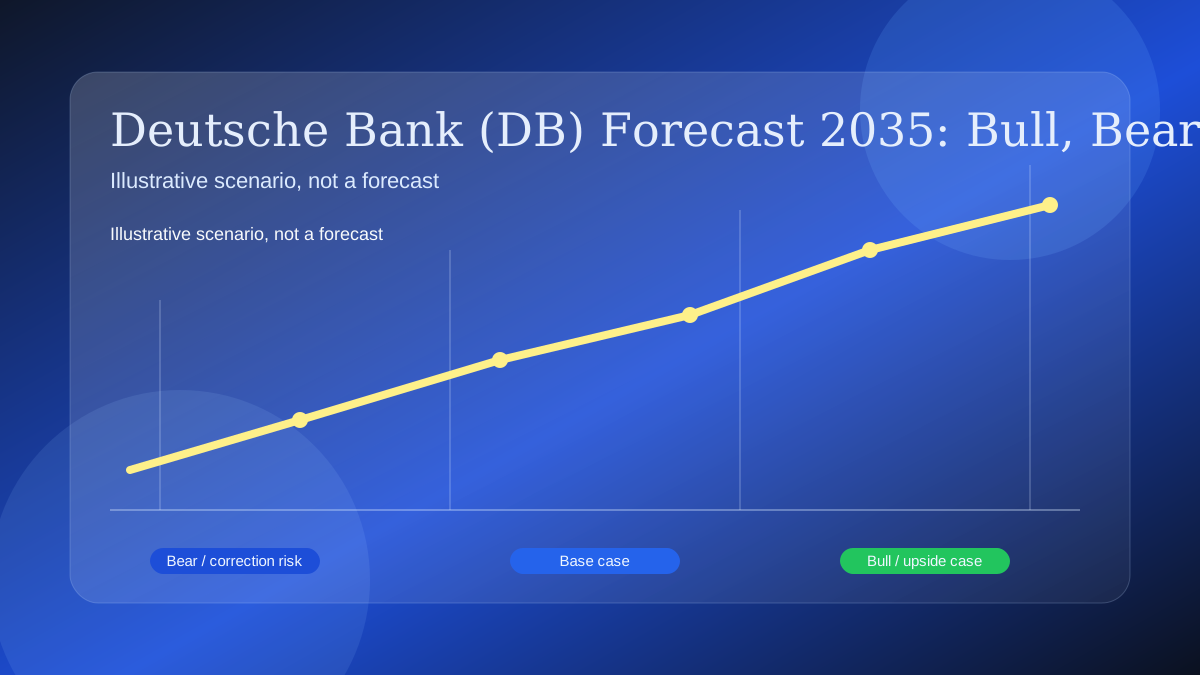
| Bull | $78-$100 | RoTE stays strong, capital returns remain generous, and investors assign a healthier European-bank multiple | 25% |
| Base | $60-$78 | Deutsche Bank compounds steadily through better returns, tighter costs, and disciplined payout policy | 50% |
| Bear | $35-$60 | Macro weakness, regulation, or strategic slippage prevents the bank from sustaining premium recovery economics | 25% |
| Outcome | Probability | Interpretation |
|---|---|---|
| Rising | 42% | Plausible if profitability and payout quality remain materially better than they were for most of the past decade |
| Falling | 22% | Still meaningful because long-horizon bank forecasts remain vulnerable to macro, credit, and regulatory shocks |
| Moving sideways | 36% | A realistic result if Deutsche Bank stays healthier but never fully escapes a cautious valuation framework |
06. Investor Positioning
How different investors might respond
| Investor type | Prudent stance | Why |
|---|---|---|
| Investor already in profit | Hold a core position, but consider trimming if financials exposure has become too concentrated after the recovery | Deutsche Bank is stronger than before, but banking reratings can reverse when macro sentiment changes |
| Investor currently at a loss | Reassess the thesis around profitability, payout, and targets rather than around headline volatility alone | The key issue is whether the bank is compounding better, not whether it had a noisy week |
| Investor with no position | Use staggered entries and avoid chasing short-term optimism around European bank rallies | Macro scares or capital-rule debates can still create better entry points |
| Trader | Use stop-losses and watch RoTE, CET1, private-credit headlines, and European macro data | Bank stocks can move quickly on sentiment shifts even when operating progress remains intact |
| Long-term investor | Focus on capital return, efficiency, strategy delivery, and normalized profitability; dollar-cost averaging can make sense | The long-term case depends on sustained execution, not a single record quarter |
| Hedging-focused investor | Use Deutsche Bank as part of a diversified European financials sleeve rather than as a standalone defensive hedge | The stock can benefit from recovery, but it still carries cyclical and sector risk |
07. Risks to Watch
What could change the outlook quickly
The greatest long-range risk is not a repeat of the old crisis narrative. It is a decade in which profitability improves, but not enough to produce a durable rerating because macro, capital, and regulatory frictions keep capping the multiple.
| Potential invalidation | Why it matters |
|---|---|
| Returns keep improving toward 2028 targets faster than expected | Would strengthen the bull case by proving the bank deserves a structurally better multiple |
| Capital return remains generous without straining CET1 | Would reinforce the thesis that the recovery is producing durable shareholder value |
| Private-credit exposure remains well contained | Would weaken the bear case by removing one of the more visible external concerns |
| AI meaningfully improves efficiency and workflow quality | Would support the long-run case by lifting operating leverage and execution quality |
08. Conclusion
Bottom line
By 2035, Deutsche Bank can plausibly be much higher than today without becoming a glamour stock. The long-run case is credible, but it still depends on durable returns and disciplined capital allocation.
FAQ
Frequently asked questions
Why does capital return matter so much for Deutsche Bank now?
Because a turnaround is not fully credible to equity investors until it starts producing repeatable payouts and buybacks. Deutsche Bank 2026 payout and buyback plans are therefore a material part of the thesis.
Why can Deutsche Bank still fall even after record profits?
Because bank valuations depend on whether investors believe current profitability is durable. Macro weakness, lower rates, private-credit concerns, or capital-rule pressure can all reduce confidence quickly.
How were the forecast ranges built?
The ranges combine the current DB share price, the 10-year CAGR, official Q1 2026 results, 2025 delivery, 2026-2028 targets, payout policy, and scenario analysis around macro, credit, regulation, and AI.
Could AI materially change Deutsche Bank over the next decade?
Potentially yes, but probably through productivity, controls, legal workflows, service quality, and operating leverage rather than through one obvious new revenue stream.
Methodology and Invalidation
How these Deutsche Bank ranges were built and what would change them
These scenario ranges are editorial frameworks, not guarantees or institutional targets. They start with Deutsche Bank recent NYSE close of $31.73 on May 14, 2026 and a 10-year starting point of $13.71 in May 2016, implying a price CAGR of about 8.75%. That historical path matters, but it is not enough by itself because bank stocks rarely compound in straight lines.
For downside language, a correction usually means roughly 10% down from a recent high, a bear market often means closer to 20%, and a crash means something sharper tied to macro shock, credit losses, or a broad confidence break. Deutsche Bank is in better shape than it was years ago, but it is still a cyclical financial institution rather than a defensive utility.
The current evidence base is materially better than it used to be. Deutsche Bank reported Q1 2026 profit before tax of EUR 3.0 billion and record post-tax profit of EUR 2.2 billion. The bank also hit its 2025 targets, including post-tax RoTE of 10.3%, and set 2026-2028 targets including post-tax RoTE above 13%, cost-to-income below 60%, and a 60% payout ratio from 2026 with additional distribution of excess capital where CET1 is sustainably above 14%.
The risk side still matters. Reuters reported that Deutsche Bank private-credit portfolio grew to nearly EUR 26 billion and that the bank itself flagged private credit as a developing risk theme. That does not break the thesis, but it does mean investors should stay disciplined. AI can also matter, yet likely through operating leverage, workflow quality, and control improvements more than through a simple top-line narrative.
Disclaimer: This material is for research and editorial purposes only, does not constitute investment advice, and should not be treated as a recommendation to buy, sell, or hold Deutsche Bank AG or any related security.
References
Sources
- Stock Analysis, Deutsche Bank (DB) price and overview
- Digrin, Deutsche Bank monthly price history
- Deutsche Bank annual reports hub
- Deutsche Bank Q1 2026 results, April 29, 2026
- Deutsche Bank Q1 2026 Financial Data Supplement
- Deutsche Bank full-year 2025 results, January 29, 2026
- Scaling the Global Hausbank strategy and 2026-2028 targets
- Deutsche Bank confirms 2026 outlook, March 12, 2026
- Deutsche Bank share repurchase program of up to EUR 1 billion
- Deutsche Bank capital distribution and share buybacks
- Deutsche Bank AI Summit 2026
- Reuters via Investing.com, Deutsche Bank posts record Q1 net profit and stays on track for 2026 targets
- Reuters via MarketScreener, Deutsche Bank highlights private-credit risks as portfolio grows
- Stock Analysis, DB historical price lookup