01. Quick Answer
The most realistic AI outcome is that it deepens ASML's moat rather than changing its business model
ASML closed at 1,306.60 on 2026-05-15, up from 88.39 at the start of its 10-year Yahoo Finance monthly series on 2016-06-01, for a price-only CAGR of about 30.91% (Yahoo Finance 10-year history; recent daily closes). AI does not need to create an entirely new business for ASML. It only needs to make advanced manufacturing complexity more essential for longer.
That channel already exists through ASML's roadmap, the Dutch Semiconductor Vision 2035, and customer materials from TSMC and Intel. AI can help ASML if it makes advanced logic, memory, and packaging demand more persistent than earlier compute cycles did.
| Point | Why it matters |
|---|---|
| AI matters through intensity, not just volume | More advanced compute can mean more lithography complexity per meaningful unit of demand. |
| High NA becomes more strategic in an AI world | If customers need smaller nodes and better economics, ASML's next moat layer matters more. |
| Service leverage can quietly benefit | A larger and more advanced installed base can raise recurring support economics. |
| The market still needs proof | AI headlines help only if customer capex converts into actual tool demand and shipments. |
02. Historical Context
ASML already sits at the center of a process-complexity trend that AI may intensify
The standard AI narrative is about chips and cloud providers. For ASML, the more relevant question is what AI does to process complexity. ASML closed at 1,306.60 on 2026-05-15, up from 88.39 at the start of its 10-year Yahoo Finance monthly series on 2016-06-01, for a price-only CAGR of about 30.91% (Yahoo Finance 10-year history; recent daily closes).
ASML's role becomes more valuable if AI workloads push customers toward higher performance, lower power, tighter yields, and more demanding node transitions. That does not automatically mean every quarter gets easier. It does mean AI can reinforce the structural need for ASML's technology rather than just boosting semiconductor headlines.
The evidence is mixed on timing. AI enthusiasm can run ahead of actual customer orders. But over a decade, even a gradual rise in tool intensity and installed-base sophistication can be meaningful at the stock level.
| Area | Why it matters | Potential effect |
|---|---|---|
| Advanced logic | AI compute keeps pressure on leading-edge node demand | Supports continued EUV intensity. |
| Memory | AI accelerators need increasingly capable memory stacks | Can improve demand visibility when memory spending recovers. |
| High NA | Customers may need next-generation lithography economics sooner | Deepens the moat if adoption sticks. |
| Installed base and service | More complex fleets raise the value of support, upgrades, and productivity tools | Adds recurring resilience beneath capex cycles. |
| Observation | Implication | Forecast effect |
|---|---|---|
| ASML already sells the key bottleneck tool set | AI amplifies relevance rather than inventing a new category | Supports premium durability if demand persists. |
| Customer capex still mediates everything | AI enthusiasm must become funded orders | Prevents overclaiming near-term certainty. |
| Policy still matters | Strategic importance can rise even while export limits stay binding | Keeps scenario ranges wide. |
03. Main Drivers
Five forces explain how AI could change ASML over the next decade
1. AI can extend advanced-node demand. More compute intensity can keep lithography complexity important for longer.
2. High NA may become more valuable. If AI economics reward leading-edge efficiency, customers may need ASML's next-generation systems sooner than base cycles would suggest.
3. Installed-base economics can strengthen. As fleets become more sophisticated, service and productivity layers can matter more.
4. AI can make the foundry ecosystem more strategic. That raises the value of a bottleneck supplier even if broader chip cycles remain volatile.
5. Export rules may become even more politically sensitive. The more strategic AI becomes, the more important policy coordination and restrictions may be for ASML's revenue mix.
04. Institutional Forecasts and Analyst Views
Company and customer evidence supports a measured moat-deepening thesis rather than AI hype
There are no credible public point forecasts saying AI will take ASML to a specific share price. That is the right starting point. The more defensible approach is to combine ASML's roadmap, TSMC, Intel, and the Dutch strategic policy backdrop rather than forcing false precision.
Analysts remain divided mainly on speed. The evidence does not support saying AI will suddenly rewrite ASML's business model. It does support saying AI could deepen the company's premium by making advanced lithography and service leverage even more central to global compute infrastructure.
The practical mechanism matters. AI helps ASML most if it lifts node intensity, foundry urgency, and the value of installed-base optimization at the same time. That is a richer and more realistic thesis than simply saying AI means more chips.
It also matters that AI can reinforce multiple demand layers simultaneously. Logic, memory, packaging, and service complexity do not have to peak in the same quarter to improve ASML's long-run economics. A gradual uplift across those layers can still be powerful for shareholders over time.
| Channel | Potential upside | Main constraint |
|---|---|---|
| Node intensity | Supports more persistent leading-edge tool demand | Only matters if customers keep funding advanced transitions. |
| High NA adoption | Deepens moat and future service base | Ramp timing can remain lumpy. |
| Memory and packaging complexity | Broadens the AI demand footprint beyond logic | Cycles can still be uneven. |
| Installed base leverage | Improves recurring economics and resilience | Does not remove sensitivity to new-system timing. |
05. Scenarios, Risks, and Invalidation
The AI bull case for ASML is about a deeper moat and longer runway, not a sudden change of identity
Bullish AI scenario
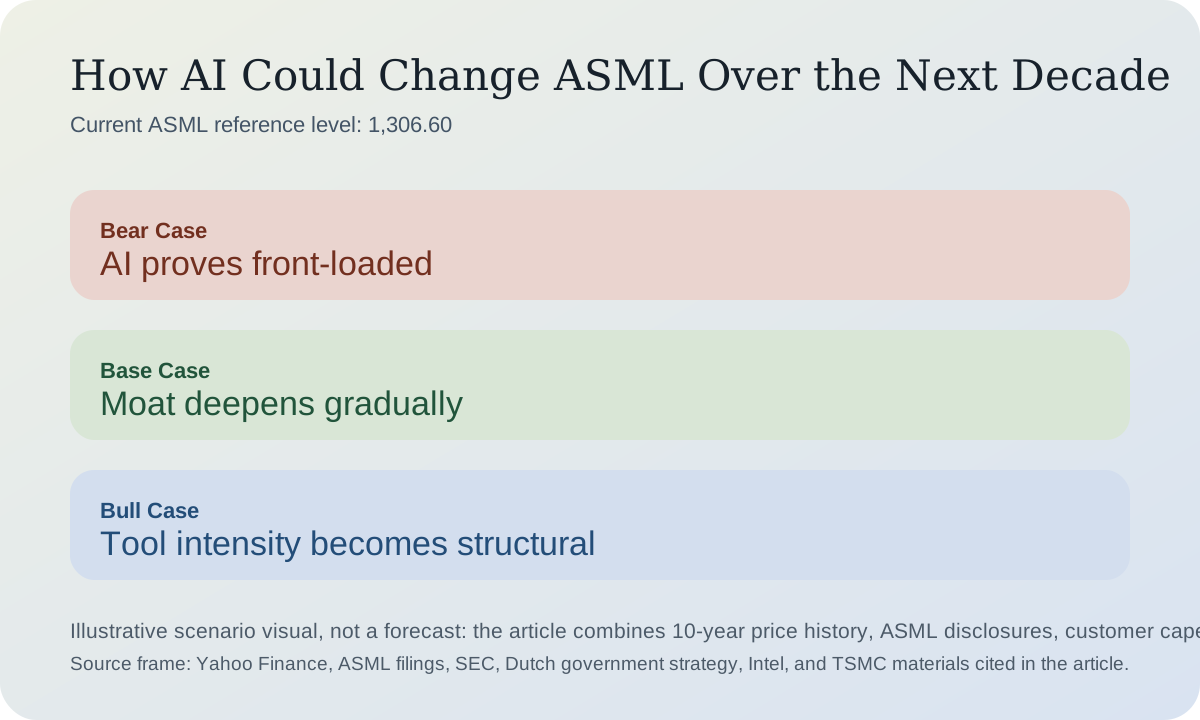
The bullish AI case is that advanced-node and memory intensity both stay elevated long enough to deepen ASML's moat, lift service leverage, and justify a stronger premium multiple for years.
Base-case AI scenario
The base case is more moderate. AI helps several demand channels and extends the runway, but timing remains cyclical and policy still limits how smooth monetization looks.
Bearish AI scenario
The bear case is not that AI disappears. It is that AI demand proves more front-loaded than structural, so the stock sees less durable benefit than the market had hoped.
Risks to watch
Watch foundry funding, memory spending, export-control policy, High NA milestones, and whether AI demand broadens across more than one customer group.
What could invalidate the AI outlook
The constructive AI view would be too strong if customer capex remains more cyclical than expected or if policy constraints block too much monetization. It would be too cautious if AI keeps making advanced manufacturing complexity more essential year after year.
Conclusion
AI could change ASML less by transforming the company than by deepening the value of what it already does best. That is still a meaningful long-run shift for investors who care about moat durability and demand quality.
The key is that AI helps most when it becomes an enduring driver of manufacturing complexity rather than a short-lived burst of excitement. If that happens, ASML's strategic premium can stay justified for longer than many cyclical equipment names ever manage.
Disclaimer: This article is for research and informational purposes only. Any market impact from AI remains uncertain and depends on customer spending and policy as much as technology itself.
| Scenario | Business effect | Stock implication | Probability |
|---|---|---|---|
| Bull | AI materially deepens tool intensity, High NA relevance, and service leverage | Longer premium runway and stronger compounding | 25% |
| Base | AI helps several channels but remains cyclical in timing | Meaningful moat support and moderate stock benefit | 55% |
| Bear | AI impact stays narrower or more front-loaded than hoped | Limited valuation benefit beyond periodic enthusiasm | 20% |
| Path | Estimated probability | Comment |
|---|---|---|
| AI materially improves ASML's long-run stock case | 50% | The channels clearly exist, but monetization still depends on funded customer roadmaps. |
| AI disappoints relative to expectations | 20% | Possible if the demand burst is less durable than the market assumes. |
| AI helps only incrementally | 30% | Still plausible because even essential infrastructure stocks can benefit gradually rather than dramatically. |
06. Investor Positioning
Investors should treat AI as moat-deepening upside rather than as an excuse for undisciplined entries
| Investor type | Cautious approach | What to watch |
|---|---|---|
| Investor already in profit | Do not let AI headlines justify ignoring position size. | Track whether AI-linked demand is actually improving order quality and visibility. |
| Investor currently at a loss | Avoid using AI as a retroactive excuse for a weak entry. | Focus on customer funding and policy, not only narrative. |
| Investor with no position | Build exposure selectively and in stages. | AI optionality helps, but valuation and timing still matter. |
| Trader | Trade around AI headlines carefully. | Narrative volatility can outrun actual order conversion. |
| Long-term investor | Treat AI as a decade-long moat thesis, not a single-quarter catalyst. | Tool intensity, service mix, and High NA adoption. |
| Risk-hedging investor | Do not confuse AI exposure with downside protection. | Separate secular upside from cycle and policy risk. |
07. FAQ
Frequently asked questions about the ASML outlook
Will AI completely transform ASML?
Probably not in the sense of changing its business model. The more realistic outcome is that AI deepens the value of ASML's existing bottleneck role.
Which AI channels matter most for ASML?
Advanced logic demand, memory intensity, High NA adoption, and installed-base service leverage appear the most direct channels.
What is the biggest risk to the AI thesis?
That AI demand proves less durable or less funded than current enthusiasm suggests, especially if policy constraints remain binding.
References
Sources
- Yahoo Finance chart API for ASML.AS, 10-year monthly history
- Yahoo Finance chart API for ASML.AS, recent daily closes
- ASML first-quarter 2026 results
- ASML annual report 2025
- ASML Investor Day 2024: 2030 opportunity and roadmap
- ASML long-term financial framework
- Dutch Semiconductor Vision 2035
- Dutch vision on generative AI
- Intel foundry update and 18A manufacturing roadmap
- TSMC fourth quarter 2025 conference call transcript and 2026 capex discussion
- ASML Form 20-F filed with the SEC
- Dutch AI Act supervision update