01. AI Setup
What AXA has already disclosed about AI
Artificial intelligence is unlikely to turn AXA into a tech stock. But it could still change AXA meaningfully over the next decade by improving underwriting workflows, claims handling, document processing, fraud detection, sales support, and internal productivity. For a large insurer, that can matter a great deal even if the market never assigns a software-style multiple.
| AI angle | Why it matters |
|---|---|
| Internal productivity | AI can save time in document-heavy insurance workflows. |
| Claims and underwriting support | Better triage and data extraction can improve consistency and cost control. |
| Governance matters | Insurers face real privacy, fairness, and model-risk obligations. |
| Valuation impact is indirect | AI matters most if it improves returns and efficiency, not if it creates headlines. |
AXA has been public about its AI efforts for several years. In July 2023, it launched AXA Secure GPT, an internal generative AI service built on Microsoft Azure OpenAI Service. AXA said the initial rollout covered 1,000 employees in Group Operations, with the aim of extending the tool to all 140,000 employees globally in the following months (AXA Secure GPT release).
| Evidence | What AXA disclosed | Interpretation |
|---|---|---|
| Secure GPT launch | Internal generative AI platform for employees | Shows AXA moved early on controlled enterprise AI. |
| FY 2025 management commentary | Automation and AI are paying off, driving efficiency gains | Suggests AI is already entering operating results. |
| Privacy and AI principles | Purpose, robustness, fairness, transparency, human agency, privacy, sustainability | Shows AXA is approaching AI as a governed insurance tool, not an unchecked experiment. |
| Operational use cases | Sorting documents, extracting information, translation, summarization, content support | These are practical insurer workflows with real scale benefits. |
The important point is that AXA's AI story already looks more operational than promotional. That matters because insurers rarely monetize AI through a separate business line. They monetize it by shaving friction out of huge processes and improving risk selection across large books of business.
In other words, AI's value to AXA is likely to show up in expense ratios, speed, and consistency before it shows up in narrative excitement.
That is a subtle but important distinction for investors. If they wait for AI to transform AXA's public identity, they may miss the quieter way value actually gets created inside mature insurers: lower processing friction, better documentation flow, and fewer avoidable errors across huge operating systems.
02. Use Cases
Where AI could matter most inside AXA
1. Claims automation and document handling
Insurance is full of structured and unstructured documentation. AI that sorts, summarizes, and extracts information faster can reduce manual effort and improve turnaround times. AXA's own privacy disclosure explicitly mentions several of these use cases (AXA privacy and AI disclosure).
2. Underwriting support and risk selection
AI can help underwriters organize data, identify risk patterns, and improve consistency. In a business where small pricing or selection improvements can matter materially over time, that is not trivial.
3. Customer and agent productivity
Secure internal AI tools can help agents and employees summarize client interactions, draft communications, and surface relevant policy information faster. That can improve service quality without changing the fundamental business model.
4. Cost discipline at scale
With a group of AXA's size, modest productivity gains can add up. This is why management's statement that automation and AI are already driving efficiency gains deserves attention (FY 2025 commentary).
5. Governance could become a competitive advantage
Because insurance is highly regulated and sensitive to fairness, explainability, and privacy, governance may end up mattering almost as much as raw model capability. AXA's published AI principles suggest it understands that constraint.
03. Market Implications
How AI could influence AXA's operating quality and valuation
Institutional research on insurance increasingly argues that technology and AI must translate into measurable operating performance rather than remain innovation theater. Deloitte's 2026 insurance outlook emphasizes digitalization and technology partnerships, while AXA's own disclosures suggest the company is already moving from experimentation to workflow integration (Deloitte 2026 outlook; AXA Secure GPT).
| Area | Potential benefit | Constraint |
|---|---|---|
| Claims operations | Faster triage and lower friction | Needs strong governance and human oversight. |
| Underwriting | Better information handling and consistency | Model bias and explainability remain real issues. |
| Employee productivity | Less repetitive work and faster communication | Benefits may be real but difficult for outsiders to measure. |
| Customer experience | Quicker responses and better service support | Trust and privacy expectations are high in insurance. |
| Valuation | Higher-quality earnings if efficiency becomes visible | The market may not pay much extra unless benefits are sustained. |
The evidence is mixed on how much AI should change AXA's valuation multiple. It is clearer on how much AI could change operating quality. For a large insurer, that distinction is enough to matter. If AI improves efficiency and underwriting discipline across millions of policies and claims interactions, the cumulative effect over a decade can be significant.
Still, investors should resist the temptation to treat AI as a magic growth engine. The more realistic view is that it makes a mature insurer better run, not fundamentally different.
That realism is useful because it sets the right hurdle. AXA does not need AI to create a new business line. It needs AI to help the existing business scale with fewer manual bottlenecks, better governance, and faster decision support. If that happens consistently, the long-run financial effect can still be meaningful.
04. Scenarios
Bull, base, and bear cases for AI at AXA
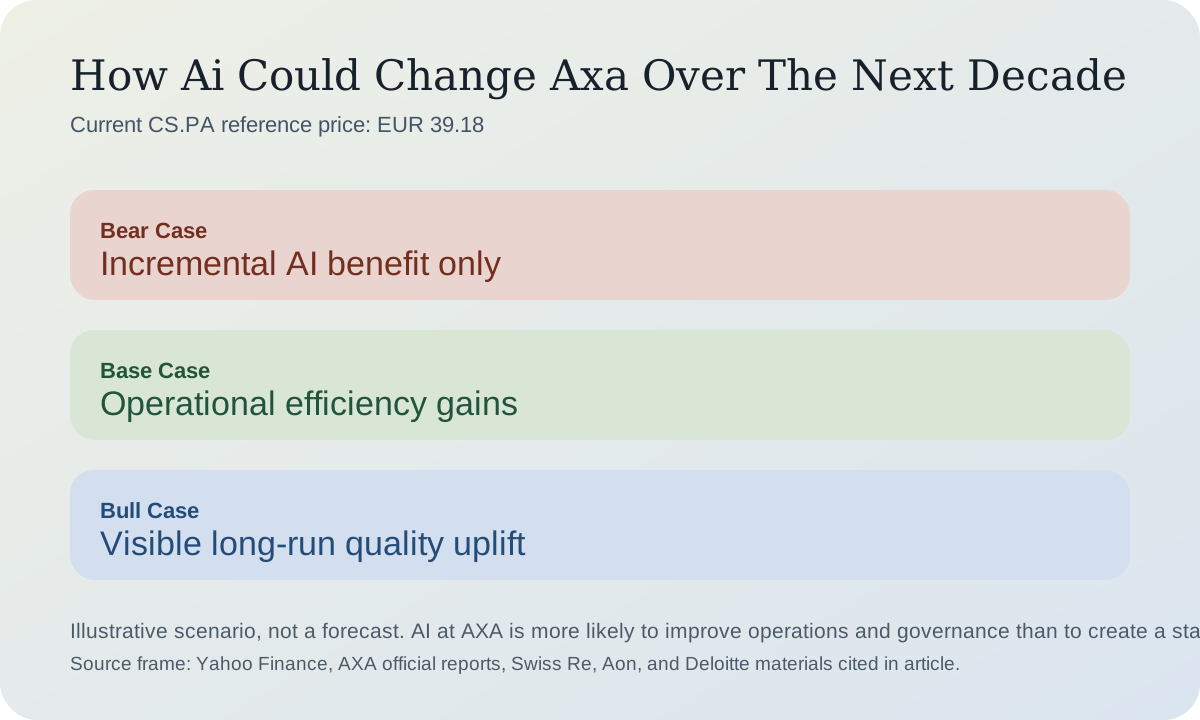
AI bull scenario
The bullish AI scenario is that AXA becomes materially more efficient, more consistent in risk selection, and faster in customer handling, with those improvements slowly supporting better margins and a stronger quality reputation. In that world, AI helps AXA earn a somewhat better long-run valuation than a peer that digitizes more slowly.
AI bear scenario
The bearish AI scenario is not disaster but disappointment. AXA invests heavily in AI tools, governance, and process change, yet the gains remain difficult for outside investors to see. Costs rise before savings become visible, and the stock receives little credit.
AI base case
The base case is that AI quietly improves operations without becoming the dominant reason to own the shares. That is often how value is created inside large insurers.
| Path | Probability | Interpretation |
|---|---|---|
| AI helps AXA outperform on efficiency | 42% | Plausible because AXA already has public tools and governance in place. |
| AI improves operations but leaves valuation mostly unchanged | 38% | The most realistic middle outcome for a mature insurer. |
| AI remains mostly incremental or disappointing | 20% | Possible if benefits stay too hard to measure or scale. |
| Investor type | Prudent approach | AI-specific watchpoint |
|---|---|---|
| Investor already in profit | Treat AI as an enhancer of thesis quality, not the sole reason to hold. | Evidence of efficiency gains in results commentary. |
| Investor currently at a loss | Do not assume AI alone will rescue a weak entry price. | Operational proof, not headlines. |
| Investor with no position | Wait for evidence that AI is visible in execution, not just corporate messaging. | Expense discipline and service metrics. |
| Trader | Do not overtrade AI headlines in an insurance stock. | Actual earnings-day references to productivity or cost ratio. |
| Long-term investor | View AI as a compounding aid that can support quality over time. | Governance, adoption, and measurable workflow benefits. |
| Risk-hedging investor | AI does not turn AXA into a hedge or a tech proxy. | Keep position sizing tied to insurance fundamentals. |
How this framework was built: it relies on AXA's official AI disclosures, management comments on efficiency gains, and broader insurance-sector research on digital transformation. Because AXA has not published a separate AI profit forecast, all valuation implications should be treated as cautious scenario work.
Risks to watch: governance failures, privacy concerns, uneven adoption, high implementation costs, and the possibility that AI benefits remain diffuse rather than visible in reported metrics.
What would invalidate this forecast: a much more aggressive external monetization strategy than AXA currently signals, or alternatively a serious governance setback that forces the company to slow AI deployment materially.
Disclaimer: This article is for informational purposes only and does not constitute investment advice. The AI scenarios discussed here are judgment calls based on public disclosures, not company guidance.
Over the next decade, AI could matter a lot to AXA without ever becoming flashy. For an insurer, that may actually be the most credible bullish interpretation.
The strongest AI thesis for AXA is therefore not disruption but disciplined augmentation. If the company keeps integrating AI into controlled workflows and can point to clearer efficiency gains over time, investors may gradually view AXA as a better operator even if they never view it as a technology story.
05. FAQ
Frequently asked questions about AI and AXA
Will AI turn AXA into a technology company?
No. The more plausible outcome is that AI makes AXA a more efficient, better-governed, and more scalable insurer.
Where can AI help AXA the most?
Claims operations, document-heavy workflows, underwriting support, and internal productivity appear to be the clearest use cases.
What is the main risk to the AI thesis?
The main risk is that AI improves internal processes but does not become visible enough in returns or efficiency metrics to alter investor perception.
Why focus on governance in an AI article?
Because insurers operate in highly sensitive areas where fairness, privacy, and explainability are central to trust and regulation.
06. Sources
Reference list
- Yahoo Finance chart API for CS.PA, 10-year monthly history
- Yahoo Finance chart API for CS.PA, recent daily closes
- AXA Full Year 2025 earnings release
- AXA 1Q26 activity indicators
- AXA 2025 Annual Report
- AXA 2024-2026 strategic plan and financial targets
- AXA strategic plan page
- AXA 2026 share buyback execution release
- AXA 2026 shareholders meeting and dividend approval
- AXA analysts coverage page
- AXA ratings page
- Swiss Re sigma 2/2025 on world insurance conditions
- Swiss Re sigma 5/2025 on insurance market outlook
- Aon Q1 2026 global insurance market overview
- Deloitte 2026 global insurance outlook
- AXA Secure GPT press release
- AXA privacy policy and AI principles
- AXA 2025 integrated report