01. Quick Answer
Ethereum's 2030 setup still leans constructive, but only if usage growth translates into value capture for ETH itself
Available data suggests Ethereum still has one of the deepest institutional and developer moats in crypto, with spot ETF access, a large staking base, and a dominant role in stablecoins and tokenization (SEC) (BlackRock) (Franklin Templeton). But the evidence is mixed on whether all that activity will flow cleanly back to ETH price. Grayscale argues the layered rollup structure can preserve Ethereum's centrality, while also acknowledging that fee migration to layer 2s has weighed on valuation (Grayscale). That is why a 2030 ETH forecast is better framed as a range of outcomes than as a single heroic number.
| Category | Evidence-based read | Implication |
|---|---|---|
| Historical data | ETH traded from roughly $85 in the late-2018 trough to around $4,780 at the August 2025 peak in available Yahoo history (Yahoo Finance) | The upside can be enormous, but the path has repeatedly included deep resets |
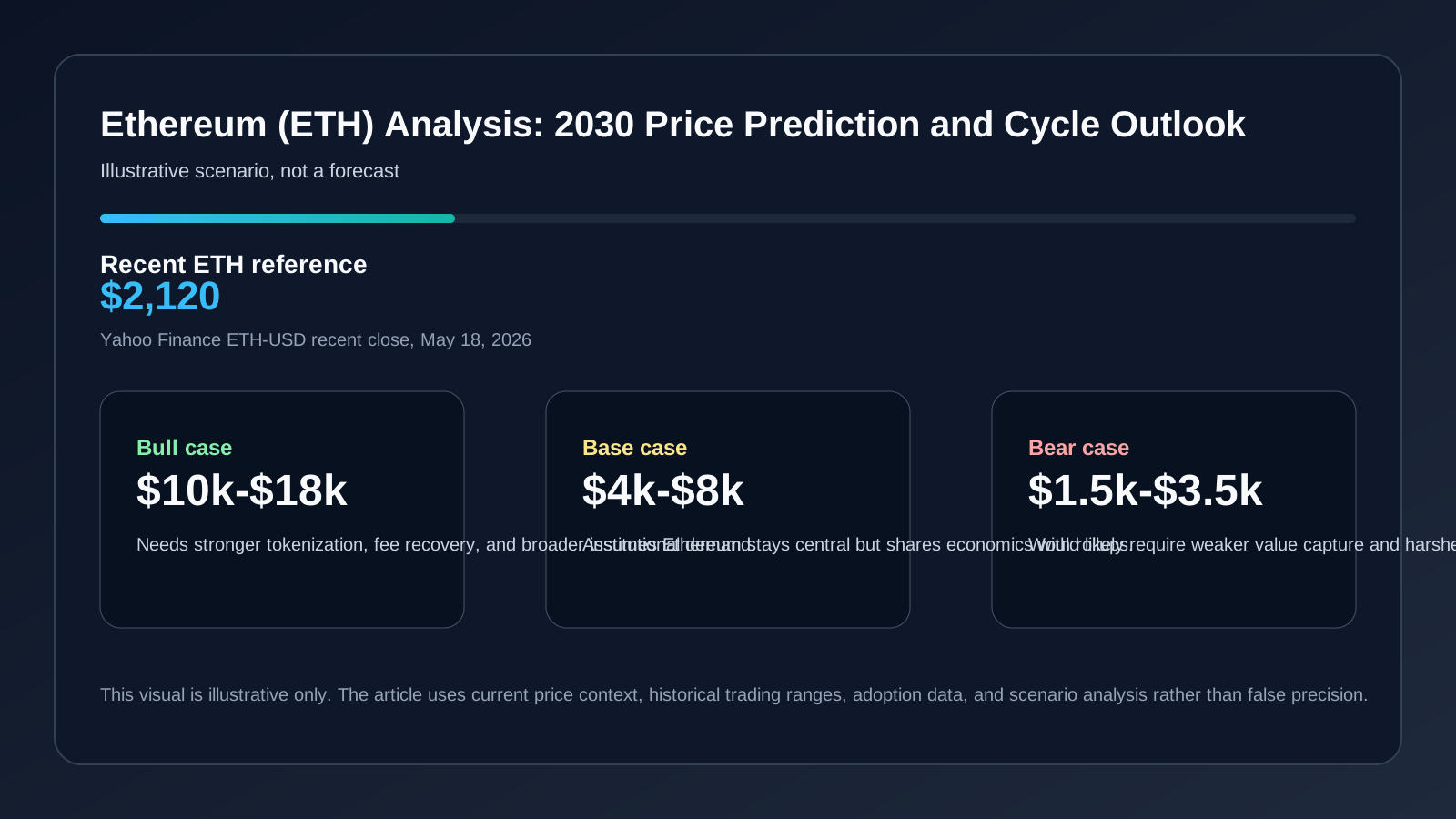
| Current market conditions | ETH closed near $2,120.16 on May 18, 2026, far below the 2025 peak (Yahoo Finance) | 2030 models should start from a market still rebuilding confidence |
| Institutional signals | Spot Ether ETP approvals, ETF wrappers, and regulated futures have deepened access (SEC) (CME Group) | Ethereum now trades inside a more institutional market structure than in prior cycles |
| Working base case | A constructive 2030 outcome remains plausible, but pricing power at the base layer is not settled | Scenario ranges are more honest than a single target |
02. Historical Context
The 2030 question starts with ETH's split personality: major network relevance and inconsistent token performance
Ethereum's available Yahoo Finance trading history begins in November 2017, which is not a full ten years but is still long enough to show the pattern that matters most for forecasting: ETH can compound dramatically during liquidity and adoption booms, then spend long stretches repricing when fee growth, macro liquidity, or sentiment deteriorate (Yahoo Finance). Fidelity's investment thesis is useful here because it frames ether as both an emerging monetary asset and the core asset that powers an application economy (Fidelity). Those two roles create upside, but they also create more variables than Bitcoin has to manage.
| Metric | Latest reading | Why it matters |
|---|---|---|
| Recent ETH close | ~$2,120.16 on May 18, 2026 | Sets the starting point for long-range CAGR and cycle analysis |
| Available price range | $85 to $4,780 | Shows both the scale of past upside and the size of historical drawdowns |
| ETF access | U.S. spot Ether ETF access exists, with BlackRock positioning ETHA as brokerage-account exposure to ether (BlackRock) | Reduces friction for traditional investors |
| Institutional market depth | CME and Glassnode said U.S. spot ETFs had reached 3.47M ETH, about 2.9% of circulating supply, in H1 2025 (CME Group and Glassnode) | Suggests regulated ownership now matters to price discovery |
| Period | Approximate price anchor | Read-through for 2030 |
|---|---|---|
| Late 2018 trough | ~$85 | Reminds investors how severe prior bear markets became |
| November 2021 high | ~$4,631 monthly close | Shows what peak-cycle enthusiasm can deliver when DeFi and NFTs surge |
| August 2025 high | ~$4,780 in available Yahoo history | Confirms ETH can revisit highs, but also that new highs alone do not guarantee follow-through |
| May 2026 | ~$2,120.16 | Implies ETH is entering the 2030 debate from a discounted, not euphoric, base |
03. Main Drivers
Five forces will probably matter more than social media narratives between now and 2030
1. ETF access broadens the buyer base, but not all ETF demand is equally sticky
The SEC's 2024 spot Ether approvals gave ETH a regulated wrapper that many institutions had been waiting for (SEC). BlackRock markets ETHA around access and convenience rather than ideology, which is important because mainstream capital often cares more about operational simplicity than crypto culture (BlackRock). That said, ETF access helps price discovery only if asset allocators keep adding exposure through cycles.
2. Staking can support the asset, but staking is not a magic valuation fix
Ethereum's proof-of-stake design ties network security directly to staked ETH, and the Ethereum Foundation itself began staking part of its treasury in February 2026 (Ethereum.org) (Ethereum Foundation). That strengthens the yield narrative and can reduce liquid supply. It does not solve the harder question of how much future fee generation belongs to ETH holders after rollups and middleware take their cut.
3. Rollups improve Ethereum's utility while complicating ETH's value capture
Ethereum.org is explicit that scaling now happens through layer 2 rollups, with current rollups already materially cheaper than mainnet and future upgrades targeting even lower costs (Ethereum.org) (Ethereum.org). This is bullish for network relevance and user growth. It is also why analysts remain divided: lower user costs can expand the ecosystem while compressing direct fee capture at layer 1.
4. Tokenization and stablecoins are the most credible long-run usage tailwinds
Franklin Templeton's tokenization work and Benji platform show traditional finance is already experimenting with real asset rails on public blockchains (Franklin Templeton) (Benji). If Ethereum keeps a large share of that settlement stack, 2030 upside stays credible.
5. Derivatives and institutional market structure cut both ways
CME said ether futures and micro ether futures activity accelerated sharply in 2025, and its ETH market report shows options and futures markets have become much deeper than in earlier cycles (CME Group) (CME Group and Glassnode). Better hedging tools support institutional participation, but they also make it easier to express bearish views and can intensify stress when positioning gets crowded.
04. Institutional Forecasts and Analyst Views
Published ETH targets are wide because the assumptions behind them are wide
VanEck published one of the most detailed public ETH valuation frameworks, estimating a 2030 base case of $22,000, a bear case of $360, and a bull case of $154,000 (VanEck). That spread is not a flaw. It is a reminder that ETH's 2030 value depends on what share of smart-contract activity Ethereum retains, how much fee revenue survives the rollup transition, and how much of that value accrues to the token.
Fidelity takes a less headline-driven approach, emphasizing ETH's hybrid role as money, a yield-bearing asset through staking, and the base asset for application activity (Fidelity). Grayscale is similarly constructive on network relevance but more cautious on fee monetization, arguing that ETH has lagged because activity migrated to layer 2s even while Ethereum remained the core settlement hub (Grayscale). The evidence is mixed enough that editorial discipline matters more than copying the most bullish published target.
| Source | Published view | What it assumes | Read-through |
|---|---|---|---|
| VanEck | $22k base, $154k bull, $360 bear by 2030 | Ethereum keeps a large smart-contract share and converts network cash flow into token value | Useful long-run map, but highly assumption-sensitive |
| Fidelity Digital Assets | No formal 2030 target in the thesis | ETH can function as an emerging store of value and application asset | Supports a constructive case without false precision |
| Grayscale Research | Constructive on network role, cautious on pricing power | Rollups and scaling preserve relevance, but fees remain uncertain | Important counterweight to pure bull narratives |
| CME and Glassnode | ETF AUM and derivatives depth have grown materially | Institutional access keeps improving | Supports market maturity, not necessarily one valuation outcome |
The practical conclusion is that a credible 2030 range should be lower than the most aggressive valuation models but materially above today's price if Ethereum remains the default settlement and tokenization layer for a meaningful share of onchain finance.
05. Bull, Bear, and Base Case
A scenario matrix is more credible than a single number because ETH's future depends on both usage growth and value capture
| Scenario | 2030 range | Conditions | Probability |
|---|---|---|---|
| Bull | $10k-$18k | ETH reclaims strong fee growth, ETFs and staking broaden ownership, and tokenization plus stablecoins expand on Ethereum-linked rails | 25% |
| Base | $4k-$8k | Ethereum stays central to crypto finance, but value capture is shared with layer 2s and market cycles remain choppy | 45% |
| Bear | $1.5k-$3.5k | Fee compression, competition, and slower institutional adoption keep ETH from sustaining a premium multiple | 30% |
| Direction | Probability | Comment |
|---|---|---|
| Higher by 2030 | 47% | The structural network case still leans positive relative to today's price |
| Lower | 22% | A structurally lower path would likely require a deeper break in value capture or regulation |
| Sideways to moderate gains | 31% | Plausible if Ethereum stays relevant but monetizes less cleanly than bulls expect |
| Investor type | Prudent approach | Main watchpoints |
|---|---|---|
| Investor already in profit | Hold a core position but rebalance if ETH becomes an oversized portfolio bet | Tax discipline, ETF flows, and staking concentration |
| Investor currently at a loss | Avoid emotional averaging unless the original thesis still centers on Ethereum's long-run utility | Time horizon, liquidity needs, and position size |
| Investor with no position | Dollar-cost averaging or waiting for pullbacks is usually cleaner than chasing sharp rebounds | ETH/BTC relative strength and fee trends |
| Trader | Use stop-loss discipline and treat rollup headlines, ETF flows, and macro data as market-moving inputs | Funding, options skew, and major support zones |
| Long-term investor | Build slowly if you believe Ethereum remains the default programmable settlement layer | Developer share, tokenization traction, and staking economics |
| Risk-hedging investor | Treat ETH as a high-beta technology and liquidity hedge, not as a guaranteed crisis hedge | Correlation with equities, rates, and crypto beta |
What would invalidate the constructive 2030 case? Clear evidence that usage growth no longer benefits ETH holders, a major policy setback for staking or ETFs, or durable loss of relevance to competing chains would all matter. What would invalidate the cautious case? Faster tokenization growth on Ethereum-linked rails, stickier ETF demand, and better base-layer pricing power would all push the range upward.
06. FAQ
Frequently asked questions
Is ETH still a credible long-term asset after layer 2 growth?
Yes, but the thesis depends on whether rollup growth strengthens Ethereum's moat more than it weakens ETH's direct fee capture (Ethereum.org) (Grayscale).
Why is VanEck's $22,000 target not your base case?
Because it relies on strong assumptions about market share, fee generation, and cash-flow conversion. It is valuable as a framework, but not as a certainty.
What matters most between now and 2030?
ETF adoption, staking economics, tokenization growth, stablecoin settlement share, and whether Ethereum can keep pricing power as rollups mature.
Could ETH still underperform even if Ethereum stays important?
Yes. The network can remain strategically important while token value capture disappoints. That is one of the central risks in this forecast.
Methodology and Invalidation
How to interpret this Ethereum 2030 framework and what would change it
The forecast ranges in this article are scenario bands, not promises. They combine live ETH price data, official Ethereum documentation, and institutional or market-structure research from major asset managers, exchanges, research desks, and financial firms, plus editorial judgment about market structure. That mix matters because ether is not driven by one variable. It reacts to fee generation, staking, tokenization demand, rollup economics, derivatives positioning, regulation, and macro risk at the same time.
Probability tables in this article are editorial estimates rather than mathematical certainties. They are derived by weighing whether the evidence currently favors stronger usage and institutionalization, a mixed middle path with slower monetization, or a weaker path marked by fee compression, risk-off conditions, or renewed competition. Where the evidence is mixed, the range stays intentionally wide. False precision is usually a sign that the analyst is hiding uncertainty rather than measuring it honestly.
The clearest invalidators would be evidence that rollup expansion permanently hollowed out ETH's pricing power, that institutional products fail to attract durable allocations, or that another platform captures the highest-value tokenization and settlement flows. The most important discipline is to state what would invalidate the working view. Investors who are already in profit, investors sitting on losses, traders, hedgers, and long-term allocators do not need the same playbook, so the positioning table separates horizon and risk tolerance instead of pretending one answer fits everyone. Disclaimer: This article is for informational and research purposes only and does not constitute personalized financial advice.
References
Sources
- Yahoo Finance ETH-USD chart API, available weekly price history
- Yahoo Finance ETH-USD chart API, recent daily closes
- Fidelity Digital Assets, Ethereum Investment Thesis
- U.S. SEC, references to the Spot Ether ETP Approval Order and related approvals
- BlackRock, iShares Ethereum Trust ETF overview
- CME Group and Glassnode, Ethereum: Insights and Market Trends H1 2025
- CME Group, record 2025 derivatives activity including ether futures growth
- Ethereum.org, Scaling Ethereum
- Ethereum.org, Ethereum roadmap
- Ethereum.org, The Merge
- Ethereum Foundation, Treasury Staking Initiative, February 24, 2026
- Grayscale Research, Ethereum: The OG Smart Contract Blockchain
- VanEck, ETH 2030 Price Target and Optimal Portfolio Allocations
- Franklin Templeton, Revolution-Not Evolution: Detangling tokenization of RWAs
- Franklin Templeton, Benji platform overview