ホーム
» ホロスコープ
»
Chinese Horse Personality: A Practical Guide to Traits, Love, and Work Style
Chinese Horse Personality: A Practical Guide to Traits, Love, and Work Style
In traditional Chinese zodiac interpretation, people born in a Horse year are often described as energetic, independent, sociable, quick-moving, and eager for freedom. The useful way to read that profile is not as a fixed personality test, but as a cultural framework: it highlights patterns traditionally associated with the Horse and gives you prompts for thinking about relationships, work habits, and personal growth.
The Horse is the seventh animal in the 12-sign Chinese zodiac cycle. Smithsonian resources note that the zodiac also combines the animal cycle with five elements—Wood, Fire, Earth, Metal, and Water—and that Chinese zodiac years begin at Lunar New Year rather than January 1. That boundary matters especially for people born in January or February. See the Smithsonian's Year of the Horse overview and the National Museum of Asian Art's Horse-year background for cultural context.
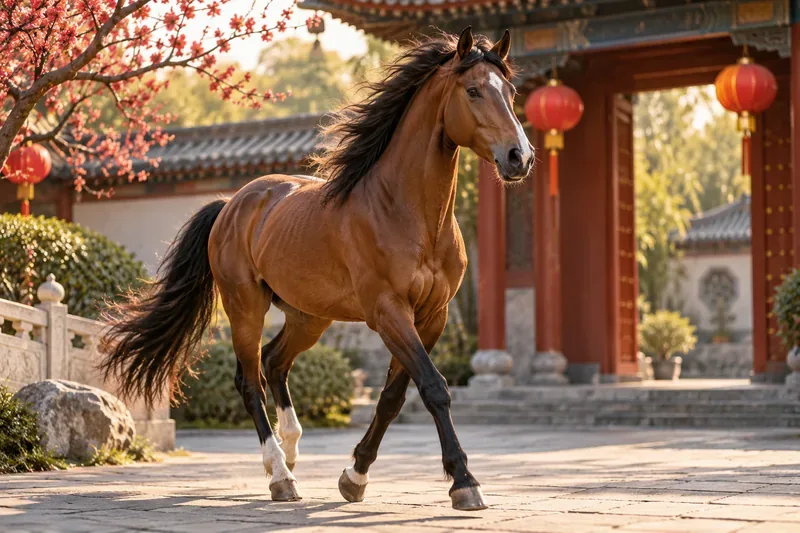
A chestnut horse moves through a traditional Chinese courtyard, reflecting the Horse sign's cultural associations with motion, vitality, and independence.
Chinese Horse personality at a glance
Area
Traditional Horse tendency
Practical watch-out
Core drive
Freedom, movement, self-direction
May resist structure too quickly
Social style
Warm, lively, expressive
Can dominate the pace of a conversation
Decision style
Fast and action-oriented
May move before checking details
Work style
Independent, energetic, adaptable
Routine can reduce motivation
Love style
Enthusiastic and affectionate
Needs space as well as closeness
Growth edge
Turning momentum into consistency
Finish what was started before chasing the next idea
Core traits traditionally associated with the Horse
Energetic and action-oriented
The Horse is commonly portrayed as a sign that prefers movement over prolonged hesitation. In everyday terms, that can look like volunteering first, learning by doing, starting conversations easily, or becoming restless when a plan remains theoretical for too long. This is one reason Horse descriptions often emphasize initiative and visible momentum.
A practical use of this trait is to give yourself short action windows. Instead of waiting for perfect certainty, define the next reversible step: make the call, build the draft, test the route, or schedule the meeting. The counterbalance is equally important—set one checkpoint where you deliberately slow down and review consequences before committing further.