01. Quick Answer
The most reasonable 2030 AstraZeneca forecast is constructive but still dependent on launch execution
A rational 2030 view on AstraZeneca starts with acknowledging that the stock already reflects a decade of solid compounding. With AZN near `$184.96 and a 10-year CAGR around 11.85%, the long-run case now depends on whether the company can keep advancing its oncology, rare disease, and broader pipeline ambitions while navigating pricing and policy risk. Available data suggests a base case around `$220 to `$280 by 2030 is defensible if launch breadth stays strong.
| Point | Why it matters |
|---|---|
| AstraZeneca is a diversified growth platform | AstraZeneca is better understood as a diversified pharma growth platform than as a single-franchise trade. |
| The 2030 target still matters | The 2030 revenue ambition still shapes how investors interpret execution today. |
| Breadth is a key competitive advantage | Pipeline and launch quality matter more than any one quarter of reported revenue. |
| Long-run forecasting should stay scenario-based | Scenario ranges are more honest than certainty language in large-cap pharma forecasting. |
02. Historical Context
AstraZeneca is still a pharmaceutical company first, but the modern thesis depends on oncology depth, rare disease durability, and new-growth optionality
AZN moved from roughly $60.38 to about $184.96 over the last 10 years based on Yahoo Finance monthly data, implying a 10-year CAGR of about 11.85%. That is a strong long-run result for a mega-cap pharmaceutical company and suggests the market has already been rewarding AstraZeneca for pipeline depth, commercial execution, and increasingly diversified growth engines. The company is not a one-product story. Oncology, rare disease, CVRM, and immunology all matter, and management continues to frame 2030 around scale, launches, and portfolio depth rather than a single blockbuster franchise.
| Metric | Latest reading | Why it matters |
|---|---|---|
| Q1 2026 total revenue | `$15.288 billion, up 8% | Shows the business is still compounding from a large base |
| Core operating profit | Up 12% | Suggests margin discipline and product mix remain supportive |
| Core EPS growth | Up 5% | Useful for judging whether revenue momentum is translating to shareholder value |
| 2030 sales ambition | `$80 billion | Acts as the strategic north star for long-run forecast frameworks |
| Feature | AstraZeneca implication | Forecast effect |
|---|---|---|
| Diversified therapy areas | Less dependence on one franchise than many biotech names | Helps support a steadier base case even when one segment slows |
| Large launch slate | Management still expects more than 20 launches by 2030 | Pipeline breadth supports upside if execution remains strong |
| Global exposure | US pricing pressure matters, but growth also comes from international and emerging markets | Creates both diversification and geopolitical complexity |
| Growing AI and digital-health ambitions | Evinova and Enterprise AI suggest operational and R&D optionality | AI may support better long-run efficiency even without immediate revenue re-rating |
03. Main Drivers
Five forces are most likely to shape AstraZeneca stock over the next several years
1. Oncology and rare disease still anchor the premium
The Q1 2026 results press release explicitly tied growth to double-digit expansion in Oncology and Rare Disease. That matters because these businesses often command better long-run growth expectations and help justify a quality premium.
2. The 2030 sales ambition creates both upside and pressure
Reuters reported that management is still steering toward `$80 billion in annual sales by 2030 with more than 20 expected launches. That target supports the long-run bull case, but it also means the market will punish any visible slippage in launch cadence or late-stage readouts.
3. Policy, pricing, and reimbursement remain structural risks
Like every large pharmaceutical company, AstraZeneca operates under constant pricing scrutiny. Strong innovation can offset some of that pressure, but not all of it. Policy drift in the US and other major markets remains a persistent variable in any forecast.
4. Pipeline quality matters more than one quarter of earnings
AZN can tolerate temporary noise in reported revenue if investors remain convinced that the launch slate, trial data, and pipeline depth are still strong. The reverse is also true: a good quarter does not matter much if the pipeline narrative weakens.
5. AI and digital-health infrastructure may improve efficiency more than investors currently model
AstraZeneca's Enterprise AI program and Evinova platform show that management is trying to accelerate trial design, evidence synthesis, operational workflows, and product development. These gains are harder to model than a drug launch, but they may still matter materially over a decade.
04. Institutional Forecasts and Analyst Views
The strongest evidence base comes from current revenue execution, management targets, and launch breadth rather than a heroic one-number target
There are fewer credible long-dated point forecasts for AZN than there are for commodity names or index narratives because the ultimate path depends on launches, trial data, mix, pricing, policy, and operational execution. The better approach is to combine current operating evidence, management's 2030 ambition, therapy-area depth, and Reuters reporting on how the market currently interprets the story.
| Source | What it says | Implication for AZN |
|---|---|---|
| Q1 2026 results press release | Total revenue above `$15 billion, profit and EPS still growing | Supports the case that AstraZeneca remains a large-cap healthcare compounder |
| Reuters, February 2026 | Company still targets `$80 billion in revenue by 2030 and more than 20 launches | Confirms a large strategic growth ambition that still matters for long-range scenarios |
| Therapy-area pages | CVRM, oncology, rare disease, and immunology all remain active growth vectors | Helps explain why AZN is more diversified than a single-franchise pharma story |
| Evinova and Enterprise AI materials | AI-native clinical and enterprise tooling is becoming more important | AI optionality may improve productivity, pipeline speed, and operating leverage over time |
| Current market baseline | Stock already trades near `$185 after a solid 10-year compounding run | The base case should be constructive, but not detached from current valuation reality |
05. Scenarios
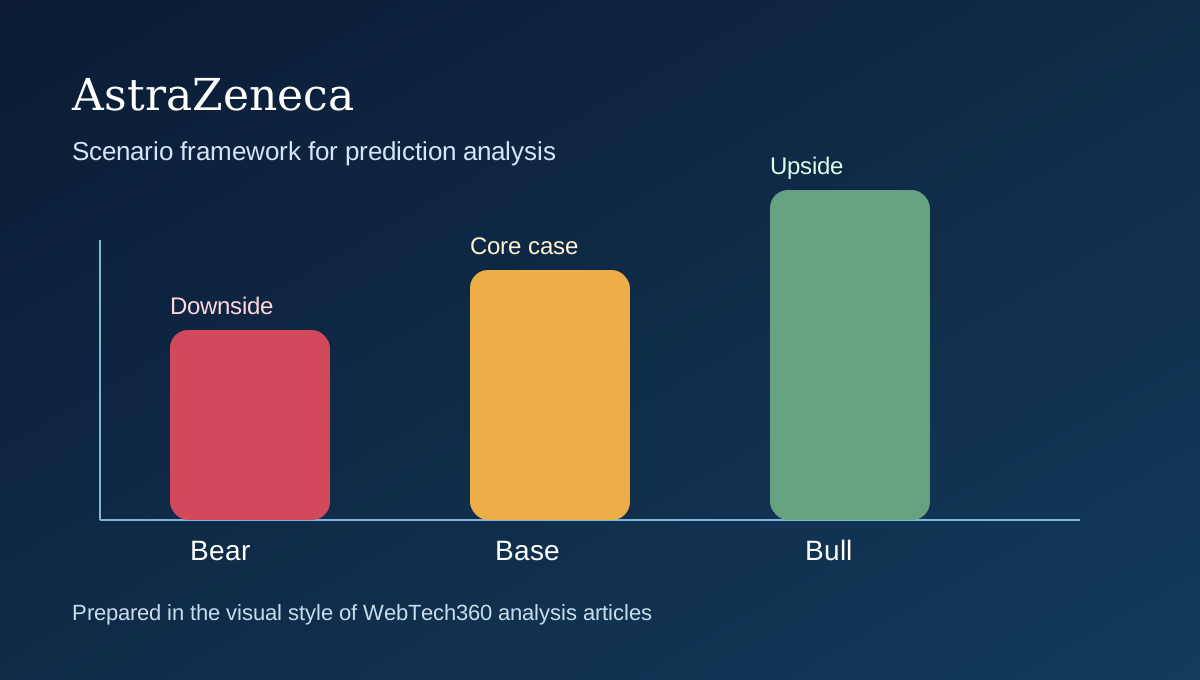
Bull, bear, and base-case scenarios for AZN
| Scenario | 2030 range | Conditions | Probability |
|---|---|---|---|
| Bull | `$280-`$340 | Launch cadence stays strong, pipeline breadth delivers, and the market keeps rewarding execution with a quality premium | 25% |
| Base | `$220-`$280 | AstraZeneca compounds steadily toward its strategic ambition without major valuation expansion | 50% |
| Bear | `$150-`$220 | Pipeline or pricing friction slows the growth profile enough to compress the premium | 25% |
| Direction | Probability | Comment |
|---|---|---|
| Higher | 40% | Most likely if launch breadth and therapy-area depth keep validating the long-run platform thesis |
| Lower | 20% | Would likely require policy and pipeline pressure at the same time |
| Sideways to measured gains | 40% | Plausible because large-cap pharma can keep compounding without dramatic rerating |
06. Investor Positioning
How different investors might respond
| Investor type | Prudent stance | Why |
|---|---|---|
| Investor already in profit | Hold core, trim if position size assumes flawless pipeline execution | AstraZeneca can keep compounding, but large pharma premiums can still compress around policy or trial disappointments |
| Investor currently at a loss | Reassess thesis around launches, oncology depth, and 2030 ambition rather than one quarter | The long-run case depends more on pipeline quality than on one near-term earnings beat or miss |
| Investor with no position | Use staggered entries and avoid chasing after strong healthcare rotations | Quality pharma names can look expensive right before periods of multiple digestion |
| Trader | Use stop-losses and watch trial calendars, pipeline readouts, and policy headlines | Short-term moves in large pharma often hinge on data events and market interpretation |
| Long-term investor | Focus on portfolio breadth, cash generation, and launch cadence; consider dollar-cost averaging | AZN is better suited to patient compounding frameworks than to aggressive trading narratives |
| Hedging-focused investor | Use AZN as part of a defensive growth sleeve, not as a pure safe haven | Healthcare can cushion macro volatility, but pipeline and pricing risks still matter |
07. Risks to Watch
What could change the outlook quickly
The main risks are policy, launch timing, pipeline disappointment, and the possibility that current expectations already price in too much clean execution. The evidence is mixed because AstraZeneca remains operationally strong, but large-cap pharma is never free of event risk.
| Possible invalidation | Why it matters |
|---|---|
| Launch momentum exceeds current expectations | Would strengthen the long-run bull case and make the 2030 ambition look more achievable |
| Policy or pricing pressure intensifies materially | Would likely compress valuation even if core scientific execution remains solid |
| AI-enabled clinical and operating productivity becomes visible sooner | Could improve the market's willingness to reward execution with a higher-quality multiple |
| Late-stage pipeline disappointments cluster together | Would weaken confidence in breadth and raise doubts about medium-term launch quality |
| Global healthcare demand remains resilient while oncology and rare disease stay strong | Would undermine the bearish case that current expectations are already too full |
08. Conclusion
Bottom line
By 2030, AstraZeneca most likely looks like a higher-quality healthcare compounder rather than a speculative biotech winner. The base case remains constructive, but it still depends on management converting breadth into commercial reality.
FAQ
Frequently asked questions
Is AstraZeneca mainly an oncology stock?
Oncology is a major pillar, but not the whole story. Rare disease, CVRM, immunology, and vaccines or immune therapies also matter to the long-run case.
Why does the `$80 billion 2030 target matter so much?
Because it provides the strategic frame for launch expectations, portfolio investment, and how investors judge whether current valuation is justified.
How were the forecast ranges built?
The ranges combine the current AZN price, the 10-year CAGR, Q1 2026 revenue and earnings signals, the 2030 sales ambition, launch breadth, and scenario analysis around pipeline, policy, and valuation. They are editorial scenario ranges, not guaranteed targets.
Can AI really matter to AstraZeneca investors?
Yes, but mostly through clinical-trial productivity, data, discovery support, and operational efficiency rather than through a simple direct AI revenue line.
Methodology and Invalidation
How these AZN ranges were built and what would change them
These scenario ranges are editorial frameworks, not promises or institutional targets. They start with the live AZN price near `$184.96` in mid-May 2026, then layer on the stock's 10-year CAGR of roughly 11.85%, the current Q1 2026 revenue and profit signals, the strategic `$80 billion 2030 ambition, and the reality that AstraZeneca is a broad healthcare platform rather than a narrow one-asset story. A purely mechanical projection of the last decade would ignore launch risk, policy pressure, and the possibility that the market becomes less willing to pay a premium multiple even if the underlying business stays healthy. That is why scenario ranges are more useful than a single-point forecast.
For downside language, a correction usually means a decline of around 10% from a recent high, a bear market closer to 20% down, and a crash something sharper and more abrupt. Large pharmaceutical companies rarely move like speculative biotech, but they can still re-rate meaningfully on policy shifts, failed trials, or launch disappointments. That is why AZN should be treated as a quality compounder with event risk, not as a bond proxy.
The evidence base here is intentionally current. The Q1 2026 results press release showed total revenue of `$15.288 billion, core operating profit up 12%, and core EPS up 5%. Reuters reported in February 2026 that AstraZeneca still sees steady growth ahead and remains committed to an `$80 billion annual sales ambition by 2030 backed by more than 20 expected launches. The official therapy-area pages show that the company still has multiple growth vectors, while the Evinova and Enterprise AI materials suggest management is investing in a more productive R&D and operating model. The evidence is constructive, but not one-directional, because pricing, launch timing, and pipeline expectations still matter.
What would invalidate the constructive case? Slower launch momentum, policy pressure, pricing drag, or unexpectedly weak late-stage data would all matter. What would invalidate the bearish case? Continued growth across multiple therapy areas, cleaner execution against the 2030 ambition, and visible benefits from AI-enabled clinical or operating productivity would weaken it. Investors should treat these articles as conditional research tools that need updating as results, launches, and policy signals evolve.
Disclaimer: This material is for research and editorial purposes only, does not constitute investment advice, and should not be treated as a recommendation to buy, sell, or hold AstraZeneca PLC or any related security.
References
Sources
- Yahoo Finance chart API, AZN 10-year monthly history and current price
- AstraZeneca investor relations, results and presentations hub
- Nasdaq mirror of AstraZeneca Q1 2026 results press release
- AstraZeneca investor relations homepage and annual reports archive
- Reuters via Investing.com, AstraZeneca forecasts growth in 2026 and continues building pipeline, February 10, 2026
- Investing.com summary of AstraZeneca Q1 2026 slides, May 2026
- AstraZeneca CVRM therapy-area overview
- AstraZeneca Vaccines and Immune Therapies overview
- Evinova launch press release
- Evinova and Bristol Myers Squibb partner on AI-native clinical trials, February 2026
- AstraZeneca Enterprise AI page
- AstraZeneca Evinova AI and ML engineer role describing trial acceleration targets
- AstraZeneca Evinova role describing AI-native platform scale across active studies
- AstraZeneca sustainability resources and reporting hub