01. Quick Answer
A credible 2035 Bitcoin forecast needs to ask how high BTC can go without pretending anyone can model a decade of macro and policy shocks perfectly
Very few credible institutions publish formal 2035 Bitcoin targets. That absence is important. It means a 2035 BTC forecast should be built from scenarios, adoption math, and long-run capital-market logic rather than from overconfident certainty. Available data suggests BTC could plausibly trade far above current levels by 2035 if it keeps winning share as a digital store of value and macro hedge. But the evidence is mixed on whether that implies a mid-six-figure outcome, an eventual seven-figure outcome, or a long period of wide, frustrating consolidation first.
| Category | Evidence-based read | Implication |
|---|---|---|
| Historical data | BTC has already gone from a sub-$1,000 asset in 2016 to a six-figure asset at the 2025 peak | Long-run upside is plausible, but not linear |
| Current market conditions | The market is still digesting the post-2025 leverage reset | Long-duration forecasts should be patient, not euphoric |
| Institutional forecasts | ARK publishes 2030 scenarios, while Fidelity, Galaxy, and Bitwise frame maturation rather than 2035 certainty | 2035 ranges must be editorial and explicitly conditional |
| Working base case | BTC has a reasonable path to mid-six figures by 2035 if institutionalization persists | How high depends on adoption share, not just scarcity slogans |
02. Historical Context
How high Bitcoin can really go depends on whether the next decade looks more like asset maturation or repeated speculation
The strongest argument for a 2035 BTC forecast is not hype. It is precedent. Bitcoin has already survived multiple bear markets, exchange failures, policy hostility, and repeated claims that it was finished. Yahoo Finance data show a 10-year price range from roughly $575 in August 2016 to a monthly closing high near $115,758 in July 2025, with a recent close near $76,864 on May 18, 2026. That arc tells us two things at once: the upside can be enormous, and the path can be brutal.
Fidelity’s cycle research matters here because it suggests Bitcoin may now be moving into a different regime. The firm argued in February 2026 that BTC’s volatility was decreasing even as price reached fresh highs above $126,000 in October 2025 and that this pattern could point toward fewer classic boom-and-bust extremes. If that view is broadly right, then 2035 may be shaped less by explosive manias and more by slower adoption, deeper institutional ownership, and a market that can compound over time while still suffering cyclical drawdowns.
| Metric | Latest reading | Why it matters |
|---|---|---|
| Recent BTC close | ~$76,864 | Sets the base from which any 2035 CAGR should be measured |
| Spot bitcoin ETP holdings | Nearly 1.3 million BTC as of January 30, 2026, per Fidelity | Reduces freely trading supply and changes ownership structure |
| Public-company cohort | Fidelity identified 49 companies with more than 1,000 BTC by end-2025 | Shows treasury demand is broadening beyond one company |
| Regulated derivatives depth | CME said 2025 crypto notional volume approached $3 trillion | Supports maturity but also expands the market’s hedging and shorting tools |
| Annualized growth assumption | Implied 2035 level | How demanding it looks |
|---|---|---|
| 5% CAGR | ~$119k | Very conservative; implies BTC matures but barely expands beyond inflation-like compounding |
| 10% CAGR | ~$181k | Reasonable if BTC becomes a stable portfolio sleeve but not a dominant macro asset |
| 15% CAGR | ~$275k | Plausible if institutional access keeps widening and supply remains tight |
| 20% CAGR | ~$417k | Requires stronger adoption and another wave of reserve-style demand |
| 25% CAGR | ~$631k | Aggressive; would likely require BTC to capture a much larger share of global wealth storage |
03. Main Drivers
The long-run upside case rests on five structural questions
1. Does Bitcoin keep taking share from gold and cash-like hedges?
ARK’s 2030 framework is still the best formal map of this debate. Its model treats digital-gold substitution and institutional allocations as the largest long-run contributors. If BTC captures more of the role played by gold, offshore savings, or politically exposed cash reserves, the upside can be very large. If it remains a niche hedge, 2035 ceilings fall sharply.
2. Does portfolio inclusion broaden from early adopters to mainstream allocation?
SEC-approved spot ETPs created the wrapper. The next question is whether large advisory platforms, pensions, endowments, and multinational treasuries treat BTC as a permanent sleeve. Bitwise argued in late 2025 that mainstream access was only beginning. That is a constructive sign, but the rate of adoption remains uncertain.
3. Does supply stay meaningfully illiquid?
ARK’s work on active supply and Fidelity’s work on resilient holder cohorts both point to the same issue: not all BTC is equally available for sale. If more supply becomes effectively vaulted in ETPs, treasuries, and long-term wallets, price sensitivity to incremental demand rises. That is bullish. The risk is that supply comes loose at scale whenever BTC re-enters euphoric territory.
4. Can regulation normalize without killing the asset’s scarcity premium?
Regulation has become less binary than it was in earlier cycles. The White House reserve order, SEC-approved ETPs, and greater regulated-market depth all support normalization. But full normalization can cut both ways. It attracts capital, and it also reduces some of the anti-establishment premium that part of the BTC thesis relies on.
5. What happens to mining economics, energy access, and technology risk?
Cambridge’s methodology shows that Bitcoin mining is an industrial system shaped by hash rate, block subsidy, fees, equipment efficiency, and electricity cost. Over a decade, energy competition, AI data-center demand, and eventual quantum-readiness debates can all matter. Fidelity explicitly noted that miners may pivot toward AI-hosting economics if those returns remain superior, which could change network investment patterns without necessarily destroying Bitcoin’s security model.
04. Institutional Forecasts and Analyst Views
There is no clean institutional consensus for 2035, so the responsible move is to bridge from 2030 research with explicit assumptions
Because few major institutions publish 2035 BTC targets, the best available approach is layered. ARK’s 2030 official range of roughly $300,000 to $1.5 million gives one end of the spectrum. Fidelity’s work argues for a more mature, less reflexive market, which supports the idea that extreme upside may take longer but also that the floor may be improving. Galaxy’s published $250,000 by year-end 2027 target implies that mid-six-figure prices by 2035 are not inherently absurd if adoption continues. But none of those sources, on their own, prove a seven-figure 2035 outcome.
| Source | Published horizon | Use in a 2035 framework | Caution |
|---|---|---|---|
| ARK Invest | 2030 | Best formal long-range adoption model currently published | Highly sensitive to penetration assumptions |
| Fidelity Digital Assets | 2026 cycle and structure work | Supports the thesis that BTC is maturing and may suffer shallower future cycle extremes | Does not tell you the exact 2035 price |
| Galaxy Research | 2027 | Offers a realistic bridge target and underscores that near-term uncertainty remains high | Shorter horizon than the 2035 question |
| Bitwise | 2026 | Supports the view that institutional access can keep demand above new issuance | Does not solve long-run macro or policy risk |
The practical conclusion is straightforward. Analysts remain divided on magnitude, but the evidence supports scenario-building. A disciplined 2035 forecast should ask how much global wealth-storage share BTC captures, not whether the next influencer target sounds exciting.
05. Bull, Bear, and Base Case
How high can Bitcoin really go by 2035? Wide bands are more honest than false precision
| Scenario | 2035 range | Conditions | Probability |
|---|---|---|---|
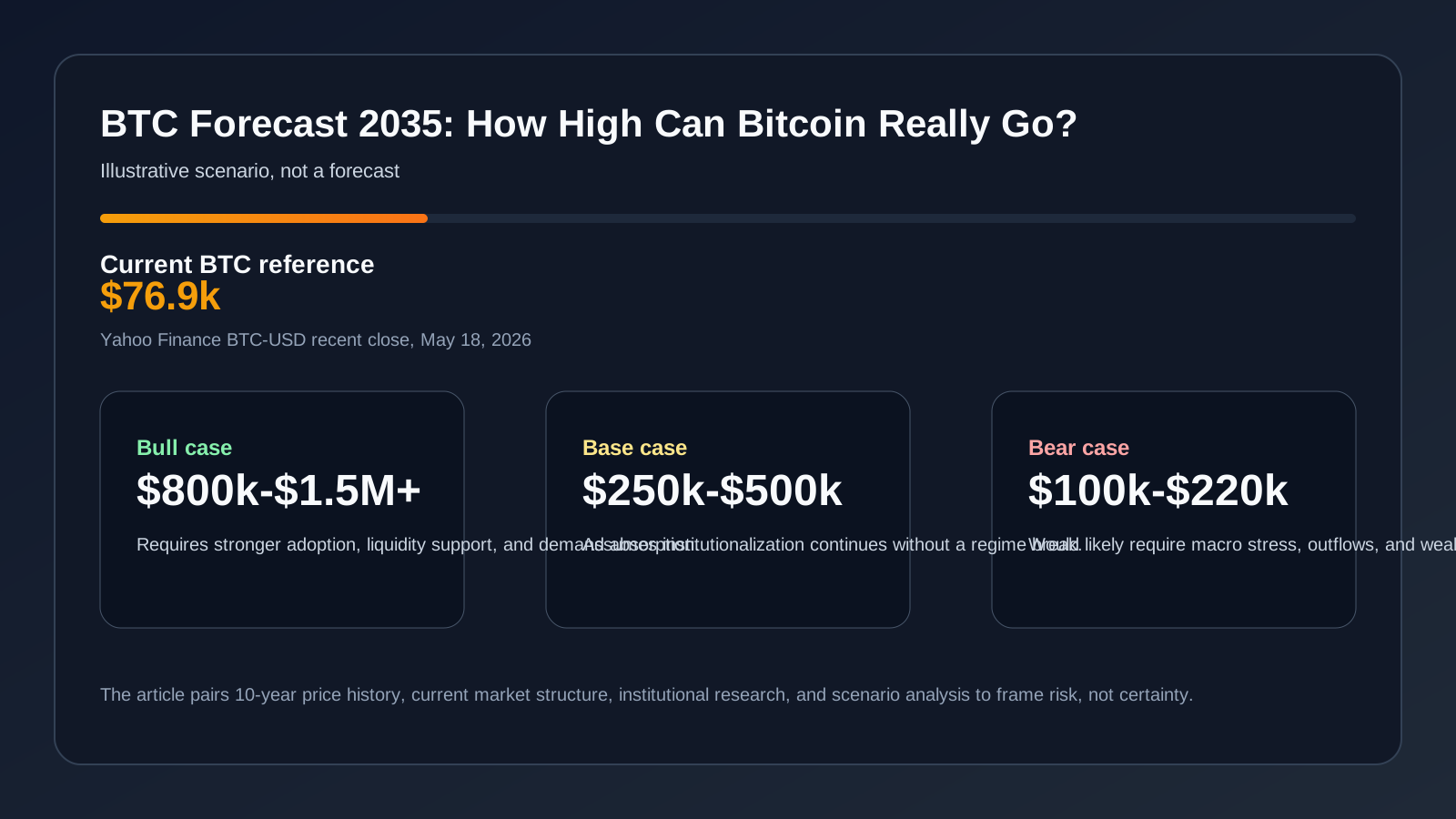
| Bull | $800k-$1.5M+ | BTC wins large-scale digital-gold share, advisory and institutional adoption broadens globally, and supply remains structurally tight | 20% |
| Base | $250k-$500k | BTC matures into a durable macro allocation, compounds over time, and clears prior cycle highs without sustaining ARK-style bull-case penetration | 50% |
| Bear | $100k-$220k | BTC survives and remains important, but adoption plateaus, macro policy stays restrictive, and competition from other digital rails limits further re-rating | 30% |
| Direction | Probability | Comment |
|---|---|---|
| Higher by 2035 | 55% | The long-run structure still favors a higher price than today if BTC remains institutionally relevant |
| Lower | 15% | A permanently lower path would likely require a deep thesis break, not just another correction |
| Sideways to moderate gains | 30% | Plausible if BTC behaves more like a mature store of value than a hyper-growth asset |
| Investor type | Prudent approach | Main watchpoints |
|---|---|---|
| Investor already in profit | Rebalance periodically so a winning BTC allocation does not become an unmanaged macro bet | Concentration risk and tax planning |
| Investor currently at a loss | Focus on thesis durability rather than trying to “get even” quickly | Holding period, liquidity needs, and sizing |
| Investor with no position | Enter slowly and accept that long-run conviction still requires short-run drawdown tolerance | Entry discipline and custody method |
| Trader | Do not use a 2035 thesis to justify sloppy risk management over the next three weeks | Volatility regime, funding, and macro events |
| Long-term investor | Dollar-cost averaging remains more robust than betting on one perfect entry point | Policy, ETF penetration, and supply concentration |
| Risk-hedging investor | Use BTC as part of a hedge toolkit, not as a total substitute for cash, gold, or duration | Correlation in crises and liquidity events |
What would invalidate the high-end 2035 case? Slower institutional adoption, a durable loss of BTC’s scarcity premium, major security or policy shocks, or proof that the asset cannot expand beyond a niche tactical role would all matter. What would invalidate the cautious case? Faster global portfolio adoption and continued evidence that BTC’s cycle drawdowns are compressing as ownership broadens.
06. FAQ
Frequently asked questions
Is a $1 million Bitcoin by 2035 realistic?
It is possible, but not a base case. That scenario depends heavily on BTC capturing a much larger share of global store-of-value demand than it does today.
Why is the 2035 range so wide?
Because no serious analyst can forecast ten years of regulation, macro policy, energy economics, and adoption behavior with narrow precision.
Does BTC need another mania to go higher?
Not necessarily. Fidelity’s work suggests a more mature BTC could grind higher with less extreme volatility if institutional demand deepens.
What matters more: scarcity or adoption?
Both matter, but adoption usually decides how much scarcity is worth in the market. A finite supply with weak demand does not automatically create a high price.
Methodology and Invalidation
How to interpret this Bitcoin 2035 framework and what would change it
The forecast ranges in this article are scenario bands, not promises. They combine live price data from Yahoo Finance, 10-year context, post-ETF market structure, public-company treasury activity, adoption research, regulated derivatives activity, and institutional commentary from firms such as ARK, Fidelity, Bitwise, Galaxy, and CME. That mix is helpful because bitcoin does not respond to a single variable. It reacts to liquidity, regulation, leverage, adoption, macro sentiment, and the behavior of long-term holders at the same time.
Probability tables in this article are editorial estimates rather than mathematical certainties. They are derived by asking which path currently has the strongest evidence: renewed accumulation and broader institutionalization, prolonged consolidation after the 2025–2026 reset, or a deeper repricing caused by macro stress and forced selling. Where the evidence is mixed, the range stays wide on purpose. False precision is usually a sign that the analyst is hiding uncertainty rather than measuring it honestly.
The most important discipline is to state what would invalidate the working view. The most important invalidators would be evidence that adoption is plateauing, that regulated access is not translating into durable holdings, or that BTC cannot hold relevance as digital-financial infrastructure evolves. Investors who are already in profit, investors sitting on losses, traders, hedgers, and long-term allocators do not need the same playbook, so the positioning table separates horizon and risk tolerance instead of pretending one answer fits everyone. Disclaimer: This article is for informational and research purposes only and does not constitute personalized financial advice.
References
Sources
- Yahoo Finance BTC-USD chart API, 10-year monthly price history
- Yahoo Finance BTC-USD chart API, recent daily closes
- U.S. SEC, statement on the approval of spot Bitcoin exchange-traded products, January 10, 2024
- ARK Invest, Bitcoin 2030 price-target methodology, April 24, 2025
- Fidelity Digital Assets, Is Bitcoin’s Four-Year Cycle Over?, February 24, 2026
- Fidelity Digital Assets, 2026 Look Ahead report
- Strategy, first-quarter 2026 results and bitcoin treasury update, May 5, 2026
- Chainalysis, 2025 Global Crypto Adoption Index
- CME Group, Crypto Catch-Up Q4 2025
- The White House, Strategic Bitcoin Reserve executive order, March 6, 2025
- Cambridge Centre for Alternative Finance, Bitcoin electricity consumption methodology
- Bitwise, 10 Crypto Predictions for 2026
- Galaxy Research, 26 crypto, bitcoin, DeFi, stablecoin, and AI predictions for 2026
- Bitcoin.org, Bitcoin Core validation and the 21 million supply rule