Home
» News
»
Autumn Clock Change 2026: When Do Clocks Fall Back in the U.S.?
Autumn Clock Change 2026: When Do Clocks Fall Back in the U.S.?
Quick answer: In most of the United States, daylight saving time ends on Sunday, November 1, 2026. At 2:00 a.m. local daylight time, clocks move back one hour to 1:00 a.m. standard time. The 1 a.m. hour happens twice, giving areas that observe the change an extra hour on the clock that night. Hawaii, most of Arizona, and several U.S. territories do not make this seasonal change.
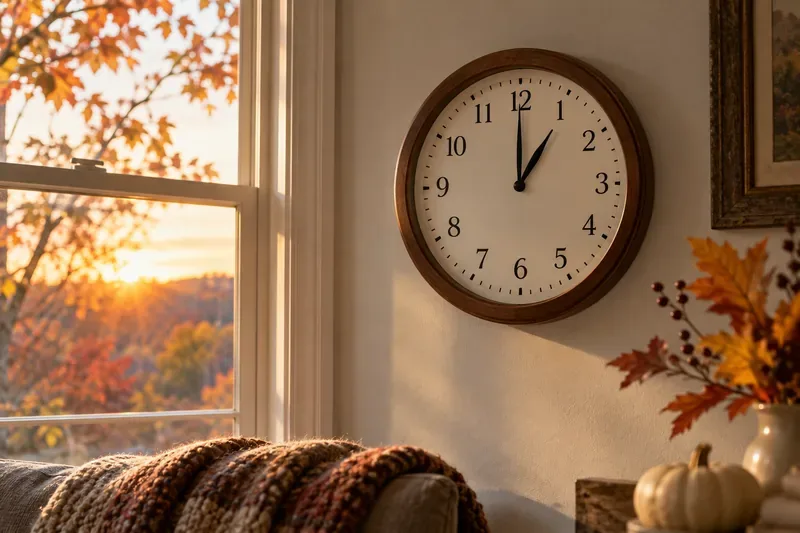
An analog clock at 1:00 beside a window framed by autumn foliage, a reminder that the 1 a.m. hour repeats when daylight saving time ends.
2026 fall-back schedule at a glance
What to check
2026 schedule
Date
Sunday, November 1
Change time
2:00 a.m. local daylight time
Clock action
Turn clocks back one hour, from 2:00 a.m. to 1:00 a.m.
Who changes
Most U.S. states and participating areas
Who generally does not
Hawaii, most of Arizona, American Samoa, Guam, the Northern Mariana Islands, Puerto Rico, and the U.S. Virgin Islands
The date follows the federal pattern: daylight saving time (DST) ends on the first Sunday in November. The National Institute of Standards and Technology (NIST) lists the 2026 end as November 1 at 2 a.m. local time. The U.S. Naval Observatory explains that, at the fall transition, 2 a.m. daylight time becomes 1 a.m. standard time.
What “fall back” means on the clock
On Saturday night, set any non-automatic clocks back one hour before bed, or make the change when you wake up Sunday. In a place observing DST, the sequence is 1:00 a.m., 1:59 a.m., then 1:00 a.m. standard time again; the clock does not jump directly from 2 to 1 until the first 2 a.m. transition point. In everyday terms, you gain an hour on the clock, although the daylight pattern also shifts: standard time places more of the day’s sunlight earlier by the clock and less in the evening.
The change occurs at 2 a.m. in each local time zone, rather than at one nationwide moment. That means the wall-clock hour is the same locally, while the corresponding moment in a national or international schedule differs by time zone. If you are coordinating a call, trip, livestream, or work shift across states, confirm the time zone shown on the event rather than assuming everyone changes at the same instant.
Which U.S. places do not change clocks?
DST is not observed in Hawaii, American Samoa, Guam, the Northern Mariana Islands, Puerto Rico, or the U.S. Virgin Islands. Most of Arizona stays on standard time year-round. The exception is the Navajo Nation, which observes DST, so rules can differ within Arizona depending on the specific location. The U.S. Department of Transportation’s Daylight Saving Time page summarizes the state and territory exemptions; NIST also identifies the Navajo Nation exception.
Practical check: If you are traveling, do not rely on the state name alone for Arizona. Check the destination city or the time zone on a current itinerary, hotel reservation, or meeting invite. In the places listed above that do not observe DST, local clocks stay on their existing standard-time schedule on November 1.
What should you adjust manually?
Phones, computers, and many connected devices normally update when their time-zone and automatic date-and-time settings are correct. NIST notes that computers use their operating system’s time-zone rules to translate time signals into local time, so keeping software current matters. If a device has automatic time disabled, an outdated system, or the wrong time zone selected, check it instead of assuming it changed correctly.
Usually automatic: internet-connected phones and computers with automatic time and location/time-zone settings enabled.
Check manually: wall clocks, watches, car clocks, ovens, microwaves, thermostats, cameras, and other devices that do not receive automatic time updates.
Verify after the change: alarm clocks, smart-home schedules, and calendar events tied to a fixed local time, especially if they are important.
Some radio-controlled clocks receive a time signal and are designed to make seasonal adjustments. NIST says a radio-controlled clock should implement the DST rules automatically, but if it displays the wrong hour afterward, check that it recently synchronized and has the correct time-zone setting. A clock with an automatic DST feature may also need that feature turned off if you live in an area that does not observe DST.
A short checklist for the weekend
On Saturday, October 31, identify clocks that do not update themselves.
Confirm the time zone and automatic time settings on phones, computers, and connected devices.
Set manual clocks back one hour before bed or check them Sunday morning.
On Sunday, compare key clocks with a reliable time source and confirm alarms or schedules that matter.
If a device is wrong, verify its time zone, DST setting, and software updates before changing the displayed time manually.
Does every U.S. state follow the same rule?
Places that observe DST follow the federally designated dates; a state may exempt itself from DST under state law. The Department of Transportation says states that observe DST must begin and end it on the federally mandated dates. Its overview also notes that states cannot choose permanent DST on their own under the current framework. This article describes the schedule currently published for 2026, not a prediction about future legislation.
For this fall, the useful planning point is straightforward: unless you are in a non-observing state, territory, or local exception, expect the time change early Sunday, November 1. If a local government or your device’s time-zone database publishes a specific advisory, follow that current local information, particularly when travel or a scheduled service depends on the exact hour.
Sources and date checked
Schedule checked September 27, 2026, against NIST’s 2026 DST rules, the U.S. Department of Transportation’s DST guidance, and the U.S. Naval Observatory’s explanation of the clock transition. Local observance exceptions are summarized from federal sources; check location-specific time-zone settings when traveling.