Home
» News
»
Chlorthalidone Recall: How to Check Your Blood Pressure Medication Safely
Chlorthalidone Recall: How to Check Your Blood Pressure Medication Safely
Updated September 30, 2026. A U.S. recall involving chlorthalidone, a prescription diuretic used to lower blood pressure, is drawing attention because the affected tablets failed dissolution specifications. The important point is that this is a lot-specific recall, not a recall of every chlorthalidone prescription. The September action covers a specific 25 mg product made by Inventia Healthcare Limited, and an earlier June 2026 recall involved two other lots of the same drug. If you take chlorthalidone, the safest next step is to identify your product and ask your pharmacist to verify the dispensing source if the lot number is not visible.
This article summarizes information available from the FDA recall system and official pharmacy recall notices as of September 30, 2026. It is informational, not a substitute for individualized medical advice.
What is actually recalled right now?
The September 2026 recall listed in the FDA Enforcement Report concerns Chlorthalidone Tablets, USP, 25 mg, manufactured by Inventia Healthcare Limited. The affected product was distributed nationwide in the United States. The recall was initiated on September 3, 2026 and classified by the FDA as Class II on September 17.
Identifier
September 2026 recall
Strength
25 mg
Package
100 tablets per bottle
NDC
64980-599-01
Batch / lot
RISA24002
Expiration
04/2027
Recall number
D-0852-2026
Reason
Failed dissolution specifications
Quantity
13,567 bottles
You can verify recall records through the FDA Enforcement Reports. Search by the recall number, drug name, NDC, or manufacturer.
Common misunderstanding: “All chlorthalidone has been recalled.”
Verified: The September recall identifies one specific 25 mg product, NDC, batch, and expiration date. It does not apply to every strength, manufacturer, or lot of chlorthalidone.
What depends on your situation: A pharmacy may dispense tablets into its own amber prescription vial, and that patient-facing label may not show the manufacturer’s batch number.
What to do: Check the label first. If the lot or manufacturer is missing, call the dispensing pharmacy and ask it to trace your prescription to the original stock bottle.
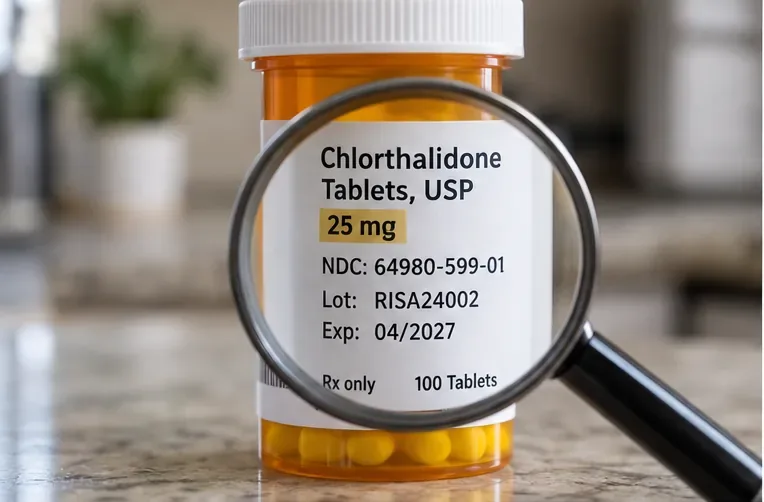
Start with the identifying fields on the bottle: drug name, strength, NDC, batch or lot number, and expiration date.
How to check your chlorthalidone in four steps
1. Confirm the drug name and strength
Look for “chlorthalidone” and the strength on your prescription label. The current September recall concerns 25 mg tablets. Do not assume another strength is included just because the drug name matches.
Action: Write down the exact drug name, strength, pharmacy prescription number, and fill date before you call anyone. Those details help the pharmacy locate the dispensing record quickly.
2. Compare the NDC, batch, and expiration date
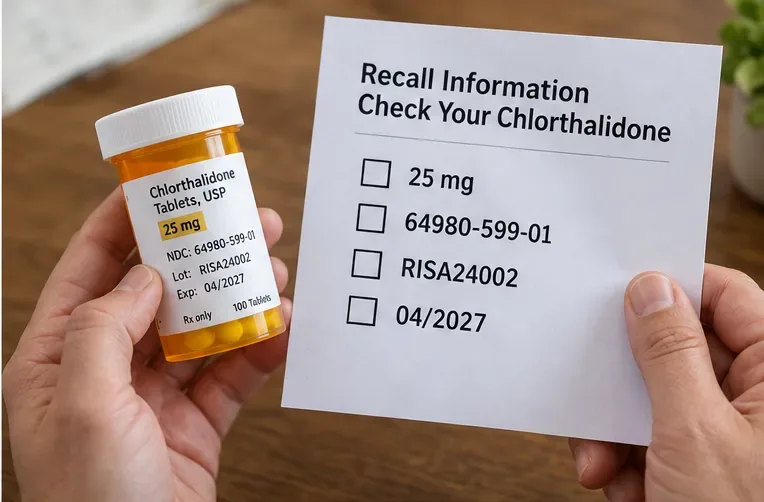
For the September recall, the key identifiers are NDC 64980-599-01, batch RISA24002, and expiration 04/2027. Matching only one field is not enough to conclude that your bottle is affected.
Action: Compare all available identifiers. If your vial does not show the batch, do not guess based on pill color, shape, or the fact that your tablets are 25 mg.
Match the product identifiers together rather than relying on the drug name or tablet appearance alone.
3. Ask the pharmacist to verify the source bottle
Pharmacies commonly repackage tablets from a larger manufacturer bottle into a prescription vial. That means the lot number that determines recall status may exist in the pharmacy’s inventory records rather than on your label.
Action: Tell the pharmacist the recall number D-0852-2026 and ask whether your fill came from batch RISA24002. If you filled the prescription more than once, ask about each fill you still have at home.
If the manufacturer lot is missing from your vial, the dispensing pharmacy is often the fastest place to verify whether your fill came from a recalled stock bottle.
4. Do not change the dose or stop treatment on your own
The FDA explains that for Class II and Class III drug recalls, patients can generally continue taking the medicine unless the recalling company gives different instructions. The agency also notes that, in some situations, stopping a medicine may be more harmful than continuing it while a replacement is arranged. See the FDA’s consumer guidance on drug recalls.
Action: If your pharmacy confirms that your tablets are from a recalled lot, ask the pharmacist or prescriber how to obtain an unaffected replacement and how to avoid a gap in treatment. Do not double doses, skip doses, or switch medications without professional guidance.
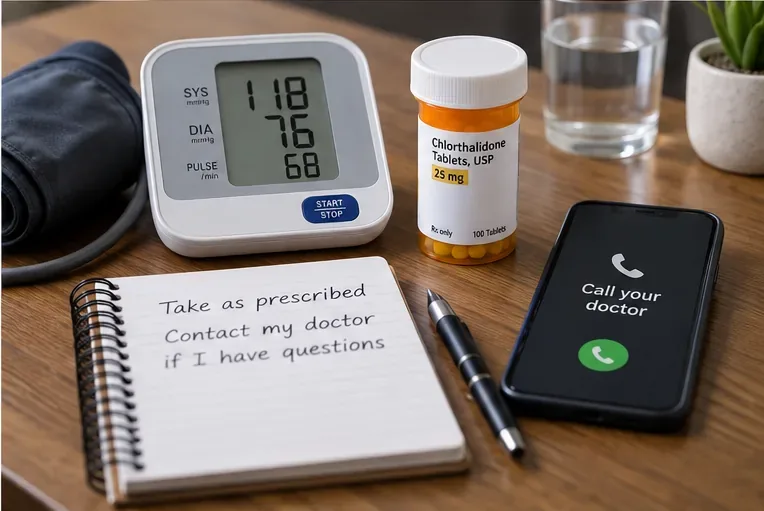
Keep taking medication according to professional instructions while you contact the pharmacy or prescriber; if you already monitor blood pressure at home, keep a record to share with your care team.
What does “failed dissolution specifications” mean?
Dissolution testing checks how a tablet releases its active ingredient under standardized laboratory conditions. A tablet that fails the required specification did not meet the approved quality standard for how the drug should be released.
Common misunderstanding: “Failed dissolution means the pills are contaminated or poisonous.”
Verified: The stated reason for the recall is failed dissolution specifications. That is a drug-release quality problem. It is not, by itself, evidence of a contaminant, foreign material, or toxic substance.
What is uncertain: A failed dissolution test does not tell a patient exactly how much medication an individual tablet delivered in the body or exactly how much a person’s blood-pressure control was affected.
What to do: Treat the recall as a quality issue that needs verification and replacement planning, rather than trying to diagnose the tablet’s performance from symptoms alone.
What does FDA Class II mean?
The FDA defines a Class II recall as a situation in which use of or exposure to a product may cause temporary or medically reversible adverse health consequences, or where the probability of serious adverse health consequences is remote. That definition is available in the FDA’s recall classifications and definitions.
Common misunderstanding: “Class II means it is harmless.”
Verified: Class II is lower risk than Class I, but it is still a formal recall classification. It does not mean there is zero risk.
What depends on your situation: The clinical importance of a possibly underperforming blood-pressure medicine depends on factors such as your blood pressure, other medications, medical history, and how long you may have taken tablets from the affected lot.
What to do: Let the pharmacist or prescriber decide how quickly you need a replacement and whether any additional blood-pressure follow-up is appropriate.
There was also an earlier chlorthalidone recall in June 2026
The September lot is not the only chlorthalidone recall from Inventia/Rising Pharma in 2026. An earlier retail-level recall involved 25 mg tablets with expiration 04/2027:
RISA24001, NDC 64980-599-01, 100-count bottle.
RISB24002, NDC 64980-599-10, 1,000-count bottle.
The earlier recall is FDA recall number D-0610-2026. An official notice posted by the California State Board of Pharmacy states that the recall followed out-of-specification stability testing, including assay and dissolution results. The notice can be read in the Board’s Rising Pharma chlorthalidone recall notice.
Action: If your pharmacy says your medication is not from RISA24002, ask it to check whether your remaining supply could instead come from the earlier RISA24001 or RISB24002 lots.
What if your pharmacy bottle has no lot number?
This is common and does not mean the medication is impossible to check. The pharmacy’s dispensing and inventory records may link your prescription fill to the stock bottle used at the time.
Have the prescription number and fill date ready.
Ask which manufacturer supplied the tablets.
Ask whether the stock bottle’s NDC and batch are available in the pharmacy record.
If you transferred the prescription between pharmacies, contact the pharmacy that actually dispensed the pills you still have.
Action: Do not throw away the bottle before speaking with the pharmacy. Its label may contain the prescription number and fill information needed to trace the product.
Should you monitor your blood pressure more closely?
If you already monitor blood pressure at home, keeping your usual record can give your clinician useful context. However, a recall notice does not create one universal monitoring schedule for everyone, and home readings should not be used to change your chlorthalidone dose without medical guidance.
Action: Record readings the way your clinician has previously instructed and share unexpected changes with the care team. If you have severe or concerning symptoms, seek prompt medical care rather than waiting for a recall question to be resolved.
What is still unknown from the public recall information?
The public recall information identifies the affected product and quality failure, but it does not establish that every tablet in the batch performed the same way or that every patient taking the lot experienced reduced treatment effect. We also did not find a verified FDA patient-injury count specific to the September chlorthalidone recall in the official sources reviewed for this article.
Action: Avoid interpreting the recall as proof that a symptom was caused by the medication. If you experienced a serious reaction, product-quality problem, or suspected therapeutic failure, discuss it with a health professional and consider reporting it through FDA MedWatch.
Quick checklist before you call the pharmacy
Drug: Chlorthalidone Tablets, USP.
Strength: 25 mg.
September recall NDC: 64980-599-01.
September recall batch: RISA24002.
Expiration: 04/2027.
September recall number: D-0852-2026.
Earlier June lots to ask about: RISA24001 and RISB24002.
Have your prescription number and fill date available.
The most useful distinction is simple: a chlorthalidone recall is not the same thing as a recall of your chlorthalidone. Confirm the identifiers, let the pharmacy trace the lot when necessary, and arrange any medication change with a pharmacist or prescriber rather than stopping a blood-pressure drug abruptly.