Home
» News
»
Why Nvidia Is Trending: The $150 Billion Buyback, NVDA Stock, and the AI Business Behind It
Why Nvidia Is Trending: The $150 Billion Buyback, NVDA Stock, and the AI Business Behind It
Nvidia is trending on September 28, 2026 for two connected reasons: a fresh $150 billion increase to its share-repurchase authorization and continued extraordinary growth in its AI infrastructure business. The buyback announcement is the immediate news catalyst. The deeper reason NVDA keeps drawing attention is that Nvidia's latest quarter showed $96.2 billion in total revenue, including $89.0 billion from Data Center, as cloud providers, AI labs, enterprises, and governments continue building large-scale AI systems.
For anyone trying to understand the surge in searches around Nvidia stock, the useful distinction is this: the buyback is a capital-allocation event, while the AI business is the operating engine. A repurchase authorization can affect how investors think about per-share value and management's use of cash, but it does not by itself determine where NVDA stock goes next. Nvidia's ability to keep selling high-value AI computing systems at strong margins matters much more over time.
Nvidia announced on September 28 that its board had approved an additional $150 billion for share repurchases, bringing the remaining authorization to $235 billion. The company described it as the largest share-repurchase authorization increase in history. The primary source is Nvidia's own September 28, 2026 buyback announcement.
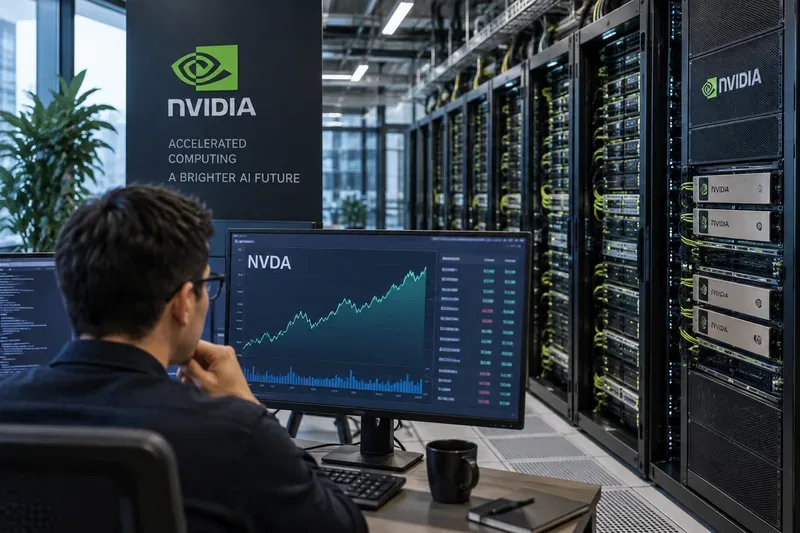
A market analyst studies an NVDA chart beside dense AI server racks, reflecting the two sides of the Nvidia story: stock-market attention and the underlying data-center computing business.
Why Nvidia is trending today
The clearest same-day trigger is the new buyback authorization. Share repurchases let a company use cash to buy its own stock in the market. If shares are actually repurchased and retired or held as treasury stock, the share count can decline, which can increase earnings per share when all else is equal. But an authorization is permission to buy, not a promise that all of the money will be spent immediately.
That distinction matters here. Nvidia already had a large repurchase program before today's announcement. In its second quarter of fiscal 2027, the company said it returned about $26.0 billion to shareholders through repurchases and dividends and had about $99.0 billion remaining under its authorization at quarter-end. The newly announced increase takes the remaining authorization to $235 billion.
For someone following NVDA only because of today's headline, the practical takeaway is: do not treat “$150 billion buyback” as the same thing as “Nvidia is buying $150 billion of shares today.” The actual pace of repurchases can vary with market conditions, cash needs, strategic investment, acquisitions, and other corporate priorities.
The bigger story is still AI data-center revenue
Nvidia's latest reported quarter explains why the company can contemplate such a large capital-return program. For the quarter ended July 26, 2026, Nvidia reported $96.2 billion in revenue, up 106% from a year earlier. Data Center revenue reached $89.0 billion, up 117% year over year. GAAP gross margin was 75.0%, and GAAP diluted earnings per share were $2.46.
The table shows why Nvidia is no longer best understood as primarily a gaming-chip company. Gaming remains part of its history and product portfolio, but its financial center of gravity is now AI infrastructure. Data Center represented the overwhelming majority of quarterly revenue.
What Nvidia actually sells into the AI boom
It is easy to reduce Nvidia's AI business to “GPUs,” but that misses how the company is expanding the amount of hardware and software it can sell into each AI data center. Nvidia increasingly positions its offering as a full-stack platform that combines accelerators, CPUs, high-speed interconnects, Ethernet or InfiniBand networking, systems, software libraries, and deployment tools.
That matters because the economics of a modern AI cluster are not determined by the GPU alone. Thousands of accelerators need to communicate quickly, access memory efficiently, move data through storage and networking systems, and run software that keeps expensive hardware highly utilized.
In Nvidia's latest 10-Q, the company said the quarter's Data Center growth was driven by the ramp of Blackwell Ultra infrastructure. It also said hyperscale revenue more than doubled from a year earlier. Investors can review the company's filing through its fiscal Q2 2027 Form 10-Q.
Blackwell is important, but Vera Rubin is the next test
Blackwell and Blackwell Ultra have been major contributors to Nvidia's current growth, but the market is already looking ahead. Nvidia's next-generation Vera Rubin platform is now moving into production and commercial deployment.
On May 31, Nvidia said Vera Rubin was ramping into full production with server makers and supply-chain partners. The platform combines multiple components, including Vera CPUs, Rubin GPUs, NVLink, networking, storage-related infrastructure, and other systems designed to operate as an integrated AI platform. Nvidia said the platform targets agentic AI workloads, where models may perform long sequences of reasoning, retrieval, tool use, and inference.
This product transition is important for NVDA because high-growth semiconductor companies are often judged not only on current demand but on whether each new generation can sustain customer spending. A strong Blackwell cycle does not automatically guarantee a strong Rubin cycle. Customers have to see enough performance, efficiency, and economic value to keep expanding deployments.
Why cloud-company spending matters so much
Nvidia's results depend heavily on customers continuing to build AI infrastructure at enormous scale. One useful example is AWS. In August 2026, AWS and Nvidia said AWS planned to deploy an additional 2 million Nvidia Blackwell Ultra, Rubin, and Rubin Ultra GPUs during 2027-2028, on top of earlier expansion plans.
This illustrates a central part of the NVDA investment debate. If hyperscalers and AI-native companies keep increasing capital spending because they can monetize AI workloads, Nvidia has a large addressable market. If customers eventually decide that the returns on AI infrastructure are weaker than expected, spending growth could slow. Nvidia can execute well operationally and still face pressure if its biggest customers moderate their buildouts.
What the latest outlook says
For fiscal Q3 2027, Nvidia guided to $108.0 billion in revenue, plus or minus 2%. The company also said the outlook assumes no Data Center compute revenue from China.
That combination tells investors two things. First, management expected another sequential increase from the $96.2 billion reported in fiscal Q2. Second, China remains a meaningful source of uncertainty rather than a growth assumption built into the near-term guidance.
The company's latest 10-Q says U.S. export licensing and Chinese restrictions have limited H200 sales into China. Nvidia reported that H200 shipments to China represented less than 1% of Data Center revenue in its most recent quarter and disclosed a $0.4 billion charge in the first half of fiscal 2027 related to excess H200 inventory and purchase obligations after demand diminished.
Why NVDA can move sharply even when the business is growing
A fast-growing business does not guarantee a steadily rising stock price. NVDA can react sharply to changes in expectations because the market is already pricing in substantial future AI demand.
Consider two hypothetical earnings scenarios. In the first, Nvidia grows revenue by 50%, but investors had expected 65%. The business would still be growing quickly, yet the stock could fall because results missed expectations. In the second, revenue grows by 40% when the market expected 30%, and the company raises its outlook. The stock could respond positively even though the absolute growth rate is lower than in the first scenario.
This is why people tracking NVDA should separate business performance from expectations embedded in the stock price. Revenue growth, gross margin, product demand, supply, and customer spending are operating facts. Whether the shares are expensive or cheap depends on the price investors are paying relative to the earnings and cash flow they expect in the future.
Does the $150 billion buyback mean management thinks the stock is cheap?
The authorization shows that Nvidia's board is willing to allocate substantially more capital to repurchases, but it should not be treated as a precise valuation signal. Companies approve buybacks for several reasons: returning excess cash, offsetting dilution from employee equity compensation, managing capital structure, and repurchasing shares when management considers that an attractive use of capital.
The useful question is not simply “How large is the authorization?” but “How much stock does Nvidia actually repurchase, at what average price, and how does that compare with alternative uses of the cash?” Those details become visible over time in earnings reports and SEC filings.
What to watch next if you follow NVDA
Instead of focusing only on daily stock moves, a more durable NVDA checklist is:
Data Center growth: Is AI infrastructure revenue still expanding at a pace that supports market expectations?
Blackwell Ultra demand: Does the current platform continue to ramp smoothly?
Vera Rubin adoption: Do cloud providers, AI labs, and enterprises move into the next generation at scale?
Gross margin: Can Nvidia preserve strong profitability as product mix and system complexity change?
Hyperscaler capital spending: Are the largest cloud and internet companies continuing to invest aggressively in AI?
China and export controls: Do regulatory restrictions further limit Nvidia's addressable market or product strategy?
Networking and full-system sales: Is Nvidia capturing more revenue per AI cluster beyond GPUs alone?
Actual repurchases: How quickly does the company use the newly expanded authorization?
The bottom line on why Nvidia is trending
Nvidia's September 28 trend is not just a random spike around a ticker symbol. The immediate catalyst is concrete: the company increased its share-repurchase authorization by $150 billion, leaving a total of $235 billion available. But the reason that announcement matters is the scale of the cash-generating AI business underneath it.
The latest quarter showed $96.2 billion of revenue, $89.0 billion from Data Center, and continued growth tied to Blackwell Ultra. At the same time, Vera Rubin is moving into production, major cloud providers are planning large deployments, and management is guiding to further sequential revenue growth.
The counterweight is that NVDA is highly sensitive to expectations. AI infrastructure spending, product transitions, customer concentration, competition, export restrictions, and future margins can all change the story. A buyback authorization can support the capital-return case, but it does not remove those operating risks or guarantee a particular stock outcome.
This article is an explainer based on public company information available as of September 28, 2026. It is not investment advice or a recommendation to buy, sell, or hold NVDA.