Dengue is not just a travel-related concern in Florida. Local transmission has been confirmed in parts of the state in 2026, although risk is not uniform from one county to another. The most useful response is not panic but a clear plan: know the symptoms, watch closely for warning signs as a fever improves, prevent mosquito bites, and seek medical care promptly when the situation calls for it.
As of September 2026, Florida health officials have documented locally acquired dengue in several counties. For example, the Florida Department of Health reported an unusual increase in Hillsborough County, Orange County reported additional locally acquired cases in September, and Polk County issued an advisory on September 24 after a locally acquired case. These are verified examples of ongoing local transmission, not proof that every neighborhood in Florida has the same level of risk. For the latest county-by-county picture, check the Florida Department of Health arbovirus surveillance page.
What symptoms should make you think about dengue?
The most common pattern is fever together with one or more of the following: headache, pain behind the eyes, muscle or joint pain, nausea, vomiting, or rash. According to the CDC dengue symptoms guidance, symptoms usually last two to seven days, and most people recover in about a week.
One common misunderstanding is that dengue must cause an extremely dramatic illness from the start. That is not true. Some infections cause no symptoms, and many symptomatic cases begin with signs that can resemble other viral illnesses. A fever and body aches alone cannot confirm dengue.
Action: If you develop fever or compatible symptoms while living in Florida, especially after recent mosquito exposure or travel to an area where dengue is circulating, contact a healthcare provider. Tell the clinician where you have been and when symptoms began.
Does a falling fever mean the danger has passed?
No. This is one of the most important dengue misconceptions to correct. In people who progress to severe dengue, warning signs often appear as the fever is going away, commonly in the next 24 to 48 hours. The CDC notes that severe dengue can worsen quickly and requires urgent medical care.
Go to an emergency department or seek immediate medical care if a person with suspected or confirmed dengue develops any of these warning signs:
- Severe abdominal pain or tenderness
- Repeated or persistent vomiting
- Bleeding from the nose or gums
- Vomiting blood or passing blood in the stool
- Marked tiredness, restlessness, irritability, drowsiness, or another concerning change in mental status
- Difficulty breathing, fainting, signs of shock, or rapidly worsening weakness
The exact severity cannot be judged reliably at home from the fever number alone. A person may seem temporarily better when the temperature falls even while the critical phase is beginning.
Action: Pay extra attention during the first day or two after the fever resolves. If warning signs appear, do not wait for a routine appointment.
What should you do if symptoms are mild?
There is no specific antiviral medicine that cures dengue. Treatment is mainly supportive: rest, fluids, symptom control, and monitoring for deterioration. The CDC treatment guidance recommends acetaminophen for fever and pain and advises avoiding aspirin and nonsteroidal anti-inflammatory drugs such as ibuprofen because of bleeding concerns.
Hydration matters because fever, poor appetite, and vomiting can lead to fluid loss. Water and drinks containing electrolytes can help, but the right amount depends on age, body size, pregnancy status, kidney or heart disease, and how much fluid a person is losing. People who cannot keep fluids down need medical assessment rather than simply trying to drink more at home.
If you already take aspirin, an anticoagulant, or another medicine that affects bleeding for a prescribed medical reason, do not change it on your own. Contact the prescribing clinician or another qualified healthcare professional for advice.
Action: For mild suspected dengue, arrange medical guidance, rest, drink fluids, use acetaminophen only as directed, and monitor closely for warning signs.
Can you tell dengue from flu, COVID-19, or another infection by symptoms alone?
Usually not with confidence. Fever, headache, fatigue, aches, nausea, and rash overlap with many illnesses. Dengue often causes prominent body pain and pain behind the eyes, but those features are not unique enough to make a diagnosis by themselves.
A blood test is the way to confirm dengue. The choice of test can depend on how many days have passed since symptoms started, so timing matters. A clinician may also consider other infections, including chikungunya, Zika, influenza, COVID-19, or other causes of fever, depending on the person's symptoms, travel, exposures, and local disease activity.
Action: Do not rely on an online symptom list to rule dengue in or out. If dengue is plausible, contact a healthcare provider and mention the exact date symptoms began.
How is dengue spreading in Florida?
Dengue viruses are transmitted primarily through the bite of infected Aedes mosquitoes. It is not spread through ordinary casual contact in the way a cold or influenza is. However, a person with dengue can infect a mosquito that bites them while the virus is circulating in their blood; that mosquito can later transmit the virus to another person.
Florida's 2026 situation shows why both travel history and local exposure matter. On September 4, the Florida Department of Health said Hillsborough County had reported 59 locally acquired dengue infections at that point. On September 18, Orange County announced two additional locally acquired cases, and on September 24, Polk County reported a locally acquired case. See the official Florida dengue precaution notice, the Orange County alert, and the Polk County advisory.
What remains uncertain is the exact infection risk for any one Florida resident on any given day. Surveillance data can lag, mild cases may never be diagnosed, and county-of-residence data do not always identify the precise place where exposure occurred.
Action: Use current Florida Department of Health and county health department advisories rather than assuming risk is the same statewide.
How can you reduce the chance of a dengue infection?
The most reliable prevention strategy for Florida residents is reducing mosquito bites and mosquito breeding around the home. The CDC dengue prevention guidance recommends insect repellent, loose-fitting long-sleeved shirts and pants, and mosquito control in and around the home.
Use an EPA-registered insect repellent according to its label. The U.S. Environmental Protection Agency explains that registered products have been evaluated for safety and effectiveness when used as directed. You can review EPA guidance on repellents for mosquito-borne illness.
- Apply EPA-registered repellent to exposed skin as directed on the label.
- Wear loose-fitting long sleeves and long pants when practical.
- Repair or use intact window and door screens.
- Empty, scrub, cover, or discard containers that hold water, including buckets, flowerpot saucers, toys, and other outdoor items.
- Remember that Aedes mosquitoes can bite during the day as well as around dawn and dusk; daytime activity is not a reason to skip protection.
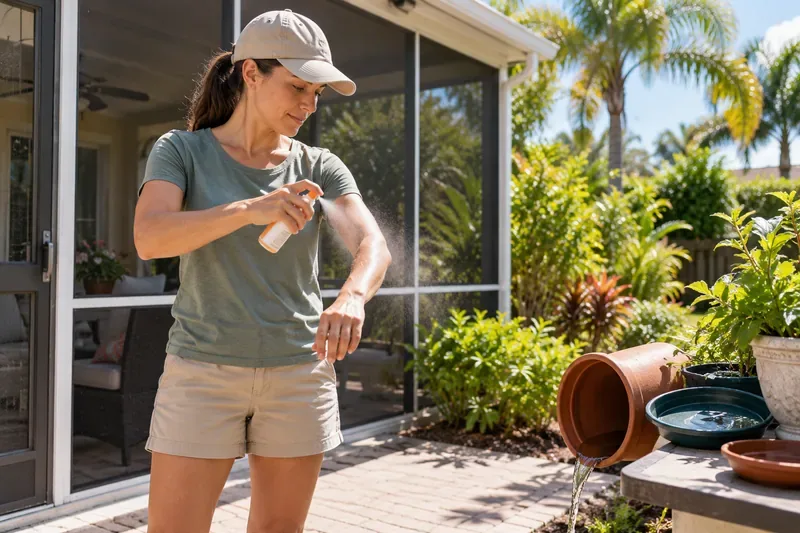
Applying mosquito repellent and removing standing water around a screened Florida home are practical ways to reduce exposure to mosquitoes that can transmit dengue.
Action: Make bite prevention a daily habit during periods of local dengue activity, not something reserved only for evening hours.
If someone in your home has dengue, why should they still avoid mosquito bites?
A common assumption is that mosquito prevention no longer matters once someone is already sick. In fact, it still matters. During the early part of illness, a mosquito that bites an infected person can acquire dengue virus and later transmit it to someone else.
CDC advises people with dengue to prevent mosquito bites, especially during the first week of illness. Screens, air conditioning when available, repellent used according to instructions, and a bed net when appropriate can help reduce the chance of mosquitoes feeding on the sick person.
Action: If dengue is suspected or confirmed, continue mosquito precautions for the ill person and everyone else in the household.
Who should have a lower threshold for calling a clinician?
The decision depends on the individual rather than on a single universal rule. Infants, older adults, pregnant people, and people with significant medical conditions may need closer assessment. So may anyone who is dehydrated, unable to drink, repeatedly vomiting, bleeding, unusually sleepy, or becoming rapidly weaker.
Social circumstances matter too. Someone who lives alone, has difficulty reaching emergency care, cannot reliably monitor symptoms, or has limited access to fluids may need a different plan than a healthy adult with close support and easy access to care.
Action: If you are unsure whether home monitoring is appropriate, call a healthcare provider and describe both the symptoms and the person's medical circumstances.
What is verified, what depends on circumstances, and what is still uncertain?
| Question | What we know | What to do |
|---|
| Is dengue present in Florida? | Yes. Locally acquired infections have been confirmed in multiple Florida counties in 2026. | Check current state and county advisories and use mosquito precautions. |
| Does everyone infected get sick? | No. Many infections cause no symptoms; symptomatic illness ranges from mild to severe. | Do not use the absence of dramatic symptoms to judge community risk. |
| Does a lower fever always mean recovery? | No. Warning signs can emerge after the fever subsides. | Watch closely for 24–48 hours after fever resolution. |
| Can symptoms alone confirm dengue? | No. Symptoms overlap with other illnesses; blood testing can confirm infection. | Seek clinical evaluation when dengue is plausible. |
| Is the risk the same everywhere in Florida? | No. Local transmission and mosquito activity vary by place and time. | Use current local surveillance rather than statewide assumptions. |
When should you seek care right now?
Contact a healthcare provider if you have a new fever or dengue-like symptoms and live in or recently visited an area with dengue risk. Seek urgent or emergency care for severe abdominal pain, persistent vomiting, bleeding, blood in vomit or stool, extreme tiredness or restlessness, difficulty breathing, fainting, confusion, signs of shock, or rapid worsening—especially as the fever is going away.
For current Florida activity, use the Florida Department of Health weekly arbovirus reports. National surveillance is also available through the CDC current dengue data page, but CDC notes that national surveillance is provisional and can lag behind state and local reporting.
The practical takeaway is simple: dengue in Florida is a real but geographically variable risk. Prevent mosquito bites, do not assume that a disappearing fever guarantees recovery, and get medical help promptly when warning signs appear.