Home
» News
»
EU Biometric Border Control Problems: What Travelers Need to Know About EES Delays
EU Biometric Border Control Problems: What Travelers Need to Know About EES Delays
Updated September 18, 2026. Europe’s Entry/Exit System (EES) is now part of routine border control for many non-EU visitors, including most U.S. travelers entering the Schengen area for a short stay. The system is officially fully operational, but that does not mean every airport, ferry terminal, or land crossing works at the same speed. Technical faults, staffing limits, busy arrival waves, and problems with self-service equipment can still produce long lines or temporary changes in how biometric checks are handled.
The practical takeaway is simple: plan for a full biometric check, allow more time at the border, and do not rely on reports that a country has “turned off” EES unless the relevant authority has confirmed it. The system itself has not been canceled.
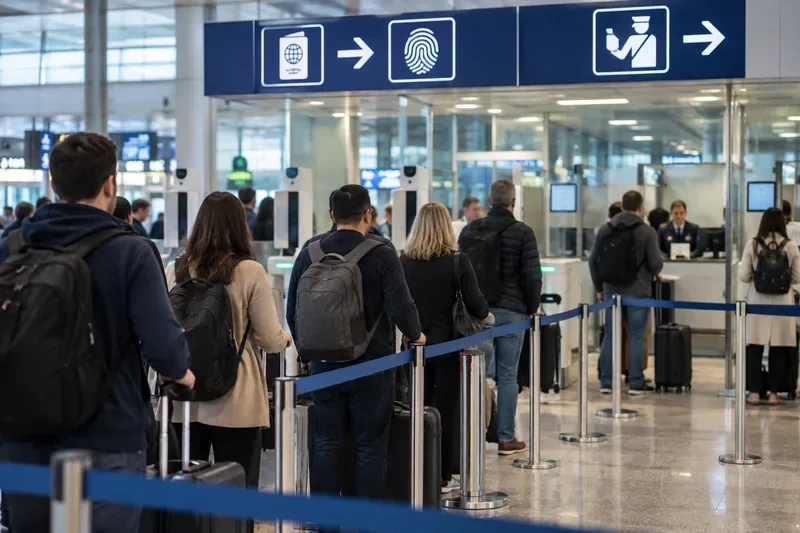
Travelers queue at an airport border-control area with biometric kiosks and staffed inspection booths. EES processing times can vary by crossing point and traffic level.
Quick reference: what EES changes for travelers
Question
Practical answer
Who is generally covered?
Non-EU nationals making short stays in the 29 European countries using EES, including visa-exempt U.S. visitors.
What is collected?
Passport data, entry and exit records, a facial image, and fingerprints, subject to the applicable exemptions.
Do passports still get stamped?
For travelers covered by EES, manual passport stamping ended when the system became fully operational on April 10, 2026.
Can the border process take longer?
Yes, especially on a first EES registration or when terminals are congested, equipment is unavailable, or extra manual processing is needed.
Is EES the same as ETIAS?
No. EES is a border registration system. ETIAS is a separate travel authorization system and, as of September 18, 2026, is not yet in operation.
What is the EU Entry/Exit System?
EES is the European Union’s digital system for recording the entry, exit, and refusal of entry of eligible non-EU nationals traveling for short stays. It was launched gradually in October 2025 and became fully operational at external border crossing points on April 10, 2026.
The system applies across the Schengen area countries participating in EES. That includes most EU states plus Iceland, Liechtenstein, Norway, and Switzerland. Ireland and Cyprus are not part of the EES border system in the same way. The official EU overview is available on the Entry/Exit System website.
Instead of relying on passport stamps to determine when a short-stay traveler entered and left, EES creates an electronic travel record. The European Commission says the system records travel-document details, the date and place of border crossings, a facial image, fingerprints, and any refusal of entry.
Why are travelers reporting problems if EES is fully operational?
“Fully operational” describes the legal and technical deployment of the system across participating borders. It does not guarantee identical performance at every checkpoint. The European Commission’s 2026 State of Schengen reporting acknowledged implementation challenges involving self-service systems, biometric registration capacity, infrastructure, and congestion when many flights arrive within the same time window.
Those issues can show up to travelers as slow-moving lines, closed kiosks, repeated fingerprint attempts, a switch from self-service equipment to an officer, or unusually long waits before reaching passport control. In other words, the main risk for most travelers is operational delay rather than a new application requirement at the airport.
First-time EES registration can take longer
A traveler whose biometric record has not yet been created generally needs a fuller enrollment step at the border. Border officers may scan fingerprints and capture a facial image before the person is admitted. On later trips, the system can use the existing record for verification, although data may sometimes need to be collected again.
The Council of the EU explains that travelers with biometric passports may be able to use self-service systems where those systems are available, but availability depends on the crossing point. See the Council’s explanation of how EES works.
Kiosks and automation do not work the same everywhere
One of the easiest mistakes is to assume that every Schengen airport offers the same kiosk, e-gate, or mobile pre-registration process. They do not. Automation is implemented locally, and the EU’s Travel to Europe mobile app currently has limited country support rather than universal coverage.
The official app page says pre-registration can be submitted within 72 hours of travel where the participating country supports it. At present, Sweden supports passport data, facial image, and the entry questionnaire, while Portugal supports the entry questionnaire. The app is optional and does not replace the border check. Check current support on the official Travel to Europe mobile app page before relying on it.
Are countries allowed to pause biometric checks?
EU law created limited contingency measures for periods of excessive waiting or technical failure. During the rollout, participating countries could temporarily suspend some EES functions at specific border crossing points. The rules also provided a post-rollout period in which biometric collection could be temporarily suspended in exceptional congestion, subject to time limits and notification requirements.
The legal basis is Regulation (EU) 2025/1534. It distinguishes between a partial suspension, in which biometric collection can be omitted while other EES data are still recorded, and a full suspension used for qualifying system or infrastructure failures.
Recent reports have described broader or extended biometric relief in some countries. However, as of September 18, 2026, an equivalent public European Commission notice confirming a blanket country-wide EES suspension could not be verified in the official sources reviewed for this article. Travelers should therefore assume normal EES processing unless a border authority, airport, carrier, or government travel advisory says otherwise.
What happens if fingerprint or facial recognition fails?
A failed scan does not automatically mean a traveler will be refused entry. Biometric matching is one part of the border-control process, and border guards can carry out additional checks when automated processing does not succeed. Causes can include poor fingerprint quality, equipment problems, difficulty matching a previous image, or the need to re-register data.
However, refusing to provide biometrics when EES requires them is different from a technical failure. The European Commission states that a traveler who refuses required fingerprints or facial-image capture can be denied entry. The official explanation of what information is stored and travelers’ data rights is on the EES data page.
Who may not need to provide fingerprints?
Some travelers are exempt from fingerprint collection even though other border checks may still apply. The system’s published statistics specifically note exemptions for children under age 12 and people for whom fingerprinting is physically impossible. In addition, short-stay visa holders may already have fingerprints in the Visa Information System, so those fingerprints are not stored again in EES in the same way.
There are also broader categories of people to whom EES does not apply, including EU citizens and nationals of Iceland, Liechtenstein, Norway, and Switzerland. Certain residence-permit holders, long-stay visa holders, and qualifying family members may also be outside the normal EES registration process. Travelers with an unusual immigration status should check the official eligibility rules rather than assuming the standard tourist procedure applies.
How much extra time should you allow?
There is no single EU-wide delay estimate that is reliable for every border crossing. Queue time depends on passenger volume, staffing, terminal layout, equipment, how many travelers need first-time enrollment, and whether several flights arrive together. A small regional airport and a major international hub can have very different conditions on the same day.
For flights, follow the airline and airport’s recommended arrival time rather than using a generic EES number. If you have a self-transfer, separate ticket, ferry connection, or rail connection after clearing an external Schengen border, add a larger buffer than you would have used before biometric registration became routine. Tight connections are especially risky when you must collect baggage and pass immigration before checking in again.
Practical checklist before you travel
Confirm whether EES applies to you. Most U.S. tourists on short stays are covered, but residence status and family-member rules can change the answer.
Use a valid passport in good physical condition. Damaged biometric chips or unreadable document pages can slow automated processing.
Expect fingerprints and a facial image on a first registration. Do not plan on a kiosk being available just because another airport has one.
Check your airport, ferry port, rail operator, and carrier on the day of travel. Local disruption information is more useful than general Europe-wide advice.
Use the Travel to Europe app only where officially supported. It is optional and does not eliminate the border check.
Leave extra connection time. This matters most when entering Schengen before an onward flight, train, ferry, or separately ticketed connection.
Keep proof of onward travel and accommodation accessible. EES changes how entries and exits are recorded, but normal entry-condition questions can still be asked.
Do not confuse EES with ETIAS. ETIAS is separate and is not yet accepting travel-authorization applications as of this update. The EU posts current ETIAS status on the Travel to Europe portal.
What to do if your EES record appears wrong
EES is not only a queue-management issue; it also creates a digital travel history that can affect how remaining short-stay time is calculated. If you believe an entry or exit was recorded incorrectly, do not wait until the end of a future trip to address it.
The official EES data guidance says travelers have the right to request access to their data and to ask for inaccurate or incomplete information to be corrected. Requests are handled through the competent authorities or data-protection contacts of participating countries. Keep travel evidence such as boarding passes, ferry tickets, and other records that can help establish when and where you crossed the border.
Bottom line for travelers
EES is operating across participating external Schengen borders, and biometric checks are now a normal part of travel for many non-EU short-stay visitors. The problems travelers are encountering are mainly uneven implementation issues: queues, local equipment trouble, staffing pressure, and the extra time required when a biometric record must be created or rechecked.
Plan for the full process rather than hoping for a temporary biometric pause. Verify conditions with official sources close to departure, allow enough time for a slower border crossing, and keep in mind that EES and ETIAS are separate systems. That approach remains useful even as individual airports improve their automation and contingency procedures.