Home
» News
»
Meta VR Glasses vs. AI Glasses: What They Do and How to Choose
Meta VR Glasses vs. AI Glasses: What They Do and How to Choose
Start with what you want to see and do. If you want immersive games, 3D movies, or a large private virtual workspace, look at a Meta Quest headset—or consider Meta’s newly announced Meta VR Glasses if you can wait until spring 2027. If you want hands-free photos, calls, audio, or quick AI help while walking around, choose everyday AI glasses such as Ray-Ban Meta. If you want short messages, directions, or captions in your field of view, the display-equipped Meta Ray-Ban Display is a separate option. These product names sound similar, but the devices solve different problems.
Illustrative example only: Imagine Jordan, a fictional U.S. shopper who searches for “Meta VR glasses” after seeing a headline, but also wants help remembering errands and taking hands-free photos. Jordan has not tested these products; the example simply shows how to apply the published specifications and availability to a real buying decision. The details below were checked against Meta, Meta Horizon OS, and Ray-Ban’s U.S. pages on September 24, 2026. Prices and availability can change.
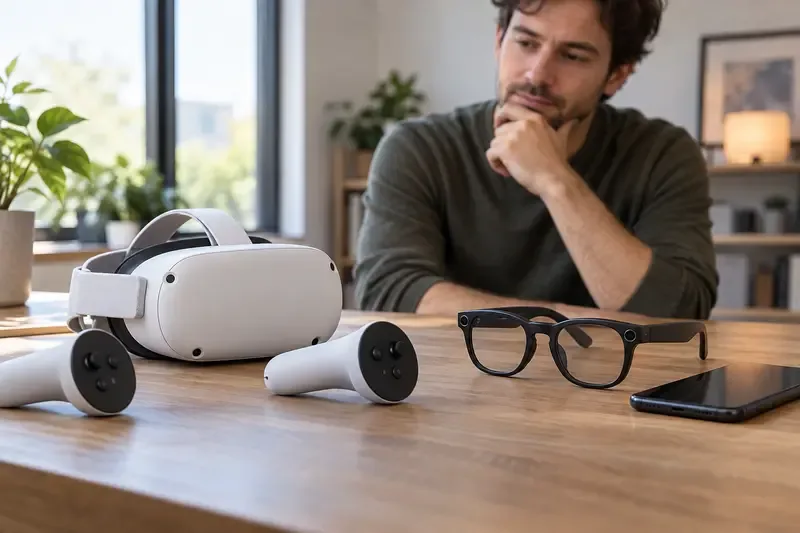
A VR headset with controllers and a pair of everyday camera glasses sit side by side while a shopper weighs their different uses.
First, know which kind of “Meta glasses” you are comparing
Device type
What it is for
Current buying status
Meta Quest 3 or Quest 3S
Standalone mixed-reality headsets for immersive games, apps, and virtual environments; the Quest system supports hand tracking and controllers.
Current Meta Quest products; compare prices and bundles in the official store.
Meta VR Glasses
A newly announced, lightweight immersive VR device focused on private cinema, sports, gaming, and a multi-screen workspace.
Announced September 23, 2026; Meta says spring 2027 launch and $1,299.99 U.S. starting price.
Camera-and-audio AI glasses
Everyday eyewear with a camera, open-ear audio, voice controls, and Meta AI features.
Ray-Ban Meta (Gen 3) is announced as available now from $449; Ray-Ban Meta Audio is available for preorder from $349 and ships October 13, 2026.
Display AI glasses
Everyday smart glasses with a small in-lens display for glanceable information, plus the Meta Neural Band wrist controller.
Meta Ray-Ban Display starts at $799, but availability and the latest feature rollout vary by market.
Use the names carefully when searching or shopping: “Meta VR Glasses” is the new product announced for 2027; “Meta Quest” refers to current headset products; “Ray-Ban Meta” usually means camera-and-audio AI eyewear; and “Meta Ray-Ban Display” adds an in-lens display. Jordan can avoid comparing a $449 everyday pair with a $1,299 immersive device as if they were interchangeable.
What Meta VR glasses do
Meta’s September 23, 2026 announcement describes Meta VR Glasses as a high-end immersive device in an eyewear form factor. The company lists a roughly 100-gram frame, 5K micro-OLED display, Dolby Vision and Dolby Atmos, and a separate compute, battery, and storage puck linked by an optical tether. Meta says the puck can deliver up to three hours of continuous high-resolution media playback. The announced starting price is $1,299.99, with sales planned for spring 2027. This is a future product announcement, not a device shoppers can buy today.
The device is aimed at experiences that benefit from a large, immersive view: 3D films, live sports, gaming, and multiple private virtual screens for work. Meta also says hand gestures and eye movements can control the system without controllers. A lighter glasses-shaped frame may appeal to someone who dislikes the bulk of a conventional headset, but the connected puck remains part of the setup. Before buying, Jordan should wait for independent hands-on evaluations, final retail terms, and a confirmed launch date rather than treating a company announcement as a tested result.
For an immersive headset available now, Meta’s current comparison lists Quest 3 and Quest 3S. Both are wireless all-in-one mixed-reality devices with head and hand tracking, color passthrough, and access to the Meta Horizon platform. The published comparison lists Quest 3 with higher per-eye resolution and a wider field of view, while Quest 3S has lower resolution and a narrower view; listed battery estimates are about two hours for Quest 3 and about two and a half hours for Quest 3S. Actual runtime depends on use. A headset is more physically present on your face than ordinary glasses, but it is the practical route if you want to play the current Quest library now.
Jordan’s choice here depends on timing and format: buy a Quest if immersive apps matter now, or wait for the announced Meta VR Glasses if the lighter form and premium cinema/workspace claims are worth waiting and budgeting for. The two are not the same kind of purchase even though both target immersive viewing.
What Meta AI glasses do
Camera-and-audio AI glasses are designed for everyday use outside a virtual environment. Ray-Ban Meta glasses pair with a smartphone and the Meta AI app. Depending on model, market, language, and feature availability, a wearer can capture photos and video hands-free, listen to audio through open-ear speakers, make calls, use voice controls, and ask Meta AI about a scene or request help such as translation. When a wearer asks Meta AI about what the glasses see, Ray-Ban’s support information says a photo is sent to Meta’s cloud for processing and an audio response is returned. Check the current privacy settings and permissions before enabling features.
Meta announced Ray-Ban Meta (Gen 3) on September 23, 2026, with a 12-megapixel camera, 3K video recording, and up to nine hours of battery life, and said it is available from $449. The same announcement introduced Ray-Ban Meta Audio, an audio-first model without the camera features described for Gen 3; it offers music, calls, and hands-free AI assistance, with up to 12 hours of use claimed by Meta. Its preorder price starts at $349, with shipping announced for October 13. These are manufacturer figures, not independent test results.
Meta Ray-Ban Display is different again: it adds a small full-color screen for short, glanceable interactions such as messages, translations, or navigation, and is bundled with the Meta Neural Band wristband for gesture control. Meta’s latest September 2026 update describes additional features and expansion to more markets. It is still not a VR headset: it does not turn the wearer’s whole view into a virtual cinema or a room-scale game.
For Jordan’s everyday errands, regular camera-and-audio AI glasses could make more sense than a Quest: they look closer to ordinary eyewear and can offer quick hands-free interaction. If Jordan particularly wants to read a glanceable prompt or see navigation cues rather than hear every answer, the display version may be worth considering. If a camera is not important, the new Audio model is a separate choice. Prescription needs, fit, lens options, and regional feature availability should be checked with the seller.
How to choose for your routine
Choose Quest 3 or Quest 3S if your priority is games, immersive apps, or mixed-reality experiences you can use now. Compare resolution, field of view, fit, controller needs, and current price on Meta’s official product pages.
Consider Meta VR Glasses if you mainly want a personal cinema, sports viewing, or a multi-screen virtual workspace in a lighter frame—and you can wait for the announced spring 2027 launch, accept the tethered puck, and plan for the announced premium price.
Choose camera-and-audio AI glasses if you want hands-free photos, video, calls, music, and spoken assistance during ordinary daily activities. Confirm that the app, phone, language, and AI features you need are supported where you live.
Consider display AI glasses if you want brief visual prompts, messages, or directions without putting on a VR headset. Check current market availability and whether the bundled wristband and display interaction suit you.
Jordan can make the decision concrete by writing down three likely weekly uses, such as watching a movie, taking a hands-free photo, or receiving a navigation prompt. If most examples involve immersive entertainment, compare Quest and the upcoming VR Glasses. If they happen while walking, commuting, or talking with people, compare everyday AI eyewear. If none of the advertised functions would replace a task Jordan already does, waiting is a reasonable option.
Comfort, privacy, and practical limits
Try eyewear on before committing if possible. Nose pads, temple pressure, prescription compatibility, tint, and fit can matter more over a full day than a camera specification. A VR headset has a different weight distribution and may need a clear play area; Meta’s current device comparison gives a minimum room-scale area for Quest play and lists battery life in hours rather than all-day use. Meta VR Glasses’ announced optical tether and puck also mean a buyer should consider where the puck will sit during viewing.
Camera eyewear raises social and privacy questions because other people may not immediately notice it is recording. Meta says its Gen 3 glasses include a recording LED intended to make capture more apparent. Respect other people’s consent and any workplace, school, or venue rules. AI functions can also depend on a phone, account, internet access, country, and language; the exact feature set can change with software updates.
For Jordan, the best choice is therefore not “the most advanced glasses” in the abstract. It is the device whose main function matches the way Jordan expects to use it, whose fit and privacy tradeoffs feel acceptable, and whose price and availability are real today—or whose announced launch is worth waiting for. Check official product pages again before ordering because product details, software features, and regional sales plans can change.