Home
» News
»
Meta VR Glasses: What to Know About Meta’s New 100-Gram VR Glasses
Meta VR Glasses: What to Know About Meta’s New 100-Gram VR Glasses
The most important thing to know: Meta VR Glasses are not simply another pair of Ray-Ban Meta smart glasses. Announced on September 23, 2026, they are a full virtual-reality computing device in a glasses-style form factor, with the main compute, battery, and storage moved into a separate wired “puck.” Meta says the glasses weigh about 100 grams, will cost $1,299.99 in the United States, and are scheduled to go on sale in spring 2027.
That design makes Meta VR Glasses most relevant to people who want immersive movies, private multi-screen work, live sports, or VR gaming without wearing a conventional headset. If your priority is all-day audio, camera capture, or lightweight AI assistance while walking around normally, Meta’s other glasses lines are the more direct comparison.
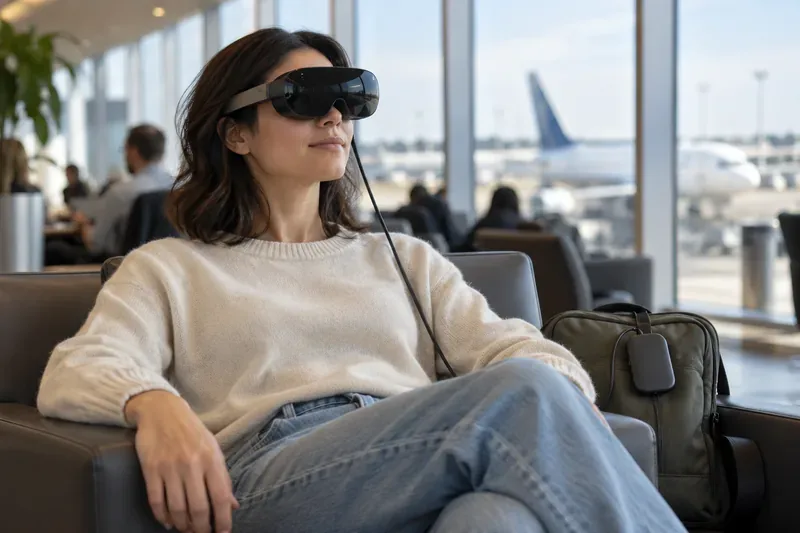
A traveler wearing lightweight immersive eyewear connected to a compact pocket device in an airport lounge.
What Meta VR Glasses actually are
Meta describes the product as a next-generation VR platform that combines a personal cinema, workspace, gaming system, and spatial calling device. Unlike Meta Quest 3, the device does not put the processor, battery, and storage in the eyewear itself. Instead, the glasses contain the displays and sensors, while a separate puck handles the heavy computing work and connects through an optical tether.
That split is the reason Meta can claim a weight of about 100 grams. In its launch announcement, Meta says the glasses are roughly five times lighter than Quest 3. The tradeoff is obvious: you gain a much lighter device on your face, but you also have a cable and a second piece of hardware clipped to a pocket or bag.
Much lighter on the face than a conventional standalone VR headset.
Display
5K Infinite Display using micro-OLED panels, 37 pixels per degree
Meta is emphasizing text clarity, media quality, and productivity.
Optics
Ultra-compact pancake lenses
Helps keep the glasses-style enclosure thinner than a traditional headset.
Visual formats
Dolby Vision; first IMAX Enhanced-certified VR device
Targets premium movie and streaming use.
Audio
Dolby Atmos spatial audio integrated into the frames
Reduces the need for separate headphones for immersive media.
Processor
Qualcomm Snapdragon Reality Elite
The external puck is designed to handle high-performance VR workloads.
Battery
Up to three hours of continuous high-resolution media playback
Enough for many movies, but not an all-day untethered device.
Charging
45W fast charging
Useful when the external puck needs to be topped up between sessions.
Controls
Voice, eye input, and natural hand gestures; no controller required for core interaction
Fits the idea of a portable computer rather than a gamepad-first headset.
Price and launch
$1,299.99 in the U.S.; spring 2027
This is a premium first-generation category, not a low-cost Quest replacement.
Why the 100-gram design could matter more than the raw specs
Traditional VR headsets put most of their electronics, battery, cooling, and optics on your face. Meta VR Glasses reverse part of that design decision. The puck can be heavier because it sits on your body rather than your head, while the glasses can focus on displays, sensors, and optics.
For a frequent traveler, that could make the difference between watching a two-hour movie in VR and giving up after 30 minutes because of facial pressure. For someone working in a coffee shop or on a flight, lower face weight may also make a private virtual monitor setup more practical.
The cable is the counterweight to that benefit. A person who strongly prefers a completely wireless experience may find the tether inconvenient, especially when moving around. The product makes the most sense when you are seated, standing in one area, or carrying the puck in clothing or a bag.
Movies and live sports are a major part of the pitch
Meta is positioning these glasses as a premium media device. It says Meta VR Glasses will be the first IMAX Enhanced-certified VR device and will support select titles in expanded aspect ratios. Disney+ plans to offer 3D movies on the platform beginning in November in select countries, and Meta says other services including Prime Video, YouTube, DIRECTV, AMC+, Crunchyroll, Plex, ESPN, Peacock, HBO Max, and Paramount+ are part of the media lineup.
Availability will depend on the specific service, region, subscription, and content rights. The presence of a partner name does not mean every title will be available in 3D everywhere.
Sports are another headline use case. Meta says the device will support immersive live events with 180-degree views and high-resolution streaming, and that more than 100 immersive live U.S. sports events per year are planned once the glasses launch, through partners including ESPN, MLB, NBC Sports, TNT Sports, and UFC.
It is also trying to be a portable private office
Meta says users can open one large virtual display or multiple private screens while still seeing the real environment through full-color passthrough. A particularly ambitious feature is the ability to turn a flat surface into a virtual keyboard and touchpad using hand tracking.
That could be useful for someone answering email during a layover, reviewing documents on a flight, or working with several screens in a hotel room without packing a monitor. But whether it can replace a physical keyboard for long writing sessions will depend on latency, tracking accuracy, ergonomics, and software behavior that cannot be judged from the announcement alone.
In other words, a short reply or light browsing session is a much easier use case than writing a 30-page report with no physical keyboard.
Gaming is controller-free by default, but not limited to hand tracking
Meta says more than 75 games will be available at launch that can be played using hand gestures alone. It also plans support for Xbox Cloud Gaming, which would provide access to hundreds of streamed games.
This gives the device two distinct gaming roles. The first is native spatial interaction, where hands are the controller. The second is a portable display for conventional cloud games, where users may still prefer a gamepad depending on the title. Meta has not yet published the final launch game list or all accessory compatibility details, so buyers should wait for the shipping software catalog before assuming a specific game will work the way they expect.
Meta AI is built into the operating system
Meta says its AI agent is integrated directly into the device. You will be able to speak to the glasses and combine voice with gaze and hand gestures to open apps, search, start media, or adjust a workspace.
That is different from the role Meta AI plays in camera-and-audio smart glasses. Meta VR Glasses have a full immersive display and can present information inside a VR interface, whereas Ray-Ban Meta-style glasses are primarily designed for everyday eyewear use.
Hologram calling: useful term, but understand what it means
Meta also announced “hologram” calling. In practice, the company describes a photorealistic digital version of the user whose expressions and reactions are represented during a call. Other Meta VR Glasses users can see that representation spatially in front of them, while people joining from a phone or computer can see it on a normal screen.
This is not a physical hologram projected into a room. It is a spatial avatar or digital representation shown through the display. Meta says the feature is intended to work with calling apps including WhatsApp and Zoom.
How Meta VR Glasses differ from Meta Ray-Ban Display and other Meta smart glasses
The names are easy to confuse because Meta now has several eyewear categories. Meta VR Glasses are the immersive product: they are designed to replace much of what a VR headset does. Meta Ray-Ban Display, by contrast, is an everyday AI-glasses product with a built-in display for glanceable information, navigation, notifications, and other lightweight tasks. Meta announced new Display features at Connect 2026, including expanded navigation and a new app experience; those details are in the Meta Ray-Ban Display update.
Meta also expanded its non-VR glasses range with Ray-Ban Meta Audio and Ray-Ban Meta Gen 3. Those products emphasize audio, AI, calls, cameras, and all-day wear rather than immersive virtual screens. Meta’s official overview of that lineup is in the Connect 2026 AI glasses announcement.
Who should consider Meta VR Glasses?
They look most relevant if you:
want a lighter alternative to a conventional VR headset for long movies or seated experiences;
travel often and value a private, large virtual screen;
care about premium 3D media and immersive live sports;
want to experiment with multi-screen spatial productivity;
are comfortable carrying a separate compute puck and paying early-adopter pricing.
You may want to wait if you:
mainly want everyday smart glasses for calls, music, photos, and AI assistance;
need more than about three hours of continuous high-resolution media use between charges;
strongly dislike cables or external hardware;
need detailed prescription-lens, fit, field-of-view, refresh-rate, or accessibility information before buying;
want to evaluate the final app library, game catalog, or regional streaming availability first.
What Meta has not fully specified yet
As of September 24, 2026, Meta’s public launch announcement gives several headline specifications but does not provide every detail a technical buyer would normally want. The announcement does not list a final field of view, refresh rate, exact per-eye pixel dimensions, RAM and storage configurations, complete wireless specifications, detailed prescription-lens options, or a complete launch-country list.
Those omissions matter. For example, 37 pixels per degree is useful for judging visual density, but field of view and refresh rate also shape how a VR display feels. Likewise, the 100-gram weight describes the eyewear itself, not the total system including the puck and cable.
Until Meta publishes a full product specification and support documentation closer to spring 2027, those points should be treated as unknown rather than filled in from rumors or assumptions.
Bottom line
Meta VR Glasses are best understood as a lightweight VR computer that happens to look more like glasses, not as a simple upgrade to Ray-Ban Meta. The 100-gram eyewear, external compute puck, 5K micro-OLED display, premium movie partnerships, controller-free interaction, and multi-screen workspace make the product unusually ambitious.
The main tradeoffs are just as clear: a $1,299.99 launch price, a wired external puck, roughly three hours of high-resolution media playback, and several important specifications that have not yet been published. For someone who spends hours watching immersive content or working in virtual screens, the design could be compelling. For someone who just wants smarter everyday eyewear, Meta’s AI-glasses lines are likely the more appropriate category.
Source note: Product details in this article are based on Meta’s September 23, 2026 launch announcement and related official Meta product updates. Features, content availability, country support, and launch timing can change before retail release.