Home
» News
»
Pentagon Data Breach: What Military Personnel Should Do Now to Protect Their Information
Pentagon Data Breach: What Military Personnel Should Do Now to Protect Their Information
Updated September 26, 2026. Military personnel who receive a Defense Manpower Data Center (DMDC) breach notice should focus on one outcome: making stolen personal information harder to use, while creating enough monitoring to catch misuse quickly. The most useful response is not to change everything at once. It is to close the highest-risk paths first, verify that those protections are actually active, and know which warning signs require escalation.
Public reporting based on breach notifications says DMDC discovered a vulnerability in a file-sharing system on July 16, 2026. The notices say unauthorized users had accessed files containing unencrypted personally identifiable information between October 2025 and July 16, 2026. Depending on the individual, exposed data could include a Social Security number along with information such as a name, date of birth, contact details, sex, race, or military personnel information including occupational specialty. The notification reportedly said there was no indication at the time that the recipient's information had been misused.
The exact number of affected people has not been publicly confirmed by the Department of Defense as of this update. That matters because estimates circulating in news coverage should not be treated as the final scope of the incident. The more reliable question for an individual service member is whether you received an official notice and what information that notice says was exposed.
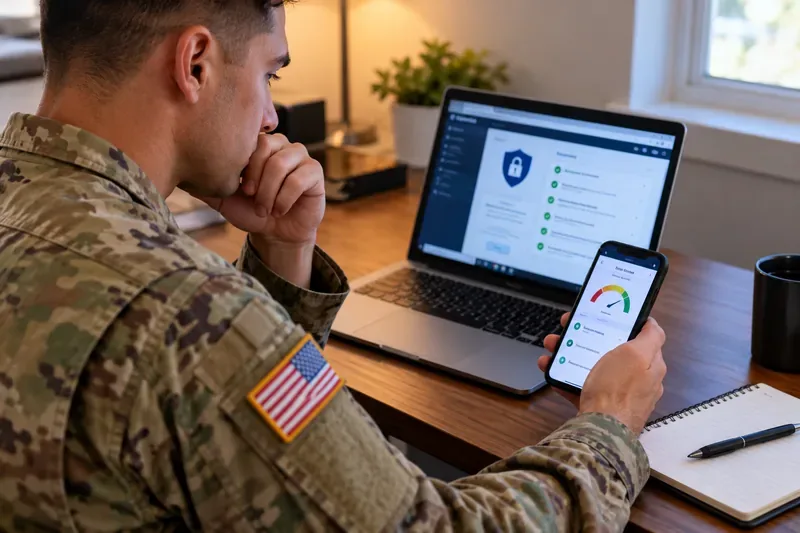
A service member reviews account-security information on a laptop and phone, illustrating the practical follow-up that can reduce the risk of identity misuse after a breach.
First, determine what “protected” should look like
A good response to a breach should produce observable results. You should be able to confirm that your credit is frozen or protected by an appropriate alert, that important accounts use unique credentials and strong authentication, that you can recognize legitimate breach communications, and that you have a plan for detecting tax, benefits, banking, or credit fraud.
Protection is not the same as a guarantee. A credit freeze cannot stop every type of fraud. Credit monitoring cannot prevent an attacker from trying to use your identity. Password changes do not make an exposed Social Security number secret again. The goal is to reduce the number of useful attack paths and shorten the time between misuse and detection.
1. Verify the breach notice before acting on it
Data breaches often trigger phishing campaigns because criminals know recipients are worried and expect follow-up messages. Treat any unexpected email, text, call, or letter asking for additional personal information as something that must be verified independently.
Use the contact information printed in the breach letter or an official .mil or .gov source, rather than a link in an unsolicited message.
Do not provide your Social Security number, bank credentials, login codes, or payment information to someone who contacts you unexpectedly.
If the notice offers identity-monitoring or restoration services, enroll using the instructions in the verified notice instead of searching for a look-alike enrollment site.
The Social Security Administration warns that government impersonators may already know some personal information and use it to sound convincing. Its current guidance is to avoid confirming sensitive information to unexpected callers and to verify activity through official accounts instead. See the SSA Office of Inspector General guidance on protecting your Social Security number.
How to know this step is complete
You have independently verified the source of the notice, know which categories of your information were exposed, and have saved a copy of the notice in a secure location. If you cannot verify a message, stop using its links and contact the relevant agency through an official channel.
2. Freeze your credit if your Social Security number was exposed
For most people whose Social Security number was exposed, a credit freeze is one of the strongest preventive steps available. A freeze restricts access to your credit file, making it much harder for an identity thief to open new credit in your name. It is free, does not affect your credit score, and remains in place until you lift it.
For active-duty personnel, an active duty fraud alert is another option. It tells businesses to take extra steps to verify your identity before opening new credit and lasts one year, with renewal available for the length of deployment. It can be useful when deployment or relocation makes regular monitoring harder. A fraud alert and a credit freeze serve different purposes, and the FTC notes that a person may use both.
How to know this step is complete
Confirm that each bureau shows your freeze or selected alert as active. Save confirmation numbers and recovery information somewhere secure. If you later apply for a mortgage, auto loan, apartment, insurance product, or other service that requires a credit check, temporarily lift only the freeze needed for that transaction, then restore it afterward.
3. Review credit reports for signs that protection came too late
A freeze is preventive. It does not erase fraud that happened before the freeze. Review your credit reports for accounts, hard inquiries, addresses, or balances that you do not recognize. The FTC recommends checking credit reports after a breach involving Social Security numbers.
Use AnnualCreditReport.com, the federally authorized source for free credit reports. Do not assume that a paid credit-monitoring dashboard replaces a review of the underlying reports.
What to check
Good result
When to escalate
New accounts
Every account is familiar
Any card, loan, utility, or financing account you did not open
Credit inquiries
Inquiries match applications you made
A hard inquiry from a company you do not recognize
Addresses and names
Personal details are accurate
An unfamiliar address, alias, or employer appears
Balances and status
Amounts and payment history look correct
Unexpected debt, delinquency, or collection activity
If you find evidence of identity theft, move beyond monitoring and begin a formal recovery process at IdentityTheft.gov. The site creates a recovery plan based on the type of misuse you report.
4. Secure the accounts that can reset your other accounts
Your primary email account, mobile phone account, financial accounts, and password manager are especially important because they can be used to reset access elsewhere. An attacker who has demographic information may be better able to answer identity-verification questions or impersonate you with customer support.
Use a unique password for your primary personal email account and any account that stores financial or identity information.
Turn on multifactor authentication, preferably using an authenticator app, security key, or passkey where supported.
Review account recovery email addresses, phone numbers, trusted devices, and active sessions.
Remove recovery methods you no longer control.
Ask your mobile carrier about a port-out or account-transfer PIN if available, especially if your phone number was among the exposed contact data.
Do not change dozens of low-value passwords while leaving your email or phone account weak. Prioritize accounts that can authorize password resets, financial transfers, tax filings, benefits changes, or identity verification.
How to know this step is complete
You should be able to list your highest-value accounts and confirm that each uses a unique credential and a strong second factor. If you discover unknown sign-ins, reset the password, sign out other sessions, update recovery options, and contact the provider's security team.
5. Watch Social Security and tax records, not just credit
Credit fraud is only one possible use of an exposed Social Security number. Someone may attempt employment-related identity fraud, benefits fraud, or tax-return fraud without opening a conventional credit account.
The Social Security Administration recommends reviewing your earnings record through your personal Social Security account and reporting earnings that do not belong to you. See the SSA guidance for an exposed or stolen Social Security number.
For tax protection, the IRS allows eligible taxpayers to request an Identity Protection PIN, or IP PIN. This six-digit number helps prevent someone else from filing a federal tax return using your Social Security number. The program is available proactively to people who can verify their identity. Details are available on the IRS IP PIN page.
When this step needs a stronger response
Escalate if you see earnings you did not earn, receive tax correspondence about a return you did not file, receive an authentication message you did not initiate, or discover changes to benefits or direct deposit information. Those are signs of attempted or actual misuse, not merely exposure.
6. Use the offered credit monitoring, but understand its limits
The breach notice reportedly offers affected individuals one year of credit monitoring and identity-restoration services. If your verified notice includes that offer, it is reasonable to use it. Monitoring can make suspicious activity easier to spot and restoration services can be valuable if fraud occurs.
However, monitoring is not a substitute for a credit freeze. It usually alerts you after something appears in a monitored data source. It also may not detect every form of misuse involving tax records, employment, benefits, medical accounts, or account takeover. Treat it as an additional detection layer rather than the main control.
7. Be more skeptical of highly personalized phishing
Information such as military affiliation, occupational specialty, contact data, and date of birth can make a fraudulent message appear unusually credible. A scammer may reference a real unit, role, relocation, benefit, or administrative process while still directing you to a fraudulent site.
Pay particular attention to messages that create urgency, request secrecy, ask you to move money, or send you to a login page through an unexpected link. If a message claims to come from a government office, financial institution, insurer, or credit bureau, open a new browser window and navigate to the official site yourself.
A practical protection checklist
Verify whether your DMDC notice is genuine and identify exactly what data it says was exposed.
Enroll in offered monitoring through the verified instructions in the notice.
Freeze your credit with all three national credit bureaus if your Social Security number was exposed.
Consider an active duty fraud alert if it fits your service status and deployment situation.
Review all three credit reports for unfamiliar accounts, inquiries, or personal details.
Secure your primary email, mobile carrier, financial accounts, and password manager with unique credentials and strong multifactor authentication.
Review your Social Security earnings record for unfamiliar activity.
Consider an IRS IP PIN to reduce the risk of fraudulent federal tax filings.
Keep the breach notice, freeze confirmations, and any fraud documentation in a secure place.
If actual misuse appears, report it at IdentityTheft.gov and follow the recovery plan rather than relying only on monitoring alerts.
When to change your approach
If you see no suspicious activity, the prevention-and-monitoring approach above is appropriate: keep freezes active, maintain strong authentication, and continue reviewing financial and government records periodically.
If you see a confirmed fraudulent account, tax filing, benefits change, unauthorized transfer, new phone line, or other concrete misuse, switch from prevention to incident response. Contact the affected institution's fraud department, preserve records, file an identity-theft report, dispute fraudulent credit information, and follow any agency-specific recovery instructions.
If you are unable to access your accounts, suspect a SIM-swap or email takeover, or discover that recovery information has been changed, prioritize regaining control of those accounts before spending time on routine monitoring.
What these steps cannot do
No consumer action can make exposed personal data private again. A credit freeze mainly addresses new-credit fraud. An active duty alert relies on creditors following verification procedures. Credit monitoring is selective and retrospective. Multifactor authentication protects accounts only when it is enabled and the attacker cannot bypass or socially engineer the recovery process.
That is why the strongest response uses several layers: reduce new-credit risk, secure account recovery channels, monitor government and financial records, and react quickly to specific evidence of misuse.
Bottom line
For military personnel affected by the DMDC breach, success is not measured by how many security steps you take. It is measured by whether the most important safeguards are actually active and whether you can detect misuse early. Verify the notice, freeze credit when a Social Security number was exposed, secure the accounts that control your digital identity, review credit and government records, and use any verified monitoring service offered in the notice.
This article reflects information publicly available as of September 26, 2026. Because the Department of Defense has not publicly confirmed the final number of affected individuals or published a complete incident report, personnel should rely on their individual breach notice and later official DoD communications for details about their own exposure.