01. Quick Answer
The cleanest Siemens bull case is that the business mix keeps getting better while the market still underestimates that shift
Siemens does not need speculative hype to move higher. It needs enough evidence that Smart Infrastructure remains structurally strong, Digital Industries is recovering, software ARR keeps growing, and industrial AI improves customer economics. Available data suggests that upside case is credible and helps explain why some analysts still see further rerating potential.
| Point | Why it matters |
|---|---|
| The bull case starts with business-mix quality | Siemens now trades on a blended industrial and software logic rather than on a pure old-economy multiple. |
| Electrification and software can reinforce each other | Automation, electrification, and industrial AI are the main engines behind the longer-term rerating case. |
| AI can strengthen the moat without becoming a fad | Divisional execution and capital allocation still matter because Siemens is a complex business mix. |
| The bullish thesis still needs counterarguments | Wide ranges are more defensible than a single precise number for a cyclical large-cap industrial. |
02. Historical Context
Siemens is no longer just a diversified industrial. The equity story increasingly revolves around software, electrification, automation, and industrial AI.
Siemens moved from roughly EUR 64.36 in May 2016 to a recent close of EUR 271.60 on May 14, 2026, implying a price CAGR of about 15.49% over 10 years. That is a strong long-run result for a large European industrial company and helps explain why any serious Siemens forecast needs to respect both the quality of the franchise and the risk of paying too much for it. The historical record suggests that Siemens has evolved from a broad conglomerate into a more focused digital-industrial platform with meaningful exposure to factory software, rail, building electrification, and data-center-related demand.
The current market backdrop is also more supportive than it was a few years ago. Official Q1 and Q2 FY2026 releases showed record order backlog, double-digit order growth at Smart Infrastructure, improving automation demand in Digital Industries, and a growing annual recurring revenue base tied to software. At the same time, Siemens is not risk-free. Mobility faced tariff pressure in Q2 FY2026, and Reuters reported in March 2026 that management was considering a divisional reorganisation. That mix of operating strength and structural change is exactly why range-based forecasting is more credible than a single heroic target.
| Metric | Latest official reading | Why it matters |
|---|---|---|
| Q2 FY2026 orders | EUR 24.1bn, up 18% comparable | Strong order growth helps support future revenue visibility and backs the current rerating |
| Q2 FY2026 order backlog | EUR 124bn record high | Backlog gives Siemens more resilience than a pure short-cycle automation name |
| Q2 FY2026 software ARR | EUR 5.5bn, up 11% | Recurring software growth supports a higher-quality earnings mix over time |
| Q2 FY2026 free cash flow | EUR 1.7bn at group level | Cash conversion matters because Siemens is balancing buybacks, M&A, and AI investment |
| Feature | Siemens implication | Forecast effect |
|---|---|---|
| Large industrial installed base | Exposure to automation, rail, buildings, and electrification gives breadth and resilience | Supports the base case but can cap near-term upside when macro industrial demand softens |
| Growing software and ARR mix | Xcelerator, Altair, and digital services improve recurring revenue quality | Can justify a better multiple than older-cycle industrial peers |
| Industrial AI optionality | AI can improve design, simulation, automation, and workflow economics | Strengthens the long-term bull case, but only if monetization becomes visible |
| Capital allocation flexibility | Buybacks and portfolio moves can support returns, but also create integration and execution risk | Scenario ranges should include both operational and capital-allocation outcomes |
03. Main Drivers
Five forces are most likely to shape Siemens stock over the next several years
1. Digital Industries has to prove the automation upturn is real
Official Q1 and Q2 FY2026 materials showed healthier orders, better software momentum, and stronger profitability at Digital Industries. HSBC argued in late April 2026 that improving industrial automation demand and so-called physical AI could drive earnings upside. That helps the bull case, but investors still need evidence that this is a durable recovery rather than a short inventory snapback.
2. Smart Infrastructure is increasingly central to the earnings mix
Smart Infrastructure delivered record orders in both Q1 and Q2 FY2026, supported by electrification and data-center-related demand. That matters because it gives Siemens exposure to one of the more durable capex themes in global industry. If electrification and data-center buildouts stay strong, Smart Infrastructure can continue to anchor the base case even if factory automation remains uneven.
3. Software acquisitions must translate into a better quality multiple
Altair expanded Siemens in simulation and industrial AI, while Dotmatics extended the software reach into life sciences R&D. These deals are strategically coherent, but large software acquisitions only help shareholders if they improve recurring revenue, cross-sell depth, and margin quality enough to support long-run valuation. Available data suggests the evidence is improving, but it is not fully settled.
4. Industrial AI could widen the moat, but the market will look for proof
Siemens used CES 2026 and Hannover Messe 2026 to position itself as a leader in industrial AI, digital twins, and physical-world deployment. That narrative is credible because the company has real automation infrastructure, not just software demos. Still, investors should distinguish between technical progress and equity-market monetization. The stock benefits most when AI improves throughput, backlog, software ARR, and customer stickiness.
5. Organisation and macro risks still matter
Reuters reported in March 2026 that Siemens was considering a reorganisation of Digital Industries and Smart Infrastructure. Even if the long-run strategy remains intact, reorganisations can create temporary friction. Meanwhile, tariffs already pressured Mobility in Q2 FY2026. For that reason, the evidence is strong enough for a constructive view, but not strong enough for complacency.
04. Institutional Forecasts and Analyst Views
The cleanest way to build a Siemens forecast is to combine recent price, 10-year compounding, official order trends, and external analyst context
If Siemens traded like a slow industrial utility, a recent price near EUR 271.60 might already look rich. But the stock no longer trades purely on legacy industrial logic. The market is paying for a business mix that includes software, recurring revenue, electrification, rail, and increasingly industrial AI. That is why it is more sensible to use a range framework built on operating evidence than to repeat isolated price targets without context.
| Source | What it says | Implication for Siemens |
|---|---|---|
| Q2 FY2026 official results | Orders rose 18%, backlog reached EUR 124bn, and software ARR hit EUR 5.5bn | Supports a constructive medium-term base case because the stock is being backed by real operating momentum |
| Q1 FY2026 official results | Smart Infrastructure posted record orders, and Digital Industries showed improved revenue and margin trends | Suggests the industrial cycle was improving before the latest quarter, not just during it |
| Annual Report 2025 | Siemens generated EUR 78.9bn in revenue and continued shifting toward a One Tech Company model | Reinforces the thesis that portfolio quality, not just raw size, is driving the rerating |
| HSBC note, April 28, 2026 | The broker upgraded Siemens to Buy and lifted its target to EUR 300 on improving industrial automation demand | Shows that at least some institutional analysts see further upside if DI recovers and SI stays strong |
| AI and digital-twin releases | Siemens keeps expanding Xcelerator, industrial copilots, and the NVIDIA-linked AI operating system | AI strengthens the bull case, but mostly as a compounding margin and software-quality lever rather than a near-term hype trade |
05. Scenarios
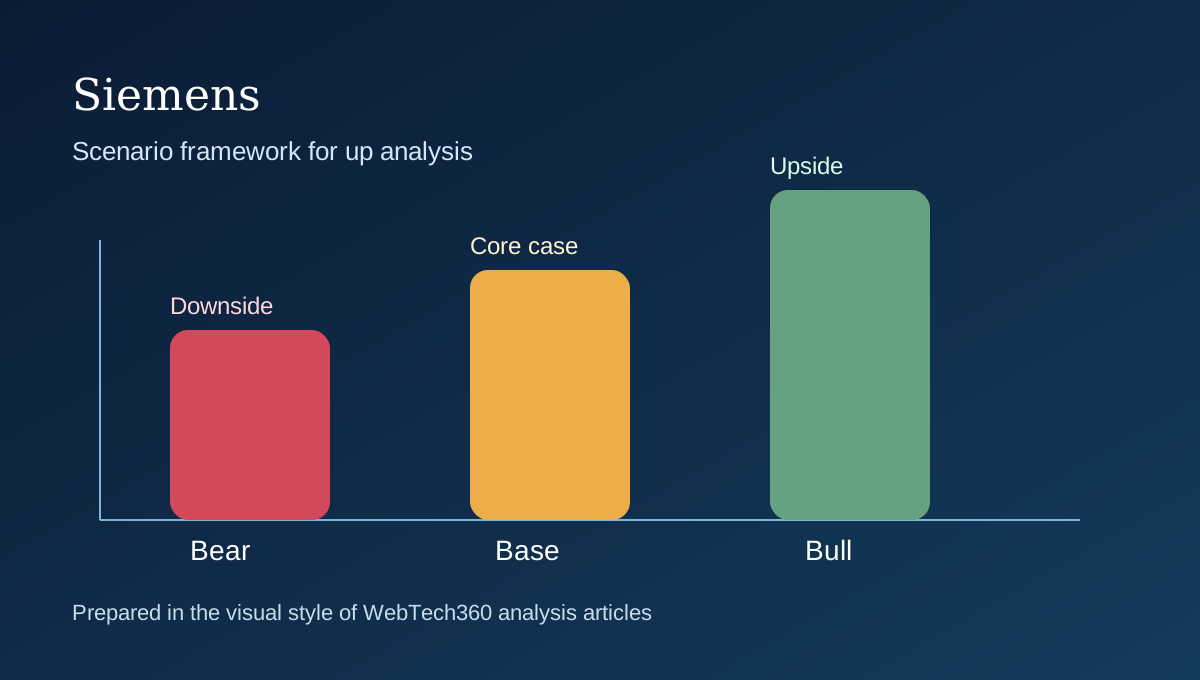
Bull, bear, and base-case scenarios for Siemens
| Scenario | Range | What would likely drive it | Editorial probability |
|---|---|---|---|
| Bull | EUR 320-EUR 380 | Digital Industries recovers, Smart Infrastructure stays strong, and software plus AI support a better quality multiple | 35% |
| Base | EUR 285-EUR 320 | Siemens keeps compounding, though valuation expansion remains moderate rather than dramatic | 40% |
| Bear rebuttal | EUR 240-EUR 285 | Macro or execution pressure keeps the stock from fully reflecting operating progress | 25% |
| Outcome | Probability | Interpretation |
|---|---|---|
| Higher | 47% | A decent upside move is plausible because Siemens combines industrial depth with improving software and AI quality |
| Flat to mildly higher | 32% | Still plausible if operating progress is good but not enough to trigger larger multiple expansion |
| Lower | 21% | The bull case weakens if automation and AI monetization disappoint relative to expectations |
06. Investor Positioning
How different investors might respond
| Investor type | Prudent stance | Why |
|---|---|---|
| Investor already in profit | Hold a core position, but consider trimming if industrial and software exposure has become too concentrated | Siemens has quality, but the stock is no longer obviously cheap after a strong multi-year run |
| Investor currently at a loss | Reassess the thesis around backlog, Digital Industries, and Smart Infrastructure rather than reacting only to price | The right question is whether the operating mix is improving, not whether the stock was volatile for a few weeks |
| Investor with no position | Use staggered entries and avoid chasing after AI headlines or sharp post-earnings gaps | Siemens can still compound, but better entries often appear when industrial sentiment cools |
| Trader | Use stop-losses and watch DI orders, SI margins, Mobility commentary, and reorganisation headlines | Short-term moves can turn on divisional commentary faster than on the long-term thesis |
| Long-term investor | Focus on backlog, ARR, electrification, software mix, and AI monetization; dollar-cost averaging can make sense | The long-term Siemens case works best for patient investors who understand cyclical and software hybrid businesses |
| Hedging-focused investor | Use Siemens as part of a diversified Europe-industrial sleeve rather than as a standalone hedge | It is more resilient than many cyclicals, but it is still exposed to macro, capex, and valuation shifts |
07. Risks to Watch
What could change the outlook quickly
The strongest bull arguments are software mix, electrification, and AI readiness. But they only become market-moving if those strengths translate into better earnings quality, durable order growth, and steady cash generation.
| Potential invalidation | Why it matters |
|---|---|
| Digital Industries sustains a stronger automation upcycle than expected | Would strengthen the bull case by proving that earnings quality is improving faster than the market expected |
| Smart Infrastructure keeps converting electrification and data-center demand into higher-margin growth | Would support higher valuation because SI is already a major profit anchor |
| Software ARR and Xcelerator monetization accelerate | Would make Siemens look more like a recurring-revenue compounder and less like a purely cyclical industrial |
| Industrial AI becomes visibly monetizable across digital twins, operations, and factory automation | Would increase confidence that AI is a real earnings lever rather than only a strategic narrative |
08. Conclusion
Bottom line
Siemens is a credible digital-industry leader because it combines real industrial infrastructure with software and AI. The bull case is solid, but it still depends on execution rather than on hype alone.
FAQ
Frequently asked questions
Why does backlog matter so much for Siemens?
Because record backlog provides forward visibility across infrastructure, software, and mobility projects. It helps investors distinguish between a short-term industrial wobble and a genuinely weakening demand picture.
Is Siemens more of an industrial company or a software company now?
It is both. Siemens still has industrial and infrastructure exposure, but software, ARR, simulation, digital twins, and AI are becoming more important to how investors value the business.
How were the forecast ranges built?
The ranges combine the recent Siemens share price, the 10-year CAGR, official FY2026 order and margin trends, external analyst commentary, and scenario analysis around industrial demand, software monetization, and AI adoption.
Could AI materially change Siemens over the next decade?
Yes, but the most realistic path is gradual. AI is more likely to improve Siemens through better software attach, higher-value automation workflows, digital-twin usage, and smarter factories than through one sudden revenue spike.
Methodology and Invalidation
How these Siemens ranges were built and what would change them
These scenario ranges are editorial frameworks, not promises or institutional targets. They start with a recent Siemens close of EUR 271.60 on May 14, 2026 and a 10-year starting point of EUR 64.36 in May 2016, which implies a price CAGR of about 15.49%. That historical performance is useful, but it is not enough by itself. We also look at the current business mix, Q1 and Q2 FY2026 orders, backlog, software annual recurring revenue, free cash flow, divisional margin trends, industrial automation demand, and industrial AI optionality.
For downside language, a correction usually means roughly 10% down from a recent high, a bear market often means closer to 20%, and a crash means something sharper and usually tied to macro shock, policy disruption, valuation reset, or a clear break in the underlying thesis. Siemens is less speculative than many AI-linked stocks, but it can still correct meaningfully if Digital Industries slows, Smart Infrastructure normalizes, or reorganisation risk spooks investors.
The evidence base is current. Siemens reported Q2 FY2026 orders of EUR 24.1 billion, revenue of EUR 19.8 billion, backlog of EUR 124 billion, software ARR of EUR 5.5 billion, Industrial Business profit of EUR 3.0 billion, and a group free cash flow figure of EUR 1.7 billion. Q1 FY2026 had already shown strong momentum, with Smart Infrastructure record orders and better profitability at both Digital Industries and Smart Infrastructure. External market context also matters: HSBC upgraded the stock to Buy in late April 2026, while Reuters reported in March 2026 that Siemens was considering organisational changes in key divisions.
What would invalidate the constructive case? A real automation relapse, a sharp slowdown in Smart Infrastructure, poor integration of acquired software assets, margin erosion, or AI staying mostly cosmetic would all weaken the thesis. What would invalidate the bearish case? Sustained order growth, accelerating software ARR, better-than-feared DI recovery, and clear AI monetization would do the opposite. Investors should treat these articles as conditional research tools that deserve updating as orders, margins, and industrial demand evolve.
Disclaimer: This material is for research and editorial purposes only, does not constitute investment advice, and should not be treated as a recommendation to buy, sell, or hold Siemens AG or any related security.
References
Sources
- Stock Analysis, FRA:SIE recent closing prices and daily history
- Digrin, Siemens AG monthly price history for SIE.DE
- Siemens Investor Relations, financial results hub
- Siemens Q2 FY2026 press release, May 13, 2026
- Siemens Q1 FY2026 press release, February 11, 2026
- Siemens Annual Report 2025 PDF
- Siemens completes Altair acquisition, March 26, 2025
- Siemens completes Dotmatics acquisition, July 1, 2025
- Siemens and NVIDIA expand partnership to build the Industrial AI Operating System, January 6, 2026
- Siemens showcases industrial AI at Hannover Messe 2026
- Siemens brings AI to the physical world with Eigen Engineering Agent, April 20, 2026
- Siemens and Humanoid bring physical AI to the factory floor, April 16, 2026
- Investing.com citing HSBC upgrade to Buy on improving industrial automation demand, April 28, 2026
- Reuters via MarketScreener, Siemens plans reorganisation of two divisions, March 30, 2026