01. Quick Answer
The clearest 2027 Walmart framework is a catalyst map, not a one-line defensive retail story
By 2027, Walmart stock will likely be judged on a compact set of variables: whether comparable sales remain solid, whether digital margin gains continue, whether advertising and membership grow into more meaningful profit pools, whether tariffs can be absorbed or passed through without major share loss, and whether higher-income shopper gains remain sticky. That makes 2027 close enough for operating cadence to matter, but still far enough away that one quarter cannot settle the long-run debate.
| Category | Evidence-based read | Implication |
|---|---|---|
| Historical data | WMT moved from about $24.34 to about $132.46 over 10 years | Long-run upside is credible, but future ranges should reflect Walmart's maturity and improving mix |
| Current market conditions | Traffic, digital growth, and ads remain constructive, though tariff and guidance caution still matter | Forecasts should stay scenario-based, not simply defensive by default |
| Institutional signals | Official reporting, Reuters, and Axios all point to quality execution with visible cost and valuation questions | Analysts remain constructive, but not without caveats |
| Most important watchpoints | Comparable sales, e-commerce margins, ad growth, tariff pass-through, and higher-income customer retention | These variables will likely shape the stock range more than generic retail optimism |
02. Historical Context
Walmart is still a retailer first, but the modern thesis is increasingly about mix, data, and omnichannel efficiency
WMT moved from roughly $24.34 to about $132.46 over the last 10 years based on Yahoo Finance monthly data, implying a 10-year CAGR of about 18.46%. That is a strong long-run result for a mature retailer and reflects more than simple store scale. Walmart's modern investment case now mixes price leadership, grocery dominance, e-commerce expansion, membership, fulfillment efficiency, advertising, and data-driven merchandising. The key forecasting question is no longer whether Walmart can survive digital disruption. It is whether the company can keep shifting toward better-margin growth while defending its value positioning in a more inflation- and tariff-sensitive world.
| Metric | Latest official reading | Why it matters |
|---|---|---|
| FY2026 revenue | `$713 billion | Shows the company still compounds at extraordinary scale |
| Q4 FY26 revenue | `$190.7 billion, up 5.6% | Confirms the growth streak remained intact into early 2026 |
| E-commerce growth | Double-digit growth with improving margins | Digital profitability matters because it changes the quality of the retail model |
| Advertising and membership | Ads and Walmart+ both continued to grow strongly | Higher-margin layers matter more than raw top-line growth at this stage |
03. Main Drivers
Five forces are most likely to shape Walmart stock over the next several years
1. Grocery and value positioning still define the defensive core
Walmart's ability to gain share in grocery and value categories remains central because it makes the business resilient when consumers feel pressure. Axios and Reuters both highlighted that higher-income shoppers continued to migrate toward Walmart, which strengthens the argument that the company is gaining share beyond its traditional customer base.
2. E-commerce margin improvement is one of the most important quality upgrades in the story
Retail investors used to treat Walmart's e-commerce efforts mainly as a defensive response to Amazon. That framing is increasingly outdated. Walmart's own commentary and Reuters reporting show that digital growth is now tied to improving economics, not just revenue volume.
3. Advertising and membership can improve the margin structure meaningfully
Advertising, marketplace services, and Walmart+ matter because they give the company more ways to monetize traffic and fulfillment assets. If these higher-margin businesses scale faster, Walmart can justify a stronger long-run multiple than a traditional low-margin retailer.
4. Tariffs, sourcing, and price pass-through remain a real risk
Reuters reported in April 2026 that Walmart was looking to pass more tariff costs on to consumers. That matters because it highlights the tension at the heart of the thesis: Walmart wins when it is seen as a value leader, but broad cost inflation can still test that position if the company has to raise prices too aggressively.
5. Leadership and execution discipline still matter at this scale
John Furner's formal move into the CEO role put more attention on continuity of execution. For a company this large, small changes in pricing, inventory, fulfillment, and labor productivity can matter more than dramatic strategic pivots.
04. Institutional Forecasts and Analyst Views
The market respects Walmart's defensive quality, but it increasingly values the higher-margin mix behind the retail scale
Recent reporting gives a practical baseline. Walmart's own materials show ongoing growth and operating leverage, while Reuters and Axios both highlight investor sensitivity to tariffs, price pass-through, and cautious guidance. The evidence is strong, but not one-directional, which is why a 2027 article should remain scenario-based rather than attached to a single target.
| Source | Message | Interpretation |
|---|---|---|
| Walmart official reporting | Revenue growth and operating-income growth remained healthy through Q4 FY26 | Operational quality remains strong |
| Reuters | Tariff pass-through remains a live issue even as ads and e-commerce improve | Supports a constructive but cost-aware base case |
| Axios | The growth streak under the new CEO remained intact, though guidance stayed cautious | Keeps both upside and valuation discipline visible |
| Walmart CFO remarks | Advertising growth and e-commerce margin progress remain strategically important | Strengthens the thesis that Walmart is improving the quality of its revenue mix |
05. Bull, Bear, and Base Case
How the forecast range and probability table are built
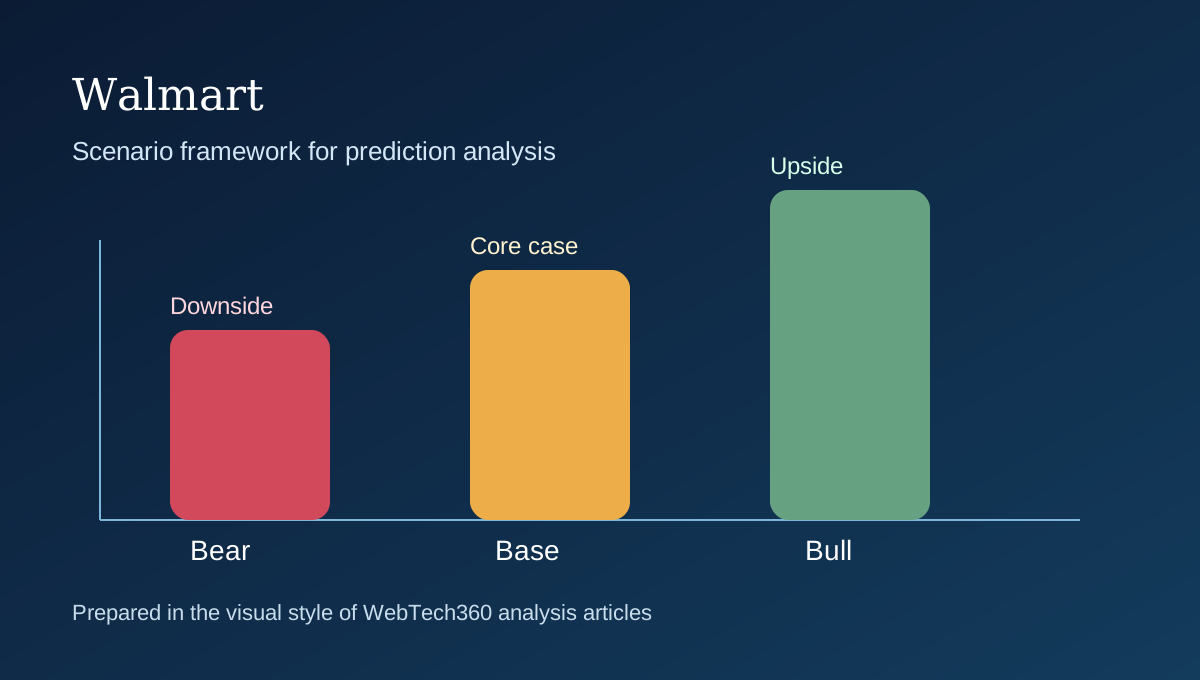
The ranges in this article are not institutional point targets. They are editorial scenario matrices built from current price, 10-year compounding history, grocery share resilience, digital margin improvement, advertising and membership growth, tariff exposure, and whether Walmart can keep improving its earnings mix without giving up price leadership.
| Scenario | 2027 range | Conditions | Probability |
|---|---|---|---|
| Bull | $155-$170 | Traffic stays strong, digital margins improve, and ads plus membership keep compounding cleanly | 30% |
| Base | $140-$155 | Execution remains healthy, though valuation still reflects caution around tariffs and consumer mix | 45% |
| Bear | $110-$140 | Tariff pressure, weaker spending, or slower digital progress reduce confidence in earnings quality | 25% |
| Direction | Probability | Comment |
|---|---|---|
| Higher | 45% | Still credible if Walmart continues combining traffic strength with better-quality digital monetization |
| Lower | 20% | Would likely require several catalysts turning negative at the same time |
| Sideways | 35% | Plausible if fundamentals remain good but the stock keeps digesting a premium defensive valuation |
| Investor type | Prudent approach | Main watchpoints |
|---|---|---|
| Investor already in profit | Hold a core stake, but trim if valuation now assumes tariff-free execution and sustained margin upgrades | Position size, multiple expansion, and guidance |
| Investor currently at a loss | Reassess whether the thesis is defensive traffic, digital improvement, or ad growth before averaging down | Comparable sales, gross margin, and e-commerce profitability |
| Investor with no position | Stage entries or wait for pullbacks tied to tariff or consumer fears instead of chasing defensiveness at any price | Valuation, macro retail data, and management guidance |
| Trader | Use stop-loss discipline and trade around earnings, same-store sales, guidance, and macro consumer data | Volatility, options pricing, and defensive sector rotation |
| Long-term investor | Dollar-cost average only if convinced Walmart can keep improving margin mix through digital, ads, and membership | Per-share earnings growth, return on capital, and mix quality |
| Risk-hedging investor | Rebalance if Walmart has become too large a defensive position relative to faster-growth or more cyclically sensitive names | Portfolio concentration and opportunity cost |
Conclusion: Walmart's 2027 path likely turns on a small number of highly visible catalysts, especially comparable sales, digital-margin improvement, ad growth, tariff handling, and whether the company keeps broadening its customer mix. Disclaimer: This article is for informational and research purposes only and does not constitute personalized financial advice.
06. FAQ
Frequently asked questions
Is Walmart still mainly a defensive grocery stock?
Grocery and value positioning still anchor the thesis, but digital margins, advertising, membership, and marketplace economics increasingly matter too.
What matters most for the next forecast revision?
Comparable sales, digital-margin progress, advertising growth, tariff costs, and guidance around consumer behavior are the key inputs.
Is the biggest risk tariffs or a consumer slowdown?
Both matter. Tariffs can pressure price leadership and margins, while a consumer slowdown can shift mix and spending behavior in less favorable ways.
What would invalidate the bullish case?
Weaker e-commerce economics, slower ad growth, heavier tariff pressure, or fading share gains with higher-income customers would all weaken the bullish case.
Methodology and Invalidation
How to interpret this Walmart framework and what would change it
Walmart should not be analyzed like a simple big-box retailer anymore, but it also should not be treated as a pure digital platform. The company sits at the intersection of grocery leadership, general merchandise, e-commerce, marketplace services, advertising, membership, and logistics. That mix is why point targets without context can be misleading. Walmart can look expensive relative to slow-growth retail peers and still look reasonable if its digital mix, ad business, and membership economics keep improving. It can also look safe right before tariffs, inflation, or execution issues start pressuring margin expectations.
These articles therefore use a range-based framework anchored to three things: current price, 10-year growth history, and present operating evidence. Yahoo Finance chart data place WMT around `$132.46` in mid-May 2026, versus roughly `$24.34` at the start of the 10-year comparison window. That implies a 10-year CAGR of about 18.46%. For a large retailer, that is a very strong result. But it is not a forecast by itself. Walmart's next decade will depend on whether it keeps improving the quality of its sales mix, protects price leadership under cost pressure, and converts e-commerce and ad scale into higher structural returns.
Primary documents matter most. Walmart's 2025 annual report describes a company with scale few competitors can match, while the Q4 FY26 earnings release and presentation showed revenue growth of 5.6%, operating income growth faster than sales, and continued progress in e-commerce, membership, and advertising. The first-quarter 2026 earnings-call notice is also relevant because it confirms the next near-term checkpoint and frames management's current disclosures around a `\$713 billion` revenue base. These primary materials establish both the resilience of the core business and the importance of the higher-margin layers now being built on top.
External reporting helps explain what the market is debating now. Axios emphasized the growth streak and the cautious tone of guidance under the new CEO. Reuters reporting pointed to tariff pass-through risk, continued gains with higher-income shoppers, and the importance of the advertising and e-commerce margin story. Available data suggests Walmart currently benefits from both defensive traffic and a gradually improving earnings mix. The challenge is that both strengths can be pressured if inflation, tariffs, or execution around price leadership become less favorable.
Investor positioning should therefore reflect horizon. A trader may care most about comparable sales, margin commentary, and guidance. A long-term allocator should care more about whether Walmart can keep converting its store, data, and logistics advantages into durable share gains and better margin quality. Someone already in profit may trim if the stock's premium multiple now assumes flawless execution. Someone with no position may prefer staged entries during tariff or macro-driven pullbacks instead of chasing a defensive winner. What would invalidate a constructive Walmart view? Weaker e-commerce economics, slower ad growth, tariff pressure overwhelming price leadership, or a consumer slowdown that meaningfully changes the sales mix would all matter. What would invalidate a bearish Walmart view? Continued traffic gains, better digital margins, resilient grocery share, and evidence that higher-margin businesses are scaling faster would weaken it.
Inline evidence anchors the framework (Yahoo WMT chart API; Walmart Q4 FY26 earnings release; Walmart 2025 annual report; Axios on the growth streak and guidance; Reuters on tariff pass-through; Walmart CFO at JPMorgan Retail Roundup). That combined evidence base is why the forecast ranges here are scenario tools rather than certainty theater.
References
Sources
- Yahoo Finance chart API, WMT 10-year monthly history and current price
- Walmart to host first quarter earnings conference call May 21, 2026
- Walmart Q4 FY26 earnings release
- Walmart Q4 FY26 earnings presentation
- Walmart 2025 annual report
- Walmart, Form 10-K annual report filing for 2025
- Walmart investor relations financial results hub
- Axios syndicated summary on Walmart growth streak and cautious guide, February 19, 2026
- Axios, Walmart extends growth streak under new CEO, February 19, 2026
- Walmart CFO transcript at 2026 JPMorgan Annual Retail Roundup
- Reuters, Walmart looks to pass more tariff costs to consumers, April 10, 2026
- Reuters, Walmart ad business growth and e-commerce margin gains, March 27, 2026
- Reuters, higher-income shoppers continue to gain at Walmart, February 19, 2026
- Nasdaq / Walmart release summary for Q4 FY26