Home
» Android
»
Concept to Reality: Which Galaxy S27 Ultra Rumors Are Actually Believable?
Concept to Reality: Which Galaxy S27 Ultra Rumors Are Actually Believable?
The most believable Galaxy S27 Ultra rumors are the least dramatic ones: a next-generation flagship chipset, a 200MP-class main camera, an integrated S Pen, a roughly 6.9-inch 120Hz-class AMOLED display, and incremental gains in battery life, charging, thermals, and AI. A modest battery-capacity increase is more credible now that Samsung has publicly discussed silicon-carbon battery technology in shipping Galaxy foldables. By contrast, claims such as a 144Hz display, a huge 6,000-7,000mAh battery, self-healing front glass, or a guaranteed return to titanium deserve much more skepticism.
That distinction matters because the Galaxy S27 Ultra has not been officially announced as of September 14, 2026. There is no Samsung specification sheet to verify the final camera count, battery size, frame material, biometric system, memory standard, or launch configuration. The best way to evaluate the rumor cycle is therefore to ask three questions: Does the claim continue an established Galaxy Ultra pattern? Is the required technology actually ready for mass-market phones? And does the upgrade fit within realistic size, heat, cost, and power constraints?
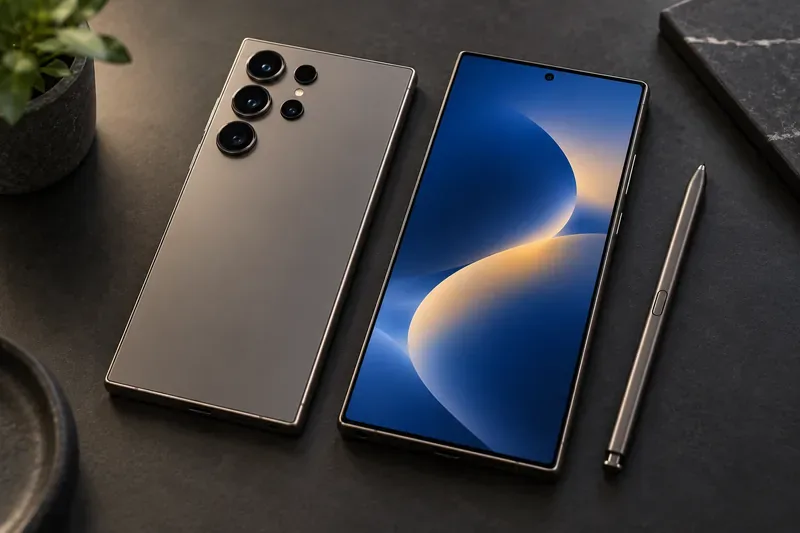
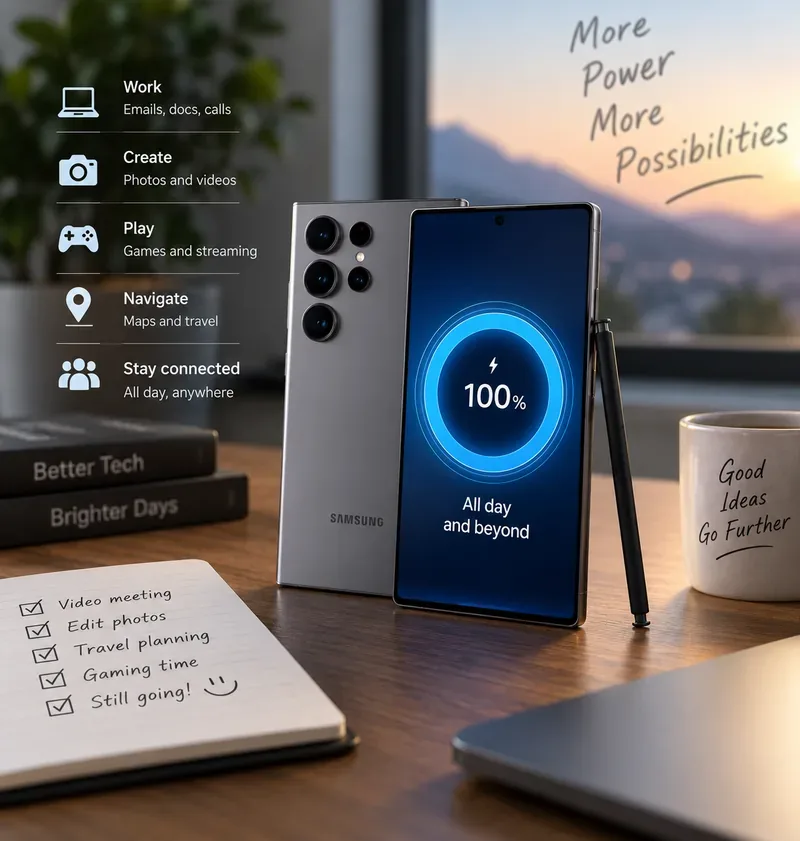
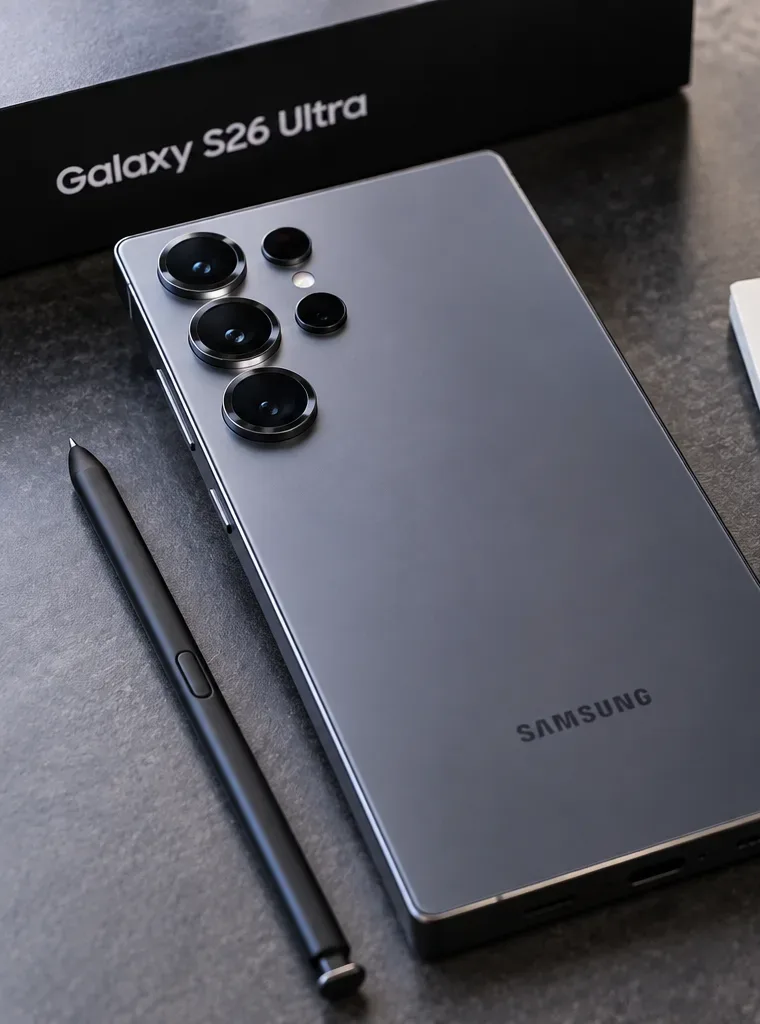
A phone-and-stylus review setup with a checklist reflects the central question around the Galaxy S27 Ultra: which rumored upgrades are supported by real technology, and which remain speculative?
The quick credibility ranking
Rumor theme
Credibility now
What makes it believable or questionable
Next-generation Snapdragon-class flagship chip
High
Annual flagship silicon is expected, and Qualcomm has already previewed its next mobile Oryon CPU generation reaching 5GHz. The exact commercial chip name and Galaxy-specific tuning are not confirmed.
200MP main camera remains
High
Samsung has used a 200MP wide camera on recent Ultra models and continues developing 200MP mobile sensors. The exact S27 sensor is unknown.
Integrated S Pen remains
High
The S Pen is still a defining Ultra feature on the S26 Ultra. There is no official evidence that Samsung plans to remove it.
Modestly larger silicon-carbon battery
Medium-high
Samsung has confirmed silicon-carbon anode use in the Galaxy Z Fold8 family, making the chemistry a real Galaxy technology rather than a concept. S27 Ultra capacity is still unconfirmed.
65W wired charging
Medium
The S26 Ultra already reaches up to 60W wired charging, so a small step upward is technically plausible. Samsung has not announced 65W for the S27 Ultra.
Three rear cameras instead of four
Medium-low
A redesigned camera system is possible, but removing a dedicated focal length would require Samsung to prove that sensor cropping and computational imaging preserve useful zoom quality.
LPDDR6 and UFS 5.0
Medium
Both technologies are real and Samsung is developing or producing them, but component readiness does not prove inclusion in a specific phone.
Polar ID secure face authentication
Low-medium
The technology exists, is designed for phones, and has reached manufacturing readiness, but no public Samsung announcement ties it to the S27 Ultra.
144Hz display
Low
Samsung has stayed at 120Hz on recent Ultra generations. There is no official indication that 144Hz is the next priority.
6,000-7,000mAh battery in the same thin body
Low
Silicon-carbon can improve energy density, but extremely large jumps must still fit safety, thermal, structural, S Pen, camera, and wireless-charging requirements.
Self-healing front glass
Low
No public Samsung or Corning product announcement establishes such a cover material for the S27 Ultra.
Start with the S26 Ultra baseline, not the rumor sheet
The strongest reality check is the current phone. Samsung lists the Galaxy S26 Ultra with a 6.9-inch QHD+ Dynamic AMOLED 2X display with an adaptive refresh rate up to 120Hz, a 5,000mAh battery, up to 60W wired charging, up to 25W wireless charging, an integrated S Pen, and a four-camera rear system led by a 200MP wide camera. Samsung also lists the phone at 7.9mm thick and 214 grams. Those are the engineering constraints the S27 Ultra must improve on, not a blank sheet of paper. See Samsung's official Galaxy S26 series announcement and specifications and the Galaxy S26 Ultra product page.
The S25-to-S26 change is also useful context. The S25 Ultra was 8.2mm thick and 218 grams with a titanium frame, while the S26 Ultra moved to Armor Aluminum and became thinner and lighter. Samsung's Galaxy S25 Ultra product page documents that earlier design. This shows Samsung is willing to change materials, but it also argues against assuming that a titanium return is inevitable one generation later.
Most believable: another flagship chip with more on-device AI
A new high-end processor is the safest S27 Ultra expectation, but rumor readers should separate the broad direction from exact branding. Qualcomm said in August 2026 that its next-generation Snapdragon flagship platform uses a new Oryon CPU capable of reaching 5GHz and adds a new Flex Cache architecture. That makes a substantial silicon upgrade entirely believable. Read Qualcomm's official next-generation Oryon CPU preview.
What is not yet confirmed is the retail name often attached to leaks, the final clock configuration, whether Samsung gets a customized “for Galaxy” version, or whether every regional S27 Ultra ships the same platform. If you care mainly about gaming frame rates, sustained performance, or local AI, wait for measured thermal and battery tests rather than assuming a 5GHz headline automatically translates into a faster phone after ten minutes of load.
Very believable: a 200MP-class main camera, but not necessarily the rumored camera layout
Keeping a 200MP main camera is credible because it is already part of Samsung's Ultra formula. The S26 Ultra combines a 200MP main camera with 50MP ultrawide, 50MP 5x telephoto, and 10MP 3x telephoto cameras. Samsung Semiconductor also continues to develop 200MP ISOCELL sensors, including the 200MP ISOCELL HP5 highlighted in its 2026 portfolio.
The more aggressive claim is that the S27 Ultra could reduce the rear camera count from four to three. That is possible, but camera count alone tells you very little. A larger or more capable telephoto sensor could theoretically cover multiple focal lengths through sensor crop and computational processing. The tradeoff is that Samsung would have to preserve portrait-friendly midrange zoom and low-light telephoto quality. If you regularly shoot people around 3x or rely on smooth transitions among several optical focal lengths, this is one rumor you should not judge from megapixel numbers alone.
Believable with conditions: a modestly larger silicon-carbon battery
This rumor has become more credible because the underlying technology is no longer hypothetical inside Samsung's phone business. In an August 2026 engineering interview, Samsung said it introduced a silicon-carbon anode in its latest Galaxy Z devices to improve energy density while also redesigning the battery system for stability and thinness. Samsung describes that work in its official Galaxy Z engineering interview.
That does not prove the S27 Ultra will use the same chemistry, and it certainly does not confirm a specific capacity. A move from 5,000mAh to something in the low-to-mid 5,000mAh range would be much easier to believe than a jump to 6,000 or 7,000mAh while keeping roughly the same dimensions, S Pen silo, large cameras, wireless charging coil, cooling system, and structural requirements.
If battery life is your main reason to wait, focus on three eventual numbers rather than capacity alone: actual mixed-use endurance, sustained power efficiency under cellular use, and charging time from 10% to 80%. A slightly larger battery paired with a more efficient chipset can matter more than a dramatic capacity claim that never reaches production.
Possible but not confirmed: 65W charging
The S26 Ultra already supports up to 60W wired charging, so a 65W ceiling would be an incremental and technically realistic change. It is not, however, a reason by itself to delay a purchase. A five-watt increase at the charger label does not guarantee a meaningful reduction in total charge time because phones taper power aggressively as the battery fills and warms.
For practical buying decisions, the better question is whether Samsung changes the charging curve, thermal behavior, or time to roughly 80%. If the S27 Ultra arrives with a larger battery, the same real-world charging time could still represent an improvement even without a headline-grabbing wattage jump.
Technically ready, product decision unknown: LPDDR6 and UFS 5.0
Memory rumors are unusually tricky this year because the components themselves are real. Samsung Semiconductor now lists LPDDR6 for mobile and AI workloads. Samsung also announced its UFS 5.0 storage solution in June 2026, with mass production planned for the fourth quarter of 2026.
That timing makes LPDDR6 and UFS 5.0 plausible for an early-2027 flagship, but it does not make them guaranteed. Qualification schedules, supply, cost, capacity mix, board design, and product segmentation can all push a new memory generation to a later device. Rumors claiming both that the S27 Ultra “will definitely get” these technologies and that they have “definitely been canceled” should be treated as provisional until Samsung publishes final specifications.
If you keep a phone for four to six years and care about on-device AI, large game assets, or heavy local media work, this is one area worth watching. If your usage is messaging, browsing, streaming, and casual photography, the difference between storage generations is unlikely to be the deciding factor.
Real technology, weak S27 evidence: Polar ID secure face unlock
Polar ID is not imaginary. Metalenz describes it as a compact polarization-based face-authentication system for smartphones that can reject spoofing attempts using information from polarized light. The company says the system is designed to work with Snapdragon platforms, and it announced manufacturing readiness with UMC in late 2025. In 2026, it also demonstrated an under-display implementation. See Metalenz's official Polar ID product page and its mass-production announcement.
The missing piece is Samsung. There is currently no public Samsung announcement saying the S27 Ultra will use Polar ID. Therefore, the correct conclusion is: the technology is believable; the device-specific rumor is not yet strong. If secure face unlock is a must-have feature for you, do not buy or delay a phone based on this rumor until Samsung confirms the authentication hardware and supported payment/security use cases.
Low confidence: 144Hz display, giant battery claims, and self-healing glass
144Hz display
A 144Hz panel is technically feasible in premium Android phones, but feasibility is not the same as likelihood. Samsung used a 120Hz adaptive display on both the S25 Ultra and S26 Ultra. Moving to 144Hz would add a marketable number, yet the practical benefit over 120Hz is small for most scrolling and video use and can add power and tuning costs. Unless Samsung identifies gaming or latency as a major product priority, 120Hz remains the more conservative prediction.
6,000-7,000mAh battery
Silicon-carbon chemistry supports the idea of better energy density, not unlimited capacity. A very large battery must coexist with the S Pen silo, cameras, cooling, speakers, antennas, structural frame, wireless charging system, and water resistance. That makes a moderate increase much easier to defend than a huge jump while dimensions remain virtually unchanged.
Self-healing cover glass
This is the kind of rumor that sounds futuristic enough to spread quickly but currently lacks the manufacturer trail that would make it credible. Until Samsung or Corning announces a commercial cover material with a defined self-repair mechanism, durability rating, and deployment plan, treat “self-healing Galaxy glass” as concept territory rather than a purchase expectation.
What about the design and frame?
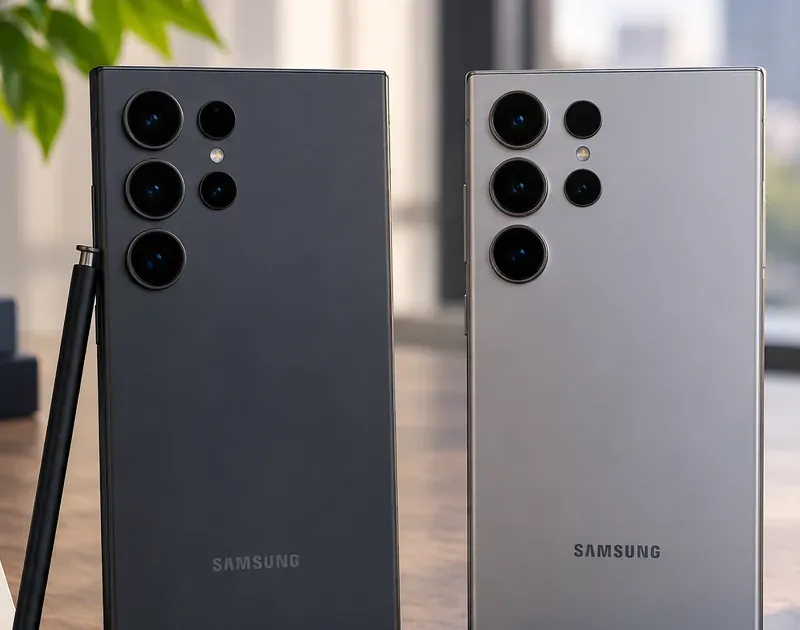
Small ergonomic changes are believable. Samsung already made the S26 Ultra thinner and lighter than the S25 Ultra and changed from titanium to Armor Aluminum. That makes another modest refinement in edge shape, weight distribution, or camera housing completely plausible.
A dramatic redesign is harder to call. Accessory-industry dummy units and leaked renders can become more useful as launch approaches, but they can still reflect incomplete dimensions, old CAD data, or cosmetic shells. For someone who uses a case, the difference between a slightly rounder frame and a new camera island may matter much less than total weight and camera protrusion. For someone who goes caseless, edge curvature and material texture can materially affect comfort and grip.
Who should actually wait for the S27 Ultra?
Wait if you own an S26 Ultra and are satisfied with it. The credible S27 improvements look evolutionary today, and there is no confirmed feature that makes an immediate upgrade necessary.
Wait if secure face authentication or next-generation memory is essential to you. Those are plausible differentiators, but the exact implementation remains unverified.
Do not wait solely for a 144Hz display or a 6,000mAh-plus battery. Those claims are currently too weak to make a purchase decision around.
If you need a phone now, compare against the confirmed S26 Ultra rather than the rumored S27 Ultra. The S26's specs, dimensions, charging, camera system, and S Pen support are known quantities.
If your current phone is an S23 Ultra, S24 Ultra, or older, waiting can still make sense if your device remains reliable. You will get a clearer picture once Samsung, Qualcomm, certification bodies, and component suppliers reveal final product details.
How to tell when an S27 Ultra rumor becomes trustworthy
Rumor confidence should rise in stages. First, the enabling technology appears in an official component announcement. Second, production readiness or certification appears. Third, multiple independent supply-chain signals converge. Finally, Samsung publishes the device specification. A rumor should not jump from stage one to stage four just because the technology exists.
For example, UFS 5.0 is officially real and scheduled for mass production, so it passes the technology-readiness test. Polar ID is real and manufacturing-ready, so it also passes that test. Neither has passed the final S27 Ultra product-confirmation test. That is why both belong in the “possible” column rather than the “confirmed” column.
Bottom line
If you strip away the most sensational claims, the believable Galaxy S27 Ultra picture is straightforward: Samsung is likely to keep the core Ultra identity—large high-refresh AMOLED display, S Pen, 200MP-class main camera, premium zoom, strong water resistance, and top-tier processing—while pushing efficiency, AI, camera quality, battery density, and charging forward.
The most interesting rumor with a real technical foundation is a modest battery upgrade enabled by silicon-carbon chemistry. The most interesting but still unproven feature is Polar ID. The safest hardware prediction is a new flagship Snapdragon-class platform. The rumors to be most cautious about are 144Hz, giant battery capacities in an unchanged body, self-healing glass, and any leak that presents exact final specifications months before Samsung has published them.
Verification date: September 14, 2026. Samsung has not officially announced the Galaxy S27 Ultra, so every device-specific specification discussed above should be treated as unconfirmed unless explicitly identified as an S26 or component-level fact.