Home
» Android
»
Galaxy S27 Ultra Gaming in 2027: What Samsung Needs to Dominate
Galaxy S27 Ultra Gaming in 2027: What Samsung Needs to Dominate
Mobile gamers rarely lose a match because a phone has a weak benchmark score. The more common problems appear after 20 or 30 minutes: frame rates dip as the device heats up, battery drains faster than expected, charging adds more heat, touch responsiveness feels inconsistent, or a game that looked smooth at launch begins to stutter. That is the real challenge Samsung would have to solve if the Galaxy S27 Ultra is going to dominate mobile gaming in 2027.
As of September 14, 2026, Samsung has not announced the Galaxy S27 Ultra or published official gaming specifications for it. There is therefore no verified S27 Ultra “gaming plan” yet. What we can evaluate is the direction Samsung has already established with the Galaxy S26 Ultra and the features that would need to improve for the next Ultra to become a genuinely stronger gaming device.
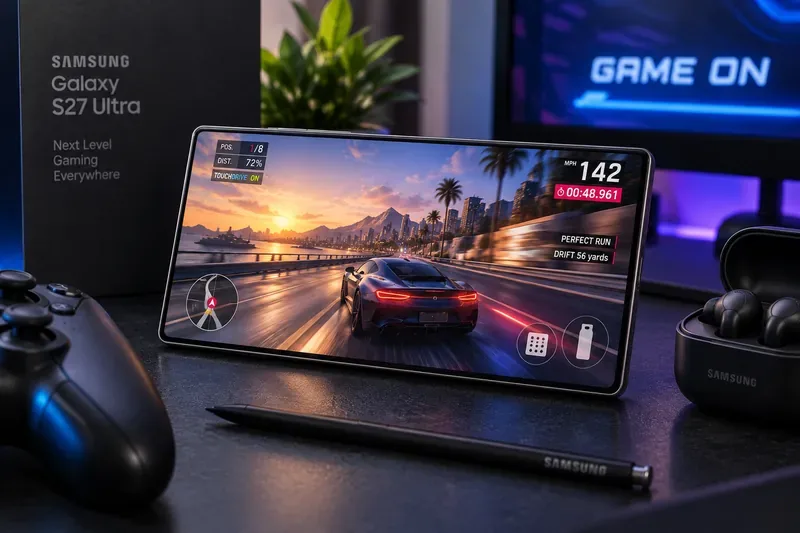
A concept gaming setup showing a premium Galaxy Ultra-style phone with a racing game, controller, stylus, and earbuds. It illustrates the mobile-gaming use case discussed here and does not depict confirmed Galaxy S27 Ultra hardware or software.
Quick reference: the gaming baseline Samsung already has
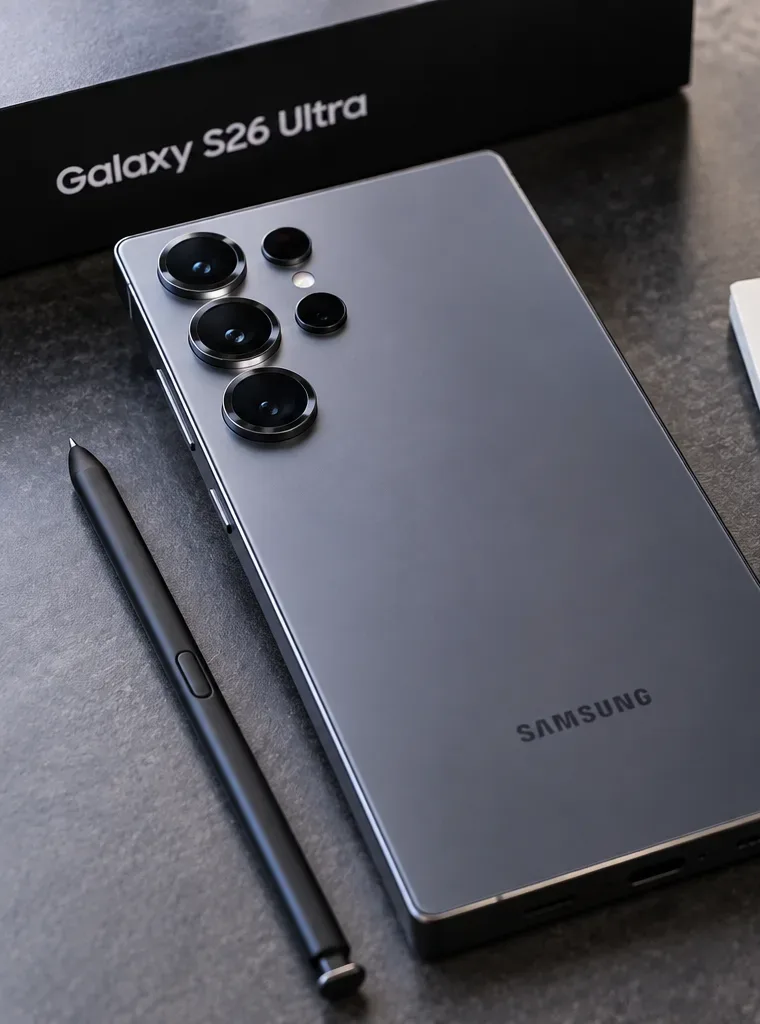
The Galaxy S26 Ultra gives us a useful starting point. Samsung officially lists a customized Snapdragon 8 Elite Gen 5 for Galaxy, a 6.9-inch Dynamic AMOLED 2X display with an adaptive 1–120Hz refresh rate, a 5,000mAh battery, up to 60W wired charging, up to 25W wireless charging, and configurations reaching 16GB of RAM with 1TB of storage. Samsung also says the customized chip improves GPU performance by up to 24% versus the prior generation and uses a redesigned cooling system for sustained workloads. Those details come from Samsung’s official Galaxy S26 series launch announcement and Galaxy S26 Ultra product page.
Gaming area
Verified S26 Ultra baseline
What an S27 Ultra should improve
Sustained graphics
Snapdragon 8 Elite Gen 5 for Galaxy; Samsung cites up to 24% higher GPU performance
Hold high frame rates for longer, not just score higher in short tests
Cooling
Redesigned vapor chamber and thermal interface material
Better sustained brightness, latency, and efficiency while gaming
Battery
5,000mAh
More gaming time per charge through higher efficiency and/or capacity
Charging
Up to 60W wired; up to 25W wireless
Less heat during play-and-charge sessions and a strong full-charge curve
Memory and storage
12GB/256GB or 512GB; 16GB/1TB in supported markets
Keep the 16GB/1TB tier and avoid storage pressure from large games
Game controls
Game Booster with performance modes and per-game tuning
More transparent FPS, frame-time, thermal, and power controls
1. Sustained frame rate has to matter more than peak speed
The first priority is not a bigger benchmark number. It is sustained performance. A phone can render a game at a very high frame rate for a few minutes and still feel slower later if heat forces the processor to reduce clocks. That behavior is called thermal throttling: the system deliberately lowers performance to stay within safe temperature limits.
For competitive games, consistent frame pacing matters just as much as the average frames per second. Frame pacing describes how evenly frames arrive on screen. A game averaging 90 FPS can still feel rough if some frames arrive quickly and others take much longer. The ideal S27 Ultra gaming upgrade would therefore combine a faster GPU with steadier frame times after the phone is fully warmed up.
Samsung is already moving in that direction. Its S26 Ultra materials emphasize a redesigned vapor chamber, thermal interface material around the processor, and improved heat dissipation during gaming. For 2027, the useful question will be whether Samsung expands that thermal headroom enough to keep performance near its initial level through a long session.
2. Cooling is the feature that makes every other gaming upgrade usable
A vapor chamber is a sealed heat-spreading component that moves thermal energy away from the processor over a wider area. Better cooling does not make a game faster by itself; it gives the CPU and GPU more room to stay fast before temperatures force them to slow down.
Samsung says the S26 Ultra’s updated thermal design improves heat dissipation and its current product page describes a multi-channel cooling structure with tuned thermal interface material. That is the right foundation, but a gaming-focused S27 Ultra would benefit from three practical improvements: more heat-spreading area, lower hot-spot temperatures where fingers normally rest in landscape mode, and smarter performance curves that avoid sudden drops after a thermal limit is reached.
For real players, this is more valuable than another decorative gaming mode. A cooler device is easier to hold, wastes less energy, protects charging speed, and is more likely to maintain stable GPU clocks.
3. A 120Hz screen is already enough if Samsung improves the whole latency chain
The S26 Ultra already reaches an adaptive 120Hz refresh rate. Moving to a higher advertised refresh rate could sound impressive, but it would not automatically improve every game. Many titles cap output at 60, 90, or 120 FPS, and a display cannot show extra unique frames that the game does not render.
The more meaningful S27 Ultra improvements would be lower input latency, consistent touch response, strong brightness without rapid thermal dimming, and efficient variable-refresh behavior. Input latency is the delay between your action and the visible response. For shooters, rhythm games, racing, and fighting titles, reducing that delay can matter more than increasing the panel from 120Hz to a higher headline number.
Samsung’s 6.9-inch display is already large enough for virtual controls and detailed HUDs. The priority for 2027 should be making that screen stay bright, responsive, and power-efficient throughout a long session.
4. Battery endurance needs to improve without turning the Ultra into a brick
Gaming stresses the CPU, GPU, display, modem, audio system, and sometimes the camera or microphone at the same time. That is why gaming battery life can differ dramatically from ordinary mixed-use endurance.
The S26 Ultra retains a 5,000mAh battery. Samsung advertises strong general battery life, but it does not publish one universal gaming-runtime figure because results depend heavily on the title, graphics settings, network conditions, screen brightness, frame-rate target, and temperature.
For the S27 Ultra, the best result would be more watt-hours of usable energy without a major increase in weight, combined with a more efficient processor and display. A larger battery would help, but efficiency is just as important: every watt that does not become unnecessary heat can become extra play time.
5. Play-and-charge gaming should get even better
Samsung already offers one of the most practical features for long gaming sessions: Pause USB PD charging when gaming. On supported Galaxy devices, a compatible USB Power Delivery charger with PPS can power the device while battery charging is paused, reducing battery heat and wear. Samsung’s current support documentation lists the Galaxy S26 family among supported models and explains the requirements on its official Pause USB PD charging guide.
This should absolutely remain on the S27 Ultra. Samsung could make it easier to understand by showing when direct power is active, current device temperature, and why the feature is unavailable if the charger or battery level does not meet requirements.
For players who game at a desk, this matters more than extreme fast-charging numbers. Keeping the battery out of the hottest part of the power loop can help both comfort and long-term battery health.
6. Game Booster should become a real performance dashboard
Samsung’s Game Booster already offers useful controls. Current Samsung documentation says users can select Performance, Standard, or Battery Saver optimization and can customize individual games with options for optimization level, FPS, resolution, and frame boosting. See Samsung’s Game Booster settings guide.
The next step should be transparency. A serious 2027 gaming phone should let users see what is happening rather than guessing. Useful additions would include a live frame-time graph, battery power draw, thermal status, CPU/GPU utilization, and a clear indicator when the system lowers performance because of temperature.
That would let players choose intelligently. A demanding open-world game might benefit from a 60 FPS cap and higher graphics quality, while a competitive shooter might prioritize 120 FPS and lower resolution. Per-game profiles are exactly where a general-purpose flagship can behave more like a dedicated gaming device without adding physical gamer styling.
7. Vulkan and ray tracing need developer support, not just capable hardware
Vulkan is a low-overhead graphics API that gives game developers detailed control over how software uses the GPU. Ray tracing simulates the paths of light rays to create more realistic reflections, shadows, and lighting. Samsung currently markets both Vulkan optimization and hardware-accelerated ray-tracing capabilities for Galaxy gaming.
Qualcomm also positions Snapdragon Elite Gaming around hardware-accelerated ray tracing and advanced graphics features in its official Snapdragon gaming overview.
For the S27 Ultra, faster ray tracing would be welcome, but software adoption is the limiting factor. A feature only matters if games actually use it. Samsung could strengthen its position by working with major studios on optimized graphics presets, shader compilation, frame pacing, and power profiles for Galaxy hardware.
8. Storage and memory need to match the size of modern games
Large mobile games can consume tens of gigabytes once optional textures, voice packs, updates, and downloaded maps are included. The S26 Ultra currently reaches 1TB of storage with 16GB of RAM in supported markets, while lower-capacity versions use 12GB of RAM. Samsung lists those configurations on its official S26 Ultra purchase page.
For a gaming-focused S27 Ultra, 16GB of RAM on the highest tier should be the floor rather than an unusual configuration. More important, Samsung should preserve at least a 1TB option so players do not have to constantly uninstall 20GB, 40GB, or larger game packages to make room for updates.
9. Controller, audio, and cloud gaming support still matter
A flagship phone is not only a touch-screen gaming device. Samsung’s own gaming support materials cover Bluetooth controllers, Gaming Hub, game recording, cloud gaming, and Game Booster shortcuts. The S27 Ultra does not need proprietary accessories to win here; it needs reliable compatibility and low-friction setup.
For controller play, the practical goals are low wireless latency, stable Bluetooth connections, proper button mapping, and easy switching between touch and controller input. For cloud gaming, network quality matters more than local GPU power, so strong wireless performance and predictable background-task management become part of the gaming experience too.
10. The 2027 advantage could come from smarter performance management
AI is often marketed as a feature users actively invoke, but gaming could benefit more from invisible intelligence. The system could learn which titles are GPU-limited, which are CPU-limited, how much brightness the player normally uses, and when a 120 FPS target creates excessive heat for little visible benefit.
The important condition is user control. Automatic tuning should never make performance unpredictable. The best S27 Ultra implementation would offer clear presets such as Competitive, Balanced, Battery-Saver, and Quality, while still letting advanced users override frame rate, resolution, and power behavior per game.
Practical checklist: what would prove the S27 Ultra is a real gaming upgrade?
Sustained performance: high FPS remains stable after at least 30 minutes, not only during a short benchmark.
Frame pacing: frame-time graphs stay consistent without frequent spikes or long stutters.
Thermals: the phone avoids uncomfortable hot spots in landscape orientation and does not suddenly throttle.
Display: 120Hz-class gaming remains bright and responsive without aggressive dimming.
Battery: heavy games last longer at equivalent brightness, graphics settings, and network conditions.
Charging: USB PD bypass remains available and clearly indicates when it is active.
Game Booster: per-game FPS, resolution, and performance profiles remain accessible and become easier to monitor.
Graphics: Vulkan and ray-tracing improvements appear in actual supported games, not just specification sheets.
Storage: at least a 1TB option remains available for users with large game libraries.
Accessories: common controllers and audio devices connect reliably with minimal setup.
Which gamers would benefit most?
Competitive shooter and MOBA players
Prioritize sustained 90 or 120 FPS, low input latency, stable touch response, and thermal consistency. A faster peak GPU matters less if performance falls sharply after the device warms up.
Open-world and graphics-heavy players
Look for stable 60 FPS, strong Vulkan optimization, enough storage, and efficient ray tracing where games support it. These titles usually stress the GPU for long periods and expose weak cooling quickly.
Long-session and desk gamers
Battery bypass, USB PD compatibility, thermal behavior, controller support, and comfortable surface temperature matter most. This is where Samsung’s existing direct-power gaming feature gives it a useful foundation.
Cloud gamers
Local GPU speed is less important. Display latency, network stability, controller latency, battery efficiency, and background-process management become the critical factors.
How to verify the S27 Ultra when Samsung actually announces it
Start with Samsung’s official specification sheet, not rumor-based comparison pages. Confirm the processor, display refresh range, battery capacity, charging limits, RAM/storage options, and any changes to the vapor chamber. Then check Samsung’s support pages for the current Game Booster controls and USB PD gaming behavior.
After launch, do not judge gaming performance from a five-minute benchmark. Look for tests that run demanding games for 30 to 60 minutes and report average FPS, 1% low frame rate, frame-time consistency, battery drain, and device temperature. Those measurements show whether a phone is genuinely fast after heat builds up.
Bottom line
The Galaxy S27 Ultra does not need to become a neon-covered gaming phone to dominate mobile gaming in 2027. Samsung already has many of the right building blocks: a high-end customized Snapdragon platform, 120Hz AMOLED display, serious vapor-chamber cooling, 60W charging, Game Booster, USB PD charging bypass, Vulkan support, and hardware ray tracing.
The next leap is consistency. If the S27 Ultra can hold high frame rates longer, stay cooler in the hand, extend gaming battery life, make direct-power gaming easier, and expose better per-game performance controls, it could be a substantially better gaming device than the S26 Ultra without sacrificing the productivity and camera strengths that define the Ultra line.
Until Samsung publishes official Galaxy S27 Ultra specifications, those are requirements to watch for, not confirmed features. For gamers, that distinction is important: the phone that wins in 2027 will be the one that stays fast after the benchmark is over.